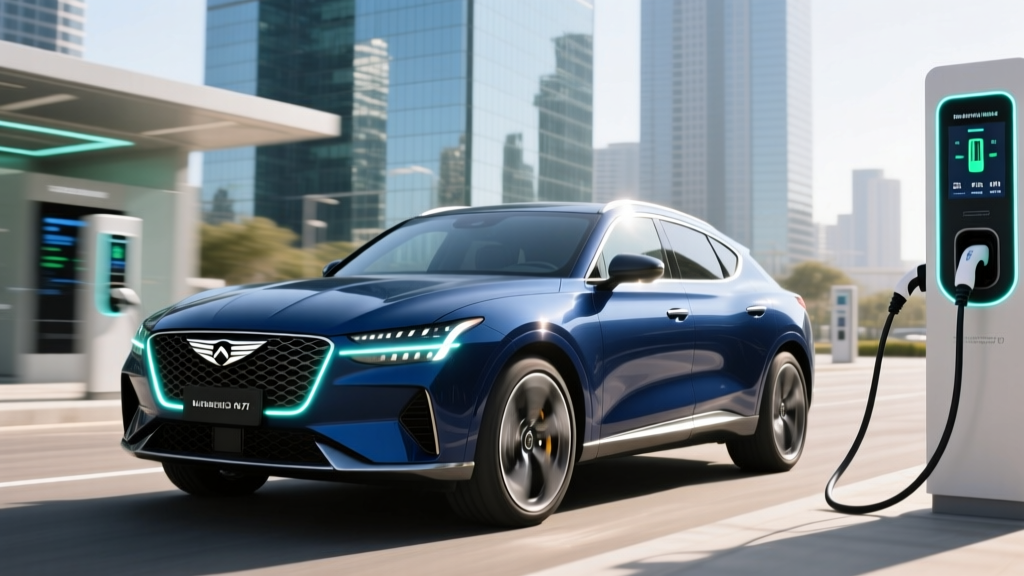
The Genesis Electrified GV70 occupies a narrow but compelling lane in the luxury electric SUV segment: it pairs the refined ride quality and interior craftsmanship Genesis is known for with a legitimate dual-motor electric powertrain. For 2026, the Electrified GV70 continues with its 77.4 kWh battery pack, all-wheel-drive standard, and a starting price that undercuts rivals like the BMW iX and Mercedes EQE SUV — though it trails them on range. This review breaks down every number that matters for a real purchase decision.
Genesis Electrified GV70 at a Glance: Key Specs
| Spec | Value |
|---|---|
| EPA Range | 236 miles |
| Usable Battery | 77.4 kWh (NMC lithium-ion) |
| Powertrain | Dual-motor AWD |
| Horsepower / Torque | 429 hp / 516 lb-ft (Boost mode) |
| 0-60 mph | 4.2 seconds |
| Max DC Fast Charge | ~350 kW (peak, 800V architecture) |
| 10-80% DC Charge Time | ~18 minutes (ideal conditions) |
| Level 2 Home Charge Rate | 10.9 kW (AC onboard charger) |
| MPGe (Combined) | 85 MPGe |
| Efficiency | 39 kWh/100 mi |
| Cargo (rear seats up / folded) | 28.7 / 56.9 cu ft |
| Base MSRP (Advanced trim) | ~$67,000 |
| Battery Warranty | 10 years / 100,000 miles |
Range and Efficiency: EPA vs the Real World
Real-World Expectation: Plan for 200–220 miles on sustained highway driving at 70+ mph. In freezing temperatures (below 32°F), expect a 20–30% reduction, dropping effective range to roughly 165–190 miles without preconditioning.
The Electrified GV70's 236-mile EPA rating is the single most debated number on its spec sheet. In a segment where the BMW iX xDrive50 posts 324 miles and the Tesla Model Y Long Range hits 320 miles, 236 feels modest for a vehicle in the $67,000+ bracket. According to fueleconomy.gov, the combined efficiency rating sits at 85 MPGe (39 kWh per 100 miles), which is middling — the GV70's weight and luxury insulation work against it aerodynamically.
In practice, city driving with regenerative braking set to maximum can push range slightly above the EPA sticker, as stop-and-go traffic lets the dual motors recapture energy efficiently. Highway cruising at 75 mph, however, is where the 77.4 kWh pack shows its limits. On a 200-mile interstate run with moderate climate control usage, you'll likely arrive with 10–15% state of charge remaining — comfortable, but not generous.
Cold weather is the real equalizer. The Electrified GV70 uses a heat pump (standard on 2026 models), which mitigates cabin-heating energy draw compared to resistive heaters. But lithium-ion chemistry inherently loses performance below freezing. If you live in Minnesota or upstate New York and lack a garage, budget for 170 miles of usable winter range and plan charging stops accordingly. Battery preconditioning activates automatically when a DC fast-charger is set as the navigation destination, which helps restore charge speed in cold conditions.
Charging Speed: 800V Architecture Pays Off
| Charging Level | Power | Connector | Time / Rate |
|---|---|---|---|
| Level 1 (120V household) | ~1.4 kW | J1772 / NACS adapter | ~3–4 mi/hr (55+ hrs full charge) |
| Level 2 (240V home) | 10.9 kW | J1772 (or NACS w/ adapter) | ~30 mi/hr (~7.5 hrs 10–100%) |
| DC Fast Charge | Up to ~350 kW peak | CCS1 (NACS adapter available) | 10–80% in ~18 min (ideal) |
This is where the GV70's 800-volt electrical architecture earns its keep. Shared with the Hyundai Ioniq 5 and Kia EV6 platform-mates, the 800V system allows peak charge rates up to 350 kW on compatible ultra-fast chargers (Electrify America 350 kW stalls, for example). In controlled testing, the 10–80% sprint completes in roughly 18 minutes — competitive with the best in the segment.
The critical nuance: peak is not sustained. The GV70's charge curve is aggressive between 10–55% SoC, holding above 200 kW. From 55–80%, the rate tapers progressively, dropping below 100 kW past 70%. This is normal lithium-ion charge management to protect cell longevity, but it means the 18-minute claim requires you to arrive at a low state of charge and plug into a charger capable of delivering the full rate. On a 150 kW Electrify America stall, expect 10–80% in approximately 25–28 minutes instead.
For home charging, the 10.9 kW onboard AC charger is adequate. A full Level 2 session from 10% to 100% takes roughly 7.5 hours — easily handled overnight on a 48-amp hardwired wall connector. Daily commuters adding 40–60 miles of range will top up in 1.5–2 hours. Note that Genesis does not include a Level 2 home charger in the box; budget $500–$800 for a quality unit (ChargePoint Home Flex, Emporia Level 2) plus $500–$2,000 for professional installation depending on your electrical panel capacity.
Connector compatibility deserves a mention: the 2026 Electrified GV70 ships with a CCS1 inlet. Genesis provides a NACS adapter for Tesla Supercharger access, expanding the public charging network significantly. Always verify adapter firmware is updated for reliable handshake at Supercharger stalls.
Performance and Driving Dynamics
The dual-motor all-wheel-drive powertrain produces 429 horsepower and 516 lb-ft of torque in Boost mode (activated via a steering-wheel button, delivering maximum output for 20-second bursts). Standard output is 365 hp. The result is a 0–60 mph time of 4.2 seconds — quick enough to merge onto any freeway with authority and pass without hesitation.
Driving dynamics lean luxury-touring rather than sporty. The GV70's adaptive suspension (standard on the Prestige trim, optional on Advanced) soaks up road imperfections with a compliance that outclasses the firmer BMW iX. Road noise isolation is exceptional — a Genesis hallmark. The trade-off is a steering feel that's numb by enthusiast standards and body roll that's noticeable on tight canyon roads. This is a grand-touring EV, not a track car, and that calibration suits the majority of luxury SUV buyers.
Regenerative braking offers multiple levels selectable via steering-wheel paddles, from coasting (Level 0) to near-one-pedal driving (Level 3). Level 3 provides strong deceleration but does not bring the vehicle to a complete hold — you still need the brake pedal at stops. The i-Pedal mode (full one-pedal) is available and brings the GV70 to a full stop, holding it without brake input.
Interior, Cargo, and Technology
The Electrified GV70's cabin is where Genesis justifies its price. Nappa leather with quilted stitching, genuine aluminum and open-pore wood trim, and a 12.3-inch digital instrument cluster paired with a 12.3-inch infotainment touchscreen create an environment that rivals Audi and Mercedes at this price point. The center console features a unique crystalline gear selector that's a conversation piece.
Passenger space is competitive for the compact luxury SUV class:
- Front legroom: 41.3 inches
- Rear legroom: 37.2 inches
- Front headroom: 39.6 inches
- Rear headroom: 39.0 inches
Cargo capacity is 28.7 cubic feet behind the second row and 56.9 cubic feet with the rear seats folded. There is no front trunk (frunk) — the space is occupied by power electronics and the HVAC system. This is a missed opportunity given that competitors like the Ford Mustang Mach-E and Tesla Model Y offer meaningful frunk storage.
Technology highlights include wireless Apple CarPlay and Android Auto, a 17-speaker Lexicon audio system (Prestige trim), a fingerprint-authentication system for driver profiles, and Genesis Digital Key 2 (using your smartphone as a key fob via UWB). Over-the-air updates are supported for infotainment and certain vehicle-control modules.
Driver assistance falls under the Genesis Active Safety Control suite, which includes adaptive cruise control with stop-and-go, lane-keeping assist, blind-spot monitoring with camera display, highway driving assist, and remote smart parking assist (the GV70 can park itself while you stand outside). This is an SAE Level 2 driver-assistance system — it does not replace the driver, and hands must remain on the wheel. It competes favorably with BMW's Driving Assistant Professional but falls short of Tesla's FSD (Supervised) in terms of mapping coverage and lane-change confidence.
Pricing, Trims, and Federal Tax Credit Eligibility
| Trim | Base MSRP | Key Additions |
|---|---|---|
| Advanced | ~$67,000 | Leatherette, 12.3" dual screens, HDA2, heated/ventilated front seats |
| Prestige | ~$73,500 | Nappa leather, Lexicon audio, adaptive suspension, head-up display, Digital Key 2 |
Destination charges add approximately $1,495. A fully loaded Prestige with metallic paint lands around $75,000–$76,000 before incentives.
Does the Electrified GV70 Qualify for the Federal EV Tax Credit?
Under IRS §30D rules current for 2026, the Electrified GV70 faces a complex eligibility picture:
- MSRP cap: SUVs must have an MSRP at or below $80,000. The GV70 Advanced qualifies; the Prestige trim may exceed this threshold depending on options.
- Buyer income cap: Modified adjusted gross income must not exceed $150,000 (single), $225,000 (head of household), or $300,000 (married filing jointly).
- Battery sourcing: Critical minerals and battery components must meet phased-in percentages sourced from the U.S. or free-trade-agreement countries. As of 2026, the GV70's South Korean-assembled battery pack faces scrutiny under these rules — eligibility for the full $7,500 credit is not guaranteed and varies by production batch.
- Assembly: Final assembly must occur in North America. The GV70 is assembled in South Korea, which disqualifies it from the new-vehicle §30D credit as of current rules.
For the point-of-sale credit transfer (which allows dealers to apply the credit as a down-payment reduction at purchase), the vehicle must meet all the above criteria. Since the GV70 fails the North American assembly requirement, plan your purchase budget assuming the full MSRP out-of-pocket.
Warranty and Ownership Costs
Genesis backs the Electrified GV70 with one of the strongest warranty packages in the luxury segment:
- New vehicle: 5 years / 60,000 miles
- Powertrain (incl. motors): 10 years / 100,000 miles
- Battery capacity: 10 years / 100,000 miles (guarantees ≥70% state of health)
- Complimentary maintenance: 3 years / 36,000 miles (scheduled service)
- Roadside assistance: 5 years / unlimited miles
The 70% battery capacity retention threshold over 10 years is industry-standard, matching Hyundai/Kia's terms. For context, NMC chemistry in a thermally managed pack like the GV70's typically degrades 8–15% over the first 100,000 miles based on data aggregated from fleet operators and owner forums. Heavy DC fast-charging usage and frequent 100% charges accelerate degradation — keeping daily charges to 80% and using DCFC for road trips only will maximize longevity.
Insurance costs run 15–25% higher than the gas-powered GV70, consistent with the EV insurance premium industry-wide. Expect annual premiums of $2,200–$3,000 depending on your state, driving record, and coverage level. Get quotes before purchase — this is a real ownership cost that surprises buyers.
Pros and Cons: The Honest Verdict
✓ Pros
- Class-leading interior quality and ride comfort
- 350 kW DC fast charging (800V architecture)
- Strong warranty: 10-yr/100,000-mi battery & powertrain
- 429 hp Boost mode; 4.2-sec 0–60
- Comprehensive ADAS suite included on all trims
- 3 years complimentary scheduled maintenance
✗ Cons
- 236-mi EPA range trails key rivals by 80–90 miles
- No federal tax credit (South Korean assembly)
- No front trunk (frunk) for additional storage
- Efficiency (85 MPGe) is below segment average
- Steering feel is numb; not a sporty drive
- CCS1 inlet requires adapter for Tesla Supercharger access
Who Should Buy the Genesis Electrified GV70?
- You prioritize ride comfort, cabin luxury, and build quality over maximum range.
- Your daily commute is under 100 miles round-trip and you can charge at home nightly.
- You value a strong warranty and complimentary maintenance over cutting-edge EV range.
- You want a premium badge without the BMW/Mercedes price premium.
- You regularly drive 300+ miles between charges (road-trip heavy lifestyle).
- The $7,500 federal tax credit is essential to your purchase math.
- You need maximum cargo space or a frunk for gear.
- You want sporty handling dynamics (consider the BMW iX or Porsche Macan EV).
The Electrified GV70 is best understood as a luxury commuter that happens to be electric, rather than a purpose-built EV platform optimized for range. If your lifestyle centers on a predictable daily routine with reliable home charging, and you take road trips fewer than five times a year, the 236-mile range is manageable — you'll charge to 80% each morning and rarely think about it. But if range is your primary purchase criterion, the Tesla Model Y, Hyundai Ioniq 5, or Kia EV9 serve you better at lower prices.
Frequently Asked Questions
What is the real-world range of the Genesis Electrified GV70?
The EPA rates it at 236 miles combined. In real-world highway driving at 70–75 mph, expect 200–220 miles. In freezing weather without preconditioning, plan for 165–190 miles. City driving with regen braking can occasionally exceed the EPA number.
How fast does the Electrified GV70 charge at home and on the road?
At home on a 240V Level 2 charger (10.9 kW), it adds roughly 30 miles per hour and charges fully overnight in ~7.5 hours. On a 350 kW DC fast charger, 10–80% takes approximately 18 minutes under ideal conditions; on a 150 kW charger, expect 25–28 minutes.
Does the Genesis Electrified GV70 qualify for the $7,500 federal EV tax credit?
No — as of 2026, the Electrified GV70 is assembled in South Korea, which disqualifies it from the IRS §30D new clean vehicle credit that requires North American final assembly. State incentives may still apply. Always verify on IRS.gov and consult a tax professional.
Is the Electrified GV70 worth buying vs. the BMW iX or Tesla Model Y?
It depends on your priorities. The BMW iX xDrive50 offers 324 miles of range and sportier dynamics but starts above $87,000. The Tesla Model Y Long Range delivers 320 miles and Supercharger-native access for under $50,000 but can't match the GV70's interior quality. The GV70 wins on luxury-per-dollar; it loses on range and tax-credit eligibility.
What battery chemistry does the Electrified GV70 use?
It uses an NMC (nickel-manganese-cobalt) lithium-ion battery. NMC offers higher energy density than LFP (lithium iron phosphate), which is why the 77.4 kWh pack fits in a compact SUV footprint. The trade-off is that NMC degrades slightly faster than LFP over very high cycle counts and is more sensitive to sustained 100% charges. Daily charging to 80% is recommended.
Does the GV70 have a front trunk (frunk)?
No. The area under the hood houses power electronics, the onboard charger, and HVAC components. Total cargo space is 28.7 cu ft (seats up) and 56.9 cu ft (seats folded), all in the rear.