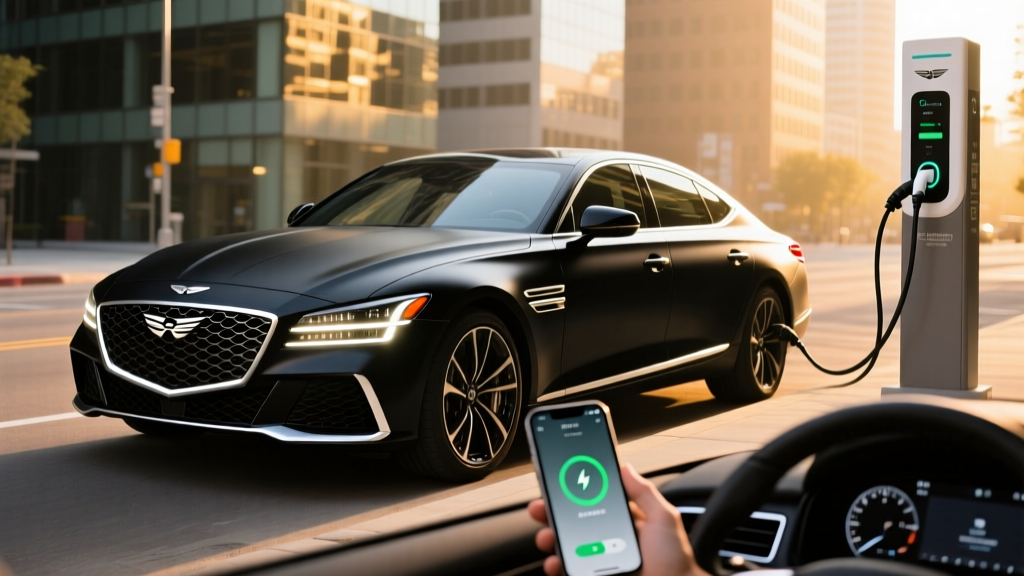
Quick Answer: Is the Genesis Electrified G80 Worth It?
The Genesis Electrified G80 delivers 282 miles of EPA-estimated range from an 87.2 kWh battery, peaks at 350 kW DC fast charging (10–80% in ~22 minutes on capable chargers), and starts around $80,000. It matches the gas G80's luxury execution while costing roughly $800–$1,200 less per year to fuel depending on your electricity rate. However, it's best suited for buyers with reliable Level 2 home charging, moderate climates, and daily commutes under 200 miles. If you regularly drive 400+ miles between charging stops or live in a charging desert, the gas G80 or a longer-range EV like the Lucid Air remains a more practical choice.
Range, Battery, and Charging: The Numbers That Matter
The Electrified G80 uses an 87.2 kWh (usable) lithium-ion battery pack paired with dual motors producing 365 horsepower and 516 lb-ft of torque. Here's the full spec breakdown:
| Specification | Value |
|---|---|
| EPA Range | 282 miles |
| Battery Capacity (Usable) | 87.2 kWh |
| Battery Chemistry | NMC (Nickel Manganese Cobalt) |
| Drivetrain | Dual-motor AWD |
| Horsepower | 365 hp |
| Torque | 516 lb-ft |
| 0–60 mph | 4.9 seconds |
| Peak DC Fast Charge Rate | 350 kW (on 800V chargers) |
| 10–80% DC Fast Charge Time | ~22 minutes (350 kW station) |
| Level 2 Charge Rate | 10.9 kW (onboard charger) |
| Level 2 Full Charge Time (0–100%) | ~8.5 hours |
| EPA Efficiency | 91 MPGe combined |
| Battery/Powertrain Warranty | 10 years / 100,000 miles |
| Base MSRP (2025 model year) | ~$80,000 (before incentives) |
Real-World Range Expectations
The EPA sticker says 282 miles, but real-world results vary significantly:
- Mild weather, city/suburban driving: 270–290 miles (regen braking helps in stop-and-go)
- Highway cruising at 70–75 mph: 230–255 miles (aerodynamic drag reduces efficiency ~15–20%)
- Cold weather (below 30°F): 195–230 miles (battery heating and cabin HVAC draw significant energy)
- Cold weather + highway: 175–210 miles (worst-case scenario)
The G80 lacks a heat pump in some model years, which exacerbates cold-weather range loss. Always precondition the battery while plugged in to mitigate this — it warms the pack using grid power rather than battery energy.
Charging Curve Reality
Genesis advertises 350 kW peak charging, but that rate is only sustained briefly at low states of charge. Expect the curve to taper meaningfully: roughly 300–350 kW from 10–30% SoC, dropping to ~150 kW by 60%, and falling below 50 kW past 80%. This is standard behavior for NMC batteries protecting cell longevity, but it means the advertised "22 minutes" applies only to the 10–80% window. A full 10–100% session will take closer to 40–45 minutes.
On Level 2 home charging at 10.9 kW (48 amps on a 60-amp circuit), you'll add roughly 30–33 miles of range per hour. An overnight charge from 20% to full takes about 7–8 hours — ideal for daily replenishment.
Electrified G80 vs. Gas G80: Cost & Capability Comparison
Many buyers cross-shop the Electrified G80 against the conventional gas G80 (2.5T and 3.5T V6 variants). Here's how they compare on the metrics that affect your wallet and daily life:
| Factor | Electrified G80 (AWD) | Gas G80 2.5T (AWD) |
|---|---|---|
| Base MSRP | ~$80,000 | ~$58,000 |
| EPA Range / Tank Range | 282 miles | ~440 miles (19.1 gal tank, 22/32 mpg) |
| Fuel/Energy Cost per Mile | $0.04–$0.06 (home charging at $0.14/kWh) | $0.15–$0.18 (premium at $4.00/gal, 25 mpg combined) |
| Annual Fuel Cost (12,000 mi) | $480–$720 | $1,800–$2,160 |
| Maintenance (Annual Avg) | $200–$400 (no oil, fewer brake replacements) | $600–$900 (oil, filters, brake pads, spark plugs) |
| 0–60 mph | 4.9 sec | 5.7 sec (2.5T) |
| Federal Tax Credit (§30D) | Eligibility varies — see below | None |
| Charging/Refueling Time | 22 min (10–80% DCFC) / 8 hrs (L2) | ~5 min (gas station) |
| Cargo Volume | 13.1 cu ft (no frunk; battery occupies underfloor) | 13.1 cu ft trunk |
The Electrified G80 commands a $20,000–$22,000 price premium over the gas 2.5T. Annual fuel and maintenance savings of roughly $1,500–$2,200 mean the break-even point arrives in approximately 10–14 years without incentives — making the federal tax credit and any state rebates critical to the financial equation.
Federal Tax Credit & Incentive Eligibility
Under current IRS §30D clean vehicle credit rules, the Electrified G80 faces several eligibility hurdles that buyers must verify before counting on the full $7,500:
- MSRP cap: Sedans must have an MSRP under $55,000. The Electrified G80 at ~$80,000 exceeds this cap, meaning it does NOT qualify for the §30D new-vehicle credit as currently structured.
- Buyer income limits: AGI caps of $150,000 (single) / $300,000 (joint) — moot if the MSRP cap already disqualifies the vehicle.
- Battery sourcing requirements: Critical mineral and battery component sourcing thresholds increase annually; even qualifying vehicles must meet these to receive the full credit.
- Point-of-sale transfer: For vehicles that do qualify, the credit can be transferred to the dealer at purchase for an immediate price reduction.
Bottom line: Do not purchase the Electrified G80 expecting the $7,500 federal credit. The MSRP cap for sedans disqualifies it. Some states offer separate EV rebates or HOV lane access that may partially offset the cost — check your state's energy office for current programs. A tax professional can advise on any applicable state-level credits.
Total Cost of Ownership: 5-Year Breakdown
| Cost Category | Electrified G80 | Gas G80 2.5T AWD |
|---|---|---|
| Purchase Price (MSRP) | $80,000 | $58,000 |
| Federal Tax Credit | $0 (MSRP cap) | $0 |
| Fuel/Energy (5 yrs, 12k mi/yr) | $2,400–$3,600 | $9,000–$10,800 |
| Maintenance (5 yrs) | $1,000–$2,000 | $3,000–$4,500 |
| Insurance (5 yrs, est.) | $12,000–$15,000 | $9,500–$12,000 |
| Home Charger Install (one-time) | $500–$2,000 | $0 |
| Depreciation (est. 5-yr) | $35,000–$42,000 | $25,000–$30,000 |
| Estimated 5-Year Total Cost | $130,900–$144,600 | $104,500–$115,300 |
Key ownership observations:
- Insurance runs 15–25% higher on the Electrified G80 due to higher repair costs and vehicle price. Get quotes before purchasing.
- Depreciation is steeper for luxury EVs in the current market. The gas G80 holds value somewhat better due to broader buyer demand and no range-anxiety concerns at resale.
- Fuel savings are real but insufficient alone to close the $22,000 purchase gap over five years.
- The Electrified G80 makes financial sense primarily for buyers who value the driving experience, instant torque, quietness, and environmental benefits — not purely as a cost-saving play.
Real-World Ownership: What First-Time EV Buyers Must Know
Home Charging Is Non-Negotiable for This Car
The Electrified G80 is a large, heavy luxury sedan with moderate efficiency (roughly 3.5–4.0 miles per kWh). Public DC fast charging at $0.35–$0.50/kWh erases most of your fuel-cost advantage over gas. To realize the advertised savings, you need:
- A Level 2 home charger (240V, 48-amp circuit recommended) — installation typically costs $800–$2,000 depending on panel proximity and local permit requirements. A panel upgrade from 100A to 200A service adds $1,500–$3,500.
- Access to off-peak electricity rates if your utility offers time-of-use plans — charging overnight at $0.08–$0.12/kWh drops your cost per mile to roughly $0.03.
If you live in an apartment without charging access or rely exclusively on public chargers, the Electrified G80's ownership experience deteriorates significantly. You'll spend $1,800–$2,500 annually on public charging — comparable to the gas G80's fuel bill.
Climate Matters More Than You Think
Owners in Phoenix, Los Angeles, or Atlanta will see range close to EPA estimates year-round. Buyers in Minneapolis, Chicago, or Boston should budget for 25–35% range loss during winter months. The Electrified G80's battery thermal management system works to protect the pack, but cabin heating draws heavily from the 87.2 kWh battery. Preconditioning while plugged in is essential — it uses grid power to warm the battery and cabin before departure, preserving range for actual driving.
Charging Network Compatibility
The Electrified G80 uses the CCS1 connector for DC fast charging and the J1772 connector for Level 2. It does NOT have a native NACS (Tesla) port. However, Hyundai Motor Group (Genesis' parent) has announced NACS adoption for future models, and CCS-to-NACS adapters may become available. For now, you'll rely on Electrify America, EVgo, ChargePoint, and other CCS-compatible networks. Reliability on these networks varies — plan routes using apps like PlugShare and always have a backup charger identified on road trips.
Common Misconceptions: Myths vs. Facts
| Myth | Fact |
|---|---|
| "The battery will need replacing in 5 years for $20,000." | Genesis warrants the battery for 10 years/100,000 miles against defects and excessive degradation (typically below 70% capacity). NMC batteries in modern thermal-managed packs are lasting 200,000+ miles with gradual, manageable degradation of ~1–2% per year. |
| "It charges as fast as filling a gas tank." | Even at peak 350 kW, a 10–80% charge takes ~22 minutes — and only at stations capable of delivering that power. Most public chargers deliver 50–150 kW, extending that to 35–60 minutes. |
| "The $7,500 tax credit brings the price down to $72,500." | The Electrified G80's MSRP exceeds the §30D sedan cap of $55,000. It does not qualify for the federal new-vehicle credit under current rules. |
| "AWD means it handles snow like a Subaru." | The dual-motor AWD provides excellent traction, but the G80's weight (~5,200 lbs) and luxury tire compound mean winter tires are strongly recommended for icy conditions. Weight helps in a straight line but increases stopping distances. |
| "I can road-trip anywhere with 282 miles of range." | With real-world highway range of 230–255 miles and charging infrastructure gaps in rural areas, trips through the Mountain West, Great Plains, or rural Southeast require careful planning. Always keep a 50-mile buffer. |
Decision Framework: Should You Buy the Electrified G80?
Choose the Electrified G80 If:
- You have Level 2 home charging (garage or driveway with 240V access)
- Your daily commute is under 150 miles round-trip, with occasional 250-mile trips
- You live in a moderate or warm climate (or accept winter range reduction)
- You value silent, instant-torque acceleration and want a luxury sedan that stands apart from the German establishment
- You've confirmed your state offers additional EV incentives that help offset the price premium
- You plan to keep the car 7+ years, allowing fuel savings to accumulate and depreciation to stabilize
Choose the Gas G80 (or Consider Alternatives) If:
- You cannot install a home charger (apartment, street parking, HOA restrictions)
- You regularly drive 300+ miles between stops in areas with sparse charging infrastructure
- You live in a very cold climate and cannot tolerate 25–35% range loss in winter
- The $22,000 price premium over the gas G80 is a dealbreaker without tax credit offsets
- You want maximum towing capacity — the Electrified G80 is not rated for towing, while the gas G80 can tow up to 3,500 lbs with proper equipment
- You want a longer-range luxury EV — consider the Lucid Air Pure (419 mi EPA, ~$70,000) or BMW i5 eDrive40 (295 mi EPA, ~$68,000)
Frequently Asked Questions
Does the Genesis Electrified G80 qualify for any federal tax credit?
No. Under current IRS §30D rules, new sedans must have an MSRP below $55,000 to qualify for the clean vehicle credit. The Electrified G80 starts around $80,000, well above this threshold. Some buyers may qualify for state-level incentives — check your state's energy department or consult a tax professional.
How long does the Electrified G80 battery last?
Genesis covers the high-voltage battery for 10 years or 100,000 miles, warranting it against defects and capacity loss below a specified threshold (typically 70% state of health). Based on data from Hyundai Motor Group's NMC packs in the Ioniq 5 and EV6, expect gradual degradation of roughly 1–2% per year under normal use. Most owners report 90%+ capacity retention after 50,000 miles.
Can I charge the Electrified G80 at Tesla Superchargers?
Not natively. The Electrified G80 uses the CCS1/J1772 connector standard. Tesla's North American Charging Standard (NACS) is a different physical connector. Some automakers are adopting NACS or offering adapters, but as of the current model year, Genesis has not provided a direct NACS adapter for the Electrified G80. You'll use Electrify America, EVgo, ChargePoint, and other CCS networks.
What does it cost to charge the Electrified G80 at home?
Charging the full 87.2 kWh battery from empty at the US average residential rate of ~$0.16/kWh costs approximately $14.00. In practice, you'll rarely charge from 0% — a typical daily replenishment of 40–50 kWh (150–180 miles driven) costs $6.40–$8.00. If your utility offers off-peak rates of $0.08–$0.10/kWh, costs drop to roughly $3.50–$5.00 per daily charge.
Is the Electrified G80 good for road trips?
It's adequate with planning. On the highway, expect 230–255 miles of real range before needing a charge. With DC fast charging at 150+ kW stations, you'll add 150+ miles in 20–25 minutes. However, charging infrastructure remains sparse in rural areas of the Mountain West, Great Plains, and parts of the Southeast. Use route-planning apps like PlugShare or A Better Routeplanner to identify reliable stops. For frequent 500+ mile road trippers, the gas G80 or a longer-range EV is more practical.
How does the Electrified G80 compare to the Genesis GV60?
The GV60 is a compact luxury crossover built on the dedicated E-GMP platform with 800V architecture, offering up to 294 miles of range (per fueleconomy.gov) and slightly faster peak charging. The Electrified G80 is a converted ICE platform — larger, more luxurious, and more spacious, but with less efficient packaging. Choose the GV60 for better efficiency and a lower starting price (~$53,000); choose the Electrified G80 for full-size sedan comfort and a more traditional luxury experience.
What maintenance does the Electrified G80 require?
Far less than the gas G80. There are no oil changes, spark plugs, transmission fluid services, or exhaust system repairs. You'll still need tire rotations (EVs wear tires faster due to instant torque and heavy weight — budget for replacement every 25,000–35,000 miles), cabin air filter changes, brake fluid checks (regenerative braking extends pad life significantly), and windshield washer fluid. Genesis includes complimentary scheduled maintenance for 3 years/36,000 miles on new vehicles.