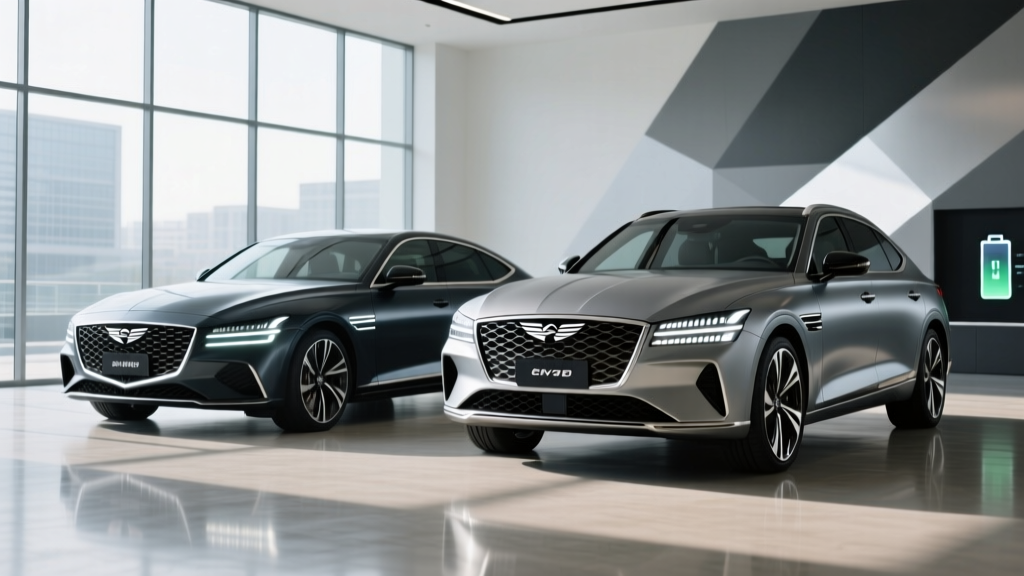
If you're shopping for a luxury EV and want something beyond the usual Tesla Model S or Model Y, Hyundai Motor Group's premium brand deserves a hard look. In this review, we evaluate the auto company Genesis on Tesla alternatives by putting its two flagship EVs — the 2026 Electrified G80 sedan and the 2026 GV60 crossover — through a data-driven comparison against their Tesla counterparts. We'll cover real-world range, charging speeds, pricing after federal tax credits, and the ownership experience that sets Genesis apart from (or falls short of) the EV benchmark.
Why Genesis Deserves a Spot on Your EV Shortlist
Genesis entered the EV space with a clear strategy: take proven Hyundai/Kia E-GMP architecture, wrap it in premium materials, and undercut German luxury pricing while matching or exceeding Tesla on interior quality. For 2026, Genesis offers two fully electric models in the U.S. — the Electrified G80 (a mid-size luxury sedan competing with the Tesla Model S) and the GV60 (a compact luxury crossover targeting the Model Y). Both ride on the group's 800V electrical architecture, enabling some of the fastest DC charging in the industry.
Unlike Tesla's minimalist approach, Genesis leans into traditional luxury: real wood and aluminum trim, quilted Nappa leather, physical knobs for climate control, and a dealership experience with complimentary valet service. The trade-off? Genesis's EV lineup is smaller, its charging network relies on third parties, and its software isn't as seamlessly integrated as Tesla's ecosystem.
2026 Electrified G80: Range, Battery, and Efficiency
The Electrified G80 pairs an 87.2 kWh usable NMC (nickel-manganese-cobalt) lithium-ion battery with a dual-motor all-wheel-drive powertrain producing 365 horsepower and 516 lb-ft of torque. The EPA rates it at 282 miles of combined range.
| Spec | Value |
|---|---|
| EPA Range | 282 miles |
| Battery (usable) | 87.2 kWh, NMC |
| Drivetrain | Dual-motor AWD |
| Horsepower | 365 hp / 516 lb-ft |
| 0–60 mph | 4.9 seconds |
| MPGe (combined) | 92 MPGe |
| kWh/100 mi | 36 kWh |
| Cargo Volume | 13.1 cu ft trunk + 1.0 cu ft frunk |
| Rear Legroom | 38.7 inches |
| Base MSRP | $80,350 (incl. destination) |
| Battery Warranty | 10 years / 100,000 miles |
The G80's efficiency of 36 kWh/100 miles is competitive with the Tesla Model S Dual Motor (which achieves roughly 33 kWh/100 mi), though the Model S benefits from a larger battery and more aerodynamic body to achieve over 400 miles of range. Where the G80 wins is interior space utilization — 38.7 inches of rear legroom beats the Model S's ~35.4 inches, making it the more comfortable executive sedan for rear-seat passengers.
2026 GV60: The Compact Crossover Tesla Alternative
The GV60 is Genesis's dedicated EV crossover, built on the E-GMP platform shared with the Hyundai Ioniq 5 and Kia EV6. For 2026, the GV60 Advanced trim features a 77.4 kWh NMC battery, dual-motor AWD, and 314 horsepower. The Performance trim bumps output to 429 hp with the same battery.
| Spec | Advanced AWD | Performance AWD |
|---|---|---|
| EPA Range | 248 miles | 235 miles |
| Battery (usable) | 77.4 kWh, NMC | 77.4 kWh, NMC |
| Horsepower | 314 hp | 429 hp |
| 0–60 mph | 5.3 seconds | 4.0 seconds |
| MPGe (combined) | 95 MPGe | 88 MPGe |
| Cargo Volume | 24.0 cu ft (rear seats up) | 24.0 cu ft |
| Base MSRP | $53,550 | $60,050 |
Charging Speed: Genesis's 800V Advantage
This is where Genesis (via E-GMP) genuinely rivals Tesla. Both the Electrified G80 and GV60 support 800V DC fast charging, enabling peak rates that match or exceed Tesla's Supercharger network speeds at compatible stations.
| Charging Level | Electrified G80 | GV60 |
|---|---|---|
| Max DC Fast Charge | ~240 kW (peak) | ~235 kW (peak) |
| 10–80% DCFC Time | ~22 minutes | ~18 minutes |
| Level 2 (240V, 48A) | 11.5 kW (~37 mi/hr) | 10.9 kW (~38 mi/hr) |
| Level 1 (120V, 12A) | ~1.4 kW (~4 mi/hr) | ~1.4 kW (~5 mi/hr) |
| Charge Port | CCS1 (NACS adapter avail.) | CCS1 (NACS adapter avail.) |
The GV60's 10–80% time of approximately 18 minutes on a 350 kW-capable charger is among the fastest in its class — Tesla's Model Y typically requires 25–30 minutes for the same session at a V3 Supercharger. However, this advantage requires access to Electrify America or similar high-power CCS stations, which remain less ubiquitous than Tesla's Supercharger network. For 2026, Genesis provides a NACS adapter enabling access to Tesla Superchargers, though at reduced speeds (Superchargers cap CCS-adapted vehicles at ~150 kW in most cases).
Charging curve reality: Both Genesis EVs sustain peak charging power only up to approximately 55–60% state of charge, after which the curve tapers significantly. Expect the 60–80% portion of the session to take nearly as long as 10–60%. This is normal for NMC chemistries but worth planning for on road trips — charging to 90%+ adds considerable time.
Pricing, Tax Credits, and Ownership Cost
| Model / Trim | MSRP | §30D Credit Eligible? | Est. Net Price |
|---|---|---|---|
| Electrified G80 (single trim) | $80,350 | No — exceeds $55,000 sedan MSRP cap | $80,350 |
| GV60 Advanced AWD | $53,550 | Potentially — under $80,000 SUV cap* | ~$46,050* |
| GV60 Performance AWD | $60,050 | Potentially — under $80,000 SUV cap* | ~$52,550* |
*Federal tax credit eligibility under IRS §30D depends on multiple factors current for 2026: buyer income caps ($150,000 single / $300,000 joint AGI), MSRP caps ($80,000 for SUVs, $55,000 for sedans), and battery component/critical mineral sourcing requirements that shift annually. The Electrified G80 is ineligible as a sedan priced above $55,000. The GV60, classified as an SUV, clears the MSRP cap but must meet evolving critical-mineral and battery-component sourcing rules to qualify for the full $7,500. Genesis also offers point-of-sale transfer of the credit at participating dealers. Consult a tax professional for your specific eligibility.
On the ownership-cost side, Genesis includes three years of complimentary maintenance and 24/7 roadside assistance, plus three years of Electrify America charging credits (typically 1,500 kWh). Tesla offers no free maintenance and has phased out complimentary Supercharging for new vehicles. Insurance costs for both brands are comparable in the luxury EV segment — expect $2,200–$3,000/year depending on state and driving record, per III data.
Tech, Driver Assistance, and the Genesis Experience
Genesis equips both EVs with its Genesis Active Safety Control suite — a Level 2 driver-assistance system per SAE classification. This includes adaptive cruise control with stop-and-go, lane-centering, highway driving assist, and automated emergency braking. It is competent and predictable, but it is not a hands-free system like GM's Super Cruise or Ford's BlueCruise. The driver must maintain steering-wheel contact at all times.
Where Genesis outshines Tesla is the infotainment and cabin experience. The G80 features a 12.3-inch digital cluster and 14.5-inch widescreen infotainment display with a dedicated rotary controller — no touchscreen-only guesswork while driving. The GV60 offers a crystal sphere shifter (a rotating glass orb that reveals the gear selector), fingerprint authentication, and facial recognition for personalized settings. Both support wireless Apple CarPlay and Android Auto, which Tesla still does not offer natively.
Genesis's Connected Services app provides remote preconditioning, charge scheduling, and vehicle status — critical for optimizing battery temperature before DC fast charging in cold weather. Preconditioning the battery before a fast-charge session can shave 5–10 minutes off your 10–80% time in winter.
Pros and Cons: Genesis EVs vs. Tesla
Genesis Advantages
- Superior interior materials and build quality vs. Tesla
- 800V architecture enables 18–22 min 10–80% DC charging
- 10-year/100,000-mile battery warranty (Tesla: 8 yr/120,000 mi)
- Complimentary maintenance and charging credits included
- Physical controls + wireless CarPlay/Android Auto
- Quieter cabin, more rear-seat comfort (G80)
Genesis Drawbacks
- Shorter EPA range than Tesla equivalents (GV60: 248 mi vs Model Y: 320+ mi)
- Relies on third-party charging networks (CCS + adapter for NACS)
- Smaller dealer/service network than Tesla
- No hands-free highway driving feature
- G80 sedan ineligible for federal tax credit (MSRP cap)
- Lower software/OTA sophistication vs. Tesla
Who Should Buy a Genesis EV?
Choose the GV60 if: You want a compact luxury crossover with rapid charging, can accept ~250 miles of range, value distinctive design and dealer-service experience, and qualify for the §30D tax credit to bring the effective price under $50,000.
Stick with Tesla if: Maximum range, Supercharger network access, and software integration (app, OTA updates, Sentry Mode) are your top priorities — or if you regularly road-trip beyond 300 miles between stops.
Frequently Asked Questions
What is the real-world range of Genesis EVs?
The Electrified G80 delivers approximately 245–260 miles on the highway (EPA 282 mi), dropping to 210–225 miles in cold weather. The GV60 Advanced manages 215–230 highway miles (EPA 248 mi) and around 190–205 miles in freezing temperatures. These figures assume 70 mph highway speeds; city driving with regenerative braking can exceed EPA estimates.
How fast do Genesis EVs charge at home and on the road?
On a Level 2 home charger (48A/240V), the G80 adds roughly 37 miles per hour and the GV60 about 38 miles per hour — a full overnight charge for either. On a 350 kW DC fast charger, the GV60 charges 10–80% in approximately 18 minutes and the G80 in about 22 minutes, thanks to 800V architecture. At Tesla Superchargers via NACS adapter, expect peak rates around 150 kW.
Does the Genesis GV60 qualify for the federal EV tax credit?
The GV60 is classified as an SUV and its MSRP falls under the $80,000 cap, making it potentially eligible for up to $7,500 under IRS §30D. However, eligibility also depends on your adjusted gross income (capped at $150K single/$300K joint), and the vehicle's battery components and critical minerals must meet 2026 sourcing thresholds. The Electrified G80 sedan is not eligible due to the $55,000 sedan MSRP cap. Always verify current rules at irs.gov and consult a tax professional.
Is Genesis worth buying over Tesla?
Genesis wins on interior luxury, charging speed at CCS stations, warranty coverage, and dealer service experience. Tesla wins on range, charging-network convenience (Superchargers), software, and resale value data. For buyers who charge at home 90% of the time and value a premium cabin, Genesis is a compelling alternative. For frequent road-trippers who depend on public charging, Tesla's infrastructure advantage remains significant.
What is the battery warranty on Genesis EVs?
Genesis covers the high-voltage battery and electric powertrain for 10 years or 100,000 miles, whichever comes first. This exceeds Tesla's 8-year/120,000-mile battery warranty on the Model Y and Model S. The warranty covers defects and capacity loss below a specified threshold (typically 70% state of health). Genesis also includes 3 years/36,000 miles of bumper-to-bumper coverage and complimentary scheduled maintenance.