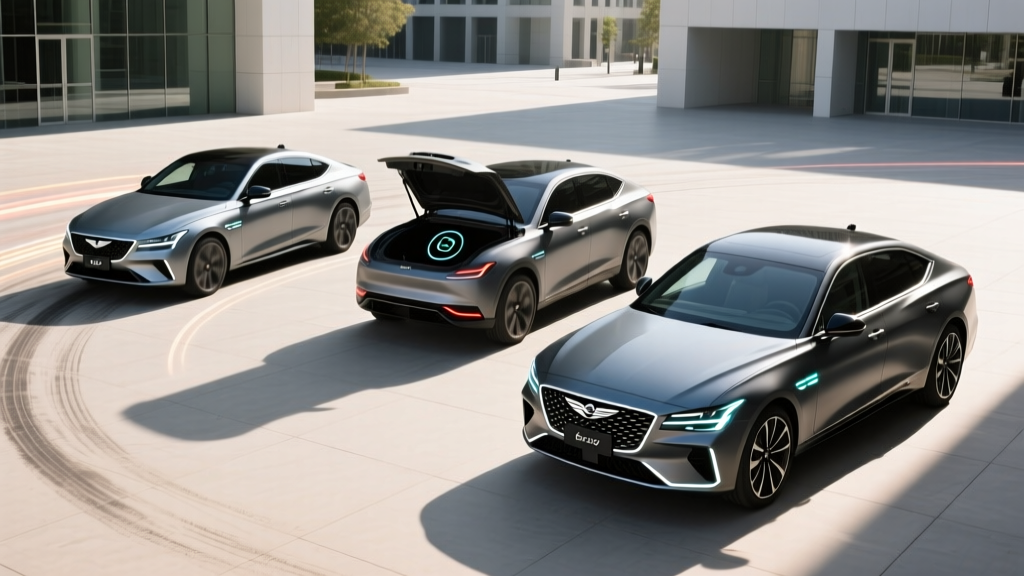
If you're researching Genesis electric cars in 2026, you're looking at three battery-electric models: the GV60 compact luxury crossover, the Electrified GV70 midsize SUV, and the Electrified G80 full-size sedan. All three ride on Hyundai Motor Group's E-GMP architecture (800V-capable, fast DC charging), offer between 248 and 282 miles of EPA range, and start between $53,000 and $74,000 before incentives. None currently qualifies for the full $7,500 federal §30D credit due to battery-sourcing rules, which is a critical factor we'll break down below.
Quick Answer: Should You Buy a Genesis EV in 2026?
Genesis electric cars are a strong pick if you prioritize luxury materials, quiet ride quality, and ultra-fast 800V DC charging (10–80% in ~18 minutes at a 350 kW station) over maximum range or Autopilot-style driver-assist tech. The GV60 is the best value at ~$53K; the Electrified G80 delivers flagship comfort at ~$80K. The main trade-offs: EPA range trails Tesla and Lucid, and federal tax credit eligibility is limited by sourcing rules. If you can charge at home and your daily commute is under 100 miles round-trip, any of the three will serve you well.
The 2026 Genesis EV Lineup at a Glance
| Spec | GV60 Advanced | Electrified GV70 | Electrified G80 |
|---|---|---|---|
| Body Style | Compact Crossover | Midsize SUV | Full-Size Sedan |
| Battery (usable) | 77.4 kWh, NMC | 77.4 kWh, NMC | 87.2 kWh, NMC |
| EPA Range | 248 mi (AWD) | 236 mi (AWD) | 282 mi (AWD) |
| Real-World Highway | ~210–225 mi | ~195–215 mi | ~240–260 mi |
| Drivetrain | Dual-motor AWD | Dual-motor AWD | Dual-motor AWD |
| Horsepower | 314 hp | 429 hp | 365 hp |
| 0–60 mph | 5.3 sec | 4.2 sec | 4.9 sec |
| Max DC Charge Rate | ~240 kW (peak) | ~240 kW (peak) | ~240 kW (peak) |
| 10–80% DC Time | ~18 min | ~18 min | ~22 min |
| Level 2 Rate | 10.9 kW | 10.9 kW | 10.9 kW |
| MPGe (combined) | 95 MPGe | 87 MPGe | 91 MPGe |
| Base MSRP | $53,050 | $66,450 | $79,950 |
| Battery Warranty | 10 yr / 100,000 mi | 10 yr / 100,000 mi | 10 yr / 100,000 mi |
Sources: fueleconomy.gov (EPA ratings), Genesis USA press specifications. Real-world highway estimates reflect 70–75 mph driving in moderate temperatures; expect 15–25% range loss below freezing.
Range, Efficiency, and the Charging-Curve Reality
The headline EPA numbers — 248 miles for the GV60, 236 for the Electrified GV70, and 282 for the Electrified G80 — put Genesis in the middle of the luxury EV pack. For comparison, the BMW iX xDrive50 achieves 324 miles EPA, and the Tesla Model X Long Range delivers 335 miles. Genesis prioritized charging speed over raw range by adopting an 800V electrical architecture.
Real-World Range Expectations
GV60: EPA 248 mi → expect ~210–225 mi on a highway road trip, ~185–200 mi in sub-30°F weather.
Electrified GV70: EPA 236 mi → expect ~195–215 mi highway, ~175–190 mi in cold weather.
Electrified G80: EPA 282 mi → expect ~240–260 mi highway, ~215–235 mi in cold weather.
The GV70's boxier shape and heavier curb weight (~4,900 lbs) cost it efficiency compared to the sleeker G80 sedan.
On the charging side, the 800V system is where Genesis electric cars shine. At a 350 kW DC fast charger (like Electrify America's latest stalls), the GV60 and Electrified GV70 can peak near 240 kW, adding roughly 100 miles of range in 10 minutes. However, peak kW is not sustained kW — the charge curve tapers sharply above 80% state of charge. If you're charging from 10–80%, plan on ~18 minutes for the GV60/GV70 and ~22 minutes for the G80's larger battery. Charging from 80–100% can add another 25–35 minutes, which is why most road-trippers stop at 80%.
At home on a Level 2 charger (240V, 48-amp circuit), all three models accept up to 10.9 kW, meaning a full overnight charge in roughly 7–9 hours. On a standard 120V Level 1 outlet, expect about 3–4 miles of range per hour — useful for topping off, but not practical as a primary charging strategy.
Genesis EV vs. Gas and Hybrid: The Cost Math
To put the ownership economics in context, here's how the GV60 Advanced stacks up against the gas-powered Genesis GV70 2.5T (a close internal-combustion sibling in size and luxury positioning):
| Cost Factor (5-Year Estimate) | GV60 Advanced (EV) | GV70 2.5T (Gas AWD) |
|---|---|---|
| MSRP (base) | $53,050 | $47,550 |
| Federal Tax Credit (§30D) | $0–$3,750* | $0 |
| Fuel / Electricity (75,000 mi) | $2,800–$4,200** | $8,500–$10,200 |
| Maintenance (5 yr) | $1,200–$1,800 | $3,500–$4,500 |
| Insurance (5 yr avg.) | $11,500–$14,000 | $9,000–$11,500 |
| Estimated Depreciation | $22,000–$26,000 | $18,000–$22,000 |
| 5-Year Total Cost | $64,550–$75,300 | $60,050–$73,750 |
*Genesis EVs have faced limited §30D eligibility due to battery-component and critical-mineral sourcing requirements. Always verify current eligibility at irs.gov before purchasing. Credit phases: up to $3,750 for battery components, up to $3,750 for critical minerals, subject to MSRP caps ($80K for SUVs, $55K for sedans) and buyer income limits ($300K joint / $150K single).
**Electricity cost assumes a mix of 80% home charging ($0.14/kWh national avg.) and 20% public DC fast charging ($0.40–$0.55/kWh). Gas assumes $3.50/gal and 24 MPG combined for the GV70 2.5T.
The EV wins on fuel and maintenance — no oil changes, fewer brake replacements thanks to regenerative braking, and no transmission fluid. But the GV60 carries higher insurance premiums (EV claims tend to be costlier) and steeper depreciation, which has been a pattern across luxury EVs. The break-even point depends heavily on your local electricity rate, how much you drive, and whether you can secure any state or utility rebates on top of the federal credit.
Real Ownership Considerations: Charging, Climate, and Daily Life
Home Charging Access Is Non-Negotiable
Genesis electric cars are best suited for owners who can install a Level 2 home charger. A 240V/48-amp hardwired station (like a ChargePoint Home Flex or Emporia Level 2) delivers roughly 30–35 miles of range per hour of charging. Installation costs vary widely:
| Item | Typical Cost Range |
|---|---|
| Level 2 Charger (hardware) | $400–$750 |
| Electrician labor (standard install) | $800–$2,000 |
| Permit & inspection | $100–$350 |
| Panel upgrade (if needed, 200A service) | $1,500–$3,500 |
| Total (no panel upgrade) | $1,300–$3,100 |
| Total (with panel upgrade) | $2,800–$6,600 |
If you live in an apartment or condo without charging access, relying on public DC fast charging is possible but adds $0.40–$0.55/kWh (versus ~$0.14 at home) and requires planning around charger availability. Check PlugShare or the Electrify America app to map stations near your home and commute route before purchasing.
Cold-Weather Range Loss
All three Genesis EVs use NMC (nickel manganese cobalt) battery chemistry, which is more energy-dense than LFP but still loses 15–25% of its range in sustained sub-30°F temperatures. The heat pump — standard on all three models — helps mitigate cabin-heating energy draw, but it can't fully eliminate the physics of cold electrolytes. If you live in Minnesota or Maine and commute 80+ miles round-trip in January, the Electrified GV70's real-world winter range of ~175 miles may require midday charging.
Driver-Assist: SAE Level 2, Not Self-Driving
Genesis equips its EVs with Highway Driving Assist 2 (HDA2), which combines adaptive cruise control with lane-centering on divided highways. This is an SAE Level 2 system — you must keep your hands on the wheel and eyes on the road at all times. It does not navigate exits, handle city streets autonomously, or qualify as "self-driving" in any legal or technical sense.
SAE Automation Level: Level 2
Genesis HDA2 provides lane-centering and adaptive cruise on marked highways. The driver is responsible for all steering, braking, and situational awareness. This is comparable to BMW's Driving Assistant Professional or Mercedes-Benz Distronic — and a step below Tesla's FSD (Supervised) in feature scope, though many reviewers find HDA2's execution more predictable.
Federal Tax Credit: What You Can Actually Claim
This is where Genesis electric cars face a headwind. Under the Inflation Reduction Act's §30D rules, a new clean vehicle must meet two sourcing requirements to qualify for the full $7,500 credit:
- Battery Component Requirement: A percentage of battery components must be manufactured or assembled in North America (threshold increases annually).
- Critical Mineral Requirement: A percentage of critical minerals must be sourced from the U.S. or a free-trade-agreement country.
- MSRP Cap: Vans, SUVs, and pickups ≤ $80,000; sedans ≤ $55,000.
- Buyer Income Cap: AGI ≤ $300,000 (joint), $225,000 (head of household), $150,000 (single).
- Final Assembly: Must occur in North America (all three Genesis EVs currently qualify here).
As of the 2026 model year, the GV60 (stickered as a sedan/crossover at $53,050) clears the MSRP cap but has historically failed one or both sourcing thresholds, limiting its credit to $0 or $3,750. The Electrified GV70 and Electrified G80 have faced the same sourcing issues, and the G80's ~$80K price pushes right against the SUV cap. Always verify current eligibility on the IRS clean vehicle credit page before signing a purchase agreement. Point-of-sale transfer is available if you qualify, allowing you to apply the credit as a down-payment reduction at the dealer.
Common Misconceptions About Genesis Electric Cars
| Myth | Fact |
|---|---|
| "Genesis EVs can't road-trip — the range is too low." | With 800V charging at ~240 kW, a GV60 adds ~200 miles in 20 minutes at a 350 kW station. Plan charging stops at 80% SoC and road-trips are practical; they just require more stops than a 350-mile-range Tesla. |
| "The battery will need replacing in 5 years." | NMC batteries in E-GMP vehicles show ~5–8% degradation over 100,000 miles based on Hyundai Motor Group fleet data. The 10-year/100,000-mile battery warranty covers capacity below 70% of original. |
| "All Genesis EVs get the $7,500 tax credit." | Federal credit eligibility depends on battery sourcing, MSRP caps, and buyer income — not the brand. Many Genesis EVs have qualified for $0 or $3,750 in recent years. |
| "I can charge on any standard outlet." | Level 1 (120V) adds ~3–4 miles per hour — enough to top off overnight, but not enough to replenish a depleted battery in a practical timeframe. A Level 2 home install is strongly recommended. |
| "Genesis HDA2 is self-driving." | HDA2 is SAE Level 2. The driver must remain fully engaged. Hands-off-wheel alerts trigger within seconds on most configurations. |
Decision Framework: Which Genesis EV Is Right for You?
Choose the GV60 if:
- You want the most affordable entry into the Genesis EV lineup (~$53K).
- Your daily commute is under 80 miles round-trip.
- You value a sporty, compact footprint for city driving and parking.
- You can charge at home and don't regularly drive 250+ miles without stopping.
Choose the Electrified GV70 if:
- You need SUV cargo space (30.3 cu ft behind the rear seats) and family seating.
- You want the quickest acceleration in the lineup (429 hp, 0–60 in 4.2 sec).
- You're willing to trade ~12 miles of EPA range for a higher ride height and towing capability (3,500 lbs).
Choose the Electrified G80 if:
- You want flagship sedan comfort, the longest range in the lineup (282 mi EPA), and a near-silent highway ride.
- You prioritize back-seat luxury for passengers or clients.
- You're comfortable with the ~$80K price point and can absorb potentially higher depreciation.
Consider a non-Genesis alternative if:
- You need 320+ miles of EPA range → look at the BMW iX, Tesla Model X, or Lucid Air.
- You want the full $7,500 federal credit → check the latest fueleconomy.gov tax credit list for currently qualifying models.
- You live in a rural charging desert with no home charging access → a PHEV like the BMW X5 xDrive50e may be a better bridge.
Frequently Asked Questions
Do Genesis electric cars use NACS or CCS charging connectors?
As of 2026, Genesis EVs sold in North America use the CCS1 connector for DC fast charging and J1772 for Level 2 AC. Hyundai Motor Group has announced a transition to NACS (Tesla's connector) for future models, but current GV60, Electrified GV70, and Electrified G80 vehicles require a CCS-to-NACS adapter to access Tesla Supercharger stalls. Tesla's official adapter (~$250) is compatible with E-GMP vehicles, though charge rates may be limited to ~150 kW at V3 Superchargers.
What does it cost to charge a Genesis EV at home per month?
At the U.S. average residential rate of ~$0.14/kWh and an efficiency of ~3.0 miles/kWh (GV60), driving 1,000 miles per month costs roughly $47 in electricity. The same distance in a gas GV70 at 24 MPG and $3.50/gallon would cost ~$146. That's roughly $1,200 in annual fuel savings with home charging.
How long will the Genesis EV battery last?
E-GMP batteries use NMC chemistry with an active liquid thermal management system. Based on data from Hyundai Motor Group's Ioniq 5 and Kia EV6 (same platform), expect ~5–8% capacity loss over 100,000 miles. The battery warranty guarantees at least 70% capacity retention for 10 years or 100,000 miles. Full battery replacement (if ever needed out of warranty) would likely cost $12,000–$18,000 based on current E-GMP pricing, though this has never been common in real-world ownership.
Are Genesis EVs reliable compared to Tesla or BMW?
Genesis as a brand consistently ranks in the top third of J.D. Power and Consumer Reports reliability surveys, and the E-GMP platform has proven robust across Hyundai, Kia, and Genesis models. Common complaints center on infotainment software quirks and 12V auxiliary battery drain during extended parking — not high-voltage battery or powertrain failures. IIHS has awarded the GV60 a Top Safety Pick+ rating.
Can I tow with a Genesis electric car?
The Electrified GV70 is rated to tow up to 3,500 lbs when properly equipped. The GV60 is rated at 2,000 lbs. The Electrified G80 sedan is not rated for towing. Note that towing reduces range by roughly 30–50% depending on trailer weight and aerodynamics — plan charging stops accordingly.