The Short Answer
General Motors reported roughly $5.5–$6.5 billion in cumulative EV-related losses between 2022 and mid-2025, driven by Ultium platform R&D, factory retooling, aggressive pricing to gain market share, and slower-than-expected production ramp-ups. By late 2025, GM narrowed quarterly EV losses to under $300 million and projected breakeven on its EV business by late 2026. For buyers, this means aggressive pricing, strong incentives, and a wide model lineup — but also potential risk if you buy from a brand still stabilizing its EV margins and software stack.
Why GM's EV Losses Matter to Car Buyers
Most EV shoppers don't follow quarterly earnings calls. But the financial health of an automaker's EV division directly affects the vehicles you can buy, the pricing you'll see on the lot, the software quality you'll live with, and the long-term support behind your purchase. When an automaker is losing money on every EV it sells, two things tend to happen: prices are artificially low (good for buyers in the short term), and cost-cutting or platform pivots can disrupt model continuity, feature rollouts, and residual values.
GM's EV story is distinct from Tesla's or Hyundai-Kia's. GM bet heavily on a proprietary battery platform (Ultium), retooled multiple North American plants simultaneously, and launched over a dozen EV models across Chevrolet, Cadillac, GMC, and Buick in a compressed timeline. That capital-intensive strategy generated enormous upfront losses — but it also means the vehicles arriving in 2026 are built on a maturing, cost-reduced version of that platform.
Breaking Down Where the Money Went
GM's EV losses aren't a single line item. They span several categories, each with different implications for buyers:
1. Ultium Platform R&D and Factory Retooling
GM invested over $35 billion in EV and autonomous vehicle development between 2020 and 2025, with a significant portion directed at the Ultium battery architecture, new dedicated EV factories (Factory ZERO in Detroit-Hamtramck, Spring Hill in Tennessee, and Orion Assembly in Michigan), and battery cell joint ventures with LG Energy Solution (Ultium Cells LLC). These are sunk capital costs — they don't directly inflate the sticker price of a 2026 Equinox EV, but they do pressure GM to sell high volumes to recoup investment.
2. Per-Vehicle Margin Deficits
In 2023, analysts estimated GM was losing $20,000–$30,000 per EV sold when fully allocating R&D and fixed costs. By 2025, that figure narrowed to roughly $3,000–$8,000 per unit as production scaled, battery cell costs fell, and GM shifted to higher-trim, higher-margin models like the Cadillac Lyriq and GMC Sierra EV. The Chevrolet Equinox EV and Blazer EV, priced more aggressively, carry thinner or negative margins but serve volume targets.
3. Pricing Wars and Incentive Spend
To move metal in a market dominated by Tesla's price cuts and flooded with new competitors, GM deployed substantial lease cash, dealer incentives, and MSRPs set below what the market might bear. The 2025 Equinox EV launched at a base MSRP of roughly $33,600 — undercutting most compact electric SUVs. These pricing strategies directly erode per-unit margins.
4. Software and Quality Launch Costs
GM's widely reported software issues in 2024 — particularly with the Blazer EV and Silverado EV infotainment and driver-assistance systems — required costly over-the-air fixes, warranty campaigns, and in some cases, temporary sales holds. Software instability doesn't show up as a neat "loss" line, but it inflates warranty reserves, depresses customer satisfaction scores, and delays revenue recognition.
| Loss Category | Estimated Scale | Impact on Buyers |
|---|---|---|
| Ultium R&D / Factory Retooling | $20B+ (2020–2025) | Long-term platform maturity; lower cell costs over time |
| Per-Vehicle Margin Gap | $3K–$30K/unit (declining) | Aggressive pricing now; possible price increases post-breakeven |
| Incentives & Lease Cash | Varies by quarter/model | Lower effective transaction prices today |
| Software / Quality Fixes | Warranty reserve increases | Early-build risk; OTA-dependent feature maturity |
GM EV Lineup in 2026: Specs, Pricing, and Tax Credits
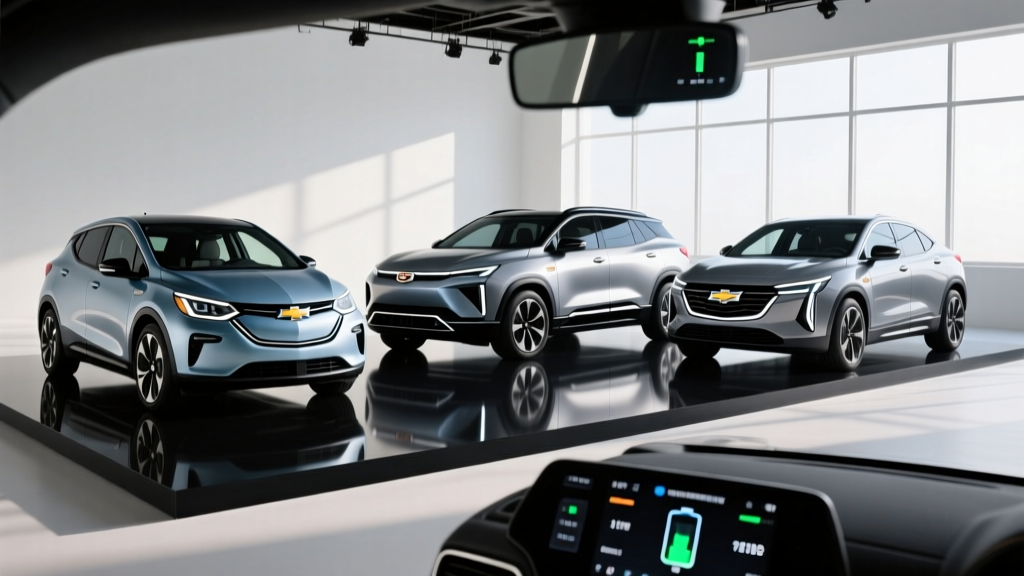
Here's where GM's financial strategy meets the showroom floor. The table below covers the core 2026 GM EV models most buyers are cross-shopping, with EPA range, battery capacity, DC fast-charge capability, base pricing, and federal tax credit status.
| Model | EPA Range | Battery (kWh, Chem.) | Peak DC Charge | 10–80% Time | 0–60 mph | Base MSRP | §30D Credit Eligible? |
|---|---|---|---|---|---|---|---|
| Chevrolet Equinox EV | 319 mi (3LT FWD) | 85 kWh, NMC | 150 kW | ~32 min | ~8.0 sec | $33,600 | Up to $7,500 (subject to income/MSRP caps) |
| Chevrolet Blazer EV | 324 mi (2LT AWD) | 102 kWh, NMC | 190 kW | ~26 min | ~6.0 sec | $44,600 | Up to $7,500 (subject to sourcing rules) |
| Cadillac Lyriq | 314 mi (Luxury RWD) | 102 kWh, NMC | 190 kW | ~26 min | ~5.7 sec | $58,590 | Up to $7,500 (MSRP under SUV cap) |
| Chevrolet Silverado EV | 440 mi (4WT Max Range) | 200+ kWh, NMC | 350 kW | ~20 min | ~4.5 sec (RST) | $39,900 (WT) | Up to $7,500 (truck MSRP cap $80K) |
| GMC Sierra EV | 440 mi (Denali Edition 1) | 200+ kWh, NMC | 350 kW | ~20 min | ~4.3 sec | $81,200 (Denali Ed. 1) | Varies by trim; exceeds MSRP cap on high trims |
Real-World Range Reality Check
EPA estimates are useful baselines, but real-world range depends on speed, temperature, and terrain. For the Equinox EV 3LT (EPA 319 mi), expect approximately 260–285 miles at sustained 75 mph highway speeds in mild weather, and 210–240 miles in sub-freezing conditions with cabin heat active. The Silverado EV's massive battery pack yields more buffer, but its aerodynamic profile as a pickup means highway efficiency drops sharply above 70 mph.
How GM's EV Strategy Compares to the Competition
Understanding GM's losses requires context. Here's how the major EV players stack up on profitability and pricing strategy as of early 2026:
| Automaker | EV Profitability Status | Pricing Strategy | Platform Maturity |
|---|---|---|---|
| Tesla | Profitable on EVs since ~2020; margins compressed by price cuts | Aggressive price reductions; minimal incentives | Mature (Model 3/Y on 3rd-gen platform) |
| Hyundai-Kia (E-GMP) | Near breakeven or slim profit on EVs | Competitive MSRPs; strong lease deals | Mature 800V platform; NACS adapter available |
| Ford (Model e) | Reporting $3B–$5B annual EV losses through 2025 | Mixed; F-150 Lightning repriced multiple times | GE1/GE2 platforms; transitioning to next-gen |
| General Motors (Ultium) | Narrowing losses; targeting breakeven late 2026 | Aggressive MSRPs; volume-first approach | Ultium maturing; software stack stabilizing |
| Rivian | Per-vehicle losses narrowing but still significant | Premium pricing; limited incentives | R1 platform mature; R2 platform upcoming |
For buyers, the key takeaway is that GM and Ford are both subsidizing EV sales to build volume and market share, while Tesla and Hyundai-Kia are closer to sustainable margins. This means GM buyers currently benefit from below-market pricing but should anticipate potential price normalization as GM approaches its breakeven target.
Total Cost of Ownership: GM EVs vs. Gas Equivalents
Losses on GM's balance sheet don't tell the whole story. What matters to you is whether a GM EV saves or costs you money over five years compared to the gas vehicle it replaces. Below is a five-year cost comparison using the 2026 Chevrolet Equinox EV 3LT versus the 2026 Chevrolet Equinox gas AWD (1.5L turbo, 175 hp, EPA 28 mpg combined).
| Cost Category | Equinox EV 3LT | Equinox Gas AWD | Notes |
|---|---|---|---|
| Purchase Price (MSRP) | $38,200 | $32,800 | EV at higher trim for feature parity |
| Federal §30D Credit | –$7,500 | $0 | Assumes buyer meets income caps ($150K single / $300K joint) and vehicle meets sourcing rules |
| Effective Purchase | $30,700 | $32,800 | Before state incentives, dealer fees |
| Fuel/Energy (75K mi) | $3,200 | $8,600 | EV: $0.13/kWh avg home charging; Gas: $3.40/gal avg |
| Maintenance | $1,800 | $4,200 | EV: no oil changes, fewer brake replacements (regen) |
| Insurance (est. avg) | $9,500 | $7,800 | EV premiums run 15–25% higher on average |
| Depreciation (est.) | $14,500 | $13,200 | EV depreciation stabilizing but still elevated vs. gas |
| 5-Year Total | $59,700 | $66,600 | EV saves ~$6,900 over 5 years in this scenario |
This comparison assumes reliable Level 2 home charging. If you rely exclusively on public DC fast charging at $0.35–$0.50/kWh, the Equinox EV's fuel cost rises to roughly $7,500–$10,000 over 75,000 miles — erasing most of the energy savings. Home charging access remains the single largest variable in EV ownership economics.
What First-Time GM EV Buyers Should Know
If you're considering a Chevrolet, Cadillac, or GMC electric vehicle, these practical points separate informed buyers from disappointed ones:
Super Cruise vs. Tesla Autopilot — Know the SAE Level
GM's Super Cruise is an SAE Level 2 driver-assistance system. It requires the driver to remain attentive and keep eyes on the road (monitored by a driver-facing camera). It operates on over 750,000 miles of pre-mapped divided highways in the U.S. and Canada. It is not self-driving. Hands-free does not mean attention-free. GM's Ultra Cruise (upcoming) will expand to surface streets but remains Level 2. Only Waymo-style robotaxis operating in geofenced areas qualify as Level 4.
Charging Connector: NACS Is Now Standard
Starting with the 2025 model year, GM adopted the Tesla NACS (North American Charging Standard) connector on all new EVs, replacing CCS1. This gives GM owners native access to Tesla's Supercharger network — the most reliable DC fast-charging network in North America, with over 25,000 stalls. If you're buying a 2024 model-year GM EV, it will still have a CCS1 port and will require a GM-provided adapter for Supercharger access.
Battery Warranty and Chemistry
GM covers Ultium battery packs with an 8-year / 100,000-mile warranty guaranteeing at least 70% capacity retention. All current Ultium packs use NMC (nickel manganese cobalt) chemistry, which offers higher energy density than LFP (lithium iron phosphate) but carries different degradation characteristics. NMC packs benefit from not being held at 100% state of charge for extended periods — set your daily charge limit to 80–90% and reserve 100% for road trips.
The Software Lesson
GM's 2024 software stumbles with the Blazer EV were a genuine issue — infotainment freezes, phantom warnings, and delayed OTA updates frustrated early adopters. By 2026, GM has overhauled its software engineering organization and pushed multiple stability-focused updates. If you're risk-averse, prioritize models that have been in production for at least 6–12 months (Equinox EV, Lyriq) over brand-new launches where early-build software bugs are more likely.
Addressing Common Misconceptions About GM EV Losses
| Myth | Fact |
|---|---|
| "GM is losing money on every EV, so they'll discontinue them." | GM's per-unit losses have narrowed dramatically. The company has committed to EV breakeven by late 2026 and has invested too deeply in Ultium infrastructure to reverse course. Model rationalization is more likely than cancellation. |
| "If GM goes profitable on EVs, prices will jump." | Some price normalization is likely, but competition from Tesla, Hyundai, and Chinese-market imports (where available) will constrain increases. Expect trim restructuring rather than across-the-board hikes. |
| "GM EVs are unreliable because of the Blazer EV launch." | The Blazer EV's software issues were real but specific to early-build units. The Lyriq and Equinox EV have had comparatively smoother launches. Check build date and software version before purchasing. |
| "The Ultium battery platform is unproven." | Ultium has been in production vehicles since the 2022 GMC Hummer EV. Cell chemistry and pack design have been validated over billions of real-world miles across multiple models. The platform is past the prototype stage. |
| "I won't be able to charge a GM EV on road trips." | With NACS adoption, GM EVs have native access to Tesla Superchargers plus Electrify America, EVgo, and other networks. Road-trip charging in 2026 is significantly more accessible than in 2022, though rural corridors still have gaps. |
Decision Framework: Is a GM EV Right for You?
Choose a GM EV If:
- You want a mainstream electric SUV or truck from a brand with a large North American dealer network for service and warranty work.
- Home Level 2 charging is available to you (garage or driveway with a 240V circuit), which is essential for capturing the full fuel-cost savings.
- You value Super Cruise for frequent highway commuting — it remains one of the most polished Level 2 systems for hands-free divided-highway driving.
- You're buying a Chevrolet Equinox EV or Cadillac Lyriq, where the value proposition and platform maturity are strongest in 2026.
- You qualify for the federal §30D tax credit (income under $150K single / $300K joint; vehicle MSRP under $55K for cars, $80K for SUVs/trucks; vehicle meets battery-sourcing requirements — verify at IRS.gov).
Look Elsewhere If:
- You rely entirely on public charging and live in an area with sparse DC fast-charging infrastructure — the ownership experience degrades significantly without home or workplace charging.
- You want a proven track record of software stability and are uncomfortable with OTA-dependent feature maturation. Consider a Tesla Model Y or Hyundai Ioniq 5, which have longer production histories.
- You're targeting a GMC Hummer EV or high-trim Sierra EV above $80K, where the MSRP cap eliminates federal tax credit eligibility and the value proposition weakens against established luxury competitors.
- You drive predominantly in extreme cold climates without access to preconditioning via a garage charger. NMC batteries lose 20–35% range in sustained sub-20°F conditions — a concern for all EVs, but more impactful on lower-range trims.
The Bottom Line for Buyers
GM's EV losses are a corporate finance story, not a reason to avoid their vehicles. In fact, those losses have produced some of the most aggressively priced EVs on the market — the Equinox EV at ~$33,600 before incentives is difficult to match on value. The real buyer risks are narrower: early-build software quality on newer models, depreciation uncertainty as the EV market matures, and the universal EV requirement of reliable home charging access.
If you're cross-shopping a GM EV, focus on the Equinox EV (best value), Lyriq (best luxury execution), or Silverado EV Work Truck (best fleet/commercial proposition). Approach the Blazer EV and Sierra EV Denali with more scrutiny on build quality and software maturity. And always verify your personal §30D tax credit eligibility before signing — the rules around battery sourcing, income caps, and MSRP limits change, and dealer point-of-sale transfer requires documentation.
For official EPA range and efficiency data on any GM model, cross-reference at fueleconomy.gov. For safety ratings, check NHTSA and IIHS before finalizing your decision.
Is GM going to stop making electric vehicles because of these losses?
No. GM has invested over $35 billion in its EV platform, factories, and battery joint ventures. The company is narrowing losses quarterly and targeting EV business breakeven by late 2026. Model rationalization (trimming low-volume variants) is possible, but a wholesale retreat from EVs is extremely unlikely given the sunk investment and regulatory environment.
Are GM EVs cheaper to buy because GM is losing money on them?
Partially, yes. GM has set MSRPs below what a fully profitable EV business would require, particularly on the Equinox EV and Blazer EV. Combined with federal tax credits and periodic lease incentives, transaction prices are competitive. Expect pricing to normalize somewhat as GM approaches its breakeven target.
Should I wait for GM to become profitable on EVs before buying?
Not necessarily. Waiting for GM profitability likely means higher prices, not better vehicles. The current buyer advantage is purchasing at below-equilibrium pricing while GM subsidizes volume growth. If the model you want is in production with stable software (check owner forums and recall data), there's a strong case for buying now.
How does the §30D federal tax credit work for GM EVs in 2026?
Under current IRS rules, eligible buyers can receive up to $7,500 for qualifying new EVs. Requirements include: buyer adjusted gross income under $150,000 (single) or $300,000 (joint); vehicle MSRP under $55,000 for sedans or $80,000 for SUVs, vans, and trucks; and the vehicle must meet battery component and critical mineral sourcing thresholds. The credit can be transferred to the dealer at point of sale, reducing your purchase price directly. Always verify current-year eligibility on IRS.gov, as sourcing rules tighten annually.
What's the best GM EV for a first-time EV buyer in 2026?
The Chevrolet Equinox EV 3LT offers the strongest combination of range (319 mi EPA), pricing (~$38,200 before credit), NACS Supercharger access, and platform maturity. It's the GM EV that most closely mirrors what mainstream compact SUV buyers expect in space, features, and value — with the added benefit of low running costs if you have home charging access.