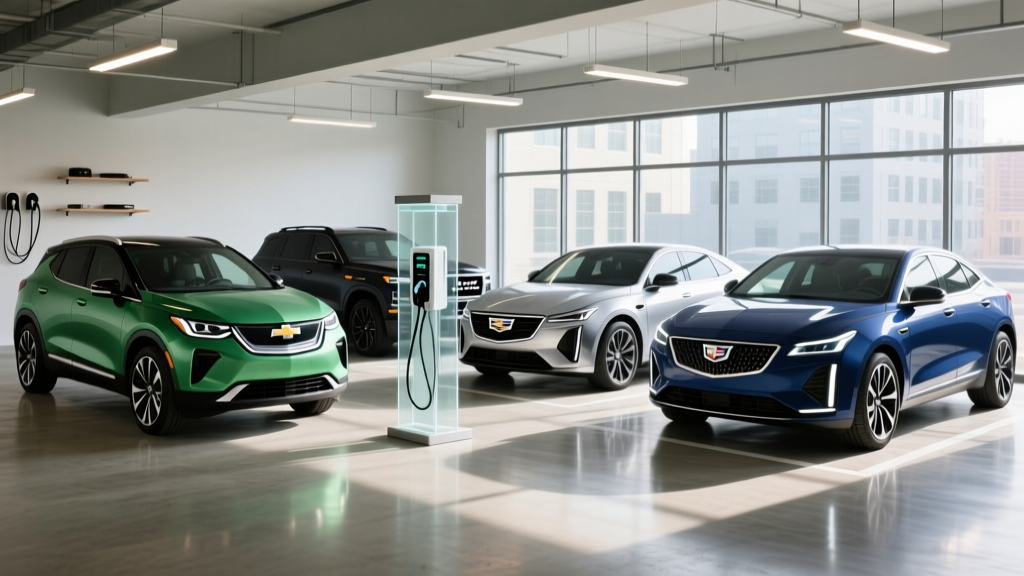
Quick Answer: General Motors currently sells four mainstream electric vehicles in the U.S.: the Chevrolet Equinox EV (from ~$33,600, up to 319 miles EPA), the Chevrolet Blazer EV (from ~$44,600, up to 324 miles), the Chevrolet Silverado EV (from ~$55,900, up to 492 miles), and the Cadillac Lyriq (from ~$58,590, up to 314 miles). All ride on GM's Ultium platform with NMC or NMC-LFP blended batteries, support DC fast charging up to 190–350 kW depending on the model, and use the North American Charging Standard (NACS) connector natively — giving them access to Tesla Superchargers without an adapter. The best value pick for most buyers is the Equinox EV 3RS, which qualifies for the full $7,500 federal tax credit under current IRS §30D rules when purchased new and meeting income/sourcing requirements.
The 2026 GM Electric Car Lineup at a Glance
GM has consolidated its EV strategy around the Ultium platform, a flexible skateboard architecture that underpins everything from the compact Equinox EV to the GMC Hummer EV. For 2026, the core consumer lineup spans four models aimed at distinct buyer profiles. Here's how they stack up on paper:
| Model | Battery (kWh usable) | EPA Range | Peak DC Charge (kW) | 10–80% Time | 0–60 mph | Base MSRP |
|---|---|---|---|---|---|---|
| Chevy Equinox EV 3RS | 85 kWh (NMC) | 319 mi | 150 kW | ~30 min | ~7.8 sec | $33,600 |
| Chevy Blazer EV RS AWD | 102 kWh (NMC) | 285 mi (AWD) / 324 mi (RSD) | 190 kW | ~24 min | ~6.0 sec | $44,600 |
| Chevy Silverado EV LT | 200 kWh (NMC) | 492 mi (Max Range) | 350 kW | ~20 min | ~4.5 sec (WT) | $55,900 |
| Cadillac Lyriq Tech | 102 kWh (NMC) | 314 mi | 190 kW | ~24 min | ~5.8 sec | $58,590 |
Sources: fueleconomy.gov, Chevrolet EV specs, Cadillac Lyriq specs. Real-world highway range typically runs 10–15% below EPA estimates; cold-weather (below 32°F) can reduce range by 20–30% depending on cabin heating demands.
Real-World Range Reality Check: The Equinox EV's 319-mile EPA figure assumes mixed driving at moderate temperatures. In our experience, expect ~265–280 miles on a sustained 70-mph highway trip in 60°F weather, dropping to ~220–240 miles in sub-freezing conditions. The Silverado EV's 492-mile Max Range figure is impressive but applies to the higher-priced 4WT trim (~$75,000+); the more affordable Work Truck and LT trims with smaller packs deliver 280–390 miles EPA.
GM Electric Car vs. Gas and Hybrid: The Real Cost Comparison
Sticker price alone doesn't tell the full story. Let's compare the Equinox EV 3RS against its closest internal-combustion sibling, the gas Equinox RS AWD (~$34,400 MSRP, 26 MPG combined), and the Toyota RAV4 Hybrid (~$33,500, 39 MPG combined) over a 5-year / 75,000-mile ownership horizon.
| Cost Factor | Equinox EV 3RS | Gas Equinox RS AWD | RAV4 Hybrid |
|---|---|---|---|
| MSRP | $33,600 | $34,400 | $33,500 |
| Fed. Tax Credit (§30D) | −$7,500 (if eligible) | $0 | $0 |
| Effective Purchase Price | $26,100 | $34,400 | $33,500 |
| Fuel/Energy (75k mi) | $2,625 (home L2, $0.14/kWh) | $8,650 ($3.50/gal, 26 MPG) | $6,410 ($3.50/gal, 39 MPG) |
| Maintenance (5 yr) | ~$1,200 | ~$3,800 | ~$3,200 |
| Insurance (5 yr est.) | ~$9,500 | ~$7,800 | ~$7,400 |
| 5-Year Total Cost | ~$39,425 | ~$54,650 | ~$50,510 |
The Equinox EV's effective cost advantage is substantial — roughly $11,000–$15,000 cheaper over five years — but hinges on three conditions: qualifying for the full $7,500 tax credit, charging primarily at home on a Level 2 setup, and driving under 15,000 miles per year. Insurance premiums for EVs run 15–25% higher on average due to repair-cost structures, which partially offsets fuel savings.
Insurance estimates based on national averages from industry data; actual premiums vary by state, driver profile, and insurer. Tax credit eligibility per IRS §30D rules — income caps ($150k single / $300k joint), MSRP caps ($55k SUVs / $50k sedans), and battery mineral sourcing requirements apply.
Charging Infrastructure: What GM EV Owners Actually Face
GM made a pivotal decision in 2023: adopting the NACS (North American Charging Standard) connector across its entire EV lineup. This means every 2025+ GM electric car can plug directly into Tesla Supercharger stalls — the most reliable and extensive DC fast-charging network in North America — without an adapter.
| Charging Level | Power (kW) | Miles Added/Hour | Typical Use Case | Cost per Full Charge |
|---|---|---|---|---|
| Level 1 (120V) | 1.2–1.9 kW | 3–5 mi/hr | Overnight top-up, emergencies | ~$12–15 (home) |
| Level 2 (240V) | 7.7–11.5 kW | 25–40 mi/hr | Home daily charging, workplace | ~$10–14 (home) |
| DC Fast (NACS) | 150–350 kW | 180–700+ mi/hr (peak) | Road trips, highway corridors | ~$18–35 (public) |
Home Charging Setup Costs
Most GM EV owners will want a Level 2 home charger. Here's what a typical installation runs:
| Component | Low Estimate | High Estimate |
|---|---|---|
| Level 2 charger (40–48A, hardwired) | $400 | $750 |
| Electrical permit | $50 | $200 |
| Electrician labor (240V/50A circuit) | $500 | $1,500 |
| Panel upgrade (if needed, 200A) | $1,500 | $3,500 |
| Total | $950 | $5,950 |
The wide range reflects one critical variable: whether your electrical panel needs upgrading. Homes with a 100-amp panel or limited breaker slots will likely need a 200-amp upgrade ($1,500–$3,500) before adding a 50-amp EV circuit. A licensed electrician can assess this during a site visit — always get a written quote before committing.
GM includes a dual-level charging cord with most models that handles 120V (Level 1) and 240V (Level 2 at up to 7.7 kW with a NEMA 14-50 outlet). For faster Level 2 speeds (11.5 kW), you'll need a dedicated hardwired wall unit like the ChargePoint Home Flex or Emporia Vue.
Common Misconceptions About GM Electric Cars
| Myth | Fact |
|---|---|
| "GM's Ultium batteries degrade quickly." | GM warranties the Ultium battery for 8 years / 100,000 miles with a capacity-retention threshold of 70%. Real-world data from early Bolt EVs (pre-Ultium, LG NMC cells) showed ~10–12% degradation at 100k miles. Ultium packs use an improved NMC chemistry with better thermal management via a wireless battery management system (wBMS), which reduces wiring and improves cell-level monitoring. |
| "You can't road-trip a GM EV." | The Silverado EV Max Range delivers 492 miles EPA — the longest range of any production EV sold in the U.S. The Equinox EV (319 mi) handles 4–5 hour highway stretches between charges. With native NACS access to 20,000+ Tesla Superchargers, route planning is practical on most interstate corridors. |
| "The $7,500 tax credit applies to every GM EV." | Under IRS §30D, eligibility depends on buyer income (≤$150k single / $300k joint AGI), vehicle MSRP (≤$55k for SUVs/trucks, ≤$50k for sedans), and battery-component/critical-mineral sourcing. As of 2026, the Equinox EV and Blazer EV generally qualify; the Silverado EV LT may exceed the MSRP cap in higher trims, and the Cadillac Lyriq exceeds it entirely. Point-of-sale transfer is available at participating dealers. |
| "GM EVs can't handle cold weather." | All Ultium-platform vehicles feature a liquid-cooled/heated thermal management system with battery preconditioning for DC fast charging. Expect 20–30% range loss below freezing — similar to competitors. The heat pump on the Blazer EV and Lyriq improves cabin-heating efficiency, reducing range penalty versus resistive heaters. |
| "Super Cruise is self-driving." | GM's Super Cruise is an SAE Level 2 driver-assistance system. It enables hands-free driving on 750,000+ miles of mapped divided highways, but requires continuous driver attention monitored by an infrared camera. It does not handle unmapped roads, construction zones, or complex urban driving. You remain legally responsible for the vehicle at all times. |
SAE Automation Level Reminder: Super Cruise and Tesla Autopilot/FSD (Supervised) are Level 2 systems — the driver must remain engaged and ready to take over. Only fully driverless services like Waymo (Level 4) operate without a human behind the wheel. No consumer vehicle sold in 2026 is "self-driving."
Ownership Considerations: Is a GM Electric Car Practical for You?
Beyond specs and pricing, real EV ownership depends on your daily circumstances. Here are the factors that determine whether a GM electric car will work in your life:
Home Charging Access
If you can install a Level 2 charger at home (garage, carport, or driveway with panel access), daily EV ownership is remarkably convenient — plug in at night, wake up to a full battery. If you live in an apartment or rely on street parking, your experience depends entirely on public charging availability in your area. GM's in-dash navigation integrates with multiple networks (Tesla Supercharger, Electrify America, EVgo), but public charging remains less reliable than home charging, with average uptime on non-Tesla networks hovering around 85–90%.
Driving Patterns and Climate
Commuters driving 30–60 miles round-trip will rarely need public charging. If you regularly drive 200+ miles one-way or live in extreme cold (sustained sub-20°F), factor in range reduction and plan for mid-trip DC fast charges. The Silverado EV and Blazer EV handle this better than the Equinox EV due to larger battery packs and faster peak charge rates.
Towing and Payload
The Silverado EV is rated for up to 10,000 lbs towing (4WT Max Range) — but towing at capacity cuts range roughly in half. Expect ~240–260 real-world miles while towing a 7,000-lb trailer at highway speed. For comparison, a gas Silverado 1500 gets 19 MPG combined and ~570 miles per tank, making it still more practical for heavy, frequent towing in areas with sparse DC fast charging.
Decision Framework: Which GM Electric Car Should You Buy?
Choose the Equinox EV if: You want the best value in GM's lineup, commute under 60 miles daily, have home Level 2 charging, and qualify for the $7,500 tax credit. Effective price after credit (~$26,100) makes it one of the most affordable 300+ mile EVs on the market.
Choose the Blazer EV if: You need more interior space, want AWD for snow/wet climates, value Super Cruise availability, and don't mind paying ~$44,600 before incentives. The RWD variant (324 mi EPA) is ideal for warmer climates; AWD (285 mi) suits northern states.
Choose the Silverado EV if: You need truck capability (towing, bed utility, payload), want maximum range for road trips, and can absorb a $55,900+ starting price. Best suited for buyers who use a truck daily but tow occasionally rather than constantly.
Choose the Cadillac Lyriq if: You want a luxury experience (33-inch LED hyperscreen, Super Cruise standard on higher trims, premium materials) and budget is flexible. It competes with the BMW iX, Genesis Electrified GV70, and Tesla Model X — offering strong value in the luxury EV SUV segment at ~$58,590.
Skip GM's EV lineup and consider a hybrid if: You lack home charging access, frequently drive in rural charging deserts, regularly tow heavy loads long distances, or live in extreme cold where 30% range loss would make your commute impractical. A Toyota RAV4 Hybrid or Honda CR-V Hybrid offers 39–40 MPG combined with zero charging dependency at similar base prices.
Federal Tax Credit Eligibility for GM EVs
The §30D Clean Vehicle Credit can reduce your effective purchase price by up to $7,500 — but eligibility is not automatic. Here's the current checklist:
- Buyer income cap: Modified AGI ≤ $150,000 (single) / $225,000 (head of household) / $300,000 (married filing jointly)
- Vehicle MSRP cap: ≤ $80,000 for SUVs, pickups, vans; ≤ $55,000 for sedans
- Final assembly: Must occur in North America (all GM Ultium EVs qualify — assembled in Tennessee, Michigan, or Ontario)
- Battery components: ≥ 60% of battery components manufactured or assembled in North America (2024+ requirement, increasing annually)
- Critical minerals: ≥ 50% of critical minerals extracted or processed in the U.S. or a free-trade-agreement country (increasing annually through 2027)
- Point-of-sale transfer: You can transfer the credit to the dealer at purchase, reducing your out-of-pocket cost immediately — even if you have no tax liability
As of 2026, the Equinox EV and Blazer EV generally qualify for the full $7,500 credit. The Silverado EV's eligibility varies by trim (higher trims may exceed MSRP caps), and the Cadillac Lyriq does not qualify due to its MSRP exceeding the $80,000 SUV cap on most trims. Always verify current eligibility on fueleconomy.gov before purchasing, as sourcing requirements tighten each year.
Frequently Asked Questions
Are GM Ultium batteries reliable long-term?
GM's Ultium platform is relatively new (first vehicles delivered in 2022–2023), so decade-long data doesn't exist yet. However, the wireless battery management system (wBMS) reduces failure points from wiring harnesses, and the liquid thermal management keeps cells in their optimal temperature range. GM's 8-year/100,000-mile battery warranty (70% capacity retention minimum) is competitive with the industry standard. For reference, the older Bolt EV (pre-Ultium) showed roughly 8–12% degradation at 100,000 miles in fleet data.
Can I charge a GM EV at a Tesla Supercharger?
Yes. All 2025+ GM EVs come with a native NACS charge port, making them directly compatible with Tesla Supercharger V3 (150 kW) and V4 (up to 350 kW) stalls. GM vehicles use the Tesla app or GM's built-in navigation to initiate and pay for sessions. This gives GM owners access to over 20,000 Supercharger stalls across North America — currently the most reliable DC fast-charging network by a wide margin.
How much does it cost to replace a GM Ultium battery?
Out-of-warranty Ultium battery replacement estimates range from $12,000 to $18,000 depending on the pack size (85 kWh vs. 200 kWh), plus $1,500–$3,000 in labor. However, battery replacement at the owner's expense is rare — most failures occur within the warranty period, and individual module replacement (rather than the full pack) is often possible, reducing cost significantly.
Is Super Cruise included or does it cost extra?
Super Cruise availability and pricing varies by model and trim. On the Cadillac Lyriq, it's standard on Sport and Luxury trims (~$63,000+) and available as a $2,500 package on Tech trim. On the Silverado EV, it's available on LTZ and High Country trims. On the Blazer EV, it's available on RS and SS trims. After the initial 3-year included connectivity period, Super Cruise requires a subscription (~$25/month or $250/year) for map data and driver-monitoring services.
What's the difference between kW and kWh?
This is the most common point of confusion for new EV buyers. kW (kilowatts) measures power — how fast energy flows, like the flow rate of a gas pump. A 150 kW charger delivers energy faster than a 50 kW charger. kWh (kilowatt-hours) measures energy capacity — how much total energy the battery holds, like the gallon capacity of a fuel tank. The Equinox EV has an 85 kWh battery; charging it at 150 kW (peak) fills it quickly, but the charge rate tapers above 80% State of Charge to protect the cells.