The Short Answer on General Motors Cancelled EV Projects
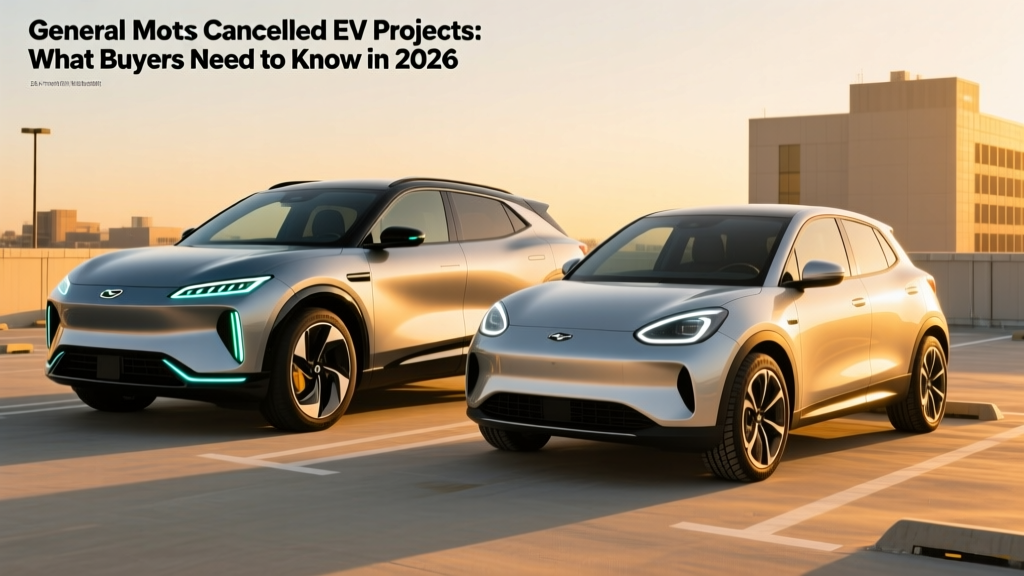
Between late 2023 and 2025, General Motors scrapped, delayed, or significantly scaled back multiple electric vehicle programs. The most impactful cancellations for buyers include the Cruise robotaxi division shutdown (GM pulled the plug in December 2024), the delayed and software-plagued Blazer EV launch, the reduced Silverado EV consumer lineup, and the abandonment of the $25,000 entry-level EV that was supposed to compete with the Tesla Model 2. GM also wrote off roughly $1.6 billion in EV-related investments during 2024-2025. If you're shopping for a GM electric vehicle in 2026, the available lineup is narrower than originally promised — but the Equinox EV and refreshed Bolt EV remain strong, practical options with real-world range above 250 miles.
Which GM EV Projects Were Cancelled or Delayed?
GM's Ultium platform was supposed to underpin a wave of affordable, long-range EVs across Chevrolet, Cadillac, GMC, and Buick. The reality has been messier. Here's a breakdown of what happened to the most significant programs:
Confirmed Cancellations
- Cruise robotaxi operations: GM ceased funding Cruise's driverless taxi service in December 2024 after a string of safety incidents and over $10 billion in cumulative losses. The Cruise Origin shuttle van was cancelled. GM retained the Cruise engineering team to focus on Level 2+ personal-vehicle ADAS (Super Cruise and Ultra Cruise).
- $25,000 next-gen compact EV: Originally teased as an affordable Ultium-based subcompact, this project was quietly shelved in favor of prioritizing higher-margin trucks and SUVs. Buyers looking for a budget EV will need to consider the Nissan Leaf, used EV market, or the 2026 Chevrolet Bolt EV (starting around $28,000 before incentives).
- Cadillac Celestiq low-volume production timeline: While not fully cancelled, the $340,000+ hand-built Celestiq has seen repeated timeline slippage and very limited allocation, making it essentially irrelevant for mainstream buyers.
- Buick Electra E5 US launch: GM decided against bringing the Buick Electra E5 (sold in China) to the US market, leaving Buick's EV lineup thin for 2026.
Significant Delays and Reductions
- Chevrolet Blazer EV: Launched with severe software defects in late 2023 that triggered a stop-sale lasting months. The 2026 model year has addressed many issues, but early damage to consumer trust lingers.
- Silverado EV consumer trims: The original plan included a $50,000-range consumer Silverado EV with 400+ miles of range. GM pivoted heavily toward $80,000+ RST and Trail Boss trims first, with the more affordable WT fleet-oriented models filling the gap. The broader consumer lineup remains limited in 2026.
- Equinox EV: Delayed from its original 2024 timeline but now in production for 2025-2026. This is arguably the most important surviving GM EV program for mainstream buyers.
What GM EVs Can You Actually Buy in 2026?
Despite the cancellations, GM's showroom still offers several competitive electric vehicles. Here's what's available with concrete specs:
| Model | EPA Range | Battery (kWh) | Peak DC Charge (kW) | 10-80% Time | 0-60 mph | Base MSRP |
|---|---|---|---|---|---|---|
| Chevrolet Equinox EV 2LT | 315 mi | 85 kWh (NMC) | 150 kW | ~30 min | 7.8 sec | $34,900 |
| Chevrolet Equinox EV RS AWD | 285 mi | 85 kWh (NMC) | 150 kW | ~30 min | 5.9 sec | $44,900 |
| Chevrolet Bolt EV (refreshed) | 259 mi | 65 kWh (NMC) | 115 kW | ~35 min | 7.0 sec | $27,900 |
| Chevrolet Blazer EV 2LT | 293 mi | 102 kWh (NMC) | 190 kW | ~25 min | 6.5 sec | $44,600 |
| Cadillac Lyriq Luxury | 314 mi | 102 kWh (NMC) | 190 kW | ~25 min | 6.0 sec | $58,500 |
| GMC Sierra EV Denali | 390 mi | 200 kWh (NMC) | 350 kW | ~22 min | 4.3 sec | $99,495 |
Real-World Range Reality Check
EPA estimates are a starting point, not a guarantee. For GM's Ultium-based vehicles (Equinox EV, Blazer EV, Lyriq), expect:
- Highway driving at 75 mph: Subtract 15-20% from EPA range. A 315-mile Equinox EV yields roughly 250-265 miles on the interstate.
- Cold weather (below 32°F): Subtract 20-35% depending on cabin heating demand. The same Equinox EV may deliver 210-250 miles in a Midwestern winter.
- DC fast charging taper: GM's Ultium batteries charge quickly from 10-60% but slow significantly above 80%. Plan to charge to 80% on road trips and keep moving — the last 20% can take as long as the first 60%.
Source: fueleconomy.gov EPA estimates; real-world figures based on independent testing and owner data.
How Do Surviving GM EVs Compare to Gas and Hybrid Alternatives?
With several GM EV projects gone, some buyers are reconsidering gas or hybrid options. Here's a data-driven comparison using the Equinox EV versus its gas and hybrid counterparts:
| Metric | Equinox EV 2LT | Equinox Gas (1.5T AWD) | Toyota RAV4 Hybrid AWD |
|---|---|---|---|
| MSRP (base) | $34,900 | $29,500 | $33,500 |
| EPA efficiency | 111 MPGe (30 kWh/100mi) | 26 MPG combined | 39 MPG combined |
| Annual fuel/energy cost (12,000 mi) | $540 (home charging, $0.135/kWh) | $1,615 ($3.50/gal gas) | $1,077 ($3.50/gal gas) |
| Annual maintenance estimate | $300 | $650 | $500 |
| 5-year total operating cost | $4,200 | $11,325 | $7,885 |
| Federal tax credit (§30D) | Up to $7,500 (eligibility varies) | $0 | $0 |
| Effective price after credit | ~$27,400 | $29,500 | $33,500 |
Key takeaway: If you qualify for the full §30D tax credit and charge primarily at home, the Equinox EV becomes the cheapest option in this comparison on day one — and saves roughly $1,400-$1,800/year in operating costs versus gas. But the credit is not guaranteed for every buyer. Check the IRS §30D eligibility rules for income caps ($150K single / $300K joint), MSRP limits ($55K SUVs / $55K sedans), and battery sourcing requirements that change annually.
Real-World Ownership Costs: The Full Picture
Purchase price and fuel savings tell only part of the story. Here's what a 5-year ownership cost breakdown looks like for the Equinox EV 2LT, including costs that catch first-time EV buyers off guard:
| Category | Cost | Notes |
|---|---|---|
| Purchase price (after §30D credit) | $27,400 | Assumes full credit eligibility; point-of-sale transfer available |
| Home Level 2 charger install | $800 - $2,200 | 240V/40A circuit; panel upgrade may add $1,500-$3,000 |
| Electricity (5 years, home charging) | $2,700 | $0.135/kWh average; public DC charging costs 2-3x more |
| Insurance (5 years) | $9,500 - $12,000 | EV premiums run 15-25% higher than gas equivalents |
| Maintenance (5 years) | $1,500 | Tire rotation, cabin filter, brake fluid; no oil changes |
| Tire replacement (1 set) | $900 - $1,400 | EV-specific tires wear 15-20% faster due to weight and torque |
| Estimated depreciation | $11,000 - $14,000 | EV depreciation remains volatile; check current resale data |
| Total 5-year cost (est.) | $33,800 - $40,500 | Varies by credit eligibility, insurance, and charging mix |
What Catches First-Time EV Buyers Off Guard
- Insurance premiums: Get a quote before buying. EV insurance can be $200-$400/year more than a comparable gas vehicle due to higher repair costs and battery replacement risk.
- Home charging access: If you rent, live in a condo without charging infrastructure, or have an older electrical panel (100A service), your charging setup costs can double or triple. A licensed electrician should evaluate your panel before purchase.
- Public charging costs: DC fast charging at Electrify America or EVgo typically costs $0.35-$0.55/kWh — nearly as expensive per mile as a fuel-efficient hybrid. Home charging is where the savings live.
- Tire wear: The Equinox EV weighs roughly 4,700 lbs — about 800 lbs more than the gas Equinox. That extra mass plus instant torque accelerates tire wear. Budget for replacement tires around 30,000-35,000 miles.
What the Cancellations Mean for Your Buying Decision
The pattern behind GM's cancelled EV projects reveals strategic priorities that affect what you can buy, how well-supported it will be, and what to expect long-term:
GM Doubled Down on Trucks, SUVs, and Premium
The cancellation of the $25,000 compact EV and the Buick Electra E5 US launch tells us GM is prioritizing higher-margin vehicles. If you were hoping for an affordable GM electric sedan or subcompact, the Bolt EV refresh is your only option — and its future beyond 2026 is uncertain.
Software Reliability Remains a Concern
The Blazer EV's disastrous launch — with infotainment crashes, charging failures, and a months-long stop-sale — exposed GM's software integration weaknesses. While the 2026 models have improved, buyers should:
- Test every software feature during your test drive (navigation, charging scheduling, phone integration)
- Confirm over-the-air update functionality before delivery
- Check owner forums for the specific model year and trim you're considering
Super Cruise Is GM's ADAS Strategy Now
With Cruise cancelled, GM's autonomous driving ambitions are channeled into Super Cruise (Level 2 hands-free driving on mapped highways) and the upcoming Ultra Cruise. This is important context: GM will not be offering robotaxi-style Level 4 autonomy in personal vehicles. Super Cruise requires the driver to remain attentive — it is a sophisticated driver-assist system, not a self-driving car.
SAE Automation Level Reminder
Super Cruise and Ultra Cruise are SAE Level 2 systems. The driver must remain engaged and ready to take over at all times. Eyes-on monitoring is enforced via an infrared camera on the steering column. Only fully driverless services like Waymo operate at Level 4. Do not treat any GM driver-assist system as autonomous.
Decision Framework: Should You Buy a GM EV in 2026?
Choose a GM EV If:
- You want a mainstream electric SUV with 300+ mile range: The Equinox EV 2LT at $34,900 (potentially $27,400 after tax credit) is one of the most affordable long-range electric SUVs available. Its 315-mile EPA range and 85 kWh Ultium battery are competitive with the Hyundai Ioniq 5 and Tesla Model Y.
- You need a premium electric SUV: The Cadillac Lyriq offers a refined ride, 314-mile range, and strong Super Cruise integration starting at $58,500.
- You want a budget EV and can accept 259 miles of range: The refreshed Bolt EV at $27,900 undercuts nearly every competitor, though its 115 kW peak DC charging is slower than rivals.
- You have reliable home charging: GM EVs deliver their best economics with Level 2 home charging. If you can install a 240V/40A circuit, operating costs are dramatically lower than gas.
- You qualify for the §30D tax credit: The point-of-sale transfer option means you can apply up to $7,500 at the dealership, reducing your out-of-pocket cost immediately.
Look Elsewhere If:
- You need an affordable electric truck: The Silverado EV's consumer trims remain expensive ($70,000-$100,000+). The Rivian R1T and Ford F-150 Lightning offer more accessible pricing in this segment.
- You want the fastest DC charging: GM's Ultium platform peaks at 150-190 kW on most models. The Hyundai Ioniq 5 and Kia EV6 charge at up to 240 kW on 800V architecture, completing 10-80% in ~18 minutes versus GM's ~25-30 minutes.
- You rely exclusively on public charging: Without home charging, EV ownership is more expensive and less convenient. Consider a PHEV like the Toyota RAV4 Prime (42 miles electric-only, 38 MPG gas) as a bridge.
- You want an electric sedan from GM: GM has no electric sedan in its 2026 US lineup. The Tesla Model 3, Hyundai Ioniq 6, and BMW i4 fill this gap.
- Software reliability is your top priority: Tesla's software integration remains more polished. GM has improved since the Blazer EV debacle but still trails in OTA update consistency.
Common Misconceptions About GM's EV Cancellations
| Myth | Fact |
|---|---|
| "GM is abandoning EVs entirely" | GM invested over $35 billion in EV and AV development through 2025 and continues to produce and expand the Ultium-based lineup. The cancellations represent portfolio pruning, not retreat. |
| "The Equinox EV was cancelled" | The Equinox EV was delayed, not cancelled. It is in production for 2025-2026 and available at Chevrolet dealers now. |
| "GM's Ultium battery platform failed" | Ultium is functional and competitive — the issue was software integration and production scaling, not the battery chemistry or architecture itself. The Lyriq and Sierra EV use Ultium with fewer reported issues. |
| "You can't get the $7,500 tax credit on GM EVs" | Several GM EVs qualify for the full or partial §30D credit depending on battery sourcing, buyer income, and MSRP. Eligibility changes as GM adjusts its supply chain. Verify current status at fueleconomy.gov. |
| "GM EVs can't charge fast" | The Sierra EV Denali charges at up to 350 kW on compatible chargers. Most Ultium SUVs peak at 150-190 kW — adequate but not class-leading. The 10-80% time of 22-30 minutes is practical for road trips. |
Battery Warranty and Long-Term Considerations
One concern amplified by GM's project cancellations: what happens to battery support if GM further reduces its EV commitments? Here are the facts:
- GM Ultium battery warranty: 8 years / 100,000 miles, with a capacity retention threshold of 60% (meaning GM will repair or replace if your battery degrades below 60% of original capacity within the warranty period). This is weaker than Hyundai's 70% threshold — worth noting.
- Bolt EV battery warranty: Also 8 years / 100,000 miles at 60% capacity retention.
- Parts availability: Federal law requires automakers to support emissions-related components for 8 years / 80,000 miles, and EV battery packs fall under similar obligations. Even if GM discontinues a model, warranty support continues.
- Long-term risk: If GM significantly shrinks its EV lineup in future years, resale values could suffer and independent repair shops may have less expertise with Ultium platforms. This is a real but moderate risk — GM remains one of the three largest US automakers.
Frequently Asked Questions
Is GM still committed to electric vehicles in 2026?
Yes, but with a narrower focus. GM continues to produce and sell the Equinox EV, Blazer EV, Bolt EV, Cadillac Lyriq, and GMC Sierra EV. The company has scaled back its robotaxi ambitions (Cruise shutdown) and cancelled the entry-level $25,000 EV, but the Ultium platform remains central to GM's product strategy through at least 2028.
What happened to the Cruise robotaxi?
GM ceased funding Cruise's driverless taxi operations in December 2024 after over $10 billion in cumulative losses and multiple safety incidents, including a pedestrian dragging event in San Francisco. The Cruise Origin shuttle was cancelled. GM reassigned Cruise engineers to work on personal-vehicle ADAS (Super Cruise / Ultra Cruise), which is SAE Level 2 — not autonomous.
Should I avoid the Blazer EV because of its launch problems?
The 2024 Blazer EV suffered from serious software defects that caused a multi-month stop-sale. The 2025-2026 model years have received substantial software updates addressing most reported issues. If you're considering one, insist on a thorough test drive that includes infotainment, navigation, and a test charge at a DC fast station. Check NHTSA recall data for your specific VIN before purchase.
Can I still get the $7,500 federal tax credit on a GM electric vehicle?
Eligibility depends on multiple factors under IRS §30D rules: your adjusted gross income must be below $150,000 (single) or $300,000 (joint filing), the vehicle MSRP must be under $55,000 for SUVs (most Equinox EV trims qualify), and the battery must meet critical mineral and component sourcing requirements that tighten each year. The credit can be transferred to the dealer at point of sale, reducing your purchase price directly. Always confirm current eligibility on fueleconomy.gov before signing a purchase agreement.
What's the best GM EV for a first-time EV buyer in 2026?
The Chevrolet Equinox EV 2LT offers the strongest combination of range (315 miles EPA), price ($34,900 before credit), and practicality for first-time buyers. If budget is the primary constraint, the Bolt EV at $27,900 is the most affordable new EV with competitive range (259 miles), though its DC charging speed is slower. Either way, ensure you have access to home Level 2 charging before committing — that's where 80%+ of EV charging happens and where the cost savings materialize.
How does the Equinox EV compare to the Tesla Model Y?
The Model Y Long Range AWD offers 320 miles EPA range, faster charging (250 kW peak, ~22 min 10-80%), and a more mature Supercharger network. The Equinox EV 2LT counters with a lower starting price ($34,900 vs ~$44,990 for Model Y LR), potentially lower insurance costs, and a more traditional dealership service experience. If you prioritize charging speed and network reliability, Tesla has the edge. If you want the lowest purchase price and don't mind slightly slower charging, the Equinox EV is compelling — especially after the §30D credit.