The Real Cost of Going Electric in California
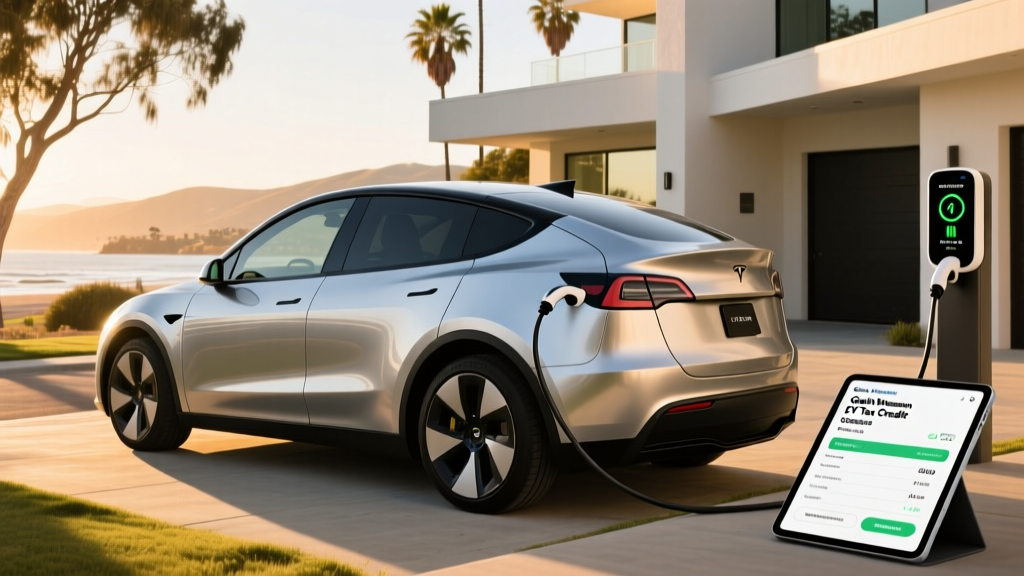
California remains the most EV-friendly state in the US, but stacking incentives correctly is where buyers either save thousands or leave money on the table. When shoppers search for the "Gavin Newsom California EV tax credit," they're usually looking for a single magic number. The reality is a layered system: a federal credit worth up to $7,500 under IRS §30D, California's CVRP rebate (income-tiered, up to $9,500 for low-income buyers), utility make-ready programs, and local air-district vouchers. Combined, a qualified buyer can knock $12,000–$17,000 off a new EV's effective price — but only if they navigate MSRP caps, income limits, and battery-sourcing rules correctly.
This guide reconciles the 2026 ownership math for a typical California EV buyer, using a 2026 Tesla Model Y Long Range AWD (EPA 320 mi, 75 kWh usable NMC battery, 250 kW peak DC charging, 0–60 in 4.8s, MSRP $48,990) as the reference vehicle against a comparable gas SUV at 27 MPG combined.
Federal Tax Credit: IRS §30D Rules for 2026
The federal EV tax credit remains governed by the Inflation Reduction Act's §30D provisions, now in its fourth year of tightened sourcing requirements. The maximum credit is $7,500, split into two $3,750 halves — one for critical-minerals sourcing, one for battery-component manufacturing. As of 2026, both thresholds have ratcheted higher, disqualifying several 2025-eligible models.
§30D Eligibility Checklist (2026)
- MSRP caps: Vans, SUVs, and pickups ≤ $80,000; sedans and other body styles ≤ $55,000
- Buyer AGI limits: $300,000 joint / $225,000 head of household / $150,000 single
- Critical minerals: ≥ 70% of battery critical minerals from US or FTA partners (2026 threshold)
- Battery components: ≥ 90% manufactured or assembled in North America (2026 threshold)
- Final assembly: Must occur in North America (VIN check at IRS qualified vehicle list)
- Transfer option: Credit may be transferred to the dealer at point of sale as a down-payment reduction, even if you owe less than $7,500 in tax
- Used EV credit (§25E): 30% of sale price, up to $4,000, on vehicles ≤ $25,000, with separate income caps ($150k joint / $75k single)
The point-of-sale transfer, added in 2024, is the single most impactful change for cash-flow-constrained buyers. Instead of waiting until April to claim the credit on your tax return, the dealer applies it at signing. Note: if your AGI exceeds the cap in the delivery year, you must repay the credit when filing — the IRS reconciles this.
California-Specific Incentives Beyond the Federal Credit
There is no single "Gavin Newsom California EV tax credit" — rather, Governor Newsom's administration has funded and expanded several programs administered by the California Air Resources Board (CARB) and the state's utilities. The major buckets:
Key California Programs (2026)
- CVRP (Clean Vehicle Rebate Project): Up to $9,500 for income-qualified buyers (≤400% FPL); $2,000–$3,000 for moderate-income households. Funded through cap-and-trade; availability fluctuates quarterly.
- Clean Cars 4 All: Up to $12,000 for low-income drivers scrapping a pre-2000 gas car, stackable with CVRP in some air districts (Bay Area, South Coast).
- Utility rebates: PG&E, SCE, and SDG&E each offer $500–$1,500 residential EV rebates plus discounted Time-of-Use (TOU) rates.
- HOV lane stickers: California's Clean Air Vehicle decals (white/green) grant solo carpool-lane access through 2027 for qualifying ZEVs — worth thousands in commute-time value in LA and the Bay Area.
- Local air-district vouchers: San Joaquin Valley and South Coast AQMD occasionally stack additional $1,000–$4,000 for residents in disadvantaged communities.
Always verify current funding status at arb.ca.gov — CVRP funds have historically run dry and been replenished within the same fiscal year.
5-Year Total Cost of Ownership: EV vs Gas in California
The following table compares our reference 2026 Tesla Model Y LR AWD against a gas SUV averaging 27 MPG combined, assuming California's 2026 averages: electricity at $0.30/kWh (blended residential TOU), gasoline at $4.85/gallon, and 12,000 miles/year.
| Category | EV (Model Y LR) | Gas SUV (27 MPG) | Δ |
|---|---|---|---|
| Purchase (MSRP after incentives*) | $37,990 | $39,500 | −$1,510 |
| Fuel / Energy | $5,400 (2.7 mi/kWh × 60k mi) | $10,778 | −$5,378 |
| Maintenance | $1,800 | $4,200 | −$2,400 |
| Insurance (5-yr total) | $11,250 | $8,750 | +$2,500 |
| Depreciation (est. resale at 60k mi) | −$18,500 | −$15,800 | −$2,700 |
| Net 5-Year Cost | $37,940 | $47,428 | −$9,488 |
*EV purchase assumes $7,500 federal §30D + $3,500 CVRP stacked. Incentives vary by buyer eligibility.
The EV wins on 5-year cost primarily through energy and maintenance, partially offset by higher insurance and steeper early depreciation. The breakeven point versus a gas SUV typically lands around year 3–4 in California, where both gas prices and EV incentives are highest in the continental US.
Charging vs Gas: The Per-Mile Math
| Scenario | Cost per Mile |
|---|---|
| Home Level 2, PG&E TOU off-peak ($0.24/kWh, 3.5 mi/kWh) | $0.069 |
| Home Level 2, blended CA average ($0.30/kWh, 3.0 mi/kWh) | $0.100 |
| Public DC fast charging (EA/Tesla SC, $0.48/kWh) | $0.160 |
| Gas SUV at 27 MPG, $4.85/gal | $0.180 |
| Gas SUV at 22 MPG city, $4.85/gal | $0.220 |
Home-charging on an off-peak TOU plan delivers a 62% cost-per-mile reduction versus gasoline. The advantage shrinks to ~11% if you rely exclusively on public DC fast chargers at $0.48/kWh — a critical consideration for apartment dwellers without home charging access. California's 2026 average public DCFC rate is among the highest in the country, which is why Level 2 home installation remains the single biggest determinant of EV economics in the state.
Maintenance Savings and Insurance Reality
| Service Item | EV | Gas Vehicle |
|---|---|---|
| Oil changes | None | $450 / 5 yr (10 changes) |
| Brake pads | $200 (regen extends life 2–3×) | $800 (2 sets) |
| Transmission fluid | None (single-speed) | $250 |
| Coolant / spark plugs | Minimal | $400 |
| Cabin air filter | $200 | $200 |
| Tires (EV-specific, heavier vehicle) | $2,400 (2 sets) | $1,800 (2 sets) |
| Total scheduled maintenance | ~$1,800 | ~$4,200 |
EVs eliminate most fluid services and dramatically extend brake life through regenerative braking — one-pedal driving rarely uses the friction brakes below 0.2 g of deceleration. The offset: EV tires cost more and wear faster due to instant torque and the ~4,500 lb curb weight of a typical crossover EV. Budget $1,200 per axle replacement for EV-rated rubber (Hankook iON, Michelin Pilot Sport EV).
Insurance: The Uncomfortable Truth
California EV insurance averages 18–28% higher than equivalent gas vehicles per 2025 III data. Three factors drive this:
- Repair cost concentration: Minor rear-end damage can total a battery pack if the enclosure is compromised.
- Parts scarcity: Body panels and high-voltage components have longer lead times than ICE parts.
- Specialized labor: Certified EV technicians command higher shop rates.
Model-specific variance is huge: a Tesla Model 3 insures ~30% higher than a Toyota Camry, while a Hyundai Ioniq 5 may be only 10–12% above a Tucson. Always quote insurance before signing a purchase agreement — a $150/month delta erases fuel savings fast.
Depreciation and Resale Value Trends
EV depreciation has been volatile. After a brutal 2023–2024 reset (Tesla price cuts and Hertz fleet liquidations pushed 3-year-old EVs to 40–55% retained value), the market stabilized through 2025 as inventory normalized and used-EV demand recovered. Current 2026 outlooks from Kelley Blue Book and iSeeCars show:
- Best retention: Tesla Model 3/Y (~58–62% at 3 years), Hyundai Ioniq 5 (~54%), Ford F-150 Lightning (~52%)
- Moderate retention: BMW i4, Rivian R1T, VW ID.4 (~48–52%)
- Weaker retention: Luxury sedans (Mercedes EQS, Lucid Air ~38–44%) — the same pattern as gas luxury sedans
The two biggest depreciation risks in 2026: (1) aggressive new-model pricing from China entering via rebadged partnerships, and (2) battery-health concerns on 6+ year-old packs, though most mainstream EVs are landing at 88–93% State of Health at 60,000 miles. LFP chemistry vehicles (base Model 3, many BYD-bound imports) show even slower degradation curves than NMC.
Who Qualifies for the Full Incentive Stack?
Here's the realistic stacking scenario for a California buyer in 2026:
- Maximum stack (low-income + disadvantaged community): $7,500 federal + $9,500 CVRP + $4,000 Clean Cars 4 All + $1,500 utility = $22,500
- Typical middle-income stack: $7,500 federal + $2,000 CVRP + $1,000 utility = $10,500
- Above income cap (>$150k single / $300k joint): $0 federal + $0 CVRP + $1,000 utility = $1,000
Income-capped buyers above the §30D threshold should look at the used-EV credit (§25E) — it applies to vehicles ≤ $25,000 with separate income caps ($150k joint / $75k single), making 2–3 year-old Model 3s and Chevy Bolts effectively cheaper than new for some households.
Frequently Asked Questions
Is there a specific "Gavin Newsom California EV tax credit"?
No single program carries that name. The phrase refers collectively to California's state-funded EV incentives (CVRP, Clean Cars 4 All, HOV decals) championed by the Newsom administration. These stack on top of the federal §30D credit but have their own income and funding rules.
How much does it really cost to own an EV over 5 years in California?
For a mainstream crossover EV like the Model Y LR, expect ~$37,000–$42,000 net 5-year cost after incentives, compared to $45,000–$52,000 for a gas equivalent. The advantage narrows for buyers who don't qualify for the federal credit or who can't charge at home.
Do I qualify for the federal EV tax credit?
Check three gates: (1) your AGI is below $150k single / $300k joint, (2) the vehicle MSRP is under the body-style cap, and (3) the specific VIN appears on the IRS qualified vehicle list with both critical-mineral and battery-component boxes checked. Use the point-of-sale transfer to apply it at purchase.
How much do I save on fuel and maintenance?
Typical California EV owner saves $1,000–$1,200/year on energy and $400–$600/year on maintenance versus a 27 MPG gas vehicle. Combined savings: ~$7,500 over 5 years, assuming home charging predominates.
Are EVs more expensive to insure in California?
Yes, typically 18–28% higher for comparable segments, driven by repair costs, parts availability, and specialized labor. Quote before purchasing — the delta varies sharply by model.
How well do EVs hold their value in 2026?
Mainstream EVs (Model 3/Y, Ioniq 5, F-150 Lightning) retain 50–62% at 3 years, in line with gas counterparts. Luxury EVs depreciate faster. Battery State of Health at 60k miles typically lands at 88–93%, reducing the "dead battery" fear that previously crushed resale.