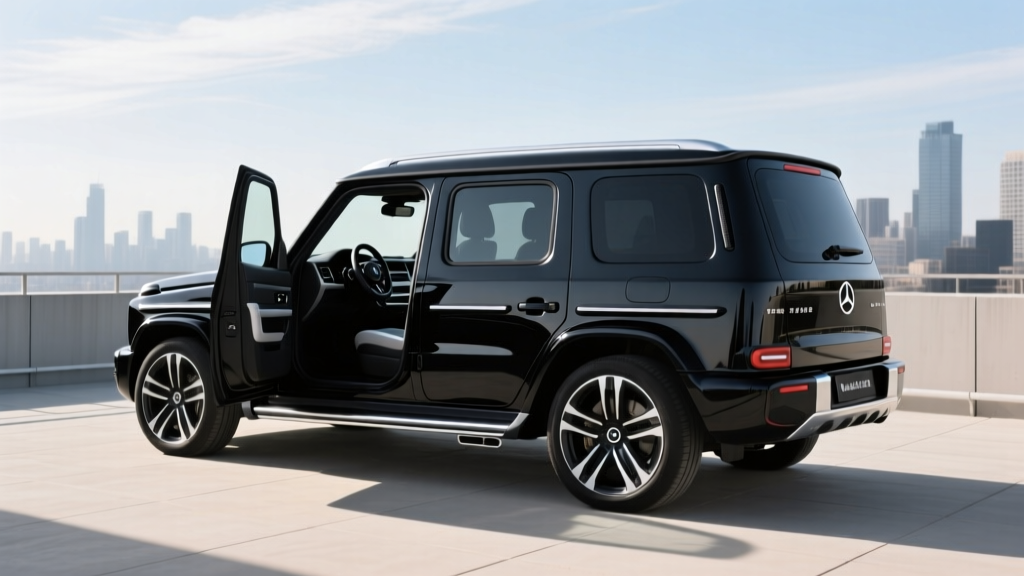
The Mercedes-Benz G-Class has been an icon of rugged luxury for decades, but the 2026 introduction of the all-electric G 580 with EQ Technology (commonly referred to as the EQG) marks a radical shift. For buyers considering a G Wagon electric lease, the financial equation is complex. It combines six-figure luxury pricing with evolving federal incentive structures and unique EV maintenance profiles. This guide breaks down the total cost of ownership (TCO), tax credit eligibility under IRS §30D, and the real-world economics of driving an electric G Wagon.
2026 Mercedes-Benz G 580 EQG: The Base Numbers
Before calculating ownership costs, we must establish the baseline specifications of the electric G-Class. The G 580 features a four-motor setup with torque vectoring and a 116 kWh (usable) lithium-ion battery.
| Spec | G 580 with EQ Technology |
|---|---|
| Base MSRP | $161,400 (est.) |
| EPA Range | ~240 miles (est.) |
| Battery Capacity | 116 kWh (NMC Chemistry) |
| DC Fast Charge Peak | 200 kW (10-80% in ~32 min) |
| 0-60 MPH | 4.6 seconds |
| Horsepower | 579 hp |
Federal Tax Credit Eligibility: The Luxury EV Challenge
Under current IRS §30D rules, the G 580 faces two primary hurdles regarding the $7,500 federal tax credit: the MSRP cap and buyer income limits. Because the G 580's MSRP exceeds the $80,000 cap for SUVs, it is not eligible for the new vehicle purchase credit.
IRS §30D Requirements (New Vehicles)
- MSRP Cap: Must be under $80,000 for SUVs/pickups/trucks. (The EQG fails this requirement).
- Income Limits: Buyer AGI must be under $300k (joint), $225k (head of household), or $150k (individual).
- Battery Sourcing: Must meet critical minerals and battery component requirements (phasing out FEOC entities).
- Point-of-Sale Transfer: Eligible buyers can transfer the credit to the dealer as a down payment reduction.
The Leasing Loophole (Commercial Credit)
When you pursue a G Wagon electric lease, the vehicle is technically purchased by the leasing company (the lessor). Under IRC §45W (the Commercial Clean Vehicle Credit), the lessor may be eligible for up to $7,500. Many luxury manufacturers "pass through" this benefit by reducing the capitalized cost of the lease. Always confirm with the dealership finance department whether the "lease cash" or "capitalized cost reduction" includes the federal incentive.
Charging vs. Gas: Cost Per Mile Analysis
The G 580's efficiency is measured in MPGe (Miles Per Gallon equivalent). Due to its weight and aerodynamics, it is less efficient than a sedan but still cheaper to "fuel" than its gas counterpart, the G 550 (14 MPG combined).
| Energy Source | Cost Unit | Efficiency | Cost Per Mile |
|---|---|---|---|
| Home Charging (Level 2) | $0.16/kWh (nat'l avg) | 2.0 kWh/mile | $0.32 |
| Public DC Fast Charging | $0.48/kWh | 2.0 kWh/mile | $0.96 |
| Gas (G 550 Premium 93) | $4.50/gallon | 14 MPG | $0.32 |
The Reality: At national averages, home charging the EQG costs roughly the same per mile as fueling the gas G 550 because the gas version is so inefficient. However, in states with high electricity rates (like California at $0.30+/kWh) or if you rely exclusively on DC fast charging, the electric G Wagon can actually be more expensive to "fuel." The savings are most pronounced for owners with solar panels or off-peak utility rates.
Insurance and Maintenance: The Hidden Variables
Insurance premiums for the electric G-Class are expected to be 15-25% higher than the gas version. Insurers factor in the higher repair costs associated with battery packs and specialized four-motor drivetrains. For a $160,000 vehicle, this can mean an additional $1,500–$3,000 annually in premiums.
| Maintenance Item | Gas G 550 | Electric G 580 |
|---|---|---|
| Oil Changes | Every 10k miles ($250+) | None |
| Brake Pads | Every 30-50k miles | Rarely (Regen braking) |
| Transmission | Fluid/Service required | None (Single-speed) |
| Tires | Standard Wear | Higher Wear (Heavy torque/weight) |
While you save on oil and brakes, the G 580's massive weight and instant torque will wear through tires faster than the gas model. Budget for high-performance tire replacements every 15,000–20,000 miles, which can cost $2,000+ for a set.
5-Year Total Cost of Ownership (TCO) Breakdown
This breakdown assumes a 5-year lease cycle, 12,000 miles per year, and a 50/50 mix of home and public charging.
| Category | Estimated Cost (5 Years) |
|---|---|
| Lease Payments (Est. $2,800/mo) | $168,000 |
| Energy (Fuel/Charging) | $12,000 |
| Insurance (Avg. $6,000/yr) | $30,000 |
| Maintenance & Tires | $6,500 |
| Depreciation (Lessee risk) | $0 (Fixed in lease) |
| Total 5-Year Cost | ~$216,500 |
Depreciation and Resale Value
Luxury EVs have experienced volatile depreciation, with some models losing 50% of their value in the first three years. However, the G-Class is a "halo" vehicle with a historically strong resale value. By leasing, you transfer the risk of long-term battery degradation and future market shifts to the manufacturer. If the used EV market softens further by 2029, you simply walk away at the end of the term.
Frequently Asked Questions
Can I use the federal tax credit as a down payment on a G Wagon lease?
Yes, if the leasing company claims the commercial credit (§45W) and passes the savings to you as a "capitalized cost reduction." This must be verified in the lease paperwork before signing.
Does the electric G Wagon qualify for HOV lane access?
Yes, in most states, the G 580 qualifies for clean air vehicle decals that allow single-occupant HOV lane access, though some states have income caps for these stickers.
Is the G 580 capable of off-road charging?
The G 580 features robust underbody protection for the battery. While it doesn't "charge" off-road, its four motors provide superior torque vectoring for trails. Ensure you have a plan for Level 1 (120V) emergency charging if you venture into remote areas.