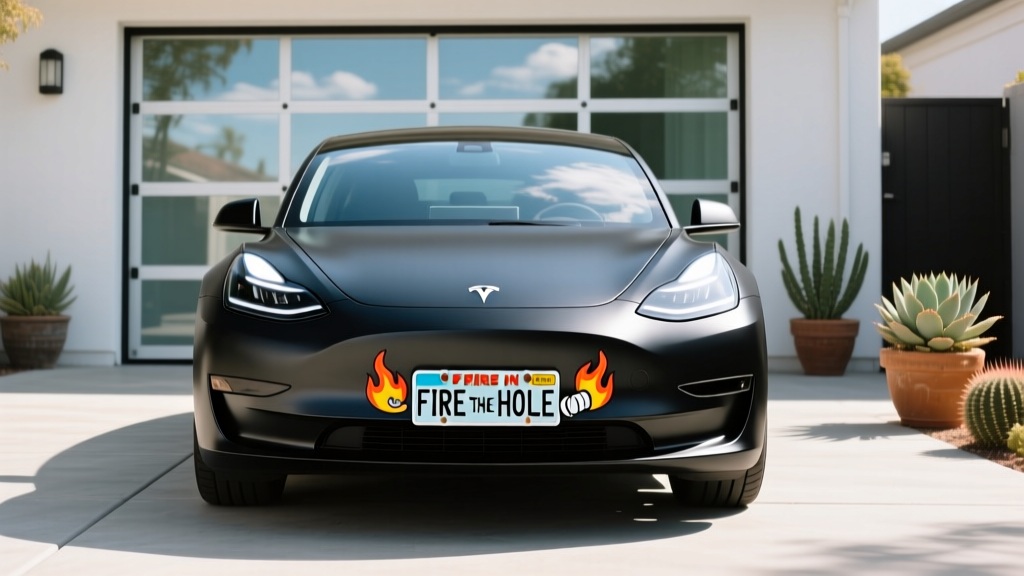
If you've spent any time in an EV forum, a Tesla Supercharger lounge, or a Reddit thread about electric cars, you've seen them: funny Tesla license plates that turn heads at every stoplight and charging station. From vanity plates poking fun at range anxiety to clever wordplay about kilowatt-hours, Tesla owners have turned their license plate frames and custom tags into a rolling comedy show. But behind every joke plate is a real vehicle with real specs that determine whether that Tesla is the right buy for your daily life.
This guide delivers the best funny Tesla license plate ideas we've found — organized by model — and pairs them with the hard data every prospective Tesla buyer actually needs: EPA range, charging speeds, battery chemistry, pricing after federal tax credits, and real-world ownership costs. Because laughing at your plate is a lot more fun when you know exactly what you're driving.
Why Tesla Owners Love Funny License Plates
Tesla's minimalist design language — clean lines, badgeless rear ends on newer models, and that iconic silhouette — practically begs for personalization. The license plate area is one of the few places owners can express themselves without wrapping the car or voiding a warranty. The EV community has developed its own humor culture around:
- Charging culture — Supercharger etiquette, charging speed bragging, and the shared experience of waiting at a stall
- Gas-car rivalry — playful jabs at internal combustion, fuel costs, and oil changes
- Tech nerdery — kilowatt-hour puns, software update jokes, and Elon references
- Range humor — self-deprecating jokes about watching the battery percentage on road trips
Whether you're looking for a custom vanity plate through your state DMV or a humorous license plate frame from a third-party seller, the ideas below are organized to match your specific Tesla model — because a joke that lands on a Model S Plaid doesn't quite work on a base Model 3.
The Best Funny Tesla License Plate Ideas by Model
Model 3 Favorites
The Model 3 is Tesla's volume seller and the gateway EV for millions of drivers. Its approachable price point means owners span every demographic — and the humor reflects that broad appeal.
- WAT TS LA — The classic. Simple, clean, works in any state that allows 7-character vanity plates.
- NO GAS — Five characters, maximum impact at the fuel pump.
- KWH MY — For the electricity nerds who track their efficiency on every drive.
- PLUG ME — A Supercharger lot favorite.
- BYE OIL — Short, punchy, and a conversation starter at every gas station you drive past.
- VOLT SWG — "Volt Swag" for the owner who takes pride in their electric ride.
- 120 MPGe — Flexing the efficiency number (your actual MPGe varies by trim and driving style).
- CHRG IT — Perfect for the owner who's always hunting for the next charger.
Model Y Favorites
The Model Y is the best-selling vehicle in the world as of 2025, so you'll see these plates at Superchargers from coast to coast.
- Y NOT EV — The quintessential Model Y pun. It almost writes itself.
- Y SO FAST — For the Performance trim owners who hit 0-60 in 3.5 seconds.
- FAM HAUL — Acknowledging the Model Y's role as the default family EV.
- Y RANGE — A nod to the 300+ mile EPA range that makes road trips viable.
- 3 ROW Y — For the optional third-row equipped models squeezing in the kids.
- AMPED UP — Works on any EV, but especially fitting on a fully loaded Model Y Long Range.
Model S and Model X Favorites
The flagship sedans and SUVs command premium prices and attract owners who appreciate both performance and status. The humor here tends to be a bit more refined — or deliberately over-the-top.
- PLAID AID — For Model S Plaid owners who need assistance managing 1,020 horsepower.
- S PER fast — Playing on the old "S P85D" naming convention.
- FALCON W — Model X owners referencing those iconic falcon-wing rear doors.
- 0 TO 60 — Simple. Confident. Accurate on a Plaid (1.99 seconds, factory claimed).
- X MARKS — A treasure-hunt reference for the Model X.
- LUDICRS — "Ludicrous" mode, compressed for a vanity plate.
Universal EV Humor (Any Tesla)
- GAS WHO — Feigning ignorance about fossil fuels.
- ELECTRI — Seven characters, one message.
- NO SMOK — No tailpipe, no smoke.
- SILENT — Because that's exactly what a Tesla sounds like at full throttle.
- WATTS UP — The perennial electric pun.
- OHM MY — For the physics-minded owner.
- TESLIFE — The community identity plate.
2026 Tesla Model Lineup: The Specs Behind the Jokes
Every funny plate above is mounted on a serious machine. Here's the data that matters when you're actually shopping for a Tesla in 2026 — because the right plate means nothing if the car doesn't fit your life.
| Spec | Model 3 Long Range AWD | Model Y Long Range AWD | Model S Long Range | Model X Long Range |
|---|---|---|---|---|
| EPA Range | 341 mi | 308 mi | 402 mi | 335 mi |
| Battery (usable) | ~75 kWh (NMC) | ~75 kWh (NMC) | ~95 kWh (NMC) | ~95 kWh (NMC) |
| Peak DC Fast Charge | 250 kW | 250 kW | 250 kW | 250 kW |
| 10–80% DCFC Time | ~25 min | ~27 min | ~30 min | ~32 min |
| Level 2 Home Rate | 11.5 kW (~44 mi/hr) | 11.5 kW (~44 mi/hr) | 11.5 kW (~34 mi/hr) | 11.5 kW (~30 mi/hr) |
| 0–60 mph | 4.2 sec | 4.8 sec | 3.1 sec | 3.8 sec |
| Horsepower | 346 hp | 384 hp | 670 hp | 670 hp |
| Drivetrain | Dual-Motor AWD | Dual-Motor AWD | Dual-Motor AWD | Dual-Motor AWD |
| MPGe (combined) | 134 MPGe | 122 MPGe | 120 MPGe | 109 MPGe |
| Efficiency (kWh/100 mi) | 25 kWh/100 mi | 28 kWh/100 mi | 28 kWh/100 mi | 31 kWh/100 mi |
| Cargo Volume | 23 cu ft (rear) + 3.1 cu ft (frunk) | 76 cu ft (max) + 4.1 cu ft (frunk) | 28 cu ft (rear) + 3.1 cu ft (frunk) | 88 cu ft (max) + 6.6 cu ft (frunk) |
| Base MSRP (2026) | $47,740 | $50,630 | $79,990 | $84,990 |
Sources: fueleconomy.gov, Tesla Model S specs, Tesla Model 3 specs. Specs reflect 2026 model year. Prices exclude destination fees.
Real-World Range: What the EPA Number Doesn't Tell You
EPA estimates are tested under controlled conditions. In real-world driving, expect the following adjustments:
- Highway driving (70+ mph): Subtract 10–15% from EPA range. A Model 3 Long Range rated at 341 mi EPA will deliver roughly 290–310 mi at sustained highway speeds.
- Cold weather (below 32°F): Subtract 20–30%. The same Model 3 may drop to 240–270 mi in freezing conditions due to battery chemistry limitations and cabin heating demand. Teslas use resistive heating in some trims rather than a heat pump in all conditions, which impacts winter efficiency.
- City/regenerative driving: You may match or slightly exceed EPA range thanks to regenerative braking recapturing energy in stop-and-go traffic.
The Model S Long Range's 402-mile EPA rating is genuinely class-leading — but on a cold-weather road trip at 75 mph with the heater blasting, plan for roughly 300–320 miles between Supercharger stops. Tesla's navigation system is excellent at predicting range based on elevation, temperature, and speed, so trust the car's built-in trip planner over your own mental math.
Charging Speed: Superchargers, Home Setup, and the Curve
Understanding Tesla charging requires separating kW (power — how fast energy flows) from kWh (energy — how much the battery holds). Think of kW as the width of a hose and kWh as the size of the bucket.
| Charging Level | Power (kW) | Miles Added per Hour | Typical Use Case |
|---|---|---|---|
| Level 1 (120V household) | ~1.4 kW | 3–5 mi/hr | Emergency/overnight trickle |
| Level 2 (240V home wall connector) | Up to 11.5 kW | 30–44 mi/hr | Daily home charging |
| DC Fast Charge (V3 Supercharger) | Up to 250 kW | ~1,000+ mi/hr (peak) | Road trips, quick top-ups |
| DC Fast Charge (V4 Supercharger) | Up to 350 kW (capable) | Varies by vehicle | Newer installations; current Teslas limited to ~250 kW intake |
The charging curve reality: Tesla's advertised "250 kW peak" is exactly that — a peak. The car charges fastest between roughly 10–30% State of Charge (SoC), then progressively tapers. From 80–100%, charging slows dramatically to protect battery health. This is why the industry standard metric is 10–80% time, which for a Model 3 Long Range sits at approximately 25 minutes on a V3 Supercharger. If you're the type of owner who makes jokes on your license plate about charging, you'll want to understand this curve — it's the difference between a 25-minute stop and a 45-minute stop.
Home charging note: Tesla's Wall Connector on a 60-amp circuit delivers up to 11.5 kW. Installation typically costs $500–$2,000 depending on your electrical panel's capacity and the distance from panel to garage. Homes with older 100-amp service panels may require a $1,500–$3,000 panel upgrade — factor this into your total purchase budget. Always hire a licensed electrician for the final installation.
Pricing, Trims, and Federal Tax Credit Eligibility
| Model / Trim | Base MSRP | Estimated After §30D Credit* | §30D Eligible? |
|---|---|---|---|
| Model 3 RWD | $42,490 | ~$34,990 | Yes (if requirements met) |
| Model 3 Long Range AWD | $47,740 | ~$40,240 | Yes (if requirements met) |
| Model 3 Performance | $54,990 | ~$47,490 | Yes (if requirements met) |
| Model Y Long Range AWD | $50,630 | ~$43,130 | Yes (if requirements met) |
| Model Y Performance | $54,490 | ~$46,990 | Yes (if requirements met) |
| Model S Long Range | $79,990 | $79,990 (no credit) | No — exceeds $55,000 sedan MSRP cap |
| Model X Long Range | $84,990 | $84,990 (no credit) | No — exceeds $80,000 SUV MSRP cap |
*Estimated prices assume full $7,500 credit eligibility. Actual credit depends on meeting all IRS §30D requirements. See checklist below. Credit can be applied as a point-of-sale reduction through a registered dealer per current IRS rules.
IRS §30D Federal Tax Credit Checklist
Qualifying for the up-to-$7,500 federal EV tax credit under IRS §30D requires meeting all of the following:
- Income caps: Modified Adjusted Gross Income (MAGI) must not exceed $300,000 (married filing jointly), $225,000 (head of household), or $150,000 (single).
- MSRP caps: Sedans (Model 3, Model S) must have an MSRP at or below $55,000. SUVs and trucks (Model Y, Model X) must be at or below $80,000.
- Battery sourcing: A percentage of critical minerals and battery components must be sourced from the U.S. or free-trade-agreement partners. These percentages increase annually. Tesla has worked to localize its supply chain, but eligibility can shift — always verify current-year requirements on the IRS website before purchasing.
- Final assembly: Vehicle must undergo final assembly in North America. All U.S.-sold Teslas are assembled in Fremont, CA, or Austin, TX, satisfying this requirement.
- Point-of-sale transfer: As of 2024+, buyers can transfer the credit to the dealer at point of sale for an immediate price reduction, rather than waiting to claim it on their tax return. The dealer must be IRS-registered.
Bottom line: Model 3 and Model Y buyers who meet income requirements are generally positioned to claim the credit, but battery-sourcing rules are the variable that changes most frequently. Model S and Model X buyers should not expect the federal credit due to MSRP caps. Consult a tax professional for your specific situation.
Driver Assistance, Tech, and Interior Features
Every Tesla sold in 2026 comes with Basic Autopilot as standard, which includes Traffic-Aware Cruise Control and Autosteer (lane centering). This is an SAE Level 2 driver-assistance system — meaning the driver must remain fully engaged, hands on or near the wheel, and eyes on the road at all times. It is not self-driving.
Tesla Autopilot and Full Self-Driving (Supervised) are SAE Level 2 systems. The vehicle can manage steering and acceleration/deceleration under certain conditions, but the human driver is responsible for monitoring the environment and must be prepared to take over immediately. No consumer Tesla is a self-driving vehicle. Level 4 (driverless in defined areas) is currently limited to robotaxi services like Waymo.
Full Self-Driving (Supervised) — Tesla's optional $8,000 upgrade (pricing subject to change; Tesla has shifted between one-time purchase and monthly subscription models) — adds Navigate on Autopilot, Auto Lane Change, Autopark, Smart Summon, and traffic light/stop sign recognition. Despite the name, FSD (Supervised) remains a Level 2 system requiring constant driver supervision.
Infotainment and interior highlights:
- 15.4-inch center touchscreen (Model 3/Y) or 17-inch (Model S/X)
- Rear-seat touchscreen on Model S/X and refreshed Model 3/Y
- Over-the-air (OTA) software updates that add features post-purchase
- Tesla app integration for preconditioning, charging status, and Sentry Mode camera access
- Gaming-capable hardware for charging-station entertainment (Steam integration on newer hardware)
- Ventilated front seats and ambient lighting on refreshed Model 3 and Model Y
Notable drawbacks: Tesla's reliance on touchscreen controls for nearly all vehicle functions (including climate, mirror adjustment, and glovebox release) remains polarizing. The lack of traditional physical buttons or a dedicated instrument cluster behind the steering wheel requires an adjustment period. Panel gap consistency, while improved, still draws scrutiny compared to legacy luxury automakers. And Tesla's service center network, though growing, can mean longer wait times for bodywork in less populated regions.
Who Should Buy a Tesla (And Which Model)?
Choose Model 3 if: You're a commuter or couple prioritizing efficiency (134 MPGe combined) and value. The Long Range AWD at ~$40,240 after the federal credit is one of the best value-per-mile-of-range propositions in the EV market. Best for daily drives under 80 miles round-trip with home charging.
Choose Model Y if: You need family cargo space (76 cu ft max with seats folded), optional third-row seating, and easier child-seat installation. The Model Y is the default pick for households with 2+ children who want an EV without stepping to a minivan.
Choose Model S if: You want 400+ miles of EPA range, genuine luxury-car acceleration (3.1 sec 0–60), and don't need the federal tax credit. Best for high-mileage executives and road-trippers who value range above all.
Choose Model X if: You need three-row seating with falcon-wing doors for tight parking-lot access, maximum cargo volume (88 cu ft), and tow rating (up to 5,000 lbs). Best for active families who tow a small trailer or boat.
Pros and Cons Across the Tesla Lineup
- Access to the Tesla Supercharger network — the most reliable and extensive DC fast-charging network in North America
- Best-in-class software and OTA updates that improve the car over time
- Strong efficiency (kWh/100 mi) across the lineup
- Class-leading range on Model S (402 mi EPA)
- Low running costs: electricity at ~$0.13/kWh national average = ~$3.25 per 100 miles in a Model 3
- Strong resale value relative to most EV competitors
- Minimal scheduled maintenance (no oil changes, no transmission fluid, reduced brake wear from regen)
- Model S and Model X do not qualify for the §30D federal tax credit due to MSRP caps
- Touchscreen-only controls are divisive and can be distracting while driving
- Charging speed capped at 250 kW — some competitors (Hyundai Ioniq 5, Kia EV6, Porsche Taycan) accept 350 kW or more
- Insurance premiums tend to be higher than comparable non-Tesla vehicles
- Service center availability varies significantly by region
- FSD (Supervised) costs extra and remains a Level 2 system despite the "Full Self-Driving" name
- No Apple CarPlay or Android Auto — Tesla's proprietary infotainment only
Warranty Coverage: Battery, Powertrain, and Vehicle
Tesla's warranty structure is straightforward and competitive within the EV segment:
- Basic Vehicle Limited Warranty: 4 years or 50,000 miles, whichever comes first.
- Battery and Drive Unit Warranty (Model 3/Y RWD): 8 years or 100,000 miles, with a minimum 70% battery capacity retention guarantee over the warranty period.
- Battery and Drive Unit Warranty (Model 3/Y Long Range & Performance, Model S, Model X): 8 years or 120,000 miles, with a minimum 70% capacity retention guarantee.
The 70% retention threshold is the industry-standard trigger for a warranty claim. If your battery degrades below 70% of its original capacity within the warranty period, Tesla will repair or replace it. In practice, Tesla battery degradation data from fleet studies shows most packs retain 85–90% capacity after 100,000 miles under normal use — meaning most owners will never need a warranty replacement. The NMC (nickel manganese cobalt) chemistry used across the current lineup offers a strong balance of energy density and cycle life, though Tesla has begun introducing LFP (lithium iron phosphate) batteries in some base Model 3 RWD trims for their longer cycle life and lower cost, at the trade-off of slightly lower energy density and reduced cold-weather performance.
Frequently Asked Questions
What is the real-world range of a Tesla Model 3 Long Range?
The EPA rates the 2026 Model 3 Long Range AWD at 341 miles. In real-world highway driving at 70–75 mph, expect approximately 290–310 miles. In cold weather (below freezing), that can drop to 240–270 miles. City driving with regenerative braking can match or slightly exceed the EPA figure.
How fast does a Tesla charge at home and on the road?
On a Tesla V3 Supercharger, peak charge rate is 250 kW, with a 10–80% time of approximately 25–32 minutes depending on the model. At home on a Level 2 Tesla Wall Connector (11.5 kW, 240V/60A), you'll add roughly 30–44 miles of range per hour — enough to fully recharge overnight for any daily commute.
How much does a Tesla cost after federal tax credits?
A 2026 Model 3 Long Range AWD starts at $47,740 MSRP and drops to approximately $40,240 after the full $7,500 §30D federal tax credit — assuming you meet all income, sourcing, and assembly requirements. Model Y Long Range drops from $50,630 to approximately $43,130. Model S and Model X do not qualify due to MSRP caps. Always verify current-year eligibility on irs.gov.
Is a Tesla worth buying vs. competitors like the Hyundai Ioniq 5 or Ford Mustang Mach-E?
Tesla's advantages are the Supercharger network, software ecosystem, and proven efficiency. Competitors like the Ioniq 5 offer faster peak charging (350 kW capable), Apple CarPlay, and more distinctive interior design. The Mach-E offers a more traditional driving feel and Ford's dealer network for service. If reliable DC fast charging on road trips is your top priority, Tesla still leads. If interior design, physical buttons, or faster charging curves matter more, cross-shop aggressively.
Can I put a funny vanity plate on my Tesla in any state?
Vanity plate rules vary by state. Most states allow 6–8 characters and prohibit offensive language. Check your state DMV's vanity plate guidelines before ordering. Some of the plates listed above (like "WAT TS LA" or "Y NOT EV") are popular enough that they may already be taken in your jurisdiction. License plate frames with humorous text are universally legal as long as they don't obstruct the plate numbers, state name, or registration stickers.
Does a Tesla qualify for the federal EV tax credit in 2026?
Model 3 and Model Y variants priced under their respective MSRP caps ($55,000 for sedans, $80,000 for SUVs) can qualify for up to $7,500 under IRS §30D, provided the buyer meets income limits and the vehicle's battery satisfies critical-mineral and component-sourcing requirements. Model S and Model X do not qualify due to MSRP caps. Rules can change — verify on the IRS website and consult a tax professional before purchasing.
What's the best Tesla for a family?
The Model Y Long Range AWD is the default family pick: 76 cu ft of cargo space, optional third row, 308 miles of EPA range, and eligibility for the federal tax credit. For larger families or those who tow, the Model X offers three rows standard, falcon-wing doors for tight spaces, and up to 5,000 lbs of towing capacity — but at nearly double the price and without the federal credit.