Quick Answer: Is a Freightliner Electric Truck Right for Your Fleet?
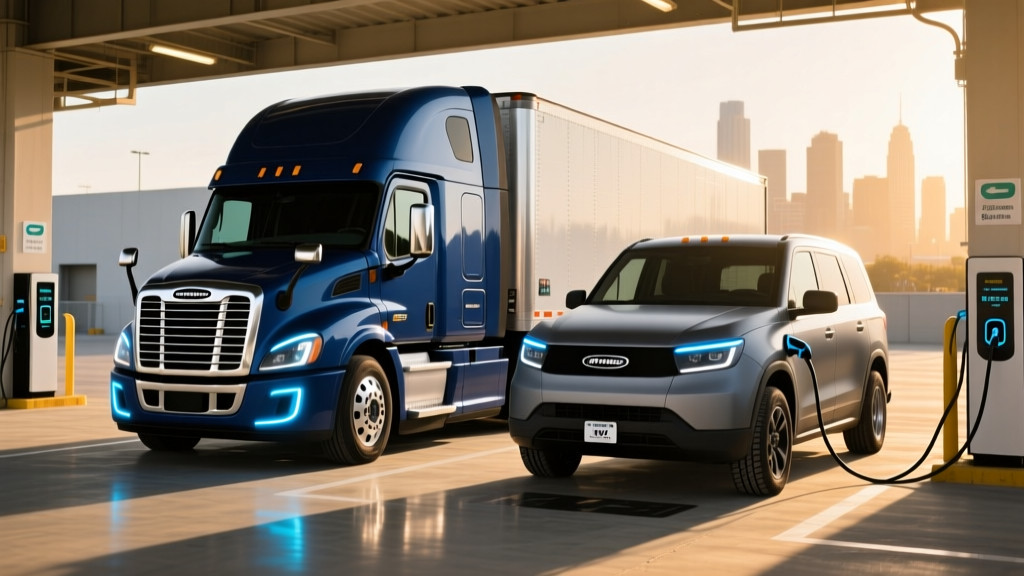
Freightliner's current electric lineup centers on two models: the eCascadia (Class 8, regional haul) and the eM2 106 (Class 6-7, local delivery). Both are designed for depot-based, return-to-base routes under 230 miles. If your fleet runs predictable daily routes within that range and can install depot DC fast charging, a Freightliner electric truck can cut fuel and maintenance costs significantly versus diesel. If your operation requires long-haul, irregular routes, or lacks depot charging infrastructure, diesel remains the practical choice in 2026.
Freightliner Electric Truck Lineup: eCascadia and eM2 at a Glance
Daimler Truck North America (DTNA) has been fielding battery-electric commercial trucks since pilot programs in 2019, with serial production of the eCascadia beginning in 2022 and the eM2 ramping through 2023-2024. As of the 2026 model year, these are the two production Freightliner electric models available to fleet buyers.
| Specification | eCascadia (Class 8) | eM2 106 (Class 6-7) |
|---|---|---|
| GVWR | 82,000 lbs (tractor) | 26,000–33,000 lbs |
| Battery Capacity (usable) | ~291–438 kWh (NMC lithium-ion) | ~150–210 kWh (NMC lithium-ion) |
| EPA Estimated Range | Up to 230 miles (varies by config) | Up to 250 miles (box truck config) |
| Real-World Range (loaded, mixed) | ~140–180 miles | ~150–200 miles |
| Peak DC Fast Charge Rate | Up to 250 kW (CCS1) | Up to 150 kW (CCS1) |
| 10–80% Charge Time (DC fast) | ~90 minutes (250 kW charger) | ~60 minutes (150 kW charger) |
| Electric Motor Output | Up to 470 hp / 1,640 lb-ft torque | Up to 260 hp / 540 lb-ft torque |
| Base MSRP (approx.) | $250,000–$350,000+ | $150,000–$220,000+ |
| Warranty (battery) | 5 years / unlimited miles (capacity retention dependent on usage) | 5 years / unlimited miles |
Specs vary by battery pack configuration, axle ratio, and body/upfit. Always confirm final specifications with your Freightliner dealer for your exact build. For the latest official data, consult Freightliner's electric vehicle page.
Real-World Range Reality Check
The eCascadia's EPA-estimated range of up to 230 miles assumes optimal conditions. In real-world fleet operations — fully loaded at 80,000 lbs GCW, with highway speeds, HVAC use, and moderate grades — plan for 140 to 180 usable miles before needing to charge. In cold weather (below 32°F), expect an additional 15–25% range reduction due to battery chemistry and cabin/battery heating loads. The eM2, used for local delivery at lower speeds and weights, holds closer to its sticker range but still loses 10–20% in winter conditions.
Freightliner Electric vs. Diesel: Operating Cost Comparison
The purchase price of a Freightliner electric truck is roughly 2–3× that of its diesel counterpart. The financial case hinges entirely on operating cost savings over the vehicle's service life. Here's a data-driven comparison for a regional haul duty cycle.
| Cost Category | eCascadia (Electric) | Diesel Cascadia |
|---|---|---|
| Purchase Price (base) | ~$300,000 | ~$140,000 |
| Federal Tax Credit (§45W Commercial Clean Vehicle) | Up to $40,000 | $0 |
| Net Purchase After Credit | ~$260,000 | ~$140,000 |
| Energy/Fuel Cost per Mile | $0.14–$0.22/mi (electricity at $0.10–$0.15/kWh) | $0.55–$0.75/mi (diesel at $4.00–$4.50/gal, 6.5 MPG) |
| 5-Year Fuel/Energy (250,000 mi) | $35,000–$55,000 | $137,500–$187,500 |
| Maintenance (5-year est.) | $8,000–$12,000 | $25,000–$35,000 |
| DEF, Oil Changes, Filters | $0 | $5,000–$8,000 |
| Depot Charger Install (per stall) | $30,000–$80,000 | N/A |
| Estimated 5-Year Total Cost | $333,000–$407,000 | $307,500–$370,500 |
Key takeaway: At current diesel and electricity prices, the eCascadia approaches diesel parity within 5–7 years on high-mileage regional routes. The breakeven timeline shortens if your fleet benefits from state incentives (California's HVIP, for example, can add $45,000–$120,000 per truck), low off-peak electricity rates, or high annual mileage. Consult the IRS §45W Commercial Clean Vehicle Credit page for current eligibility rules — note this is a separate credit from the consumer §30D credit and applies to commercial fleet purchases.
Depot Charging Infrastructure: What Fleet Buyers Must Plan For
Unlike consumer EVs that can rely on public charging networks, Freightliner electric trucks require purpose-built depot charging infrastructure. This is often the most underestimated cost and timeline item in fleet electrification.
Charging Speeds and Practical Throughput
| Charging Level | Power (kW) | Miles Added per Hour | Full Charge Time (eCascadia) |
|---|---|---|---|
| Level 2 AC (J1772/CCS1 AC) | 19.2 kW | ~8–12 mi/hr | 20+ hours (overnight only for partial replenishment) |
| DC Fast (CCS1) | 50–150 kW | ~50–100 mi/hr | 3–5 hours |
| DC Fast (CCS1, high-power) | 180–250 kW | ~100–150 mi/hr | ~90 minutes (10–80%) |
For daily operations, most fleets install 50–150 kW DC fast chargers at the depot, allowing trucks to fully recharge during driver layovers or shift changes. High-power 250 kW chargers are ideal but require significant electrical service upgrades — often a new dedicated transformer and 480V three-phase service.
Depot Installation Cost Breakdown
| Component | Low Estimate | High Estimate |
|---|---|---|
| DC Fast Charger Hardware (50–150 kW) | $25,000 | $60,000 |
| Electrical Infrastructure (transformer, conduit, panel) | $10,000 | $50,000 |
| Utility Service Upgrade (if needed) | $5,000 | $100,000+ |
| Permitting & Engineering | $3,000 | $15,000 |
| Software/Network Management | $1,000/yr | $3,000/yr |
| Total per Stall | $44,000 | $228,000+ |
Utility lead times for service upgrades can stretch 12–24 months. Start this process before ordering trucks. Many utilities offer commercial EV rate schedules with off-peak pricing that significantly reduces per-mile energy cost — contact your utility's commercial accounts team early.
Common Misconceptions About Freightliner Electric Trucks
| Myth | Fact |
|---|---|
| "Electric trucks can't handle real freight." | The eCascadia is rated for 82,000 lbs GCW and has been hauling commercial freight in fleet service since 2022. Torque delivery is instant (1,640 lb-ft), which actually improves grade performance versus diesel at low speeds. |
| "Batteries will need replacement in 5 years." | NMC battery packs in commercial service are warrantied for 5 years. Based on degradation data from early fleet deployments, packs retain 80%+ capacity after 300,000–500,000 miles when charged within recommended SoC windows (avoiding daily 100% charges). Replacement cost, if needed out of warranty, is estimated at $40,000–$80,000 depending on pack size. |
| "Charging takes too long for fleet operations." | At 150–250 kW DC fast chargers, a 10–80% charge takes 60–90 minutes. For return-to-base routes, overnight Level 2 charging or opportunity charging during driver breaks covers daily energy needs without impacting schedules. |
| "Federal incentives don't apply to commercial trucks." | The IRS §45W Commercial Clean Vehicle Credit provides up to $40,000 for qualified commercial EVs over 14,000 lbs. This is separate from the consumer §30D credit and is available to businesses that purchase and place vehicles in service. State incentives stack on top. |
| "Electric trucks can't operate in cold weather." | Cold weather reduces range by 15–25%, which is real and must be planned for. However, fleets in northern U.S. and Canadian markets operate eCascadias year-round. Battery thermal management systems precondition the pack, and route planning software accounts for seasonal range variation. |
First-Time Electric Fleet Buyer: What You Need to Know
If your fleet is transitioning to electric for the first time, here are the non-obvious factors that separate successful deployments from costly mistakes:
- Route analysis comes first, not truck selection. Use GPS telematics data to map daily mileage, stop frequency, dwell times, and terrain. Only routes with consistent daily mileage under ~80% of real-world range are good first candidates for electrification.
- kW vs. kWh matters for your charger spec. kWh (kilowatt-hours) measures battery energy capacity — how far the truck can go. kW (kilowatts) measures charging power — how fast you can refill. A 438 kWh battery charged at 150 kW takes roughly 2.5 hours for a full charge (minus taper above 80% SoC).
- Charge curve taper is real. DC fast charging speeds peak between 10–50% SoC, then taper significantly above 80%. Fleet charging strategies should target 20–80% daily cycles to maximize throughput and battery longevity.
- Driver training is essential. Regenerative braking, one-pedal driving modes, and energy-efficient driving techniques can improve real-world range by 10–15%. Untrained drivers may see significantly lower range than spec.
- Insurance premiums may be higher. Commercial EV insurance is still priced with limited actuarial data. Budget 10–20% higher premiums in year one, then renegotiate as claims data normalizes.
- Maintenance shifts, doesn't disappear. You eliminate oil changes, DEF, DPF regeneration, and transmission service. You add battery thermal management checks, high-voltage system inspections, and software updates. Tire wear may increase due to higher vehicle weight and instant torque.
Fleet Decision Framework: Should You Buy Freightliner Electric?
Choose Freightliner Electric If:
- Your trucks run return-to-base routes under 180 miles daily (eCascadia) or under 200 miles (eM2)
- You have (or can install) depot DC fast charging with utility service capacity
- You operate in a state with stackable incentives (CA HVIP, NY Truck Voucher, etc.) that bring net purchase cost within 50% of diesel
- Your fleet has predictable, repeatable routes — drayage, local delivery, food/beverage distribution, regional shuttle hauls
- You face zero-emission zone mandates (e.g., California's Advanced Clean Fleets rule, port drayage requirements)
- Daily dwell times of 1–3 hours allow opportunity charging without schedule disruption
Stick with Diesel (or Wait) If:
- Your routes regularly exceed 250 miles per day or are irregular and unpredictable
- You operate long-haul or team-driving schedules that minimize dwell time
- Your depot lacks access to three-phase electrical service and utility upgrades are cost-prohibitive or have multi-year lead times
- You operate in extreme cold climates (sustained sub-zero temps) where range loss compounds with high heating loads
- Your fleet is small (under 5 trucks) and you cannot amortize the infrastructure investment
- You need towing or heavy PTO applications that drain the battery faster than route plans allow
Freightliner Electric vs. Competitors in 2026
The Class 8 electric truck market has expanded. Here's how Freightliner stacks up against key competitors for fleet buyers cross-shopping options:
| Spec | Freightliner eCascadia | Volvo VNR Electric | Tesla Semi (announced/limited) | Peterbilt 579EV |
|---|---|---|---|---|
| Battery (usable) | 291–438 kWh | 150–375 kWh | ~900 kWh (est.) | 282–396 kWh |
| Range (EPA/claimed) | Up to 230 mi | Up to 275 mi | ~500 mi (claimed) | Up to 150 mi |
| Peak DC Charge | 250 kW | 250 kW | ~600 kW (claimed, MCS) | 150 kW |
| Dealer/Service Network | Extensive (DTNA) | Extensive (Volvo) | Limited | Moderate (PACCAR) |
| Production Status | Serial production | Serial production | Limited/low-volume | Serial production |
The eCascadia's primary advantage is Freightliner's dominant dealer and service network in North America, which matters for uptime-critical fleet operations. The Volvo VNR Electric offers comparable range with a strong dealer network. The Tesla Semi's claimed 500-mile range remains compelling but availability is still limited and the service ecosystem is thin compared to legacy OEMs. Refer to the NHTSA for safety and compliance data on all commercial vehicles.
Frequently Asked Questions
What is the total cost of ownership for a Freightliner eCascadia vs. diesel?
Over a 7-year / 350,000-mile lifecycle, the eCascadia can reach cost parity with a diesel Cascadia when factoring in the $40,000 federal §45W credit, state incentives, lower energy cost per mile ($0.14–$0.22 vs. $0.55–$0.75), and reduced maintenance. Without state incentives, parity extends to 8–10 years. High-mileage fleets (60,000+ mi/yr) reach parity fastest.
Can the Freightliner eCascadia handle highway speeds fully loaded?
Yes. The eCascadia is governed to 65–70 mph depending on spec and can maintain highway speeds at full 82,000 lbs GCW. However, sustained 65+ mph highway driving consumes energy significantly faster than urban/suburban stop-and-go routes where regenerative braking recovers energy. Highway-heavy routes will see the low end of the real-world range estimate (~140 miles).
How long do Freightliner electric truck batteries last?
Based on fleet data from early deployments (Penske, NFI, Schneider), NMC battery packs in Freightliner electric trucks retain approximately 80% capacity after 300,000–500,000 miles when operated within recommended charge windows. The battery warranty covers 5 years. Out-of-warranty replacement is estimated at $40,000–$80,000 depending on pack configuration. Battery second-life and recycling programs are developing as early trucks age.
Do I need a special license or training to operate a Freightliner electric truck?
No special CDL endorsement is required to drive an electric Class 8 truck — a standard CDL-A covers the eCascadia. However, Freightliner and DTNA strongly recommend driver and technician training on high-voltage safety, regenerative braking techniques, and energy management. Technician training for high-voltage system maintenance is available through DTNA's service network.
What state incentives are available for Freightliner electric trucks?
Incentive programs vary by state and change frequently. California's Hybrid and Zero-Emission Truck and Bus Voucher Incentive Project (HVIP) has historically offered $45,000–$120,000+ per Class 8 electric truck. New York, New Jersey, and other states have similar voucher programs. Always check current program availability and funding status with your state air quality or energy agency, as voucher funds can be exhausted quickly.
Is public DC fast charging viable for Freightliner electric trucks?
Public charging infrastructure for Class 8 trucks is still in early development. While some travel plazas and truck stops are installing high-power CCS1 chargers, the network is sparse compared to passenger EV infrastructure. Fleet operations should plan around depot charging as the primary strategy and treat public charging as a contingency, not a daily plan. The Alternative Fuels Data Center maintains a map of public charging stations suitable for medium- and heavy-duty vehicles.