The "Free Tesla" Claim: What Buyers Actually Mean
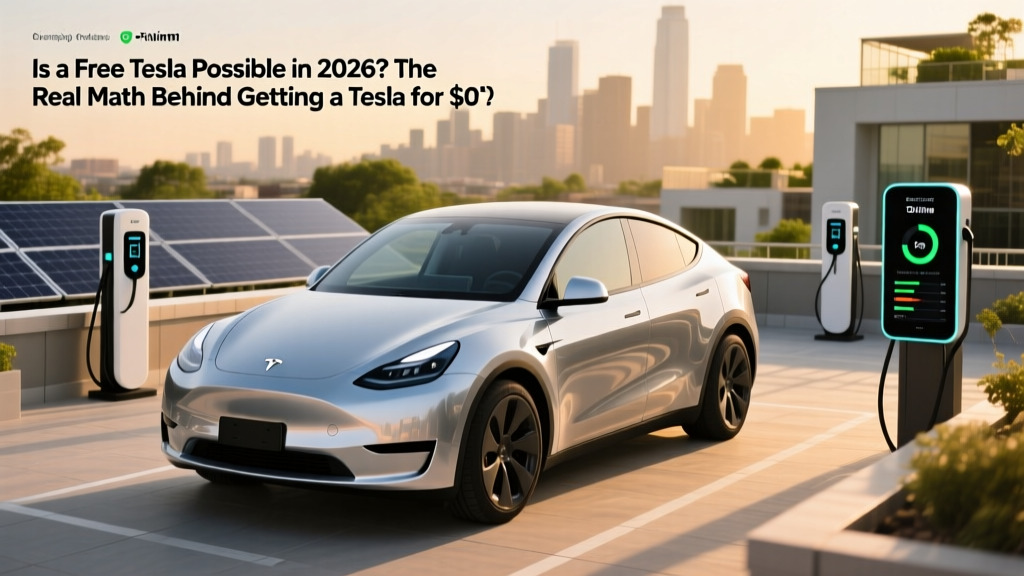
Search engines see thousands of queries every month from shoppers asking whether it's possible to get a free Tesla — or at least drive one for effectively nothing out of pocket. The short answer: no automaker is handing away vehicles. But a more useful answer exists if we reframe the question around net cost after incentives, fuel savings, and ownership economics. In 2026, a combination of federal tax credits, state rebates, employer incentives, and dramatically lower per-mile energy costs can reduce the effective cost of a Tesla Model 3 or Model Y to a fraction of its sticker price — and in narrow scenarios involving leasing, fleet programs, or solar-bundled deals, the marginal cost of driving electric can approach zero for certain commuters.
This review examines the actual numbers behind the "free Tesla" idea using the current 2026 Tesla lineup: the refreshed Model 3 (Highland and beyond) and the Model Y (Juniper refresh). We'll look at real pricing, the IRS §30D federal tax credit mechanics, state-level incentives, leasing loopholes, home solar bundling, and total cost of ownership versus gas-powered competitors.
2026 Tesla Model 3 and Model Y: Current Pricing and Tax Credit Eligibility
Before any incentive math works, you need to know what these vehicles actually cost and whether they qualify for federal help. Both the Model 3 and Model Y remain Tesla's volume sellers and the models most commonly associated with incentive-stacking strategies.
| Model / Trim | Base MSRP | MSRP Cap (IRS §30D) | Max Federal Credit | Credit Eligible? |
|---|---|---|---|---|
| Model 3 RWD | $38,990 | $55,000 (sedans) | $7,500 | Yes (if income & sourcing rules met) |
| Model 3 Long Range AWD | $45,990 | $55,000 (sedans) | $7,500 | Yes (if income & sourcing rules met) |
| Model 3 Performance | $52,990 | $55,000 (sedans) | $7,500 | Yes (if income & sourcing rules met) |
| Model Y Long Range AWD | $44,990 | $80,000 (SUVs) | $7,500 | Yes (if income & sourcing rules met) |
| Model Y Performance | $48,990 | $80,000 (SUVs) | $7,500 | Yes (if income & sourcing rules met) |
Income caps matter. Under IRS §30D rules, modified adjusted gross income (MAGI) cannot exceed $150,000 (single), $225,000 (head of household), or $300,000 (joint). Battery component and critical mineral sourcing requirements also apply and change annually — Tesla's US-built vehicles have generally qualified, but always verify current-year status at the point of sale. As of 2026, the point-of-sale transfer option lets you apply the credit as a down-payment reduction at purchase, rather than waiting for a tax refund.
How Close to "Free" Can You Actually Get? Incentive Stacking Scenarios
Let's model three realistic scenarios where buyers push effective cost toward zero. None achieve a literally free vehicle, but the net cost reductions are substantial.
Scenario A: Federal + State + Utility Rebate Stack (Model 3 RWD)
| Line Item | Amount |
|---|---|
| Base MSRP | $38,990 |
| Federal §30D credit (point-of-sale) | –$7,500 |
| California CVRP rebate (if eligible, income-based) | –$2,000 to –$7,500 |
| Utility EV rebate (example: SCE, PG&E) | –$500 to –$1,500 |
| Air district / local incentive (varies) | –$1,000 to –$4,000 |
| Net effective price (best case) | ~$18,490 – $27,490 |
In the most incentive-rich jurisdictions (California, Colorado, Massachusetts, New York), a low-to-moderate-income buyer can stack $12,000–$20,000+ in combined incentives against a $38,990 Model 3 RWD. That's not free, but it brings a Tesla into used-Camry territory.
Scenario B: Lease Passthrough + Solar Bundle
Some buyers pursue a "free Tesla" through leasing, where the leasing company claims the §30D credit and passes a portion through as a capitalized-cost reduction. Combined with a Tesla Solar Roof or panel bundle (which offers separate federal solar tax credits under §25D), the monthly energy cost of charging at home can approach zero for homes with sufficient solar production. The vehicle itself is not free — you still pay a lease — but the fuel cost can be effectively eliminated.
Scenario C: Employer / Fleet Subsidy Programs
A growing number of employers offer EV purchase subsidies ($2,000–$5,000) as part of sustainability benefits. Combined with federal and state incentives, some corporate fleet-lease programs reduce the out-of-pocket cost of a Model 3 to under $15,000 over a three-year lease term — approaching the cost of a used economy car.
2026 Tesla Model 3: Range, Battery, and Charging Specs
| Spec | RWD | Long Range AWD | Performance |
|---|---|---|---|
| EPA Range | 272 mi | 363 mi | 315 mi |
| Battery (usable, est.) | ~60 kWh (LFP) | ~79 kWh (NMC) | ~79 kWh (NMC) |
| Max DC Fast Charge | 170 kW | 250 kW | 250 kW |
| 10–80% DC Time | ~25 min | ~20 min | ~20 min |
| Level 2 Home Charge (11.5 kW) | ~30 mi/hr | ~44 mi/hr | ~44 mi/hr |
| 0–60 mph | 5.8 sec | 4.2 sec | 2.9 sec |
| Horsepower | 271 hp | 346 hp | 510 hp |
| Drivetrain | RWD | Dual-Motor AWD | Dual-Motor AWD |
| MPGe (combined) | 132 MPGe | 125 MPGe | 115 MPGe |
| Efficiency (kWh/100 mi) | 25 kWh | 27 kWh | 29 kWh |
2026 Tesla Model Y: Range, Battery, and Charging Specs
| Spec | Long Range AWD | Performance |
|---|---|---|
| EPA Range | 320 mi | 285 mi |
| Battery (usable, est.) | ~79 kWh (NMC) | ~79 kWh (NMC) |
| Max DC Fast Charge | 250 kW | 250 kW |
| 10–80% DC Time | ~22 min | ~22 min |
| Level 2 Home Charge (11.5 kW) | ~40 mi/hr | ~40 mi/hr |
| 0–60 mph | 4.8 sec | 3.5 sec |
| Horsepower | 384 hp | 456 hp |
| MPGe (combined) | 117 MPGe | 111 MPGe |
The Juniper-refreshed Model Y added a quieter cabin, ventilated front seats, an 8-inch rear touchscreen, ambient lighting, and a slightly retuned suspension. The powertrain remains largely carried over, but efficiency improved marginally thanks to reduced drag and updated thermal management. EPA data at fueleconomy.gov confirms the updated range figures.
Charging Infrastructure: Where "Free" Charging Actually Exists
A meaningful part of the "free Tesla" equation is free or near-free charging. Here's where that's realistic in 2026:
- Home solar charging: If your rooftop solar system produces excess energy, your marginal cost per kWh can drop to $0.00–$0.03, translating to roughly $0.00–$0.01 per mile driven on a Model 3.
- Workplace charging: A growing number of employers offer free Level 2 charging as an employee perk. If you charge exclusively at work, your fuel cost is literally zero.
- Tesla Supercharger credits: Tesla periodically offers referral-based or promotional free Supercharger miles (typically 1,000–5,000 miles). These don't last indefinitely but can cover early ownership.
- Apartment/condo included charging: Some multi-family housing properties include EV charging in rent or HOA fees — effectively free fuel bundled into housing costs.
- Utility off-peak rates: Even without solar, time-of-use rates as low as $0.05–$0.08/kWh make Model 3 fueling cost roughly $0.01–$0.02 per mile — a fraction of gas at $3.50/gallon in a 30-MPG sedan ($0.12/mi).
| Scenario | Cost per Mile | Annual Fuel Cost | 5-Year Fuel Cost |
|---|---|---|---|
| Gas sedan (30 MPG, $3.50/gal) | $0.117 | $1,750 | $8,750 |
| Model 3 home (avg $0.14/kWh) | $0.035 | $525 | $2,625 |
| Model 3 home solar ($0.02/kWh) | $0.005 | $75 | $375 |
| Model 3 workplace (free) | $0.00 | $0 | $0 |
| Model 3 Supercharger (avg $0.30/kWh) | $0.075 | $1,125 | $5,625 |
Interior, Tech, and Daily Ownership Experience
Both the Model 3 and Model Y share Tesla's minimalist interior architecture centered on a 15.4-inch front touchscreen. The Juniper Model Y added rear-seat ventilation controls on an 8-inch rear display. Key tech features include:
- Autopilot (standard): SAE Level 2 adaptive cruise + lane centering. Driver must remain engaged — this is not self-driving.
- Full Self-Driving (Supervised): Optional ($8,000 or $99/mo). Still SAE Level 2 despite the name. Adds automatic lane changes, traffic light/stop sign recognition, and navigation-guided driving on highways and city streets.
- Over-the-air updates: Continuous feature additions, UI improvements, and efficiency tweaks without dealer visits.
- Tesla app integration: Remote preconditioning, charging control, sentry-mode viewing, and phone-as-key.
- Heat pump (standard): Both models use a heat pump for cabin heating, significantly reducing cold-weather range loss compared to resistive heaters.
Cargo and Passenger Space
| Dimension | Model 3 | Model Y |
|---|---|---|
| Front legroom | 42.7 in | 41.8 in |
| Rear legroom | 35.2 in | 41.6 in |
| Cargo (rear seats up) | 23 cu ft (trunk) | 30 cu ft |
| Cargo (rear seats folded) | ~43 cu ft | ~72 cu ft |
| Frunk | 3.1 cu ft | 4.1 cu ft |
| Towing capacity | Not rated | 3,500 lbs |
Warranty and Long-Term Battery Outlook
Tesla's warranty coverage is competitive within the EV segment:
- Basic vehicle warranty: 4 years / 50,000 miles
- Battery & drive unit (Model 3 RWD, LFP): 8 years / 100,000 miles, 70% minimum capacity retention
- Battery & drive unit (Long Range / Performance, NMC): 8 years / 120,000 miles, 70% minimum capacity retention
- Battery & drive unit (Model Y all trims): 8 years / 120,000 miles, 70% minimum capacity retention
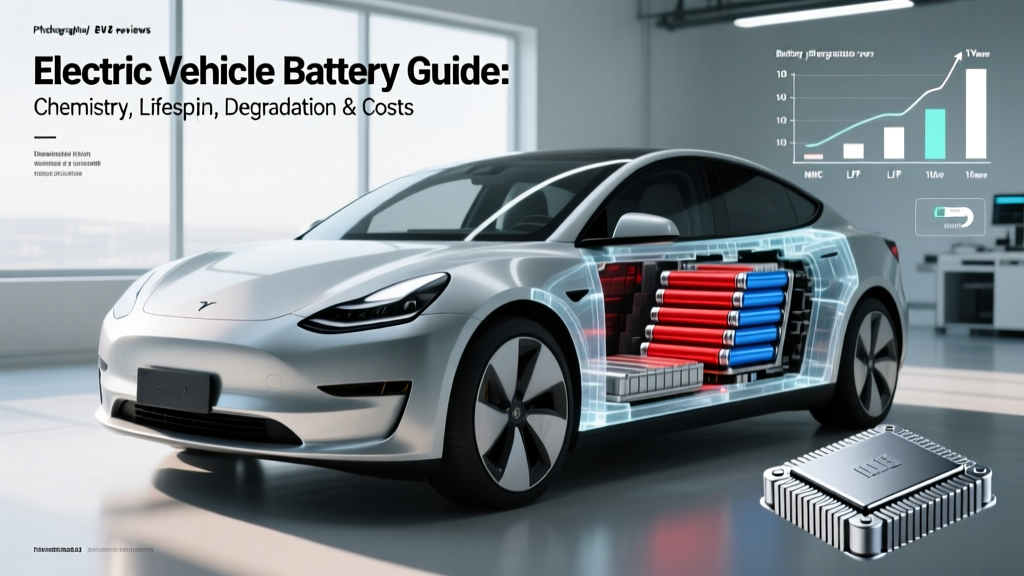
Tesla does not publish a separate powertrain warranty distinct from the battery/drive unit coverage. Real-world degradation data from fleet operators and owner surveys suggests Tesla NMC batteries retain approximately 88–92% capacity at 100,000 miles, while LFP batteries (Model 3 RWD) show slightly slower degradation curves, retaining roughly 90–94% at the same mileage — consistent with LFP's known longevity advantage in cycle life.
Pros, Cons, and Who Should Buy
Pros
- Class-leading Supercharger network access (17,000+ US stalls)
- Best-in-class energy efficiency (25 kWh/100 mi on Model 3 RWD)
- Over-the-air updates add features post-purchase
- Strong residual values relative to most EVs
- LFP battery option (RWD) tolerates daily 100% charging
- Heat pump standard for cold-climate efficiency
- Lowest per-mile fuel cost with home solar
Cons
- Minimalist interior not for everyone (no physical buttons, no instrument cluster)
- FSD (Supervised) costs $8,000 and remains Level 2
- Service center wait times remain long in many markets
- No Apple CarPlay / Android Auto
- Model 3 rear seat is tighter than competitors (Hyundai Ioniq 6, BMW i4)
- Insurance premiums 15–25% higher than equivalent gas sedans
- Build quality improved but still inconsistent panel gaps reported
Who This EV Suits Best
- Commuters with home charging: Ideal. Lowest per-mile cost in the segment, especially with solar or off-peak utility rates.
- Tech-forward buyers: OTA updates, app integration, and Supercharger navigation appeal to software-minded owners.
- Families needing cargo space: Model Y's 72 cu ft with seats folded rivals midsize SUVs. Model 3 is better for couples or single occupants.
- Cold-climate drivers: Heat pump + preconditioning makes Tesla competitive in winter, but expect 20–30% range loss below 25°F.
- Road trippers: Supercharger network remains the most reliable DC fast-charging ecosystem in the US. No rival matches it in 2026.
Is It Worth Buying vs. Key Competitors?
Decision Framework
Choose Tesla Model 3/Y if: You prioritize Supercharger access, software features, and energy efficiency above all. The incentive stack makes the Model 3 RWD one of the cheapest EVs to own per mile in 2026.
Choose Hyundai Ioniq 5/6 if: You want 800V ultra-fast charging (10–80% in ~18 min at 350 kW), a more conventional interior, and competitive pricing — though public charging relies on third-party networks.
Choose Chevrolet Equinox EV if: You want the lowest entry price in a crossover EV (~$33,000 before credits) and don't mind slower DC charging speeds (150 kW peak).
Choose BMW i4 if: You want premium build quality, a traditional instrument display, and don't mind a higher starting price (~$52,000).
Frequently Asked Questions
Can I actually get a Tesla for free in 2026?
No. No legitimate program gives away a Tesla for $0. The closest scenarios involve aggressive incentive stacking (federal + state + utility + employer) that can reduce a Model 3 RWD to ~$18,000–$27,000 net, combined with solar-powered home charging that reduces ongoing fuel cost to near zero. The vehicle itself always has a purchase or lease cost.
Does the Tesla Model 3 qualify for the $7,500 federal tax credit?
Yes, as of 2026 the Model 3 (all trims under the $55,000 sedan MSRP cap) qualifies for up to $7,500 under IRS §30D — provided the buyer meets income limits ($150K single / $300K joint MAGI), the vehicle meets battery sourcing requirements, and the credit is claimed at point of sale or on your tax return. Always verify current eligibility at irs.gov and consult a tax professional.
How much does it cost to charge a Tesla at home per month?
At the US average residential rate of ~$0.16/kWh and driving 1,250 miles/month, a Model 3 RWD (25 kWh/100 mi) costs approximately $50/month to charge at home. With solar or off-peak rates of $0.06/kWh, that drops to roughly $19/month. With workplace charging, it can be $0.
What is the real-world range of the Tesla Model Y?
The EPA rates the 2026 Model Y Long Range AWD at 320 miles. In real-world mixed driving, expect approximately 270–300 miles at highway speeds. In cold weather (below 25°F), plan for 220–260 miles of usable range before needing to charge. Preconditioning the battery before departure helps recover some of this loss.
Is Tesla's FSD worth the $8,000 cost?
FSD (Supervised) remains an SAE Level 2 system requiring active driver engagement. It handles highway driving well and has improved in city scenarios, but it is not autonomous and requires constant supervision. For most buyers, standard Autopilot (included) provides adequate highway cruise and lane-keeping. The $8,000 FSD purchase is difficult to justify purely on functionality — it's more of an early-adopter bet on future capability.
What are the biggest drawbacks of owning a Tesla?
Service center capacity remains the top complaint — wait times of 2–4 weeks for non-urgent repairs are common in many markets. Insurance costs run 15–25% higher than comparable gas vehicles due to repair complexity and parts costs. The minimalist interior (no physical buttons, no CarPlay) is polarizing. And while Superchargers are excellent, Tesla's shift to NACS means adapters are needed for some third-party CCS chargers — though Tesla now includes a CCS adapter with new vehicles.