The Short Answer on FPL EV Charging
Florida Power & Light (FPL) offers a dedicated Electric Vehicle rate plan that can cut home-charging costs to roughly $0.025–$0.04 per mile for most EVs if you charge overnight during off-peak hours. Compared to a 28 MPG gas car at $3.40/gallon (about $0.12/mile), FPL EV owners typically save $800–$1,400 per year on energy alone. The catch: you need a Level 2 home charger, a smart thermostat or EVSE on the plan, and the discipline to avoid peak-hour charging.
Why FPL EV Rates Matter for Florida EV Buyers
Florida ranks second in the U.S. for EV adoption by volume, and FPL is the state's largest utility, serving over 12 million residents. For anyone shopping for an EV in South Florida, Orlando, Tampa, or the Gulf Coast, the utility's rate structure directly determines whether your electric car is a bargain or a bill shock waiting to happen.
FPL's standard residential rate in 2026 hovers around $0.13–$0.15 per kWh depending on your county and usage tier. That's already competitive nationally. But the FPL Electric Vehicle (EV) rate — a time-of-use (TOU) plan — introduces dramatic price swings between peak and off-peak periods that reward overnight charging and punish daytime top-ups during summer A/C season.
If you're comparing an EV to a gas car or a hybrid like the Toyota RAV4 Hybrid (39 MPG combined), the FPL EV rate is what tips the total-cost-of-ownership math decisively in the EV's favor for most Florida drivers.
How the FPL EV Time-of-Use Plan Works
The FPL EV rate is built around three pricing tiers that shift by season. Here's the structure as of early 2026:
| Period | Summer (Apr–Oct) | Winter (Nov–Mar) | Best For |
|---|---|---|---|
| Off-Peak | ~$0.06/kWh (overnight) | ~$0.05/kWh (overnight) | Level 2 overnight charging |
| On-Peak | ~$0.28/kWh (weekday afternoons) | ~$0.19/kWh (weekday mornings/evenings) | Avoid if possible |
| Standard Residential | ~$0.13–$0.15/kWh (flat) | Non-EV plan baseline | |
Source: FPL Rate Information. Exact rates vary by county and are subject to Florida Public Service Commission approval. Always verify current rates before enrolling.
The off-peak window is where the magic happens. Charging a Hyundai Ioniq 5 (84 kWh usable battery, NMC chemistry) from 10% to 90% during summer off-peak costs roughly $4.03 — enough to restore about 240 miles of EPA-rated range (the Ioniq 5's EPA estimate is 310 miles for the Long Range RWD; expect ~260–280 miles real-world at highway speeds in Florida heat with A/C running).
FPL EV Charging Cost vs. Gas: The Real Numbers
Let's put actual vehicles against each other using Florida-relevant data. We'll compare a popular EV, a comparable gas car, and a hybrid — all driven 12,000 miles per year (the U.S. average per FHWA data).
| Vehicle | Efficiency | Energy Source | Cost/Mile | Annual Cost |
|---|---|---|---|---|
| Chevrolet Equinox EV (2LT, 85 kWh, FWD) | 3.2 mi/kWh (EPA ~319 mi range) | FPL EV Off-Peak ($0.06/kWh) | $0.019 | $225 |
| Chevrolet Equinox EV | 3.2 mi/kWh | FPL Standard ($0.14/kWh) | $0.044 | $525 |
| Toyota RAV4 Hybrid (AWD) | 39 MPG combined | Gas ($3.40/gal) | $0.087 | $1,046 |
| Toyota RAV4 Gas (AWD) | 28 MPG combined | Gas ($3.40/gal) | $0.121 | $1,457 |
At FPL's off-peak EV rate, the Equinox EV costs 82% less to fuel than the gas RAV4 and 78% less than the hybrid. Even on the standard residential rate without the EV plan, the EV still undercuts both by a wide margin.
But these numbers assume disciplined overnight charging. If you frequently top up during summer on-peak hours at $0.28/kWh, your cost jumps to $0.088/mile — suddenly competitive with the RAV4 Hybrid. The rate plan only saves you if you use it correctly.
Home Charging Setup: What FPL EV Owners Actually Need
The FPL EV rate plan requires a qualifying Level 2 charger (240V, typically 32A–48A) or a smart EVSE that communicates with FPL's system. Here's what installation realistically costs in Florida:
| Component | Low End | High End | Notes |
|---|---|---|---|
| Level 2 EVSE (ChargePoint Home Flex, Emporia, Wallbox) | $350 | $700 | 32A–48A, NACS or J1772 connector |
| Electrician labor (240V/50A circuit run) | $500 | $2,000 | Depends on panel proximity |
| Electrical panel upgrade (100A → 200A) | $1,500 | $3,500 | Needed on older Florida homes |
| Permit & inspection | $75 | $250 | County-dependent |
| Total (no panel upgrade) | $925 | $2,950 | |
| Total (with panel upgrade) | $2,425 | $6,450 |
Always get a licensed electrician's quote for your specific home. Final specs depend on your panel capacity, wire run distance, and local code. Consult a professional before purchasing equipment.
Florida's older housing stock — especially in Miami-Dade, Broward, and Pinellas — often has 100A panels that need upgrading before adding a 48A EV charger circuit. This is the single biggest hidden cost that first-time EV buyers underestimate.
FPL Solar + EV: Does the Combo Make Sense?
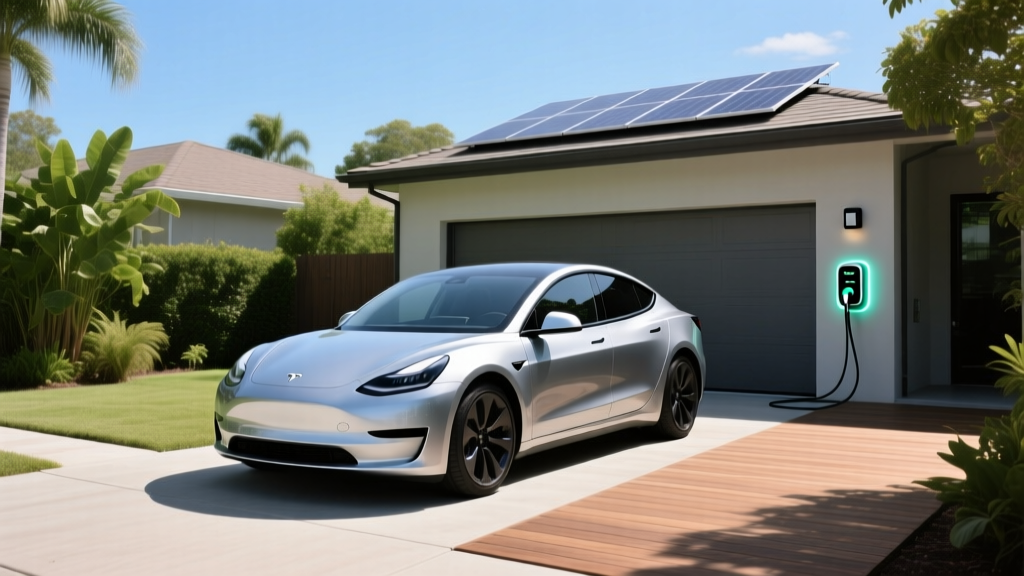
Florida's sunshine makes solar + EV an attractive pairing. If you have a rooftop solar array generating excess daytime kWh, you can offset some peak charging costs — but the economics are nuanced.
A typical 10 kW Florida solar system produces roughly 14,000–16,000 kWh/year. An EV driven 12,000 miles at 3.2 mi/kWh consumes about 3,750 kWh/year. So solar can cover your EV's entire energy budget plus most of your household usage.
However, FPL's net metering compensation for excess solar generation is at the utility's avoided-cost rate — significantly less than retail. The optimal strategy is to charge your EV during daylight hours from direct solar production, not from the grid. This conflicts with the EV rate's off-peak overnight window.
The practical answer: If you have solar, stay on the standard residential rate and charge during the day. If you don't have solar, the FPL EV rate with overnight charging is your best bet. Don't try to do both on the TOU plan — the peak-hour solar production won't offset the off-peak charging benefit enough to justify the rate structure.
Common FPL EV Misconceptions — Fact-Checked
| Myth | Fact |
|---|---|
| "My EV will survive a Florida hurricane without fuel worries." | True — but only if you can charge. Extended power outages (days to weeks) after hurricanes mean no home charging. A full EV battery gives you 250+ miles of evacuation range; a gas car with a full tank gives ~350–500 miles and access to portable fuel cans. |
| "The FPL EV rate applies to all my home electricity." | False. The EV rate is a whole-home TOU plan — it affects all your electricity pricing, not just the charger. Running your A/C during summer on-peak can spike your bill. You must shift overall usage to off-peak to truly benefit. |
| "I can charge at any public station and get the same savings." | False. DC fast charging (Electrify America, Tesla Supercharger) typically costs $0.30–$0.48/kWh in Florida — more than gas on a per-mile basis for some vehicles. Public charging is for road trips, not daily savings. |
| "EVs degrade quickly in Florida heat." | Partially outdated. Modern NMC and LFP batteries with active liquid cooling (standard on most 2024+ EVs) handle Florida heat well. Expect ~5–8% degradation over 5 years. LFP chemistry (Tesla Model 3 RWD, Ford Mustang Mach-E Select) is particularly heat-resilient. Battery warranties cover 8 years/100,000 miles minimum per federal mandate. |
| "I need a Tesla to benefit from FPL's EV rate." | False. Any BEV or PHEV with a qualifying Level 2 charger can enroll. NACS, CCS, and J1772 connectors all work. |
Federal Tax Credits + FPL Savings: The Full Picture
Beyond cheap electricity, the federal §30D Clean Vehicle Credit can reduce your EV's effective purchase price by up to $7,500 — but eligibility is complex and changes frequently.
2026 §30D Credit Requirements (Summary)
- Income caps: AGI ≤ $150K single / $225K head of household / $300K joint
- MSRP caps: ≤ $55,000 for sedans; ≤ $80,000 for SUVs, pickups, vans
- Battery sourcing: Critical minerals and battery components must meet escalating domestic/free-trade-partner thresholds (stricter each year through 2030)
- Point-of-sale transfer: You can transfer the credit to the dealer for an immediate price reduction (effective Jan 2024+)
- Assembly: Vehicle must undergo final assembly in North America
Eligibility depends on your specific tax situation, the vehicle's current sourcing compliance, and model-year rules. Consult a tax professional and verify on fueleconomy.gov before purchasing.
When you stack a $7,500 credit against a vehicle like the Chevrolet Equinox EV 2LT ($34,900 MSRP) and FPL's off-peak charging savings ($820+/year vs. gas), the payback period against a comparable gas car compresses to roughly 2–3 years for most Florida drivers.
Decision Framework: Should You Go EV on FPL?
If X, Then Y — Your FPL EV Decision Guide
Choose an EV + FPL EV rate if:
- You have (or can install) a Level 2 home charger in a garage or covered parking area
- Your daily commute is under 80 miles round-trip (covers 90%+ of U.S. commutes on a single overnight charge)
- You can shift A/C, laundry, and dishwasher usage to off-peak hours
- You qualify for at least a partial §30D credit or your state/utility offers rebates
- You drive 10,000+ miles/year (higher mileage = faster payback)
Choose a hybrid (HEV/PHEV) instead if:
- You live in an apartment or condo without charging access
- You regularly drive 300+ mile one-way trips through rural Florida/Georgia where DC fast chargers are sparse
- Your home has a 100A panel and a panel upgrade would cost $3,000+ that you can't absorb
- You want zero behavior change — a hybrid like the RAV4 Hybrid works exactly like a gas car with better MPG
Choose a PHEV (plug-in hybrid) as a middle ground if:
- You can install Level 2 and want 25–40 miles of electric-only daily driving on FPL's cheap off-peak rate
- You take occasional long road trips and want gas-engine backup without range anxiety
- Models like the Toyota RAV4 Prime (42 mi electric range, 94 MPGe) or Jeep Wrangler 4xe (22 mi electric) fit your lifestyle
What First-Time FPL EV Buyers Must Know
Enrollment timing matters. FPL may require a smart EVSE or metering equipment for the EV rate. Contact FPL before purchasing your charger to confirm compatible hardware — not all Level 2 units support the utility's demand-response signaling.
Summer peak is brutal. FPL's summer on-peak rate (~$0.28/kWh) runs during weekday afternoons — exactly when Florida A/C loads peak. If you work from home and run A/C all afternoon, the whole-home TOU plan can erode your EV charging savings. Calculate your total household usage, not just the car.
DC fast charging is not your friend, financially. Florida's public fast-charging networks (Electrify America, Tesla Supercharger, EVgo) charge $0.30–$0.48/kWh. A 10–80% charge on a Ford F-150 Lightning (131 kWh Extended Range pack) at $0.40/kWh costs roughly $36.60 for about 220 real-world miles — comparable to or more expensive than gas. Use DCFC for road trips only; daily charging should be at home on the FPL EV rate.
Insurance is higher. EV insurance premiums in Florida run 15–25% above comparable gas vehicles, driven by higher repair costs and the state's broader insurance crisis. Budget an extra $400–$800/year and shop quotes before buying.
Hurricane preparedness is real. Keep your EV charged above 80% during hurricane season (June–November). If evacuation orders come, you'll want maximum range. An EV with 250+ miles of range can reach most Florida shelters from any point in the state on a single charge — but only if the battery is full when the storm hits.
Frequently Asked Questions
Can I enroll in the FPL EV rate if I drive a plug-in hybrid?
Yes. PHEVs like the Toyota RAV4 Prime or Chrysler Pacifica Hybrid qualify for the FPL EV rate as long as you have a qualifying Level 2 charger. The off-peak rate applies to all household electricity, so your PHEV's smaller battery (typically 14–18 kWh) charges cheaply overnight while your A/C and appliances also benefit from off-peak pricing.
Does FPL offer any EV rebates or charger incentives?
FPL periodically offers rebates on Level 2 chargers and smart thermostats through its energy management programs. Availability changes — check FPL's EV page directly for current offers. Some Florida municipalities and co-ops (like JEA in Jacksonville or Tampa Electric) also have separate EV incentive programs.
What happens to my FPL EV rate during a power outage?
The rate plan doesn't apply when the grid is down — you're running on battery. A fully charged EV with 250+ miles of range is actually an advantage during extended outages: you can evacuate, reach shelters, or power essential devices via V2L (vehicle-to-load) if your EV supports it (Hyundai Ioniq 5, Ford F-150 Lightning, Kia EV6). Gas cars have the edge in refueling flexibility during prolonged outages.
Is the FPL EV rate worth it if I only drive 6,000 miles per year?
Probably not. Low-mileage drivers save less on fuel regardless of vehicle type. At 6,000 miles/year, your annual EV charging cost on the off-peak rate is roughly $113 vs. $728 for gas — a $615 savings. If you can't shift other household loads to off-peak, the whole-home TOU plan may cost you more on A/C than you save on charging. Run the math on your specific usage before enrolling.
Will charging my EV at home trip my FPL into a higher rate tier?
The FPL EV rate is a time-of-use plan, not a tiered usage plan like standard residential. Your rate per kWh is determined by the time of day, not total consumption. However, adding 3,000–4,000 kWh/year of EV charging will increase your total bill — just at the cheaper off-peak rate if managed correctly.