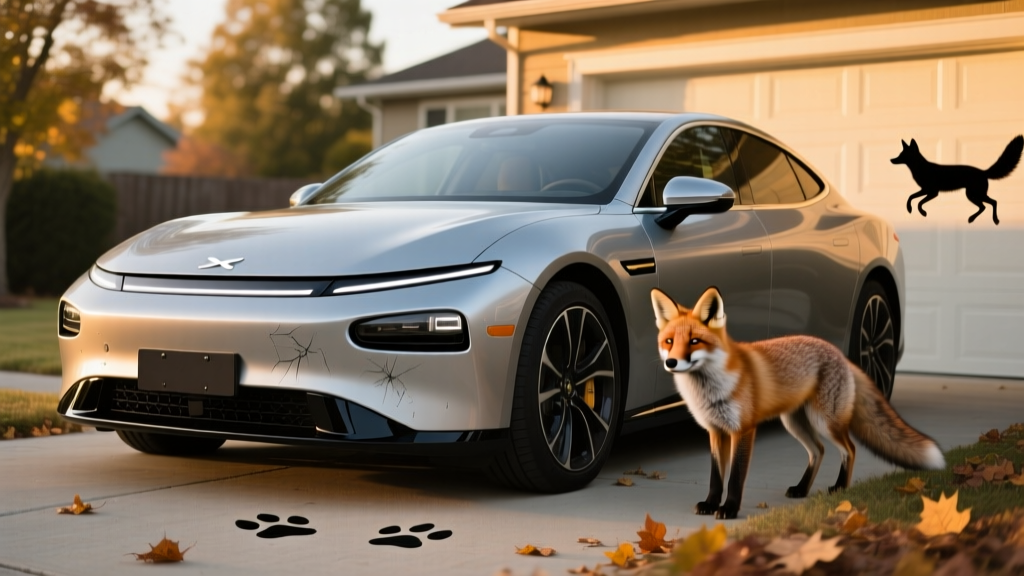
Reports from the UK and parts of Europe have surfaced claiming that foxes are believed to be damaging dozens of electric cars, with owners discovering chewed wiring harnesses, gnawed charging cables, and punctured coolant lines. If you've seen the headlines and wondered whether your EV is at risk, here's the practical answer: foxes and other urban wildlife (rodents, martens, squirrels) are attracted to the soy-based and plant-derived insulation used on many modern vehicle wiring harnesses — and EVs are not uniquely targeted, but their high-voltage cabling and exposed charge ports can make damage more costly when it occurs.
This is not an EV-specific design flaw. It's a wildlife-behavior problem that intersects with modern automotive materials science. But because EVs rely on high-voltage systems (400V or 800V architectures), a chewed harness can trigger expensive isolation faults, disable fast charging, or throw the vehicle into a safety limp mode. Understanding the real risk, the repair economics, and the prevention strategies matters for any EV owner parking outdoors in wildlife-active areas.
What's Actually Happening: Foxes, Wiring, and EV Damage
The phenomenon isn't new, but it's accelerating in suburban and semi-rural areas where urban fox populations have grown significantly. In the UK, urban fox densities have reached an estimated 10-15 foxes per square kilometer in some cities, according to the Mammal Society. These animals are opportunistic foragers and explorers, and parked vehicles — especially those in driveways near green spaces — sit squarely in their territory.
Why wiring? Modern automotive wiring insulation increasingly uses soy-based, polyamide, or plant-derived bioplastic coatings rather than older petroleum-based PVC. This shift, driven by sustainability mandates and weight reduction goals, has an unintended side effect: the insulation smells and tastes appealing to animals with keen olfactory senses. Foxes, rodents, and pine martens have all been documented chewing harnesses.
For EVs specifically, the damage profile differs from internal-combustion vehicles in three key ways:
- High-voltage orange cabling (the 400V/800V traction system) runs under the vehicle and through the engine bay to the inverter and charge port. Damage here triggers immediate safety lockouts.
- Charge port and cable exposure: EV owners who leave charge cables plugged in overnight or store portable chargers in the frunk/trunk create additional targets.
- Coolant loop complexity: EV battery thermal management systems use extensive glycol coolant lines. A punctured line can lead to battery pack overheating risk and a $3,000–$7,000+ repair.
EV vs. Gas Car: Comparing Wildlife Damage Risk and Repair Costs
A common misconception is that EVs attract more wildlife. The data doesn't support this. What the data does show is that when damage occurs on an EV, the repair bill tends to be higher due to the high-voltage system's complexity and the specialized labor required.
| Damage Scenario | Gas Car Repair Cost | EV Repair Cost | Why the Difference |
|---|---|---|---|
| Chewed 12V wiring harness | $300–$800 | $400–$1,200 | Similar 12V systems, but EV harness routing can be more complex |
| Damaged high-voltage cable | N/A | $1,500–$5,000 | Requires HV-certified technician; safety isolation protocols |
| Punctured coolant line | $200–$600 | $800–$3,500 | EV battery thermal loops require system flush, leak test, recalibration |
| Chewed charge port wiring | N/A | $600–$2,000 | Integrated charge management electronics; OEM parts often required |
| Damaged home charging cable (Level 2) | N/A | $300–$600 (cable replacement) | EVSE cables are replaceable but not cheap; J1772/NACS connectors |
The takeaway: foxes and rodents don't discriminate between a Tesla Model Y and a Toyota RAV4 when it comes to chewing wiring. But a $400 rodent repair on a gas car can become a $3,000 repair on an EV if high-voltage components are compromised. This is an ownership cost reality that EV buyers in wildlife-prone areas should factor in.
Real Costs and Savings: Does Wildlife Risk Change the EV Ownership Equation?
Let's contextualize this risk within the broader EV ownership picture. The wildlife damage concern is real but statistically minor compared to the major cost drivers: purchase price, charging, insurance, and depreciation.
| Cost Category (5-Year) | EV (e.g., 2026 Hyundai Ioniq 5 SEL) | Gas Car (e.g., 2026 Toyota RAV4 XLE) |
|---|---|---|
| Purchase Price (MSRP) | ~$47,500 | ~$33,500 |
| Federal Tax Credit (§30D) | Up to $7,500 (eligibility varies — see IRS §30D rules) | $0 |
| Fuel / Charging (5 yrs, 75k mi) | ~$3,200–$5,800 (home vs. public mix) | ~$8,500–$11,000 (at $3.40/gal, 28 MPG) |
| Maintenance (5 yrs) | ~$1,500–$2,200 | ~$3,500–$4,800 |
| Insurance (5 yrs) | ~$9,000–$12,000 | ~$7,000–$9,500 |
| Wildlife Damage Risk (estimated) | $0–$3,000 (probability-weighted) | $0–$800 (probability-weighted) |
| Estimated 5-Year Total Cost | ~$55,700–$70,500 | ~$52,500–$59,600 |
Wildlife damage is a rounding error compared to the fuel savings EVs deliver over five years (often $4,000–$7,000 less in energy costs). However, if you live in a high-fox-density area and park outdoors nightly, it's a legitimate line item to consider — and one that comprehensive auto insurance typically covers.
What First-Time EV Buyers Should Know About Wildlife and Parking
If you're shopping for your first EV and live in an area with active fox, rodent, or marten populations, here's how to factor this into your purchase and setup decisions:
Home Charging Access and Wildlife Exposure
The intersection of home charging and wildlife risk is where most damage occurs. Consider these scenarios:
- Garage parking with Level 2 charger: Lowest risk. A closed garage virtually eliminates fox access. Install a Level 2 home charger (240V, 7.2–11.5 kW) inside the garage for optimal protection and charging speed.
- Driveway parking with outdoor Level 2: Moderate risk. The charge cable and vehicle undercarriage are exposed. Use deterrents (see below).
- Street parking, public charging only: Variable risk. You can't control the environment, but you also don't leave cables connected overnight.
Climate and Seasonal Patterns
Wildlife damage peaks in autumn and winter when animals seek warmth (engine bays retain residual heat) and when natural food sources decline. Foxes in particular are crepuscular — most active at dawn and dusk — meaning overnight parking is the highest-risk window. If you're in a cold climate (USDA zones 4-6 or UK equivalents), the combination of cold weather range loss (expect 20-30% reduction below freezing) and increased wildlife activity near parked cars makes garage parking especially valuable.
Prevention Strategies: Protecting Your EV from Fox and Rodent Damage
| Myth | Fact |
|---|---|
| "EVs attract foxes more than gas cars." | Foxes are attracted to wiring insulation materials (soy-based), not the powertrain type. Both EVs and gas cars with soy-wire coatings are targets. |
| "Mothballs under the hood keep animals away." | Mothballs are toxic, environmentally harmful, and largely ineffective outdoors. They also pose risks to pets and children. |
| "Ultrasonic deterrents don't work." | Mixed evidence. Some peer-reviewed studies show 40-60% reduction in rodent activity; effectiveness varies by species, frequency range, and environment. Better than nothing, not a silver bullet. |
| "Comprehensive insurance won't cover fox damage." | Most comprehensive auto policies cover animal damage, including fox and rodent chewing. Verify your policy and deductible. |
| "EV high-voltage cables are armored and immune." | HV cables have thick insulation but are not armored against determined chewing. The orange outer sheath is a warning marker, not a physical barrier. |
Effective Prevention Methods
Based on owner reports and pest-control industry recommendations, here's what works ranked by effectiveness:
- Enclosed garage parking — Near 100% effective. If you're installing a Level 2 home charger anyway, prioritize a garage location. A 240V/48A (11.5 kW) hardwired unit like the ChargePoint Home Flex or WallConnector in a garage solves both charging speed and wildlife risk.
- Wire mesh / hardware cloth barriers — Wrapping exposed wiring and charge port areas with 1/4-inch galvanized mesh deters chewing. Cost: $20–$50 in materials. Labor-intensive but effective for known problem areas.
- Taste-deterrent sprays — Capsaicin-based or bitter-agent sprays (e.g., Rodent Defense, Tomcat Repellent) applied to wiring harnesses. Reapply every 2-4 weeks. Cost: $10–$20 per application.
- Ultrasonic pest repellers — Battery or plug-in units emitting 20-65 kHz sound. Place near the vehicle. Cost: $25–$60 per unit. Effectiveness varies; some owners report success, others don't.
- Motion-activated lights/sprinklers — Startle-based deterrents for driveway parking. Cost: $30–$80. Works better for foxes (larger, more cautious) than rodents.
- Remove attractants — Don't leave pet food, birdseed, or compost near your parking area. Foxes follow food sources.
Decision Framework: Should Wildlife Risk Affect Your EV Purchase?
Choose an EV confidently if:
- You have garage parking or can install a Level 2 charger in an enclosed space
- You carry comprehensive auto insurance (covers animal damage)
- You live in an urban area with limited wildlife density
- Your daily driving pattern is predictable and within EPA range (accounting for 20-30% cold-weather loss)
Factor wildlife risk into your EV decision if:
- You park outdoors overnight in a suburban/rural area with known fox or rodent populations
- You rely on outdoor Level 2 charging or public DC fast charging exclusively
- Your local EV service center is far away (a chewed HV cable means the car can't be driven)
- You don't carry comprehensive insurance (liability-only won't cover this damage)
Consider a PHEV or hybrid as a hedge if:
- You're in a high-wildlife area AND a charging desert (limited public DC infrastructure)
- You can't install home charging and need a vehicle that's drivable even if electrical damage occurs (a PHEV can limp on its gas engine if low-voltage systems are intact)
- The total cost of potential HV repairs ($3,000-$5,000) represents an unacceptable financial risk for your budget
Frequently Asked Questions
Are foxes specifically attracted to electric cars over gas cars?
No. Foxes and rodents are attracted to soy-based and bioplastic wiring insulation used across the entire auto industry, not just EVs. The perception that EVs are targeted more likely stems from higher repair costs when high-voltage components are damaged, making incidents more newsworthy and expensive.
Will my car warranty cover fox or rodent wiring damage?
Manufacturer warranties (typically 5-year/60,000-mile bumper-to-bumper, 8-year/100,000-mile battery/powertrain for EVs) do not cover animal damage — this is classified as an external event, similar to a rock chip or hail damage. You need comprehensive auto insurance for coverage. Check your policy deductible, which typically ranges from $250–$1,000.
Which EV brands use soy-based wiring insulation?
Most major manufacturers have transitioned to soy-based or plant-derived insulation to meet sustainability and weight-reduction targets. This includes Ford, Toyota, Hyundai/Kia, Honda, Subaru, and others. Tesla has used a mix of soy-based and traditional insulation depending on model year and harness location. The shift is industry-wide, not brand-specific.
How do I inspect my EV for wildlife damage?
Check these areas monthly if you park outdoors in wildlife-active zones: (1) Under the hood — look for chew marks, nesting material, or droppings near wiring harnesses. (2) Under the vehicle — inspect orange high-voltage cables for abrasion or bite marks. (3) Charge port area — examine the connector housing and port wiring. (4) Wheel wells — look for nesting evidence. If you see any wire damage, do not attempt a DIY repair on high-voltage components. Have the vehicle towed to a certified EV service center.
Is this problem getting worse?
Urban fox populations have been growing in the UK, parts of Europe, and some North American cities for decades. Combined with the auto industry's shift toward bioplastic wiring insulation, incident reports have increased. However, this remains a relatively low-probability event — the vast majority of EV owners never experience wildlife wiring damage. It's a risk to manage, not a reason to avoid EV ownership.
The bottom line: foxes chewing EV wiring is a real but manageable risk rooted in materials science and wildlife behavior, not an inherent EV flaw. Garage parking, comprehensive insurance, and basic deterrents address the problem effectively. When weighed against the $4,000–$7,000 five-year fuel savings and significantly lower maintenance costs that EVs deliver, wildlife damage is a minor ownership variable — not a dealbreaker. For authoritative data on EV efficiency and range ratings, consult fueleconomy.gov, and for current federal tax credit eligibility, refer to the IRS §30D guidelines.