Quick Answer: Is the Ford Transit EV (E-Transit) Right for Your Fleet?
The Ford E-Transit is best suited for commercial operators running predictable, urban delivery routes under 100 miles per day with access to overnight Level 2 depot charging. Its 126-mile EPA-estimated range (high-roof, long-wheelbase variant) and 68 kWh usable battery cover most last-mile and service-route needs. At a starting MSRP around $51,995 before incentives, the E-Transit costs significantly more upfront than a gas Transit (~$47,000), but fleet operators report fuel and maintenance savings of $3,000–$5,000 annually per vehicle. If your routes regularly exceed 120 miles, you operate in extreme cold without depot charging, or you lack overnight charging infrastructure, the gas Transit or a diesel Sprinter remains the more practical choice.
E-Transit Specs: What You're Actually Buying
| Specification | Value |
|---|---|
| EPA-Estimated Range (high-roof LWB) | 126 miles |
| EPA-Estimated Range (low-roof, regular length) | 108–126 miles (body config dependent) |
| Battery Capacity (usable) | 68 kWh (NMC lithium-ion) |
| Motor Output | 266 hp (198 kW), 317 lb-ft torque |
| Max DC Fast Charge Rate | 115 kW peak |
| 10–80% DC Fast Charge Time | ~45 minutes |
| Level 2 AC Charge Rate | 10.5 kW onboard charger |
| Level 2 Full Charge Time (0–100%) | ~8 hours |
| Payload Capacity (cargo van, max) | ~3,880 lbs |
| Cargo Volume (high-roof, extended LWB) | 487.3 cu ft |
| Starting MSRP (cargo van, low roof) | ~$51,995 |
| Battery Warranty | 8 years / 100,000 miles |
| Pro Power Onboard (optional) | 2.4 kW / 7.2 kW export |
The E-Transit uses a single electric motor driving the rear wheels. Ford deliberately sized the 68 kWh battery smaller than competitors like the Rivian EDV (Amazon's delivery van) to keep payload capacity high and cost down. The trade-off is clear: range is modest. This is not a long-haul vehicle — it's an urban workhorse designed to return to base each night.
Real-World Range Reality: The EPA 126-mile figure assumes mixed driving. In real-world fleet testing, operators report 90–110 miles of usable range on highway-heavy routes at 65+ mph. In cold weather (below 30°F), expect a 20–30% range reduction, dropping effective range to roughly 75–95 miles. The E-Transit does not currently offer a heat pump (resistance heating is standard), which increases cabin energy draw in winter. Preconditioning the battery and cabin while plugged in at the depot mitigates some of this loss.
Charging the E-Transit: Depot, Public, and What You'll Need
Charging logistics make or break the E-Transit ownership experience. Here's the breakdown by charging level:
| Level | Power | Miles Added Per Hour | Use Case |
|---|---|---|---|
| Level 1 (120V) | ~1.4 kW | ~3–4 mi/hr | Emergency top-up only; impractical for daily use |
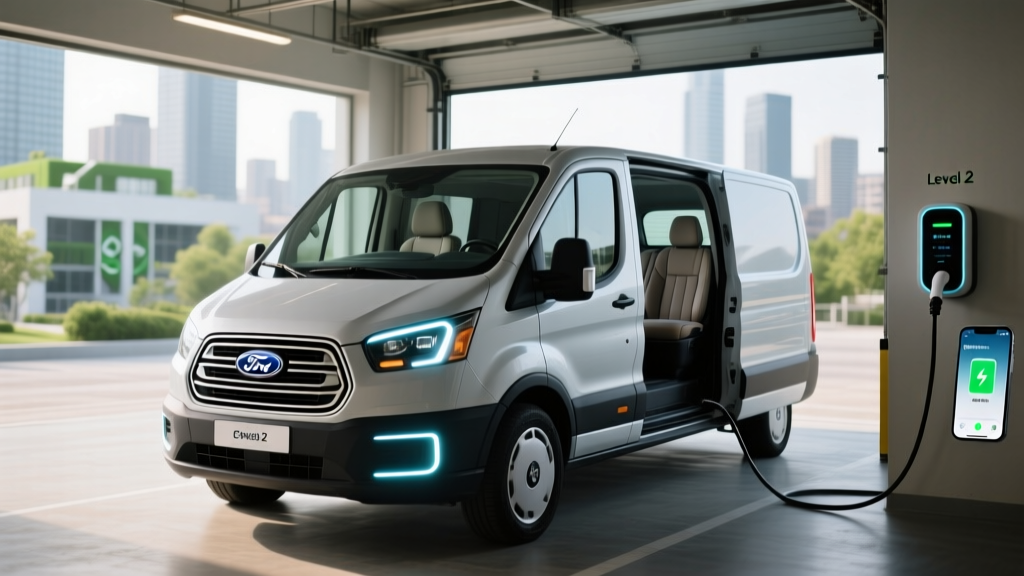
| Level 2 (240V, 48A) | 10.5 kW | ~28–30 mi/hr | Overnight depot charging; full charge in ~8 hours |
| DC Fast Charge | 115 kW peak | ~150 mi/hr (at peak) | Mid-shift top-up; 10–80% in ~45 min |
Depot charging is essential. Most fleet operators install multiple Level 2 stations at their facility. A single Ford Connected Charge Station Pro (included with the vehicle for some model years) delivers up to 10.5 kW. For a fleet of five E-Transits, you'll need either five individual Level 2 circuits or a smart load-management system that rotates charging across vehicles on fewer circuits — your commercial electrician can advise on panel capacity.
DC fast charging on the E-Transit peaks at 115 kW but tapers significantly above 80% state of charge. The charge curve holds near peak from roughly 10–55% SoC, then steps down progressively. Plan for 45 minutes to reach 80%, but a full 10–100% session can take over an hour. The E-Transit uses a CCS1 connector; NACS (Tesla-style) is not available on this model, so Tesla Superchargers are not accessible without an adapter (and Ford has not officially certified one for the E-Transit as of early 2026).
E-Transit vs. Gas Transit: Total Cost of Ownership
This is where the E-Transit makes its case — or doesn't. Let's compare a 5-year fleet ownership scenario based on 25,000 miles driven annually (urban delivery cycle).
| Cost Category | Ford E-Transit | Ford Gas Transit (3.5L EcoBoost) |
|---|---|---|
| Purchase Price (base MSRP) | ~$51,995 | ~$47,000 |
| Federal Commercial Clean Vehicle Credit (§45W) | Up to $7,500 (see eligibility below) | $0 |
| Effective Purchase Price | ~$44,495 | ~$47,000 |
| Fuel / Electricity (125k miles) | ~$4,500 (at $0.13/kWh avg) | ~$18,750 (at $3.50/gal, 15 MPG combined) |
| Maintenance (5 years) | ~$2,500 (no oil changes, less brake wear with regen) | ~$7,500 (oil, filters, transmission, brakes) |
| Insurance (est. avg) | ~$9,000 | ~$8,000 |
| Depot Charging Infrastructure (amortized per vehicle) | ~$2,000–$4,000 | $0 |
| Estimated 5-Year Total Cost | ~$62,495–$64,495 | ~$81,250 |
Net savings over 5 years: approximately $17,000–$19,000 per vehicle, assuming you qualify for the commercial credit and have depot charging. The break-even point typically arrives around year 2–3 for high-mileage urban fleets. According to fueleconomy.gov, the E-Transit achieves approximately 2.0 kWh/mile in combined driving, translating to roughly 6–7 cents per mile at commercial electricity rates vs. 23–25 cents per mile for the gas Transit.
Tax Credit Eligibility for Commercial Buyers
The E-Transit qualifies for the IRS §45W Commercial Clean Vehicle Credit — not the consumer §30D credit. Key rules:
- Credit amount: up to $7,500 for vehicles under 14,000 lbs GVWR (the E-Transit qualifies)
- Must be purchased for business use and placed in service
- Vehicle must meet battery component and critical mineral sourcing requirements (check current-year IRS guidance, as these phase in progressively)
- Credit is non-refundable — your business must have sufficient tax liability to absorb it
- Leased commercial vehicles may pass the credit through the lessor (consult your tax professional)
Real-World Ownership Considerations
Route Planning and Range Buffer
Fleet managers should plan routes to use no more than 70–80% of available range, leaving a buffer for traffic, HVAC use, and unexpected detours. For a 126-mile EPA-rated E-Transit, that means targeting routes of 85–100 miles maximum. Ford's Pro telematics system integrates route planning with state-of-charge monitoring, alerting dispatchers when a vehicle may not complete its assigned route.
Cold-Weather Operations
Operators in northern climates (Minnesota, Michigan, New England) face real range penalties. Testing in sub-freezing conditions shows 20–30% range loss, primarily from cabin heating and battery resistance. Strategies to mitigate:
- Precondition the battery and cabin while still plugged in at the depot
- Use seat heaters (lower energy draw than cabin air heating)
- Garage vehicles overnight when possible
- Reduce planned winter routes by 25%
Payload vs. Range Trade-Off
The E-Transit's 3,880-lb max payload is competitive with the gas Transit, but heavy loads reduce range. A fully loaded E-Transit may see 10–15% range reduction vs. an empty van. Operators running near max payload should plan for shorter routes or mid-day DC fast charging sessions.
Pro Power Onboard: A Hidden Advantage
The optional 7.2 kW Pro Power Onboard system turns the E-Transit into a mobile generator — useful for upfitted service vans powering tools, lighting, or equipment at job sites. This eliminates the need for a separate generator and the associated fuel, noise, and emissions. For tradespeople (electricians, plumbers, mobile workshops), this feature alone can justify the EV premium.
Common Misconceptions About the E-Transit
| Myth | Fact |
|---|---|
| "The range is too low for real work." | For urban last-mile delivery and service routes averaging 60–90 miles/day, 126 miles of EPA range (with overnight charging) is sufficient. The E-Transit is not designed for long-haul routes. |
| "Electric vans can't handle heavy payloads." | The E-Transit's 3,880-lb payload capacity is within ~200 lbs of the equivalent gas Transit 350 cargo van. Ford engineered the battery placement low in the chassis to preserve load floor height and capacity. |
| "Charging infrastructure is too expensive for small fleets." | A single Level 2 commercial installation runs $2,000–$5,000 per stall (depending on electrical panel capacity and conduit runs). Many utilities offer commercial EV infrastructure rebates covering 50–100% of installation costs. Check with your local utility. |
| "EV batteries won't last as long as a gas engine." | Ford warrants the E-Transit battery for 8 years / 100,000 miles against degradation below 70% capacity. Fleet data from early adopters shows less than 10% degradation at 80,000 miles in moderate climates. |
| "I can use Tesla Superchargers." | The E-Transit uses CCS1 and is not NACS-compatible. Ford's NACS adapter program currently covers consumer vehicles (F-150 Lightning, Mustang Mach-E), not the E-Transit as of early 2026. |
Decision Framework: Should You Buy the E-Transit?
Choose the Ford E-Transit If:
- Your daily routes are under 100 miles and return to a central depot
- You can install Level 2 charging at your facility (or already have it)
- You operate primarily in urban/suburban areas with moderate climates
- You want to eliminate fuel costs and reduce maintenance downtime
- Your business can utilize the §45W commercial tax credit
- You value Pro Power Onboard for job-site tool power
- Corporate sustainability goals or client requirements favor zero-tailpipe-emission vehicles
Stick With the Gas Transit (or Diesel Sprinter) If:
- Your routes regularly exceed 120 miles without opportunity charging
- You operate in extreme cold (below 10°F) for extended periods without garage parking
- You lack access to overnight depot charging and cannot install it
- Your business has insufficient tax liability to use the §45W credit
- You need towing capability (the E-Transit is not rated for trailer towing)
- You operate in rural areas with no DC fast-charging infrastructure along routes
What First-Time Commercial EV Buyers Should Know
Transitioning a fleet from gas to electric involves more than swapping vehicles. Plan for these factors:
- Electrical panel assessment: Before ordering vehicles, have a licensed commercial electrician evaluate your facility's panel capacity. Adding 5–10 Level 2 circuits may require a panel upgrade ($5,000–$15,000) or utility service upgrade ($10,000–$30,000+). Start this process 6–12 months before vehicle delivery.
- Utility rate structures: Commercial electricity rates vary by time of day. Many utilities offer EV-specific commercial tariffs with lower overnight rates. Charging 10 vehicles overnight on a time-of-use plan can cut electricity costs by 30–40% vs. standard commercial rates.
- Telematics and charge management: Ford Pro's software ecosystem (included with the E-Transit) provides vehicle health monitoring, charge scheduling, and route optimization. Use it — fleets that actively manage charging schedules report better range outcomes and lower electricity costs.
- Driver training: EV driving dynamics differ from gas vehicles. Regenerative braking, one-pedal-style driving (the E-Transit offers selectable regen levels), and the absence of engine noise require driver orientation. Plan a half-day training session for each driver.
- Maintenance shifts: You'll eliminate oil changes, spark plugs, and transmission service. But EV-specific maintenance includes cabin air filter replacement, brake fluid checks (regen reduces but doesn't eliminate brake use), tire rotation (EVs are heavier and wear tires faster), and coolant system checks for battery thermal management.
E-Transit Competitor Context
The E-Transit competes in a narrow but growing segment:
- Mercedes-Benz eSprinter: Offers ~200 miles of EPA range with a larger 113 kWh battery, but starts around $75,000+ and has lower payload capacity due to battery weight. Better for longer routes; significantly more expensive.
- BrightDrop Zevo 600 (GM): Targeted at large parcel delivery fleets (FedEx, Walmart). Not widely available to small commercial buyers.
- Rivian EDV: Currently exclusive to Amazon; not available for general commercial purchase.
For small-to-mid-size fleet operators, the E-Transit remains the most accessible and affordable electric commercial van on the US market as of 2026, with the broadest dealer and service network via Ford Pro.
Frequently Asked Questions
Can the Ford E-Transit tow a trailer?
No. Ford does not rate the E-Transit for trailer towing. If your operation requires towing, you'll need to retain a gas or diesel Transit for those duties.
How long does the E-Transit battery last before needing replacement?
Ford warrants the battery for 8 years / 100,000 miles, guaranteeing it will retain at least 70% of original capacity. Real-world fleet data from early-adopter operators shows approximately 8–12% degradation at 80,000 miles in moderate climates. A full battery replacement (out of warranty) is estimated at $15,000–$20,000 based on current pricing, though costs are expected to decline.
Does the E-Transit qualify for the $7,500 federal tax credit?
The E-Transit qualifies for the §45W Commercial Clean Vehicle Credit (up to $7,500 for vehicles under 14,000 lbs GVWR), not the consumer §30D credit. Your business must have sufficient tax liability to use the credit. Battery sourcing requirements apply and change annually — consult IRS guidance or a tax professional before purchasing.
What happens if I run out of charge on a route?
The E-Transit provides progressive low-battery warnings and will eventually limit speed and shut down non-essential systems to preserve remaining range. If the battery depletes fully, the vehicle must be towed to a charger — it cannot be jump-started or refueled roadside. This is why route planning with a 20–30% range buffer is critical.
Can I charge the E-Transit at a regular home outlet?
Technically yes, via a Level 1 (120V) cord, but at ~1.4 kW, it adds only 3–4 miles of range per hour — a full charge would take over 48 hours. This is only practical as an emergency backup. For daily fleet operations, Level 2 (240V) depot charging is mandatory.
Is the E-Transit available as a passenger wagon or cutaway?
Ford offers the E-Transit as a cargo van (low, medium, and high roof; regular, long, and extended wheelbase) and as a cutaway chassis for upfitters (box trucks, shuttle buses). A passenger wagon variant has not been offered in the US market as of 2026.