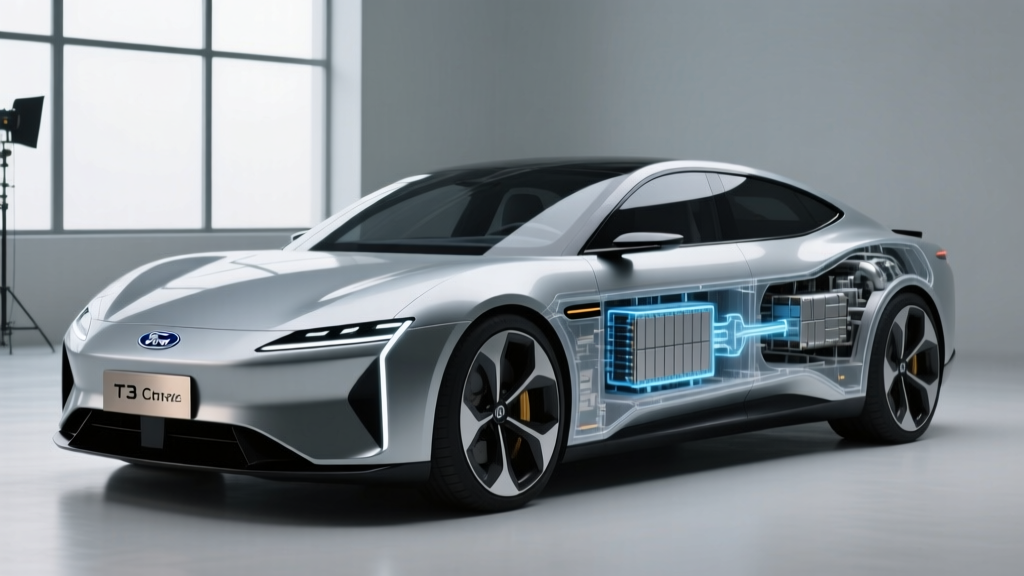
Ford's next-generation electric vehicles are being developed under a secretive internal initiative with the code name T3 (Trust, Transport, Technology). This "skunkworks" EV platform, spearheaded by former Tesla and Apple executive Alan Clarke, represents Ford's ground-up rethink of how to build affordable, high-volume electric trucks and SUVs. For buyers, the T3 platform signals vehicles targeting a sub-$40,000 starting price, 300+ miles of EPA range, and a production start targeted for 2027 at Ford's Louisville, Kentucky assembly plant.
Quick Answer: What Is the Ford Skunkworks T3 Platform?
The T3 code name refers to Ford's secretive, ground-up EV architecture developed by a dedicated "skunkworks" team. It will underpin a midsize electric pickup (successor in spirit to the F-150 Lightning's market segment, but smaller and cheaper) and potentially an SUV variant. First production vehicles are expected in 2027, with pricing rumored to start below $40,000 before incentives.
Why Ford Created a Skunkworks Team for T3
Legacy automakers have struggled to compete with Tesla's cost structure because they retrofit existing platforms or build EVs on shared assembly lines. Ford's skunkworks approach — borrowing the term from Lockheed Martin's famous advanced-projects division — isolates the T3 engineering team from the bureaucracy of the broader organization. The goal: slash development time from the typical 4-5 years to roughly 2 years, and engineer a platform where the battery, chassis, and body are designed as one integrated unit rather than a battery pack bolted into a modified ICE frame.
This matters for buyers because integrated platforms yield:
- Lower curb weight — improving efficiency (kWh/100mi) without adding battery mass
- Lower manufacturing cost — fewer parts, fewer assembly steps, which translates to lower MSRP
- More interior volume — flat floors, shorter overhangs, and optimized packaging
Ford CEO Jim Farley has publicly stated that the T3 program is the company's most important product initiative, comparing it to the original Mustang's development. The Louisville plant is being retooled with a reported $2 billion investment to support the new architecture.
Expected T3 Platform Specifications
Because the T3 vehicles have not yet been officially unveiled (as of early 2026), all specifications below are based on supply-chain reporting, patent filings, and statements from Ford executives. Treat these as preliminary estimates, not confirmed figures.
| Spec | Estimated / Reported | Notes |
|---|---|---|
| Platform | T3 (ground-up EV) | Not derived from existing ICE architecture |
| Vehicle Type | Midsize electric pickup + possible SUV | Smaller than F-150 Lightning |
| Battery Chemistry | LFP (lithium iron phosphate) likely for base; NMC for extended range | LFP cuts cost, extends cycle life; NMC offers higher energy density |
| Battery Capacity | ~70-100 kWh usable (estimated) | Depends on trim and range target |
| EPA Range Target | 300+ miles | Ford has publicly stated this goal |
| DC Fast Charge Rate | ~200-250 kW peak (estimated) | 800V architecture rumored |
| 10-80% Charge Time | ~20-25 minutes (estimated) | If 800V confirmed |
| Starting MSRP | Sub-$40,000 (target) | Before federal/state incentives |
| Production Start | 2027 (targeted) | Louisville, KY assembly plant |
| Tax Credit Eligibility | Expected §30D eligible ($7,500 potential) | Subject to MSRP caps, income limits, battery sourcing rules per IRS guidelines |
Real-World Range Reality Check
If Ford hits its 300-mile EPA target, expect approximately 240-270 miles in sustained highway driving at 70 mph, and potentially 200-230 miles in sub-freezing winter conditions. Pickup trucks, with their larger frontal area and higher drag coefficient, lose efficiency faster on the highway than sedans. These estimates are based on real-world testing patterns observed with the F-150 Lightning and Rivian R1T.
T3 vs. Current EV Trucks: How It Compares
The T3 platform's midsize pickup is expected to slot below the F-150 Lightning and compete directly with vehicles like the Chevrolet Colorado-equivalent EV (if announced), the Rivian R2T, and potentially a next-gen Tesla compact truck. Here's how the projected T3 pickup stacks up against current options:
| Attribute | Ford T3 Pickup (Est.) | F-150 Lightning (2026) | Rivian R1T (2026) |
|---|---|---|---|
| Starting MSRP | ~$38,000-$42,000 | $54,995 | $69,900 |
| EPA Range | 300+ mi (target) | 240-320 mi | 270-410 mi |
| Battery (usable kWh) | ~70-100 | 98-131 | 95-149 |
| Peak DC Charge (kW) | ~200-250 | 150-210 | 220 |
| 0-60 mph | ~5.5-6.5 sec (est.) | 3.8-5.0 sec | 3.0-4.5 sec |
| Towing Capacity | ~5,000-7,500 lbs (est.) | 7,700-10,000 lbs | 11,000 lbs |
| Segment | Midsize | Full-size | Midsize (premium) |
The trade-off is clear: the T3 pickup sacrifices the towing capacity and brute performance of the Lightning and R1T in exchange for a dramatically lower price point. For buyers who need a daily-driver truck for commuting, light hauling, and weekend projects — not 10,000-pound trailer towing — this is a rational trade.
Ownership Cost: T3 Pickup vs. Gas Midsize Truck
The strongest argument for the T3 platform isn't just the sticker price — it's the total cost of ownership (TCO). Here's a projected 5-year cost comparison against a gasoline midsize truck like the Toyota Tacoma or Ford Ranger, assuming 15,000 miles/year, $0.13/kWh home charging, and $3.40/gallon gas:
| Cost Category (5 Years) | Ford T3 Pickup (Est.) | Gas Midsize Truck (e.g., Tacoma) |
|---|---|---|
| Purchase Price (after §30D credit) | ~$30,500-$34,500 | $35,000-$42,000 |
| Fuel / Electricity (75,000 mi) | $2,925-$3,500 | $8,500-$10,200 |
| Maintenance (oil, filters, brakes) | $800-$1,200 | $3,000-$4,500 |
| Insurance (avg.) | $7,500-$9,500 | $6,000-$8,000 |
| Estimated 5-Year Total | ~$41,725-$48,700 | ~$52,500-$64,700 |
Key assumptions: The T3 pickup qualifies for the full $7,500 federal tax credit under IRS §30D rules (subject to income caps of $150K single/$300K joint, MSRP caps of $80K for trucks, and battery component/critical mineral sourcing requirements). Insurance is typically 15-25% higher for EVs due to repair costs and parts pricing, though this gap has been narrowing. EV maintenance savings come from eliminating oil changes, transmission fluid, spark plugs, and drastically reduced brake wear thanks to regenerative braking.
Real-World Ownership Considerations for T3 Buyers
Home Charging Access Is Non-Negotiable for Most Buyers
If you can install a Level 2 home charger (240V, 40-48 amp circuit), a T3 pickup with a ~85 kWh battery would recharge fully overnight in roughly 8-10 hours. Installation costs range from $500-$2,500 depending on panel capacity and conduit runs. Without home charging, relying on public DC fast chargers at $0.35-$0.50/kWh erases much of the fuel-cost advantage and adds significant inconvenience.
Climate Matters More Than You Think
LFP batteries — likely in the base T3 trim — handle cold differently than NMC. In temperatures below 20°F, expect 20-30% range reduction during short-trip driving (the battery doesn't warm up enough to recover efficiency). Ford's thermal management system and heat pump (if included) will mitigate this, but buyers in Minnesota, Montana, or New England should budget for real winter range of ~200-230 miles from a 300-mile EPA truck.
Towing Kills Range
If you plan to tow frequently, understand that towing a 4,000-pound trailer can reduce EV range by 40-50%. A 300-mile truck becomes a 150-170-mile truck under load. This isn't unique to the T3 — it applies to every EV pickup — but it's the single biggest shock for first-time EV truck owners coming from gas trucks.
Common T3 and EV Truck Misconceptions
| Myth | Fact |
|---|---|
| "The T3 will be a $25,000 truck." | Ford's target is sub-$40,000 MSRP. After the $7,500 credit, effective cost could reach ~$30,500, but the sticker won't be $25K. |
| "LFP batteries mean short range." | LFP energy density has improved significantly. Tesla's Model 3 RWD uses LFP and achieves 272 miles EPA. A midsize truck with a large LFP pack can hit 300+ miles. |
| "It'll be available in 2026." | Production is targeted for 2027. Reservations may open in late 2026, but delivery timelines for new platforms historically slip 3-6 months. |
| "EV trucks can't tow anything useful." | The T3 is expected to tow 5,000-7,500 lbs — adequate for boat trailers, small campers, and utility trailers. It won't match heavy-duty gas trucks, but most half-ton truck owners never tow above 6,000 lbs. |
| "The battery will need replacing in 5 years." | Modern EV batteries are warrantied for 8 years/100,000 miles (minimum per EPA mandate), with LFP chemistry offering 3,000+ charge cycles before significant degradation. Expect 85-90% capacity retention at 150,000 miles. |
Decision Framework: Should You Wait for the T3 or Buy Now?
Choose Based on Your Timeline and Needs
- Buy a current EV truck NOW if: You need a truck within 6 months, require 7,700+ lb towing capacity, or want proven reliability data with real-world range validation. The F-150 Lightning (starting ~$55K) and Rivian R1T (starting ~$70K) are proven, available, and eligible for incentives.
- Wait for the T3 platform if: Your budget is $35,000-$45,000, you don't need heavy towing, you can wait until mid-to-late 2027 for delivery, and you want the latest-generation charging speeds and efficiency. The T3's price point will be genuinely disruptive if Ford delivers on its targets.
- Consider a PHEV truck instead if: You lack home charging access, regularly tow over 5,000 lbs, or live in a region with limited DC fast-charging infrastructure. A plug-in hybrid gives you electric commuting with gas-powered range security.
Frequently Asked Questions
What does "skunkworks" mean in the context of Ford's EV program?
"Skunkworks" refers to a small, semi-autonomous engineering team operating outside a company's normal development process. Ford assembled a dedicated team — led by veteran engineer Alan Clarke, who previously worked on Tesla's architecture — to develop the T3 platform with fewer bureaucratic constraints. The goal is faster development, lower costs, and more innovative engineering than a traditional cross-departmental program would allow.
Will the T3 truck qualify for the $7,500 federal tax credit?
Ford is engineering the T3 for North American production (Louisville, KY) and is likely structuring battery sourcing to meet IRS §30D requirements. However, eligibility depends on final battery component sourcing, critical mineral origin, your personal income (caps at $150K single / $300K joint), and the vehicle's MSRP (must be ≤$80,000 for trucks). The credit can now be transferred to the dealer at point of sale, effectively reducing your purchase price at checkout. Always verify eligibility with a tax professional before purchase.
What's the difference between LFP and NMC batteries, and which will the T3 use?
LFP (lithium iron phosphate) batteries are cheaper to produce, have longer cycle life (3,000+ cycles vs ~1,500 for NMC), and are less prone to thermal runaway. They are heavier and less energy-dense, meaning you need more physical battery for the same range. NMC (nickel manganese cobalt) offers higher energy density but at greater cost and with more supply-chain complexity. Industry reporting suggests the T3 base model will use LFP to hit the sub-$40K price target, while an extended-range or performance variant may use NMC for buyers who prioritize maximum range.
Can I reserve a T3 truck now?
As of early 2026, Ford has not opened public reservations for T3-platform vehicles. The company is expected to reveal the production vehicle in late 2026 or early 2027, with reservations likely opening around the reveal event. Monitor Ford's EV page for official announcements.
How does the T3 compare to a hybrid truck like the Ford Maverick Hybrid?
The Maverick Hybrid starts around $28,000 and achieves approximately 42 MPG combined — a compelling option for buyers who want low fuel costs without range or charging concerns. The T3 electric pickup will cost more upfront (even after incentives) but offers dramatically lower per-mile fuel costs (~$0.04/mile vs ~$0.12/mile for the Maverick Hybrid at $3.40/gal), near-silent operation, instant torque, and zero tailpipe emissions. If you drive under 12,000 miles/year and can charge at home, the T3's fuel savings may not justify the price premium over a Maverick Hybrid. If you drive 15,000+ miles/year, the math shifts in the EV's favor.
What charging connector will the T3 use?
Ford has committed to the NACS (North American Charging Standard) connector for all future EVs, beginning with the 2025 model year. The T3 platform will use NACS natively, giving it direct access to Tesla's Supercharger network (now open to Ford vehicles via adapter or native port, depending on model year) as well as growing NACS infrastructure from Electrify America, EVgo, and other networks. This eliminates the CCS-to-NACS adapter hassle that early Ford EV adopters experienced.
Note: All specifications for the T3 platform are based on available reporting and Ford executive statements as of early 2026. Final production specs, pricing, and availability may differ. Always confirm details with Ford directly before making purchasing decisions.