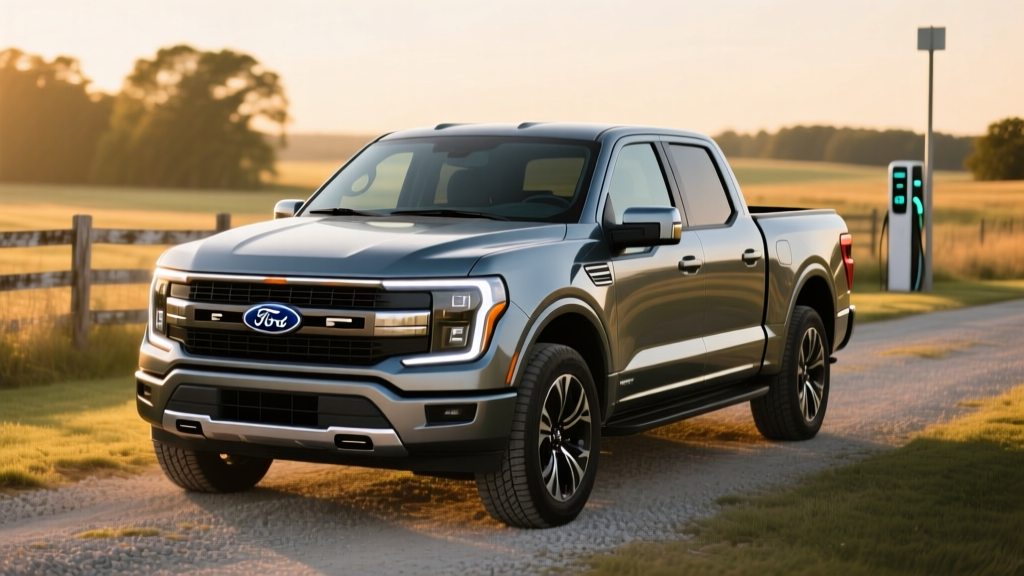
The Short Answer on Ford's New Electric Truck
If you're researching the Ford new electric truck options for 2026, the F-150 Lightning remains Ford's primary battery-electric pickup, starting at approximately $54,995 for the base Pro trim with a standard-range battery delivering an EPA-estimated 240 miles of range. The extended-range variant pushes to 320 miles EPA with a 131 kWh usable battery pack. For buyers needing heavier-duty capability, Ford has announced the next-generation electric Super Duty platform, though production timing and final specifications remain preliminary. The Lightning qualifies for partial or full federal tax credits under §30D depending on battery sourcing and buyer income, and real-world ownership costs significantly undercut the gas F-150 when home charging is available—typically saving $1,800–$2,400 annually on fuel alone for average drivers.
2026 F-150 Lightning: Current Specs and Trim Breakdown
The F-150 Lightning enters the 2026 model year with refinements to battery management software and charging optimization, though the core powertrain architecture carries over from the refreshed platform. Ford offers four primary trims, each with distinct range and capability profiles that matter enormously for truck buyers who tow, haul, or drive in cold climates.
| Spec | Pro (Std Range) | XLT (Ext Range) | Lariat (Ext Range) | Platinum (Ext Range) |
|---|---|---|---|---|
| Base MSRP | $54,995 | $69,995 | $76,995 | $96,874 |
| Battery (usable kWh) | 98 kWh (NMC) | 131 kWh (NMC) | 131 kWh (NMC) | 131 kWh (NMC) |
| EPA Range | 240 mi | 320 mi | 320 mi | 300 mi |
| Horsepower | 452 hp | 580 hp | 580 hp | 580 hp |
| Torque | 775 lb-ft | 775 lb-ft | 775 lb-ft | 775 lb-ft |
| 0–60 mph | ~4.5 sec | ~3.8 sec | ~3.8 sec | ~3.8 sec |
| Max Towing | 7,700 lbs | 10,000 lbs | 10,000 lbs | 10,000 lbs |
| Payload | 2,235 lbs | 1,952 lbs | 1,952 lbs | 1,810 lbs |
| Max DC Charge Rate | 120 kW | 150 kW | 150 kW | 150 kW |
| 10–80% DCFC Time | ~44 min | ~41 min | ~41 min | ~41 min |
| Level 2 Charge (Home) | 11.3 kW | 19.2 kW | 19.2 kW | 19.2 kW |
| Battery Warranty | 8 yr / 100k mi | 8 yr / 100k mi | 8 yr / 100k mi | 8 yr / 100k mi |
Real-World Range Reality Check
The EPA estimates are useful baselines, but truck buyers need to plan for real conditions. According to fueleconomy.gov, the extended-range Lightning achieves 78 MPGe combined. In practice:
- Highway driving (70–75 mph): Expect ~250–270 miles from the extended-range pack
- Cold weather (below 30°F): Range drops 20–30%, yielding ~200–240 miles even with preconditioning
- Towing a 5,000-lb trailer: Range cuts roughly in half—plan for 140–160 miles between charges
- Combined city/highway (mild weather): Most owners report 290–310 miles on the extended-range model
The standard-range battery suffers proportionally more in these conditions. If your typical drive cycle exceeds 180 miles one-way, the extended-range pack is essential.
Charging the Lightning: Home Setup and DC Fast Charging
Ford equips extended-range Lightnings with a 19.2 kW onboard charger—one of the fastest Level 2 systems in any consumer EV. This matters because it means a full charge from 10% to 100% takes roughly 7 hours on a properly provisioned 100-amp circuit, letting you start every morning with a full battery. The standard-range model uses an 11.3 kW charger, requiring about 9 hours for a full charge on a 60-amp circuit.
| Charging Level | Power (kW) | Miles Added Per Hour | Typical Use Case |
|---|---|---|---|
| Level 1 (120V outlet) | 1.4 kW | ~3–4 mi/hr | Emergency/trickle only |
| Level 2 (240V, 48A) | 11.3 kW | ~25–30 mi/hr | Standard-range home charging |
| Level 2 (240V, 80A) | 19.2 kW | ~42–48 mi/hr | Extended-range home charging |
| DC Fast Charge | 120–150 kW peak | ~150–200 mi in 30 min | Road trips, commercial charging |
Home installation costs for a Level 2 charger vary dramatically based on your electrical panel. A straightforward install near a 200-amp panel with short conduit runs typically costs $800–$1,500 for equipment and electrician labor. However, if your home has a 100-amp panel—which is common in older construction—you'll likely need a panel upgrade adding $1,500–$3,500 to the project. Always get a licensed electrician's assessment before committing to a trim level, since the 80-amp circuit required for 19.2 kW charging demands significant headroom on your service.
On DC fast chargers, the Lightning's charging curve is moderate rather than class-leading. The extended-range pack peaks at 150 kW but tapers noticeably above 80% state of charge. Expect a 10–80% session to take approximately 41 minutes under ideal conditions (warm battery, functioning charger). This is slower than the Hyundai Ioniq 5 or Tesla Cybertruck on comparable infrastructure, but acceptable if you plan stops around meals or rest breaks.
EV vs. Gas F-150: The Ownership Cost Comparison
The decision between an electric and gas F-150 comes down to your driving patterns, fuel costs, and how long you plan to keep the truck. Here's a data-driven comparison for a typical owner driving 15,000 miles annually over five years:
| Cost Category | F-150 Lightning (Ext Range XLT) | F-150 Gas (XLT 3.5L EcoBoost 4WD) |
|---|---|---|
| Base MSRP | $69,995 | $52,590 |
| Federal Tax Credit (§30D) | Up to $7,500* | $0 |
| Effective Purchase Price | ~$62,495 | $52,590 |
| Fuel/Energy (5 years, 15k mi/yr) | $4,500–$6,000** | $13,500–$16,500** |
| Maintenance (5 years) | ~$1,800 | ~$4,200 |
| Insurance (5 years avg) | ~$12,500 | ~$10,000 |
| Estimated Depreciation | ~$28,000 | ~$22,000 |
| 5-Year Total Cost | ~$109,295–$110,795 | ~$102,290–$105,290 |
*Federal tax credit eligibility depends on battery component sourcing, critical minerals requirements, buyer income caps ($150k single / $300k joint), and MSRP caps ($80k for trucks). Rules change frequently—verify current status at irs.gov.
**Fuel costs assume $0.14/kWh average electricity and $3.50/gallon gas. Home charging at off-peak rates can reduce Lightning costs further; exclusive public DCFC use raises them.
The Lightning's higher purchase price is partially offset by fuel savings and reduced maintenance—no oil changes, fewer brake replacements due to regenerative braking, and no transmission service. However, insurance premiums run 15–25% higher on average due to repair costs and battery replacement risk. For buyers who drive more than 20,000 miles annually, the fuel savings tip the scales decisively toward the Lightning. For low-mileage drivers (under 10,000 miles/year), the gas F-150 may remain cheaper over five years despite higher per-mile fuel costs.
Towing and Payload: Where the Lightning Succeeds and Struggles
Electric trucks face a fundamental physics challenge when towing: the energy required to move heavy loads at highway speeds drains batteries rapidly. The Lightning's maximum 10,000-lb towing capacity (with extended range and the Max Trailer Tow Package) is genuinely useful, but range anxiety becomes range certainty—you will stop more often.
In real-world towing tests conducted by multiple outlets, the extended-range Lightning pulling a 6,000-lb camper trailer achieves approximately 1.5–1.8 kWh per mile, compared to 0.45–0.50 kWh/mile unladen. That translates to roughly 130–160 miles of practical range before needing a charge. If your typical towing route has reliable DC fast chargers every 100 miles, this is manageable. If you tow through rural corridors with sparse charging infrastructure, the gas F-150's 500+ mile range between fill-ups remains a decisive advantage.
Payload capacity tells a similar story. The Lightning's independent rear suspension and heavy battery pack reduce payload compared to gas variants—the extended-range XLT maxes out at 1,952 lbs, while a comparable gas F-150 XLT can handle over 2,300 lbs. For contractors regularly loading 2,000+ lbs of materials, this limitation matters. For most recreational and light-commercial use, the Lightning's payload is sufficient.
Federal Tax Credits and Incentives: What You Actually Qualify For
The §30D Clean Vehicle Credit offers up to $7,500 for new EV purchases, but qualification has become increasingly complex since 2023. For the 2026 F-150 Lightning, eligibility hinges on three factors:
- Battery sourcing: At least 40% of critical minerals must be extracted or processed in the US or a free-trade-agreement country, AND at least 50% of battery components must be manufactured or assembled in North America. Ford has worked to reshore supply chains, but specific trim-level eligibility shifts—check the official DOE qualifying vehicle list before purchasing.
- Buyer income caps: Adjusted gross income must not exceed $150,000 (single filers), $225,000 (head of household), or $300,000 (joint filers).
- MSRP cap: The truck must have a manufacturer's suggested retail price at or below $80,000. This excludes the Platinum trim from credit eligibility but covers Pro, XLT, and most Lariat configurations.
- Point-of-sale transfer: As of 2024, you can transfer the credit to the dealer at purchase, reducing your out-of-pocket cost immediately rather than waiting for tax filing. This requires dealer participation and proper IRS registration.
Many states offer additional incentives—California's CVRP provides up to $7,000 for income-qualified buyers, Colorado offers a $5,000 state credit, and various utility companies provide $500–$1,500 rebates for home charger installation. These stack with federal credits and can meaningfully change the purchase equation, but they vary by jurisdiction and change annually. Consult your state energy office or a tax professional for current local programs.
Common Misconceptions About the Lightning
| Myth | Fact |
|---|---|
| "Electric trucks can't tow anything useful." | The Lightning tows up to 10,000 lbs—comparable to many gas half-tons. Range drops significantly, but capability is real. |
| "The battery will need replacement in 5 years." | Ford warranties the battery for 8 years/100,000 miles with a 70% capacity retention threshold. Industry data shows NMC packs typically retain 85–90% capacity at 100k miles. |
| "Charging takes hours on road trips." | DC fast charging adds 150–200 miles in 30 minutes. Plan stops around meals and you'll barely notice. |
| "You need a massive electrical upgrade at home." | Many homes with 200-amp service can add a Level 2 charger for under $1,500. Only older 100-amp panels typically require upgrades. |
| "EVs are worse in cold weather." | Range drops 20–30% in sub-freezing temps, but the Lightning's heat pump and battery preconditioning mitigate this. Remote start without garage CO risk is a genuine winter advantage. |
| "The Lightning is just a compliance car, not a real truck." | The Lightning has proven itself in commercial fleets, construction sites, and rural use. Its frunk, Pro Power Onboard, and instant torque make it functionally superior to gas trucks in many scenarios. |
Decision Framework: Is the Ford New Electric Truck Right for You?
Choose the F-150 Lightning If:
- You have reliable home charging access (garage or driveway with 240V circuit capability)
- Your daily driving is under 200 miles, with occasional longer trips you can plan around charging
- You value instant torque for towing, off-road traction, or job-site responsiveness
- You want Pro Power Onboard (up to 9.6 kW) for running tools, appliances, or backup home power
- You drive 15,000+ miles annually, making fuel savings substantial
- You qualify for federal/state tax credits that narrow the price gap with gas variants
Stick with a Gas F-150 If:
- You regularly tow heavy loads (>7,000 lbs) over long distances through areas with sparse charging
- You lack home charging access and would rely entirely on public infrastructure
- Your annual mileage is under 10,000 miles, minimizing fuel-cost advantages
- You need maximum payload capacity for commercial hauling
- You live in an area with extreme cold (-20°F or below) and cannot garage the vehicle
- You plan to keep the truck 10+ years and are concerned about long-term battery replacement costs ($15,000–$25,000 out of warranty)
Frequently Asked Questions
What is the real-world range of the F-150 Lightning extended range?
The EPA rates it at 320 miles, but expect 250–280 miles in mixed highway driving, 200–240 miles in cold weather, and 130–160 miles when towing a 5,000–6,000 lb trailer. Preconditioning the battery before driving and using seat heaters instead of cabin heat can recover 10–15 miles in winter.
How long does it take to charge the Lightning at home?
With the extended-range battery and a properly installed 80-amp Level 2 charger (19.2 kW), a full charge from 10% to 100% takes about 7 hours. The standard-range battery on a 48-amp circuit (11.3 kW) requires roughly 9 hours. Most owners charge overnight and start each day with a full battery.
Can the F-150 Lightning power my house during an outage?
Yes, with Ford's Intelligent Backup Power system and the required Home Integration System (approximately $3,895 plus installation), the Lightning can supply up to 9.6 kW to your home for up to three days on a full charge. This requires professional installation of a transfer switch and is not a simple plug-and-play solution.
What does battery replacement cost if it fails out of warranty?
Current estimates for out-of-warranty Lightning battery replacement range from $15,000 to $25,000 depending on pack size and labor. However, industry degradation data suggests most NMC packs retain 85–90% capacity at 100,000 miles and remain functional well beyond 150,000 miles. Catastrophic failure is rare; gradual capacity loss is the typical wear pattern.
Does the Lightning qualify for the $7,500 federal tax credit in 2026?
Eligibility varies by trim and changes as battery sourcing requirements tighten. As of early 2026, Pro and XLT trims with MSRP below $80,000 generally qualify for full or partial credits if buyer income limits are met. The Platinum trim exceeds the MSRP cap and does not qualify. Always verify current status at fueleconomy.gov before purchasing, as rules update periodically.
How does the Lightning compare to the Rivian R1T or Tesla Cybertruck?
The Lightning prioritizes familiarity, dealer service access, and work-truck functionality over the R1T's adventure-oriented design or the Cybertruck's polarizing aesthetics. The Lightning offers a larger frunk (14.1 cu ft), Pro Power Onboard, and conventional styling that appeals to traditional truck buyers. The R1T delivers superior range (up to 410 miles) and off-road capability; the Cybertruck offers faster charging (250+ kW) and stainless-steel durability. Your choice depends on whether you value mainstream serviceability (Lightning) or niche capability (R1T/Cybertruck).
What maintenance does the Lightning require?
Significantly less than a gas F-150. Expect tire rotations every 7,500 miles, cabin air filter replacement annually, brake fluid checks every 2 years, and windshield washer fluid top-offs. The regenerative braking system dramatically extends brake pad life—many EV owners report original brake pads lasting 100,000+ miles. No oil changes, spark plugs, transmission fluid, or exhaust system maintenance required.
The Ford new electric truck strategy centers on the F-150 Lightning as a bridge product—familiar enough to attract traditional truck buyers, capable enough to prove electric propulsion works in demanding applications. For 2026, it remains the most accessible full-size electric pickup with nationwide dealer support, making it the pragmatic choice for buyers ready to electrify their truck usage without betting on startup brands or unproven platforms.