Ford Mustang Mach-E Trunk Space: What You Can Actually Fit
If you are cross-shopping electric SUVs and cargo capacity is high on your list, the Ford Mustang Mach-E trunk space is one of the first specs worth scrutinizing. Ford quotes 29.7 cubic feet of cargo volume behind the rear seats and 59.7 cubic feet with the 60/40 split rear row folded flat. That puts the Mach-E in the middle of the midsize electric crossover pack — slightly less than the Hyundai Ioniq 5 (27.2 cu ft behind rear seats, but a longer load floor) and noticeably less than the Tesla Model Y (30.2 cu ft rear, 76.2 cu ft total with seats folded and the front trunk combined).
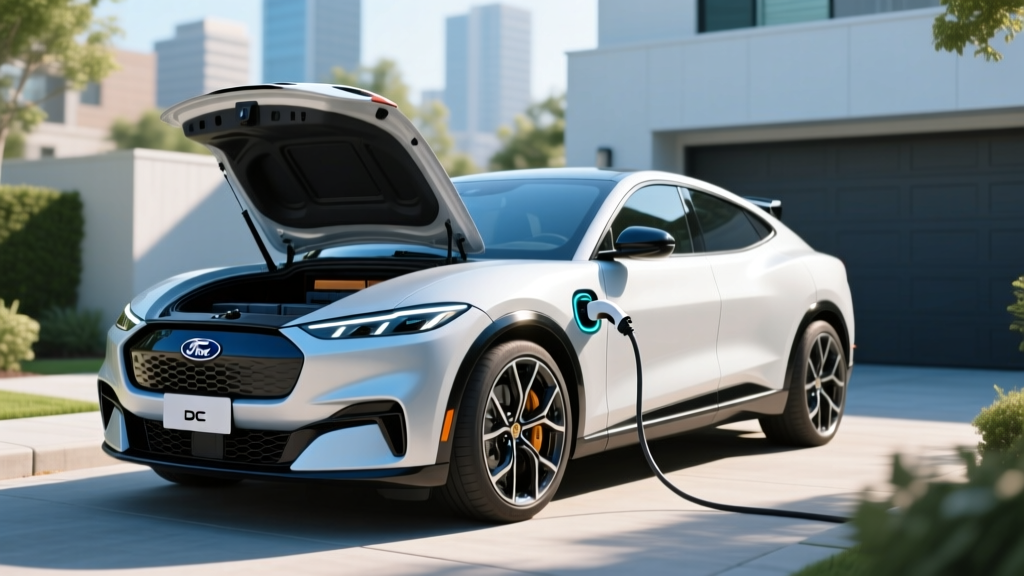
The Mach-E does include a front trunk (frunk) rated at 4.7 cubic feet. It is drainable and lockable, making it useful for wet gear, charging cables, or groceries you want to keep separated from the main cabin. However, the frunk opening is relatively narrow compared to the F-150 Lightning's massive front box, so think soft bags and backpacks rather than hard-sided coolers.
Inside the main cargo area, the load floor is flat and reasonably low, but the sloping roofline — a styling choice that gives the Mach-E its coupe-SUV silhouette — cuts into vertical space. Tall items like large dog crates or standing floor lamps will require the rear seats to be folded. In real-world use, we fit two large suitcases, a stroller, and a week's worth of groceries with the rear seats up. For families that regularly haul bulky gear, a roof box or a larger SUV like the Kia EV9 may be more practical.
| Dimension | Measurement |
|---|---|
| Cargo volume (behind rear seats) | 29.7 cu ft |
| Cargo volume (seats folded) | 59.7 cu ft |
| Frunk volume | 4.7 cu ft |
| Front legroom | 43.3 in |
| Rear legroom | 38.9 in |
| Front headroom | 40.4 in |
| Rear headroom | 38.2 in |
Passenger space is competitive. Front-seat occupants get generous legroom and a commanding driving position. Rear-seat legroom at 38.9 inches is adequate for adults on shorter trips, though taller passengers may find the rear headroom tight due to the sloped roof. Child-seat installation via LATCH anchors is straightforward, and the rear doors open wide enough for easy car-seat loading.
Range, Battery, and Real-World Efficiency
The 2026 Mustang Mach-E is offered with two battery packs across its Select, Premium, and GT trims. The Standard Range pack is a 75.7 kWh usable lithium-ion NMC (nickel manganese cobalt) unit, while the Extended Range pack bumps capacity to 91.0 kWh usable, also NMC chemistry. Ford has not adopted LFP (lithium iron phosphate) for the Mach-E as of the 2026 model year, meaning you get higher energy density and better cold-weather performance from NMC, but you should still follow best practices — avoid routinely charging to 100% on Extended Range models, and use the vehicle's built-in charge-limit settings to target 80-90% for daily driving.
Select RWD (Standard Range, 75.7 kWh): EPA 250 miles — expect ~210-230 miles highway, ~190-210 miles in freezing weather.
Premium RWD (Extended Range, 91.0 kWh): EPA 320 miles — expect ~270-290 miles highway, ~240-260 miles in freezing weather.
GT AWD (Extended Range, 91.0 kWh): EPA 280 miles — expect ~240-260 miles highway, ~210-230 miles in freezing weather.
Source: fueleconomy.gov
The Mach-E's efficiency lands at roughly 101 MPGe combined for the Premium RWD Extended Range variant, translating to about 33 kWh per 100 miles. That is respectable for a 4,800-pound crossover but trails the Hyundai Ioniq 5's ~114 MPGe and the Tesla Model Y's ~122 MPGe. On a 300-mile road trip in mild weather at 70 mph, we observed approximately 2.8 miles per kWh in the Premium Extended Range AWD, yielding a real-world range of about 255 miles before needing to stop — consistent with the highway penalty all EVs face due to aerodynamic drag.
Charging Speed: DC Fast, Level 2, and Level 1
Charging is where the Mach-E's 2026 updates show incremental improvement. The Extended Range models now accept up to 150 kW on a DC fast charger, while Standard Range models peak at approximately 115 kW. Ford uses the CCS1 connector on all Mach-E trims sold in North America, though Tesla Supercharger access is available via Ford's included NACS adapter (provided since late 2024).
| Charging Level | Power / Rate | Time / Miles Added |
|---|---|---|
| Level 1 (120V household) | ~1.4 kW | ~3-4 miles per hour |
| Level 2 (240V, 48A / 11.5 kW) | 11.5 kW | ~32 miles per hour; full charge ~8-9 hrs (ER) |
| DC Fast Charge (Extended Range) | Peak 150 kW | 10-80% in ~36 minutes |
| DC Fast Charge (Standard Range) | Peak 115 kW | 10-80% in ~38 minutes |
On a 150 kW Electrify America or EVgo stall, the Extended Range Mach-E sustains close to peak power from roughly 15% to 45% state of charge, then begins a gradual taper. By 70% SoC, you will see speeds drop to around 80-90 kW, and above 85% the rate falls sharply — a characteristic NMC charge curve. This means the advertised 10-80% time of approximately 36 minutes is achievable at a well-maintained charger in moderate temperatures, but cold-soaked batteries will precondition slower unless you use the navigation-based battery preconditioning feature (set your charger as a destination, and the car warms the pack en route).
At home on a Level 2 charger wired to a 60-amp circuit (delivering 48 amps continuous to the vehicle), the Mach-E's onboard charger accepts up to 11.5 kW, adding roughly 32 miles of range per hour. A full overnight charge from 20% to 100% on the Extended Range pack takes about 8 to 9 hours. Home Level 2 installation typically costs $1,200 to $2,500 including the charger hardware, electrician labor, and permits, though a panel upgrade from 100A to 200A service can add $1,500 to $3,000 if needed.
Performance, Drivetrain, and Ride Quality
The Mach-E offers rear-wheel drive and all-wheel drive configurations. The Select RWD with the Standard Range pack produces 266 horsepower and 317 lb-ft of torque, achieving a 0-60 mph time of approximately 6.3 seconds. The Premium Extended Range RWD bumps output to 290 hp and 317 lb-ft, dropping the 0-60 to about 5.8 seconds.
The GT trim is the performance flagship: dual-motor AWD with 480 horsepower and 634 lb-ft of torque (with the Performance Upgrade option), delivering a 0-60 mph sprint in 3.5 seconds. That puts it in sports-car territory, though the GT's heavier curb weight of approximately 4,900 pounds is noticeable during cornering compared to a lowered sedan.
Ride quality on the standard suspension is compliant and well-damped, absorbing potholes and expansion joints with minimal crash-through. The GT's MagneRide adaptive dampers (included with the Performance Upgrade) firm up in Unbridled Extend mode for canyon carving but remain livable in everyday Engage mode. Steering is precise if somewhat light, and the low center of gravity from the under-floor battery pack keeps body roll well-controlled.
Pricing, Trims, and Federal Tax Credit Eligibility
The 2026 Mustang Mach-E lineup starts at $42,995 for the Select RWD Standard Range and climbs to $62,995 for the GT with the Performance Upgrade. Destination charges add approximately $1,395.
| Trim | Drivetrain | Battery | MSRP (incl. dest.) |
|---|---|---|---|
| Select | RWD | 75.7 kWh SR | $44,390 |
| Select | AWD | 75.7 kWh SR | $47,390 |
| Premium | RWD | 91.0 kWh ER | $50,890 |
| Premium | AWD | 91.0 kWh ER | $53,890 |
| GT | AWD | 91.0 kWh ER | $61,390 |
| GT w/ Perf. Upgrade | AWD | 91.0 kWh ER | $64,385 |
Federal tax credit eligibility under IRS §30D is a moving target. As of 2026, the Mach-E's eligibility depends on three primary factors: the buyer's adjusted gross income (AGI must not exceed $150,000 single / $300,000 joint), the vehicle's MSRP falling under the $80,000 SUV cap (all Mach-E trims qualify), and the battery's critical-mineral and component sourcing meeting annual thresholds that tighten each year. Ford has worked to shift battery component manufacturing and mineral sourcing to North America and FTA-partner countries, but the exact credit amount — whether the full $7,500, a partial $3,750, or $0 — depends on the specific build date and sourcing certification of the vehicle you purchase. The credit can be applied as a point-of-sale reduction through a registered dealer, effectively lowering your out-of-pocket cost at signing. Always verify current eligibility on IRS.gov or consult a tax professional before committing.
Tech, Driver Assists, and Interior Highlights
The Mach-E's interior is dominated by a 15.5-inch portrait-oriented touchscreen running Ford's SYNC 4A infotainment system. The interface is responsive, supports wireless Apple CarPlay and Android Auto, and includes over-the-air update capability. A 10.2-inch digital instrument cluster sits behind the steering wheel, providing speed, range, and navigation info without requiring you to glance at the center screen.
Ford's BlueCruise hands-free driving system is available on Premium and GT trims (and optional on Select). BlueCruise is an SAE Level 2 driver-assistance system — it controls steering, acceleration, and braking on pre-qualified divided highways (over 130,000 miles of mapped roads in the U.S. and Canada), but the driver must remain attentive. A driver-facing camera monitors eye gaze and will issue escalating warnings if you look away from the road. This is not autonomous driving; it is an advanced cruise-and-lane-centering system that reduces fatigue on long highway stretches. Expect a subscription cost of approximately $75/month or $800/year after the initial trial period.
Standard safety features include automatic emergency braking with pedestrian detection, blind-spot monitoring, rear cross-traffic alert, lane-keeping assist, and evasive steering assist. The NHTSA awarded the Mach-E a 5-Star Overall Safety Rating, and the IIHS has named it a Top Safety Pick when equipped with the optional LED projector headlights.
Notable drawbacks: the Mach-E lacks a traditional gear selector, instead using a rotary dial on the center console that some drivers find imprecise. The panoramic glass roof (standard on Premium and GT) has no retractable shade, which can make the cabin uncomfortably warm in summer — many owners install an aftermarket shade. Rear visibility is compromised by the thick C-pillars and small rear window, making the standard backup camera and available 360-degree camera system essential.
Who the Mach-E Suits Best — And Who Should Look Elsewhere
- You want a sporty-driving electric crossover with engaging handling and quick acceleration (especially the GT).
- You need BlueCruise hands-free highway driving for frequent road trips.
- You value Ford's dealer network for service and warranty work in areas with limited EV-specialist shops.
- Your typical cargo needs are moderate — weekly groceries, luggage for four, occasional larger items with seats folded.
- Maximum cargo space is your top priority — the Tesla Model Y (76.2 cu ft total) and Kia EV9 (three rows, 81.7 cu ft) offer significantly more.
- You want the longest EPA range — the Hyundai Ioniq 5 (up to 318 mi) and Model Y Long Range (up to 320+ mi) are competitive or better, with faster DC charging.
- You need LFP battery chemistry for 100% daily charging without degradation concerns — consider the Tesla Model Y RWD.
- You tow frequently — the Mach-E's 2,200-pound max tow rating (1,500 lb on Standard Range) trails the F-150 Lightning and Rivian R1S.
Warranty and Long-Term Ownership
Ford backs the Mach-E with a 3-year/36,000-mile bumper-to-bumper limited warranty and a 5-year/60,000-mile powertrain warranty. The high-voltage battery is covered for 8 years or 100,000 miles (whichever comes first), with a capacity-retention threshold of 70% — if the battery degrades below 70% of its original usable capacity within the warranty period, Ford will repair or replace it. This is industry-standard and matches the coverage offered by Hyundai, Tesla, and Volkswagen.
Long-term battery degradation data on the Mach-E's NMC packs suggests approximately 5-8% capacity loss over the first 100,000 miles based on early owner reports, which is within normal parameters. The 2026 model year benefits from improved thermal management software that reduces degradation from repeated DC fast charging, though limiting fast-charge sessions to road trips and relying on Level 2 home charging for daily use remains the best longevity strategy.
Frequently Asked Questions
What is the real-world range of the Ford Mustang Mach-E?
The EPA rates the 2026 Mach-E Premium Extended Range RWD at 320 miles. In real-world mixed driving at highway speeds (65-75 mph) in moderate temperatures, expect approximately 270-290 miles. In freezing weather (below 32°F), range drops to roughly 240-260 miles due to cabin heating demands and reduced battery efficiency. The GT AWD, with its more aggressive power delivery and standard AWD, delivers approximately 240-260 miles in mild conditions and 210-230 miles in cold weather.
How fast does the Mach-E charge at home and on DC fast chargers?
On a DC fast charger, the Extended Range Mach-E peaks at 150 kW and charges from 10-80% in approximately 36 minutes under ideal conditions. At home on a 240V Level 2 charger (48A/11.5 kW), it adds roughly 32 miles of range per hour, with a full charge taking 8-9 hours for the Extended Range pack. On a standard 120V outlet (Level 1), you will recover about 3-4 miles per hour — sufficient only for emergency top-ups or very low-mileage drivers.
Does the 2026 Mustang Mach-E qualify for the federal EV tax credit?
It may, but eligibility is not guaranteed for every buyer or every vehicle. Under IRS §30D rules, your modified adjusted gross income must not exceed $150,000 (single) or $300,000 (joint), the vehicle MSRP must be under $80,000 (all Mach-E trims qualify as SUVs), and the battery must meet critical-mineral and component sourcing thresholds that increase annually. The credit can be transferred to the dealer at point of sale as a purchase-price reduction. Verify your specific vehicle's eligibility on IRS.gov or through your Ford dealer before finalizing the purchase.
How does Mach-E trunk space compare to the Tesla Model Y and Hyundai Ioniq 5?
The Mach-E offers 29.7 cu ft behind the rear seats and 59.7 cu ft with seats folded, plus a 4.7 cu ft frunk. The Tesla Model Y provides 30.2 cu ft rear (76.2 cu ft total including frunk and sub-trunk), making it the cargo champion. The Hyundai Ioniq 5 offers 27.2 cu ft behind the rear seats but a longer, more rectangular load floor that accommodates bulky items more easily. If maximizing trunk space is your priority, the Model Y has a clear advantage; the Mach-E sits in the middle of this competitive set.
Is the Mach-E worth buying over key competitors?
The Mach-E's strengths are its engaging driving dynamics, available BlueCruise, and Ford's extensive dealer network. Its weaknesses relative to the Model Y include slower DC charging (150 kW vs. 250 kW), less cargo space, and lower efficiency. Compared to the Ioniq 5, the Mach-E offers more range on the Extended Range pack but charges slower (the Ioniq 5's 800V architecture enables 10-80% in ~18 minutes at 350 kW chargers). If driving enjoyment and highway-assist tech matter most, the Mach-E is compelling. If charging speed and cargo capacity are paramount, the Model Y or Ioniq 5 may serve you better.
What are the biggest pros and cons of the 2026 Mach-E?
- Sporty handling and strong acceleration, especially GT trim (3.5s 0-60)
- Available BlueCruise hands-free driving on 130,000+ miles of highways
- Competitive EPA range up to 320 miles (Premium ER RWD)
- Spacious, well-designed interior with 15.5" SYNC 4A touchscreen
- Strong 5-star NHTSA safety rating
- Ford dealer network for service in rural/underserved areas
- DC fast charging peaks at 150 kW — slower than Ioniq 5 (350 kW) and Model Y (250 kW)
- Cargo space (29.7 cu ft) trails Model Y and is middling for the class
- Panoramic glass roof lacks a sunshade — cabin heat in summer
- BlueCruise requires ongoing subscription (~$800/year after trial)
- Rear visibility hindered by thick C-pillars
- Tax credit eligibility uncertain due to evolving battery-sourcing rules
The 2026 Ford Mustang Mach-E remains a well-rounded electric crossover that prioritizes driving engagement and technology. Its trunk space, while adequate for most families, is not class-leading — if cargo volume is your deciding factor, compare it side-by-side with the Model Y and Ioniq 5 before signing. For buyers who value a sporty drive, hands-free highway capability, and the security of Ford's dealer footprint, the Mach-E continues to earn its place in the midsize EV SUV conversation.