The Ford Mustang Mach-E has been one of the most recognizable electric crossovers since its launch, but buyers shopping the EV SUV segment ask one practical question above all others: how much can it actually carry? The 2026 Ford Mustang Mach-E trunk space sits at a competitive but not class-leading figure, and the answer gets more nuanced once you factor in the front trunk (frunk), passenger room, and how the sloping roofline affects real-world usability. This review covers cargo dimensions in detail alongside the full EV spec sheet — range, charging, battery chemistry, pricing, and federal tax credit eligibility — so you can decide whether the Mach-E fits your life, not just your garage.
Ford Mustang Mach-E Trunk Space and Cargo Dimensions
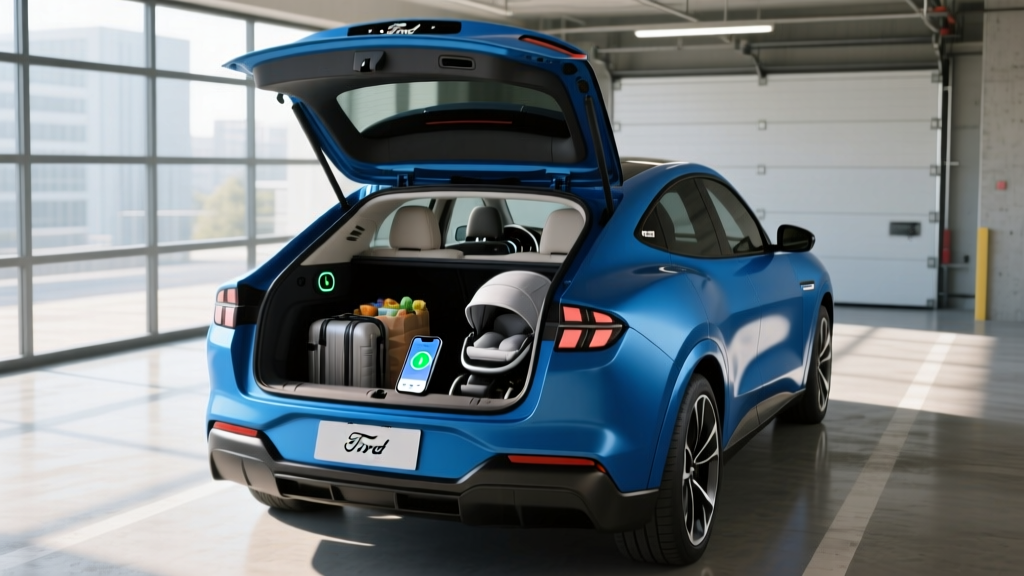
The 2026 Mustang Mach-E provides 29.7 cubic feet of cargo volume behind the second row, per Ford's official specifications. Fold the 60/40 split rear seats flat and that number expands to approximately 59.7 cubic feet. Those figures place the Mach-E in the middle of the electric compact-SUV pack — behind the Hyundai Ioniq 5 (27.2 / 59.3 cu ft, though its boxier shape yields more usable volume) and the Tesla Model Y (30.2 / 76.2 cu ft), but ahead of the Volkswagen ID.4 in some configurations.
The cargo floor is relatively flat and wide, though the sloping rear hatch — a styling choice meant to evoke the Mustang coupe lineage — cuts into vertical space. Tall items like large dog crates or stacked moving boxes will hit the headliner sooner than they would in a boxier rival. Under-floor storage is minimal because the rear axle and suspension components occupy that space on AWD trims.
The Mach-E Frunk: 4.7 Cubic Feet of Bonus Storage
One of the Mach-E's practical advantages is its front trunk, or "frunk." Ford rates it at 4.7 cubic feet, and it includes a drain plug — making it useful for storing wet gear, charging cables, or even functioning as a cooler on tailgate outings. The frunk is power-operated on higher trims (Premium and GT), which is a genuine convenience win. Total combined cargo capacity with seats folded and frunk loaded reaches roughly 64.4 cubic feet.
| Measurement | Volume |
|---|---|
| Cargo behind 2nd row | 29.7 cu ft |
| Cargo, seats folded | 59.7 cu ft |
| Frunk (front trunk) | 4.7 cu ft |
| Total maximum cargo | ~64.4 cu ft |
| Rear legroom | 38.1 in |
| Front headroom | 40.4 in |
| Rear headroom | 38.9 in |
For a family of four on a week-long road trip, the 29.7 cu ft rear area handles three carry-on suitcases and a couple of duffel bags comfortably. For larger hauling jobs — furniture, bikes (without a rack), or Costco runs — you'll want to fold at least one side of the 60/40 split. The rear headroom of 38.9 inches is adequate for most adults but tighter than the Ioniq 5 or Model Y, which matters if you frequently carry tall passengers or rear-facing child seats.
Range, Battery, and Efficiency
The 2026 Mach-E continues with two battery options across its trim lineup. The Standard Range pack is an LFP (lithium iron phosphate) unit with approximately 72 kWh of usable capacity. The Extended Range pack uses NMC (nickel manganese cobalt) chemistry with approximately 91 kWh usable. Ford's shift to LFP for the standard pack is significant: LFP cells tolerate regular 100% charging without the degradation concerns that NMC owners manage by staying below 80% for daily use.
EPA Estimated: 250 mi (Standard Range RWD) / 320 mi (Extended Range RWD) / 290 mi (Extended Range AWD)
Real-World Expectation: Plan for ~220-240 mi on the Standard Range at sustained highway speeds (70-80 mph). The Extended Range RWD delivers ~275-295 mi in mixed driving. In cold weather (below 30°F), expect a 20-30% reduction across all trims — a 320-mi Extended Range RWD could drop to ~225-255 mi on a winter road trip. The Mach-E's heat pump (standard on Extended Range trims) helps mitigate this loss compared to EVs without active thermal management.
Efficiency on the Extended Range RWD lands around 101 MPGe combined (roughly 33 kWh/100 mi), according to fueleconomy.gov. That's competitive with the Ioniq 5 but trails the more aerodynamic Tesla Model Y Long Range (~120 MPGe). In practical terms, the Mach-E uses about 3.0-3.5 kWh per 10 miles of mixed driving — a figure that matters for calculating your home-charging cost.
Charging Speed: DC Fast and Level 2
The Mach-E charges at a peak DC fast-charging rate of 150 kW on Extended Range trims and approximately 115 kW on Standard Range trims. This is the area where the Mach-E shows its age relative to newer competitors. The Hyundai Ioniq 5 peaks at 240 kW on an 800V architecture, and the Tesla Model Y can pull up to 250 kW on V3 Superchargers. The Mach-E's 150 kW ceiling means longer stops on road trips.
| Charging Level | Rate | Speed / Time |
|---|---|---|
| Level 1 (120V household) | ~1.4 kW | ~3-4 mi/hr |
| Level 2 (240V home, 48A) | ~10.5 kW | ~28-33 mi/hr; full charge in ~9-10 hr (ER) |
| DC Fast Charge (Std Range) | Peak 115 kW | 10-80% in ~40 min |
| DC Fast Charge (Ext Range) | Peak 150 kW | 10-80% in ~36 min |
The 10-80% charging time of roughly 36 minutes for the Extended Range pack is usable but not impressive by 2026 standards. The Mach-E's charge curve holds near peak for the middle portion of the session but tapers noticeably past 70% SoC. If you're planning road trips with multiple DC stops, budget about 10 extra minutes per stop compared to an Ioniq 5 or a Tesla on a V3 Supercharger. On the plus side, Ford's adoption of the NACS charge port (native Tesla connector) on the 2025+ Mach-E means direct access to Tesla Supercharger stalls without an adapter — a major infrastructure advantage that partially offsets the slower peak rate.
For home charging, the Mach-E's onboard charger accepts up to 10.5 kW (48 amps on a 60-amp circuit). A full Level 2 home installation with a Ford Connected Charge Station or a quality third-party unit like the ChargePoint Home Flex will replenish the Extended Range battery from empty in roughly 9-10 hours — easily handled overnight.
Performance and Drivetrain
The 2026 Mach-E is offered in rear-wheel drive (single motor) and all-wheel drive (dual motor) configurations across Select, Premium, and GT trims.
| Trim | Drivetrain | Horsepower | Torque (lb-ft) | 0-60 mph |
|---|---|---|---|---|
| Select SR RWD | RWD | 266 hp | 387 | 6.3 sec |
| Premium ER RWD | RWD | 290 hp | 387 | 6.1 sec |
| Premium ER AWD | AWD | 346 hp | 428 | 5.1 sec |
| GT ER AWD | AWD | 480 hp | 634 | 3.5 sec |
The GT trim's 3.5-second 0-60 time is genuinely quick and puts it in performance-SUV territory alongside much more expensive vehicles. For most buyers, the Premium ER AWD at 5.1 seconds offers more than enough passing power and all-weather traction. The single-motor RWD trims feel responsive around town but aren't meant to be sporty — they prioritize efficiency and price.
One-pedal driving is available across all trims and provides strong regenerative braking that can bring the Mach-E to a complete stop without touching the brake pedal in normal traffic. Ford's BlueCruise SAE Level 2 driver-assistance system is available on Premium and GT trims, enabling hands-free driving on pre-mapped divided highways. This is not autonomous driving — you must remain attentive and ready to take over at all times.
Pricing, Trims, and Federal Tax Credit Eligibility
The 2026 Mustang Mach-E lineup starts at approximately $39,995 for the Select Standard Range RWD and climbs to roughly $59,995 for the GT with Extended Range AWD (all figures MSRP before destination). Ford has streamlined the trim structure in recent years, but option packages — particularly the BlueCruise technology package and panoramic roof — can add $3,000-$5,000 to mid-level trims.
| Trim | Base MSRP | Est. After §30D Credit* |
|---|---|---|
| Select SR RWD | $39,995 | ~$32,495 |
| Premium ER RWD | $46,995 | ~$39,495 |
| Premium ER AWD | $49,995 | ~$42,495 |
| GT ER AWD | $59,995 | ~$52,495 |
*Federal tax credit estimates assume full §30D eligibility. Verify with a tax professional.
- MSRP Cap: SUVs/crossovers must be ≤$80,000 MSRP — all Mach-E trims qualify.
- Buyer Income Cap: AGI ≤$150,000 (single) / ≤$300,000 (joint) / ≤$225,000 (head of household).
- Battery Sourcing: Critical minerals and battery components must meet phased-in domestic/free-trade sourcing thresholds per IRS rules. Verify current-year compliance on irs.gov.
- Point-of-Sale Transfer: You can transfer the credit to the dealer at purchase, reducing your out-of-pocket cost immediately rather than waiting for tax filing.
- Final Assembly: Vehicle must undergo final assembly in North America — the Mach-E is built in Cuautitlán, Mexico, which qualifies under USMCA.
The battery-sourcing requirements have tightened annually since the Inflation Reduction Act passed, and some model-year/battery-pack combinations that qualified in prior years may not in 2026. Always confirm eligibility at purchase using the IRS VIN-lookup tool or by asking your dealer for the current credit determination letter.
Tech, Interior, and Daily Livability
The Mach-E's cabin centers on a large 15.5-inch vertical touchscreen running Ford's SYNC 4A system. The interface is responsive, supports wireless Apple CarPlay and Android Auto, and handles over-the-air updates for both infotainment and vehicle firmware. A 10.2-inch digital instrument cluster sits behind the steering wheel. Physical buttons are minimal — even the glovebox opens via the touchscreen, which is a polarizing choice.
Notable technology includes:
- BlueCruise hands-free highway driving (SAE Level 2) on 130,000+ miles of pre-mapped roads
- Phone As A Key (PAAK) — unlock and start via Bluetooth with your smartphone
- FordPass app with remote preconditioning, charge scheduling, and location tracking
- Available panoramic fixed-glass roof that opens up the cabin (no shade, which can cause heat buildup in summer)
- B&O premium audio (10 speakers on Premium/GT)
Drawbacks worth noting: the fixed glass roof lacks a retractable shade, making the cabin noticeably warmer on sunny days — many owners add an aftermarket shade. Rear visibility is compromised by the thick C-pillars and sloping hatch, making the standard rearview camera and available 360-degree camera essential. The absence of physical HVAC controls means adjusting temperature requires screen taps or voice commands, which some drivers find distracting.
Warranty and Ownership Costs
Ford provides a 3-year/36,000-mile limited bumper-to-bumper warranty and a 5-year/60,000-mile powertrain warranty. The high-voltage battery and electric drive components are covered for 8 years/100,000 miles, with a capacity retention threshold of 70% — meaning Ford will repair or replace the battery if it degrades below 70% of original capacity within that window. This matches the industry standard for EV battery warranties.
Insurance costs for the Mach-E tend to run 10-20% higher than equivalent gas-powered crossovers, consistent with the broader EV insurance trend. Maintenance is minimal — no oil changes, fewer brake replacements thanks to regenerative braking — but tire wear can be accelerated by the vehicle's weight (4,400-4,900 lbs depending on trim) and instant torque. Budget for a tire rotation every 5,000-7,500 miles and expect to replace tires every 30,000-40,000 miles on AWD trims.
Pros, Cons, and Who Should Buy the Mach-E
- Native NACS port — direct Tesla Supercharger access
- Drainable frunk with power-open on Premium/GT
- LFP standard-range battery allows daily 100% charging
- GT trim's 3.5-sec 0-60 is legitimately thrilling
- BlueCruise is among the better Level 2 systems available
- All trims under $80K MSRP cap for §30D credit
- 150 kW DC peak is slow vs. 240-250 kW competitors
- Sloping hatch limits vertical cargo space
- No physical HVAC controls — touchscreen only
- Panoramic roof lacks a shade
- Real-world highway range trails EPA by 10-15%
- Rear headroom tight for tall passengers
Best for: Commuters and small families who value driving dynamics, want NACS Supercharger access without an adapter, and don't need maximum cargo volume. The Premium ER AWD is the sweet spot — 290 miles EPA, dual-motor traction, and a well-equipped cabin for under $50K before credits. The Select SR RWD is a strong value play for budget-conscious buyers with home charging and shorter commutes.
Look elsewhere if: You regularly haul large cargo (the Model Y or Ioniq 5 are more practical), you take frequent road trips where 150 kW charging adds noticeable stop time, or you want a third row (consider the Kia EV9).
Frequently Asked Questions
What is the real-world range of the 2026 Ford Mustang Mach-E?
The EPA rates the Extended Range RWD at 320 miles, but real-world highway driving at 70-80 mph typically yields 275-295 miles. In winter conditions below 30°F, expect 225-255 miles from the same pack. The Standard Range RWD delivers around 220-240 real-world miles. Always plan road trips using 80% of the EPA figure as a safe baseline.
How fast does the Mach-E charge at home and on the road?
On a Level 2 home charger (240V, 48A), the Mach-E charges at up to 10.5 kW, adding roughly 28-33 miles per hour — a full overnight charge handles the Extended Range pack. DC fast charging peaks at 150 kW (Extended Range) or 115 kW (Standard Range), with a 10-80% session taking about 36-40 minutes. The native NACS port gives you direct access to Tesla Superchargers.
Does the 2026 Mustang Mach-E qualify for the federal EV tax credit?
All trims fall under the $80,000 MSRP cap for SUVs. Buyer eligibility depends on AGI (≤$150K single / ≤$300K joint) and current-year battery-sourcing compliance per IRS §30D rules. The credit can be transferred to the dealer at point of sale, reducing your purchase price immediately. Confirm sourcing compliance at the time of purchase, as requirements tighten annually.
How does the Mach-E compare to the Tesla Model Y and Hyundai Ioniq 5?
The Model Y offers more cargo space (76.2 cu ft max vs. 59.7) and faster charging (250 kW vs. 150 kW), but the Mach-E now shares Supercharger access via NACS. The Ioniq 5 charges much faster (240 kW, 10-80% in ~18 min) and has a roomier rear seat, but lacks a frunk. The Mach-E's advantage is driving engagement, BlueCruise, and a more traditional SUV feel. Choose based on which trade-off — cargo, charge speed, or driving dynamics — matters most to you.
Is the Mach-E a good family vehicle?
For families of up to four, yes. Rear legroom of 38.1 inches fits most child seats, and the 29.7 cu ft cargo area handles strollers and groceries. The drainable frunk is great for sports gear. However, the 59.7 cu ft max cargo with seats folded is less than rivals, and there's no third-row option. Families needing more space should look at the Kia EV9 or Rivian R1S.
What is the battery warranty on the Mustang Mach-E?
Ford covers the high-voltage battery and electric drive components for 8 years or 100,000 miles, whichever comes first. The warranty guarantees at least 70% capacity retention. If the battery degrades below that threshold within the warranty period, Ford will repair or replace it at no cost.