Ford's Mustang Mach-E enters the 2026 model year as one of the most well-rounded electric crossovers on the market — and dealer specials are making it more accessible than ever. Whether you're eyeing the Select trim for daily commuting or the GT for serious performance, understanding what's behind the incentives, how the Mach-E performs in real-world conditions, and whether it qualifies for the federal tax credit is essential before signing any paperwork.
This guide breaks down the 2026 Ford Mustang Mach-E specials landscape with hard numbers: EPA range, charging speeds, battery chemistry, total cost after incentives, and how it stacks up against rivals like the Tesla Model Y and Hyundai Ioniq 5.
2026 Ford Mustang Mach-E: Quick Spec Overview
| Spec | Select (RWD) | Premium (AWD) | GT (AWD) |
|---|---|---|---|
| EPA Range | 250 mi | 320 mi (Ext. Range) | 280 mi |
| Battery (usable) | 75.7 kWh (LFP) | 91 kWh (NMC) | 91 kWh (NMC) |
| Horsepower | 290 hp | 346 hp | 480 hp |
| 0–60 mph | 6.3 sec | 5.1 sec | 3.5 sec |
| Max DC Fast Charge | 150 kW | 150 kW | 150 kW |
| 10–80% DC Time | ~33 min | ~41 min | ~41 min |
| Level 2 Home Charge | 10.5 kW (~30 mi/hr) | 10.5 kW (~30 mi/hr) | 10.5 kW (~30 mi/hr) |
| MPGe (combined) | 105 MPGe | 98 MPGe | 84 MPGe |
| Base MSRP | $39,995 | $46,995 | $55,995 |
| Drivetrain | RWD, single motor | AWD, dual motor | AWD, dual motor |
Real-World Range: What the EPA Sticker Doesn't Tell You
EPA Estimate: 250 mi (Select RWD) / 320 mi (Premium AWD Extended Range) / 280 mi (GT)
Real-World Expectation: Highway driving at 70+ mph typically reduces range by 10–15%. Expect roughly 215–225 mi from the Select, 270–290 mi from the Premium Extended Range, and 240–250 mi from the GT on long road trips. In freezing temperatures (below 30°F), plan for an additional 15–25% reduction due to battery heating demands and cabin climate load. The Mach-E's heat pump (standard on Extended Range trims) helps mitigate cold-weather losses compared to resistive heating systems, but physics still applies.
The 320-mile Extended Range variant is the sweet spot for road-trip buyers. According to EPA data on fueleconomy.gov, the Premium AWD Extended Range achieves 98 MPGe combined — translating to roughly 31 kWh per 100 miles. That's competitive with the Hyundai Ioniq 5 Long Range (305 mi EPA, 114 MPGe combined) but trails the Tesla Model Y Long Range (330 mi EPA, 122 MPGe combined) on pure efficiency.
The Select trim's LFP (lithium iron phosphate) battery is worth noting. LFP chemistry sacrifices some energy density for longer cycle life and reduced fire risk. Ford recommends charging LFP packs to 100% regularly — unlike NMC chemistries where 80% daily limits are preferred — which partially offsets the smaller usable capacity in daily use.
Charging Speed: DC Fast, Level 2, and the Charging Curve Reality
| Charging Level | Power / Rate | Miles Added per Hour | Notes |
|---|---|---|---|
| Level 1 (120V household) | ~1.4 kW | ~3–4 mi/hr | Emergency/trickle only |
| Level 2 (240V home) | 10.5 kW | ~30 mi/hr | Full charge overnight (~10 hrs for 91 kWh) |
| DC Fast Charge | Peak 150 kW | ~180 mi in 20 min (peak) | 10–80% in ~33–41 min depending on pack |
The Mach-E's peak DC fast-charge rate of 150 kW is adequate but no longer class-leading. The Hyundai Ioniq 5 peaks at 240 kW (10–80% in ~18 minutes), and the Tesla Model Y on V3 Superchargers peaks around 250 kW. On a road trip, the Mach-E's 33–41 minute 10–80% window means slightly longer stops.
The charging curve matters as much as peak rate. The Mach-E sustains close to 150 kW from roughly 10–40% state of charge, then tapers progressively. Above 80%, charge rate drops sharply to protect the battery — often below 40 kW. This is why we quote 10–80% times rather than 0–100%. If you're planning road-trip charging, the practical move is to charge to 80% and go rather than wait for the painfully slow final 20%.
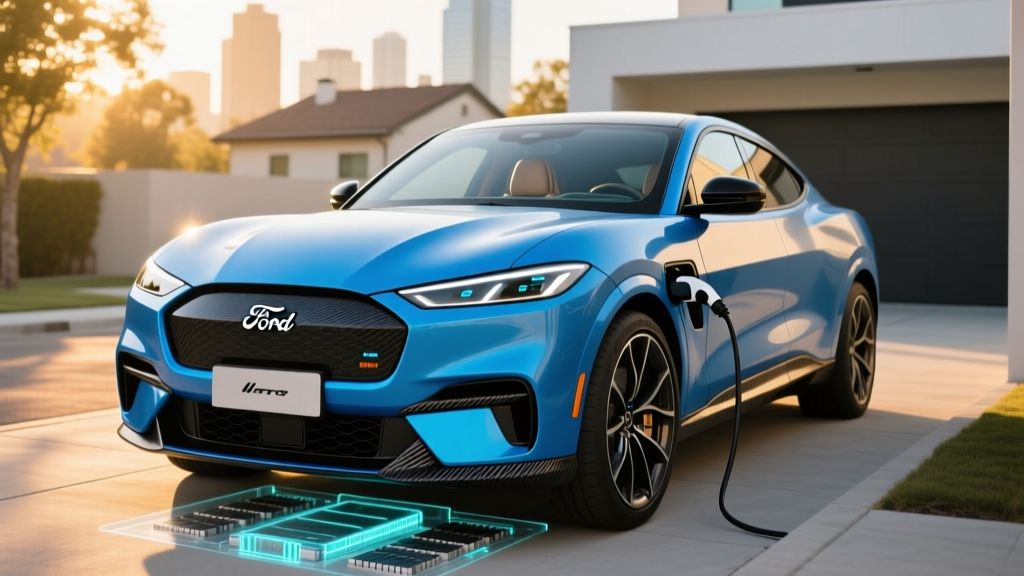
At home on a Level 2 Ford Connected Charge Station or any quality 48-amp J1772/NACS charger, the Mach-E adds roughly 30 miles of range per hour. A full overnight session (8–10 hours) replenishes even the Extended Range battery completely. Home charging installation typically runs $800–$2,000 depending on panel capacity and run length to the garage.
Performance and Drivetrain: From Commuter to Corner Carver
The base Select RWD delivers 290 horsepower and a 6.3-second 0–60 time — perfectly adequate for merging and daily driving. The Premium AWD bumps output to 346 hp with a 5.1-second sprint. But the GT is the headline act: 480 hp, 3.5 seconds to 60, and MagneRide adaptive dampers that make this 4,800-pound crossover genuinely capable on back roads.
All trims use a single-speed reduction gear (no multi-gear transmission). Regenerative braking offers multiple levels adjustable through the SYNC touchscreen, including a true one-pedal driving mode that can bring the Mach-E to a complete stop without touching the brake pedal.
The Mach-E's NACS charge port (adopted starting with the 2025 model year) gives it native access to the Tesla Supercharger network — over 25,000 stalls across North America as of 2026. This is a significant practical advantage over CCS-only vehicles in areas where Electrify America or EVgo coverage is sparse.
Pricing, Specials, and Federal Tax Credit Eligibility
| Trim | Base MSRP | Est. Federal Credit (§30D) | Effective Price (if eligible) |
|---|---|---|---|
| Select RWD | $39,995 | Up to $7,500 | ~$32,495 |
| Premium AWD | $46,995 | Up to $7,500 | ~$39,495 |
| GT AWD | $55,995 | Up to $7,500 | ~$48,495 |
Ford Mustang Mach-E specials in 2026 vary by dealer and region, but many Ford dealers are stacking manufacturer incentives (often $1,000–$3,000 in customer cash or low-APR financing) on top of available federal credits. Some dealers advertise combined savings exceeding $10,000 when factory rebates, trade-in bonuses, and the federal tax credit align.
However, the IRS §30D federal EV tax credit has specific eligibility requirements that not every buyer will meet:
- MSRP Cap: SUVs/crossovers must have an MSRP at or below $80,000. All Mach-E trims qualify.
- Income Cap: Modified AGI must not exceed $150,000 (single), $225,000 (head of household), or $300,000 (joint filers).
- Battery Sourcing: The $7,500 credit splits into two halves — $3,750 for critical-mineral sourcing and $3,750 for battery-component sourcing. Requirements tighten annually. Check the latest qualified vehicle list on fueleconomy.gov before purchasing.
- Point-of-Sale Transfer: As of 2024, buyers can transfer the credit to the dealer at purchase, reducing the sale price directly rather than waiting for a tax refund. This makes dealer specials even more impactful.
Always consult a tax professional to confirm your personal eligibility. State incentives (California's CVRP, Colorado's state credit, etc.) may stack on top — check your local DMV or energy office for current programs.
Cargo Space, Interior, and Daily Practicality
The Mach-E offers 29.7 cubic feet of cargo space behind the rear seats and 59.7 cubic feet with the rear seats folded — competitive with the Model Y (30.2/76.2 cu ft, though the Tesla's advantage comes from its deeper sub-floor area). The front trunk (frunk) adds 4.7 cubic feet of drainable storage — ideal for wet gear, charging cables, or groceries you want separated from the cabin.
Rear legroom measures 38.9 inches, which is generous for the segment. The cabin uses a minimalist design dominated by a 15.5-inch vertical SYNC 4A touchscreen. Wireless Apple CarPlay and Android Auto are standard. The available BlueCruise hands-free driving system (a SAE Level 2 driver-assist — you must remain attentive) covers over 130,000 miles of divided highways in the U.S. and Canada.
Warranty and Long-Term Battery Confidence
Ford covers the Mach-E's high-voltage battery and electric powertrain components for 8 years or 100,000 miles (whichever comes first), with a capacity-retention threshold of 70% of original capacity. If the battery degrades below that threshold within the warranty period, Ford will repair or replace it. The basic vehicle warranty is 3 years/36,000 miles.
For the LFP-equipped Select trim, long-term degradation projections are favorable. LFP cells typically retain 85–90% capacity after 1,500+ full charge cycles — translating to well over 200,000 miles of use before approaching the warranty threshold. NMC packs in the Premium and GT are somewhat more sensitive to frequent 100% charging and high-heat exposure, but Ford's liquid thermal management system provides robust temperature regulation.
Pros, Cons, and the Verdict
Pros
- NACS port = native Supercharger access (no adapter needed)
- 320-mi Extended Range variant covers most road trips comfortably
- GT trim delivers sports-car acceleration in a practical package
- LFP option on Select trim for buyers prioritizing longevity
- BlueCruise hands-free highway driving available
- Strong dealer network for service and warranty work
Cons
- 150 kW peak DC charging trails Ioniq 5 (240 kW) and Model Y (~250 kW)
- Cargo space slightly less than Model Y with seats folded
- No third-row option — families needing 6+ seats look elsewhere
- GT's efficiency drops to 84 MPGe — higher per-mile electricity cost
- Rear visibility could be better; camera mirror not available
Who the Mach-E suits best: The Select RWD is ideal for commuters who can charge at home and want an affordable entry into EV ownership — especially with LFP longevity. The Premium Extended Range AWD is the best all-rounder for couples and small families who road-trip a few times a year. The GT is for driving enthusiasts who refuse to sacrifice practicality for performance. If you regularly tow or need three rows, look at the Ford F-150 Lightning or a three-row EV like the Kia EV9 instead.
Frequently Asked Questions
What is the real-world range of the 2026 Ford Mustang Mach-E?
The EPA rates the Mach-E at 250 to 320 miles depending on trim and battery. In real-world highway driving at 70 mph, expect about 10–15% less than the EPA sticker. In freezing weather, plan for 15–25% less. The Premium AWD Extended Range is the range champion at roughly 270–290 real-world highway miles in moderate temperatures.
How fast does the Mach-E charge at home and on DC fast chargers?
At home on a 240V Level 2 charger (10.5 kW), the Mach-E adds about 30 miles of range per hour — a full overnight charge replenishes the battery. On DC fast chargers, it peaks at 150 kW, achieving a 10–80% charge in approximately 33 minutes (standard range) or 41 minutes (extended range). Charging slows significantly above 80%.
Does the 2026 Mach-E qualify for the $7,500 federal EV tax credit?
The Mach-E's MSRP falls under the $80,000 SUV cap, making it potentially eligible. However, full $7,500 credit eligibility depends on battery-component and critical-mineral sourcing requirements that change annually, plus your personal income (AGI caps apply). Check the current qualified vehicle list on fueleconomy.gov and consult a tax professional before relying on the credit.
How do Ford Mustang Mach-E specials compare to competitor incentives?
Ford dealers frequently offer $1,000–$3,000 in customer cash or low-APR financing on the Mach-E, which can stack with the federal tax credit for total savings approaching $10,000+. Tesla rarely discounts the Model Y directly but occasionally offers low-APR financing. Hyundai's Ioniq 5 incentives vary by region. Always compare the out-the-door price after all incentives, not just the sticker.
Is the Mach-E worth buying over the Tesla Model Y or Hyundai Ioniq 5?
It depends on your priorities. The Model Y wins on efficiency, Supercharger convenience (though the Mach-E now has native NACS access), and cargo volume. The Ioniq 5 wins on charging speed (240 kW peak) and interior space. The Mach-E wins on driving dynamics (especially the GT), BlueCruise availability, LFP battery option, and Ford's widespread dealer service network. Test-drive all three before deciding.
What are the biggest drawbacks of the Mustang Mach-E?
The primary limitations are its 150 kW peak charging speed (slower than key rivals), slightly less cargo space than the Model Y, and the GT trim's lower efficiency. There's no third-row option, and the rear camera mirror isn't available. For most buyers, these are minor trade-offs against the Mach-E's strengths.