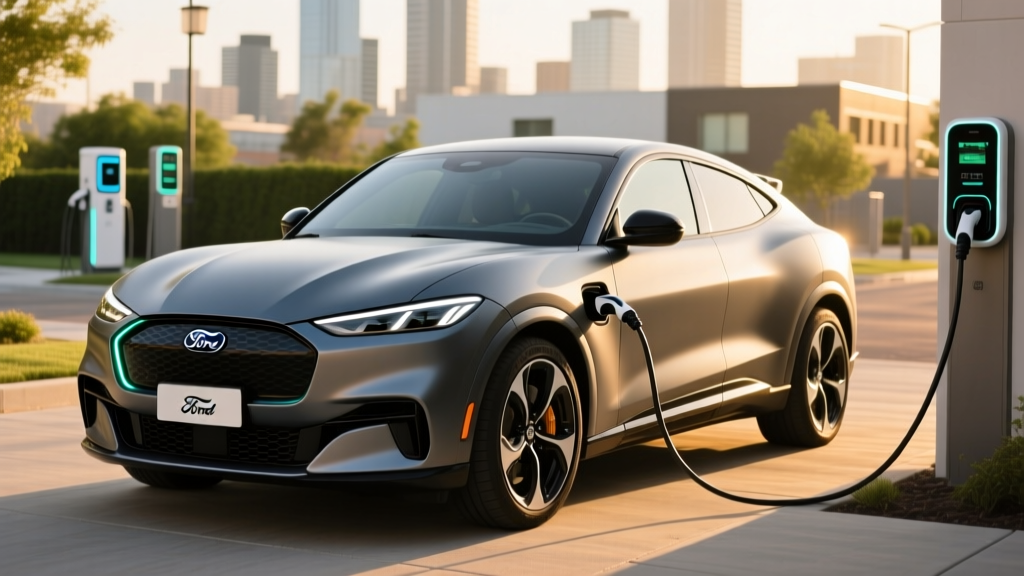
The Ford Mustang Mach-E Select has served as the entry point into Ford's electric crossover lineup since the nameplate's launch, and for the 2026 model year it remains one of the most accessible ways into a mainstream, long-range battery-electric vehicle. With a starting MSRP hovering near $39,000 before incentives, a usable battery around 70 kWh, and EPA-estimated range up to 250 miles in rear-wheel-drive form, the Select trim targets buyers who want everyday practicality without stepping into the premium or GT tiers. This review breaks down exactly what the Mach-E Select delivers—and where it falls short—using real-world driving, charging, and ownership data.
Quick Verdict: Who the Mach-E Select Is For
The Mach-E Select is best understood as a well-rounded commuter and small-family EV. It offers strong ride comfort, responsive handling for a crossover, and a spacious interior that punches above its segment weight. Where it excels: daily driving efficiency, infotainment usability, and cargo versatility. Where it compromises: peak DC fast-charging speed trails some Korean rivals, and cold-weather range loss is meaningful if you live above the 40th parallel. If you need a sub-$40K electric SUV with 240–250 miles of usable range and don't regularly tow or road-trip through charging deserts, the Select trim is a smart, data-backed choice.
Range and Efficiency: EPA Numbers vs. the Real World
For 2026, the rear-wheel-drive Mach-E Select carries an EPA-estimated 250 miles of range, while the eAWD (dual-motor all-wheel-drive) variant drops to approximately 230 miles. These figures are competitive within the segment but sit a tier below rivals like the Hyundai Ioniq 5 (up to 303 miles on Long Range trims) and the Tesla Model Y Long Range (320+ miles).
EPA Sticker: 250 miles (RWD) / 230 miles (eAWD)
Highway driving (70–80 mph, 65°F): Expect 210–225 miles (RWD) — EVs are less efficient at sustained high speeds due to aerodynamic drag.
Mixed city/suburban: 240–250 miles achievable with moderate regen use.
Cold weather (below 30°F): Plan for 170–195 miles (RWD). Lithium-ion batteries lose 15–25% of usable capacity in freezing temps, and cabin heating draws significant energy without a heat pump on the Select trim.
Practical planning range: Budget 200 miles per charge for trip planning in moderate climates; 175 miles in winter.
In terms of efficiency, the RWD Select achieves roughly 101 MPGe combined (per fueleconomy.gov), translating to approximately 33–34 kWh per 100 miles. That's solid for a 4,400-pound crossover but not class-leading. The eAWD variant dips to around 93 MPGe combined.
Battery, Chemistry, and Warranty
The Mach-E Select uses an LFP (lithium iron phosphate) battery pack with approximately 70 kWh of usable capacity (gross capacity is slightly higher to account for buffer). Ford shifted the standard-range lineup to LFP chemistry beginning with the 2024 model year, and this carries forward into 2026.
LFP trade-offs matter here: this chemistry offers excellent cycle life and can be regularly charged to 100% without the degradation concerns that NMC (nickel manganese cobalt) packs carry. However, LFP is heavier per kWh and has lower energy density, which is why the Select's range is lower than extended-range trims that use NMC. LFP also charges more slowly at the top of the curve and is more sensitive to extreme cold.
| Specification | RWD Select | eAWD Select |
|---|---|---|
| EPA Range | 250 miles | 230 miles |
| Battery (Usable) | ~70 kWh (LFP) | ~70 kWh (LFP) |
| Drivetrain | Rear-Wheel Drive | Dual-Motor AWD |
| Horsepower | 266 hp | 266 hp (combined) |
| Torque | 317 lb-ft | 417 lb-ft |
| 0–60 mph | ~6.3 seconds | ~5.1 seconds |
| Max DC Fast Charge | 150 kW | 150 kW |
| 10–80% DCFC Time | ~36 minutes | ~36 minutes |
| Level 2 Home Charge Rate | 10.5 kW (~30 mi/hr) | 10.5 kW (~30 mi/hr) |
| MPGe (Combined) | 101 MPGe | 93 MPGe |
| Cargo (Behind Rear Seats) | 29.7 cu ft | 29.7 cu ft |
| Cargo (Seats Folded) | 59.7 cu ft | 59.7 cu ft |
| Front Trunk (Frunk) | 4.7 cu ft | 4.7 cu ft |
| Rear Legroom | 38.1 inches | 38.1 inches |
| Base MSRP | $39,995 | $42,995 |
Warranty coverage: Ford provides an 8-year/100,000-mile warranty on the high-voltage battery and electric powertrain components, with a capacity-retention threshold of 70%. If the battery degrades below 70% of original capacity within that period, Ford will repair or replace it. The bumper-to-bumper warranty is 3 years/36,000 miles. This battery warranty is standard for the segment and aligns with the manufacturer's published specifications.
Charging: Home, Public, and What to Expect
Charging speed is where the Mach-E Select faces its stiffest competitive pressure. The Select peaks at 150 kW on DC fast charging via its CCS connector (NACS adapter included for Tesla Supercharger access). A 10–80% session takes approximately 36 minutes under optimal conditions—battery preconditioned, moderate ambient temperature, and a charger capable of sustaining 150 kW+.
Here's the nuance most spec sheets omit: the charge curve tapers significantly above 80%. Going from 80% to 100% on DCFC can add another 25–30 minutes, which is why road-trip strategy should focus on 10–80% hops. At a 350 kW Electrify America or Tesla Supercharger station, the Mach-E Select will not use the station's full capacity—it will peak at 150 kW and sustain roughly 100–120 kW through the bulk of the charge before tapering.
| Charging Level | Power | Speed (Miles of Range per Hour) | Full Charge Time (0–100%) |
|---|---|---|---|
| Level 1 (120V household) | ~1.4 kW | ~3–4 mi/hr | ~50+ hours |
| Level 2 (240V, 48A home charger) | 10.5 kW | ~30 mi/hr | ~7–8 hours |
| DC Fast Charge (peak) | 150 kW | ~150+ mi in 20 min | 10–80% in ~36 min |
For home charging, the onboard charger accepts up to 10.5 kW on Level 2 (48 amps on a 240V circuit). This means a full overnight charge from near-empty takes 7–8 hours. Most owners will plug in nightly and rarely need a full 0–100% session. A 40-amp or 48-amp hardwired Level 2 charger (such as the Ford Connected Charge Station or a third-party unit like ChargePoint Home Flex) is strongly recommended. Installation typically requires a 50-amp or 60-amp dedicated circuit—factor in $500–$1,500 for professional electrician installation depending on panel proximity and local permit costs. Always consult a licensed electrician for final specs.
Performance and Driving Dynamics
The RWD Select puts down 266 horsepower and 317 lb-ft of torque, delivering a 0–60 mph time of roughly 6.3 seconds. That's brisk enough for confident highway merging and passing. The eAWD variant bumps torque to 417 lb-ft and cuts the 0–60 to approximately 5.1 seconds—noticeably quicker, especially from a stop.
What stands out in daily driving is the low center of gravity and well-tuned suspension. The Mach-E Select handles corners with more composure than most crossovers in its price bracket, and the instant torque delivery makes city driving effortless. Regenerative braking offers multiple levels, including a one-pedal driving mode that can bring the vehicle to a complete stop without touching the brake pedal—a feature new EV owners quickly learn to rely on.
Ride quality is firm but compliant. Road noise is well-managed at highway speeds, though the absence of a traditional engine means tire and wind noise are more noticeable. The steering is direct and communicative for an electric crossover, which is a pleasant surprise given the segment norm of numb, over-assisted racks.
Interior, Cargo, and Tech
Step inside and the Mach-E Select greets you with a 15.5-inch vertical touchscreen running Ford's SYNC 4A infotainment system. The interface is responsive, supports wireless Apple CarPlay and Android Auto, and includes over-the-air (OTA) update capability. A 10.2-inch digital instrument cluster sits behind the steering wheel, providing speed, range, and driver-assist information.
Passenger space is generous for the segment: 43.3 inches of front legroom and 38.1 inches of rear legroom accommodate adults comfortably in both rows. The rear seat folds 60/40 for cargo flexibility.
Cargo volume is a strong point: 29.7 cubic feet behind the rear seats and 59.7 cubic feet with seats folded. The front trunk (frunk) adds 4.7 cubic feet of lockable, drainable storage—useful for groceries, gym gear, or wet items. Compared to the Tesla Model Y, the Mach-E gives up some rear cargo depth but wins on frunk usability and interior material quality at this price point.
Standard driver-assist technology includes Ford Co-Pilot360 2.0: automatic emergency braking with pedestrian detection, lane-keeping assist, blind-spot monitoring, rear cross-traffic alert, and adaptive cruise control with stop-and-go. Ford's BlueCruise hands-free highway driving system is available as an add-on subscription on higher trims and may be offered as an option package on the Select depending on model-year packaging—it is an SAE Level 2 system, meaning the driver must remain attentive and keep eyes on the road at all times.
Ford Co-Pilot360 and available BlueCruise are SAE Level 2 driver-assistance systems. The driver must remain fully engaged, monitor the road, and be prepared to take over at any moment. These systems assist with steering, acceleration, and braking on compatible highways but do not replace an attentive human driver. Level 4 autonomy (true driverless operation) is currently limited to geofenced robotaxi services like Waymo.
Pricing, Trims, and Federal Tax Credit
The 2026 Mach-E Select starts at $39,995 MSRP (RWD), including destination charge. Adding eAWD raises the price to approximately $42,995. Common option packages—such as the Mobile Power Cord, panoramic roof, or BlueCruise subscription—can push a well-equipped Select to $44,000–$46,000 before incentives.
| Configuration | MSRP | Est. §30D Credit | Effective Price |
|---|---|---|---|
| Select RWD (base) | $39,995 | Up to $7,500* | ~$32,495 |
| Select eAWD | $42,995 | Up to $7,500* | ~$35,495 |
| Select RWD w/ options | ~$44,500 | Up to $7,500* | ~$37,000 |
Federal tax credit eligibility (§30D): The Mach-E Select is assembled in North America and has historically qualified for the full $7,500 federal EV tax credit under current IRS rules. However, eligibility depends on several buyer- and vehicle-specific requirements that change periodically:
- MSRP cap: The vehicle must have an MSRP at or below $80,000 for SUVs/crossovers (the Mach-E Select clears this easily).
- Buyer income cap: Adjusted gross income must not exceed $150,000 (single), $225,000 (head of household), or $300,000 (joint filers).
- Battery sourcing: A percentage of critical minerals and battery components must be sourced from the U.S. or free-trade-agreement partners. These thresholds increase annually under the Inflation Reduction Act.
- Point-of-sale transfer: As of 2024, buyers can transfer the credit to the dealer at point of sale, receiving the $7,500 as an upfront price reduction rather than waiting to claim it on their tax return.
- One vehicle per VIN: The credit applies once per vehicle VIN and cannot be claimed again if the car is resold as used (a separate used-EV credit exists under different rules).
Always verify current-year eligibility on IRS.gov or consult a tax professional before purchase. Credit rules and battery-sourcing requirements are subject to legislative and regulatory changes.
How It Stacks Up Against Key Competitors
The Mach-E Select competes directly with the Tesla Model Y (Long Range), Hyundai Ioniq 5 (Standard Range and Long Range), Kia EV6 (Light/Standard), and Volkswagen ID.4. Here's how the Select compares on the metrics that matter most:
vs. Tesla Model Y Long Range: The Model Y wins on range (320+ miles EPA), Supercharger network exclusivity (though Ford now has NACS adapter access), and cargo volume. The Mach-E wins on interior build quality, ride comfort, and starting price on the Select trim. If range is your top priority, the Model Y leads; if value and daily comfort matter more, the Select holds its own.
vs. Hyundai Ioniq 5: The Ioniq 5's 800V architecture enables 10–80% DC charging in roughly 18 minutes at a 350 kW charger—significantly faster than the Mach-E's 36 minutes. The Ioniq 5 Long Range also offers 303 miles EPA. However, the Mach-E Select undercuts the Ioniq 5 on price and offers a more traditional crossover driving feel that some buyers prefer.
vs. Volkswagen ID.4: The ID.4 Standard Range is similarly priced but offers less range and slower acceleration. The Mach-E Select is the more engaging driver's choice; the ID.4 is the more conservative, spacious family hauler.
- You want a sub-$40K EV with 240+ miles of real-world range
- You prioritize ride comfort and handling over maximum charging speed
- You value Ford's dealer network and service accessibility
- You want LFP battery chemistry for long-term 100% charging flexibility
- You regularly drive 300+ miles between charging stops (consider Model Y LR or Ioniq 5 LR)
- You need the fastest possible DC charging for frequent road trips
- You live in an extreme cold climate and need maximum range buffer
- You want three-row seating (check the Kia EV9 or Rivian R1S)
Pros, Cons, and Ownership Realities
- Competitive base price under $40K before incentives
- LFP battery allows routine 100% charging without degradation worry
- Spacious interior with 29.7 cu ft cargo and a usable frunk
- Engaging driving dynamics for the crossover segment
- SYNC 4A infotainment is responsive and intuitive
- Qualifies for the $7,500 federal tax credit (subject to eligibility)
- Ford's widespread dealer network simplifies service and warranty work
- 150 kW peak DC charging lags 800V rivals (Ioniq 5, EV6)
- 250-mile EPA range is adequate but not class-leading
- No standard heat pump on Select — cold-weather range loss is significant
- BlueCruise hands-free driving not standard; requires subscription or package
- Rear visibility is compromised by the sloping roofline
- LFP battery is heavier, contributing to a 4,400+ lb curb weight
On the ownership side, expect insurance premiums to run 10–20% higher than a comparable gas-powered crossover, which is typical for EVs. Tire wear can be accelerated due to the vehicle's weight and instant torque—budget for tire replacement every 30,000–40,000 miles. Home charging at an average electricity rate of $0.14/kWh costs roughly $9.80 for a full charge, translating to about $0.04–$0.05 per mile—a fraction of the $0.12–$0.15 per mile a comparable gas SUV would cost at current fuel prices.
Frequently Asked Questions
What is the real-world range of the 2026 Ford Mustang Mach-E Select?
The EPA estimates 250 miles for the RWD Select and 230 miles for the eAWD variant. In real-world mixed driving at moderate temperatures, expect 220–240 miles. Highway driving at 75+ mph drops this to 210–225 miles, and cold weather (below 30°F) can reduce range to 170–195 miles. Plan trips conservatively around 200 miles per charge in normal conditions.
How fast does the Mach-E Select charge at home and on the road?
On a Level 2 home charger (10.5 kW), the Mach-E Select adds approximately 30 miles of range per hour, with a full charge taking 7–8 hours. On DC fast charging, it peaks at 150 kW and charges from 10% to 80% in approximately 36 minutes under ideal conditions. It uses a CCS connector with a NACS adapter provided for Tesla Supercharger access.
How much does the Mach-E Select cost after the federal tax credit?
The RWD Select starts at $39,995 MSRP. With the full $7,500 §30D federal tax credit (if you meet income, sourcing, and MSRP requirements), the effective price drops to approximately $32,495. The eAWD variant starts at $42,995, falling to roughly $35,495 after the credit. Always verify eligibility on IRS.gov before purchasing, as battery-sourcing and income rules are subject to change.
Does the Mach-E Select qualify for the full $7,500 federal EV tax credit?
As of current IRS guidance, the Mach-E Select qualifies for up to $7,500 under §30D, subject to buyer income limits ($150K single / $300K joint), the $80K MSRP cap for SUVs, and battery critical-mineral and component sourcing requirements. The credit can be transferred to the dealer at point of sale for an immediate price reduction. Confirm current-year eligibility at IRS.gov or with a tax professional.
Is the Mach-E Select worth buying vs. the Tesla Model Y or Hyundai Ioniq 5?
It depends on your priorities. The Mach-E Select wins on starting price, ride comfort, and interior quality. The Model Y Long Range wins on range (320+ miles) and cargo space. The Ioniq 5 wins on charging speed (18-minute 10–80% on 350 kW chargers). If value and daily comfort are your top criteria, the Select is a strong buy. If you road-trip frequently and need maximum range or fastest charging, the Model Y LR or Ioniq 5 LR may serve you better.
What is the biggest drawback of the Mach-E Select?
The most consequential limitation is its 150 kW peak DC charging speed, which results in a 36-minute 10–80% session. Competitors with 800V architectures charge in roughly half that time. For daily commuting with home charging, this is irrelevant; for frequent long-distance road trips, it means longer stops. The lack of a standard heat pump also makes cold-weather range loss more pronounced than some rivals.
How long will the Mach-E Select's battery last?
Ford warranties the high-voltage battery for 8 years or 100,000 miles against degradation below 70% of original capacity. LFP chemistry is known for excellent long-term cycle life—many industry analysts expect LFP packs to retain 85–90% capacity at 100,000 miles under normal use. Full battery replacement, if ever needed out of warranty, currently runs $10,000–$15,000 depending on labor and pack availability, though prices are expected to decline as the supply chain matures.