Quick Verdict: The Mach-E That Finally Feels Finished
After years of iterative updates, the 2026 Ford Mustang Mach-E enters its most compelling model year yet. With the switch to the NACS charge port now standard across the lineup, access to Tesla Superchargers, and the extended-range battery pushing EPA estimates to 320 miles in Select RWD trim, Ford's electric crossover has addressed its two biggest historical weaknesses: public charging convenience and range confidence. It isn't the quickest-charging EV in its class, and the GT performance trim still carries a premium that's hard to justify on efficiency alone — but as a daily driver balancing cargo space, tech, and usable range, the Mach-E is squarely in the conversation against the Tesla Model Y, Hyundai Ioniq 5, and Kia EV6.
Range, Battery & Efficiency by the Numbers
| Spec | Select RWD (Std Range) | Select RWD (Ext Range) | Premium AWD (Ext Range) | GT (Ext Range) |
|---|---|---|---|---|
| EPA Range | 250 mi | 320 mi | 290 mi | 265 mi |
| Battery (Usable) | 70 kWh | 91 kWh | 91 kWh | 91 kWh |
| Chemistry | NMC (Lithium-Ion) | NMC (Lithium-Ion) | NMC (Lithium-Ion) | NMC (Lithium-Ion) |
| MPGe (Combined) | 105 MPGe | 111 MPGe | 101 MPGe | 86 MPGe |
| kWh/100 mi | 32 | 30 | 33 | 39 |
| Horsepower | 266 hp | 266 hp | 346 hp | 480 hp |
| 0-60 mph | 6.3 sec | 6.1 sec | 5.1 sec | 3.5 sec |
| Drivetrain | RWD (single motor) | RWD (single motor) | AWD (dual motor) | AWD (dual motor) |
The Mach-E uses nickel-manganese-cobalt (NMC) chemistry across all trims. Unlike LFP batteries found in some Tesla Model Y rear-wheel-drive variants, NMC offers higher energy density — which is how Ford packs 91 usable kWh into the extended-range pack without excessive weight. The trade-off: NMC cells degrade slightly faster over time and are more sensitive to sustained 100% state of charge. Ford recommends daily charging to 90% for longevity, saving 100% for road trips. According to fueleconomy.gov, the extended-range RWD variant achieves 111 MPGe combined, making it the efficiency sweet spot of the lineup.
Charging Speed: NACS Opens the Supercharger Network
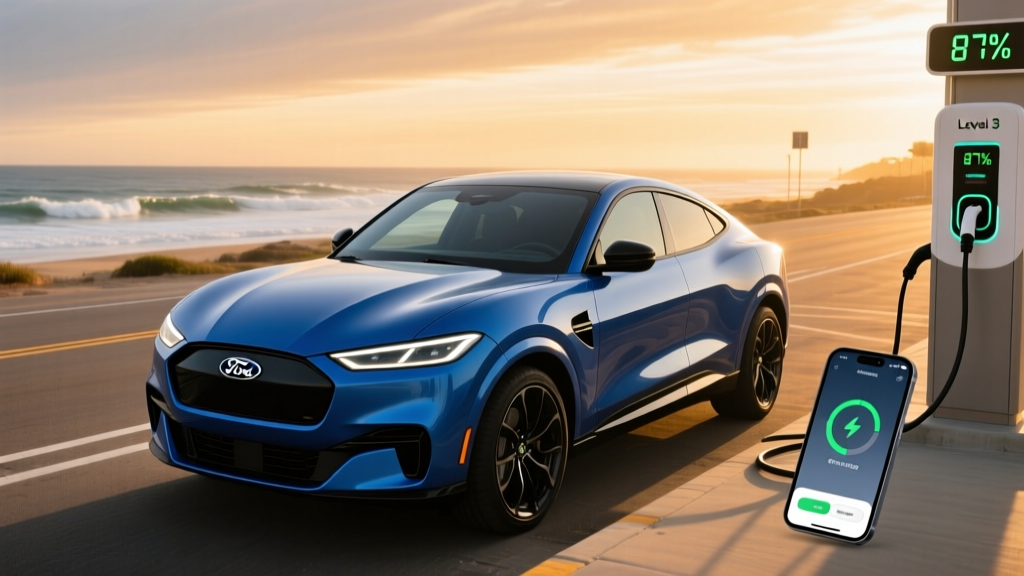
The biggest practical upgrade for 2026 is the native NACS (North American Charging Standard) port, replacing the CCS1 connector used on 2021-2024 models. This means direct access to Tesla's Supercharger network — over 25,000 stalls in North America — without an adapter. For Mach-E owners who previously relied on Electrify America or EVgo, this dramatically expands reliable DC fast-charging options on road trips.
| Charge Level | Power / Rate | Speed | Notes |
|---|---|---|---|
| Level 1 (120V) | 1.2 kW | ~3-4 mi/hr | Emergency/trickle only; full charge takes days |
| Level 2 (240V, 48A) | 11.5 kW | ~32 mi/hr | Full charge in ~10 hrs (Ext Range); requires 60A circuit |
| DC Fast Charge | Peak 150 kW | 10-80% in ~36 min | Charge curve tapers significantly above 80%; preconditioning helps |
The Mach-E's peak DC fast-charge rate of 150 kW puts it behind the Hyundai Ioniq 5 (peak 240 kW on 800V architecture) and the Tesla Model Y (peak ~250 kW at V3 Superchargers). In practice, the Mach-E sustains roughly 110-130 kW through the 20-60% state-of-charge window before tapering. If you're planning frequent 300+ mile road trips, this means 30-40 minute charge stops rather than 18-20 minute stops in the fastest-charging competitors. For daily driving with home Level 2 charging, this is a non-issue — you'll wake up with a full battery every morning.
The onboard AC charger is rated at 11.5 kW (48 amps), which is competitive for the segment. On a home Level 2 setup with a hardwired 60-amp circuit, you'll add roughly 32 miles of range per hour of charging. Expect a full overnight charge from near-empty in about 10 hours for the extended-range battery.
Performance, Ride & Daily Drivability
The Mach-E lineup spans a wide performance envelope. The Select RWD with 266 hp and a 6.1-second 0-60 time (extended range) is perfectly adequate for merging and passing — this is the volume trim, and it drives like a composed, slightly firm-riding crossover. The step up to the Premium AWD (346 hp, 5.1 seconds) adds all-weather confidence and noticeably quicker acceleration. The GT, with 480 hp and a 3.5-second 0-60, enters genuine sports-sedan territory, rivaling a Mustang GT on straight-line thrust.
What sets the Mach-E apart from some competitors is ride quality. Ford tuned the suspension with a compliance that absorbs highway expansion joints and potholes better than the stiffer Model Y. The steering is communicative without being nervous, and the low center of gravity (battery pack under the floor) keeps body roll well-controlled in corners. Regenerative braking offers multiple modes including a true one-pedal driving option that can bring the car to a complete stop without touching the brake pedal.
Interior, Cargo & Technology
The Mach-E's cabin is a departure from traditional Mustang aesthetics — minimalist, screen-forward, and decidedly crossover-oriented. The centerpiece is a 15.5-inch vertical touchscreen running Ford's SYNC 4A infotainment system with wireless Apple CarPlay and Android Auto. The interface is responsive, and physical shortcuts (volume knob, defrost button) complement the touchscreen rather than being entirely replaced by it.
Passenger space is generous for the segment:
- Front legroom: 43.3 inches
- Rear legroom: 38.9 inches
- Cargo behind rear seats: 29.7 cu ft
- Cargo with rear seats folded: 59.7 cu ft
- Front trunk (frunk): 4.7 cu ft (drainable — useful for wet gear or ice)
The frunk is smaller than a Model Y's but includes a drain plug, making it practical for tailgating or storing muddy shoes. Rear seats fold nearly flat, and the load floor height is reasonable for loading dog crates or strollers.
On the driver-assistance front, Ford Co-Pilot360 2.0 is standard, including adaptive cruise control with stop-and-go, lane centering, blind-spot monitoring, and rear cross-traffic alert. The available BlueCruise system (subscription-based after a trial period) enables hands-free driving on pre-mapped divided highways — currently over 130,000 miles of qualified roads in the US and Canada. Important clarification: BlueCruise is an SAE Level 2 system. The driver must remain attentive, and the cabin camera monitors eye gaze. This is not autonomous driving.
Pricing, Trims & Federal Tax Credit Eligibility
| Trim | Base MSRP | Est. After §30D Credit | Key Features |
|---|---|---|---|
| Select (Std Range RWD) | $39,995 | ~$32,495* | 250 mi range, 15.5" screen, Co-Pilot360 2.0 |
| Select (Ext Range RWD) | $45,995 | ~$38,495* | 320 mi range, heat pump, power liftgate |
| Premium (Ext Range AWD) | $51,995 | ~$44,495* | 346 hp, panoramic roof, BlueCruise trial, B&O audio |
| GT (Ext Range AWD) | $59,995 | ~$52,495* | 480 hp, MagneRide dampers, sport seats, GT styling |
*Estimated prices assume full $7,500 federal tax credit eligibility. Actual credit depends on individual circumstances.
The 2026 Mach-E's eligibility for the IRS §30D federal clean vehicle credit depends on several factors that buyers must verify before purchase:
- MSRP Cap: SUVs (which the Mach-E is classified as) must have an MSRP at or below $80,000. All current Mach-E trims qualify on MSRP.
- Buyer Income Limits: Modified adjusted gross income (AGI) must not exceed $300,000 (joint filers), $225,000 (head of household), or $150,000 (single filers).
- Battery Component & Critical Mineral Sourcing: A percentage of battery components must be manufactured or assembled in North America, and a percentage of critical minerals must be sourced from the US or FTA partners. These thresholds increase annually. Ford has worked to localize its supply chain, but buyers should confirm the specific vehicle's eligibility at the point of sale — dealers can provide a seller report confirming compliance.
- Point-of-Sale Transfer: Eligible buyers can transfer the credit to the dealer at purchase, reducing the purchase price by up to $7,500 on the spot rather than waiting to claim it on a tax return.
Because sourcing requirements tighten each year, a Mach-E that qualifies in early 2026 may face different rules later. Always confirm eligibility with your dealer and consult a tax professional for your specific situation.
Warranty & Long-Term Ownership
Ford backs the Mach-E with a competitive warranty structure:
- Bumper-to-bumper: 3 years / 36,000 miles
- Powertrain: 5 years / 60,000 miles
- EV battery components: 8 years / 100,000 miles (covers defects and capacity loss below 70% of original capacity)
The 70% capacity retention threshold over 8 years/100,000 miles is industry-standard, matching Tesla, Hyundai, and Kia. In practice, NMC batteries in liquid-cooled packs like the Mach-E's tend to lose roughly 8-12% capacity over the first 100,000 miles based on aggregated owner data from earlier model years — well within the warranty floor. To maximize longevity, avoid frequent DC fast charging above 80%, minimize time spent at 100% SoC, and use preconditioning when possible.
Insurance costs for the Mach-E are moderate for the EV segment. Expect annual premiums in the $1,800-$2,400 range depending on trim, location, and driving record — roughly 15-25% higher than a comparable gas-powered Escape, but lower than the Tesla Model Y in most states.
Pros, Cons & Who Should Buy
Pros
- 320-mile EPA range (Ext Range RWD) eliminates daily range anxiety
- Native NACS port unlocks Tesla Supercharger network
- Comfortable, compliant ride quality over rough roads
- Generous rear legroom (38.9") for family duty
- Drainable frunk adds practical cargo flexibility
- BlueCruise hands-free highway driving is well-executed
- Qualifies for up to $7,500 federal tax credit (with caveats)
Cons
- 150 kW peak DC charging is slower than Ioniq 5, EV6, and Model Y
- 10-80% charge time of ~36 minutes lengthens road trip stops
- GT trim's 265-mile EPA range is low for a $60K+ EV
- BlueCruise requires a paid subscription after the trial period
- No third-row seating; cargo space trails the Model Y
- SYNC 4A can lag when running wireless CarPlay + native nav simultaneously
- Commuters & daily drivers who want 300+ miles of range and comfortable highway manners.
- Small families who need rear-seat space for car seats and a frunk for gear — but don't need a third row.
- Road trippers who value Supercharger network access and can plan for ~35-minute charge stops.
- Performance seekers (GT trim) who want sports-car acceleration in a practical crossover body.
Frequently Asked Questions
What is the real-world range of the 2026 Mustang Mach-E?
The EPA rates the extended-range RWD model at 320 miles. In real-world highway driving at 70-75 mph, expect 265-280 miles. Cold weather (below 30°F) can reduce range by an additional 15-25%, bringing winter highway range to approximately 210-240 miles. City driving with regenerative braking tends to be closer to the EPA estimate.
How fast does the Mach-E charge at home and on the road?
On a home Level 2 charger (240V, 48A/11.5 kW), the Mach-E adds roughly 32 miles of range per hour, fully charging the extended-range battery in about 10 hours. On DC fast chargers, it peaks at 150 kW and charges from 10-80% in approximately 36 minutes. The charge curve tapers significantly above 80% — if you need a full charge, plan for additional time.
Does the 2026 Mach-E qualify for the $7,500 federal EV tax credit?
All Mach-E trims fall under the $80,000 SUV MSRP cap. However, eligibility also depends on buyer income limits ($150K single / $300K joint AGI), and the vehicle must meet battery component and critical mineral sourcing requirements that tighten each year. Ford has localized much of its supply chain, but always confirm eligibility with your dealer and verify against current IRS guidelines. The credit can be transferred at point of sale to reduce your purchase price immediately.
Is the Mach-E worth buying over the Tesla Model Y or Hyundai Ioniq 5?
It depends on your priorities. The Model Y offers more cargo space, faster DC charging, and a more mature Supercharger ecosystem (though the Mach-E now accesses it). The Ioniq 5 charges dramatically faster (10-80% in ~18 minutes on 800V) and has a more distinctive design. The Mach-E wins on ride comfort, interior material quality, and a more traditional driving feel. If charging speed on road trips is your top priority, the Ioniq 5 leads. If you value a comfortable daily ride and strong range, the Mach-E is an excellent choice.
What are the biggest drawbacks of the Mustang Mach-E?
The primary limitation is DC fast-charge speed: at 150 kW peak, it trails key competitors. Road-trip charge stops take 35-40 minutes versus 18-25 minutes in the fastest-charging rivals. The GT trim's range (265 EPA, ~220 real-world highway) is also modest for its price point. BlueCruise, while effective, requires a subscription after the trial period — adding ongoing cost.
Can the Mach-E use Tesla Superchargers?
Yes. The 2026 Mach-E comes with a native NACS charge port, meaning it plugs directly into Tesla Superchargers without an adapter. Ford's infotainment system can route through Supercharger locations and initiate charging sessions via the FordPass app. This was previously only available through a CCS-to-NACS adapter on older models.
How long will the Mach-E battery last?
Ford warranties the battery for 8 years or 100,000 miles against defects and capacity loss below 70%. Based on data from 2021-2024 Mach-E owners, NMC packs in this platform typically lose 8-12% capacity over 100,000 miles when properly maintained (avoiding frequent 100% charges and excessive DC fast charging). Many EV batteries remain functional well beyond 150,000 miles with gradual degradation.