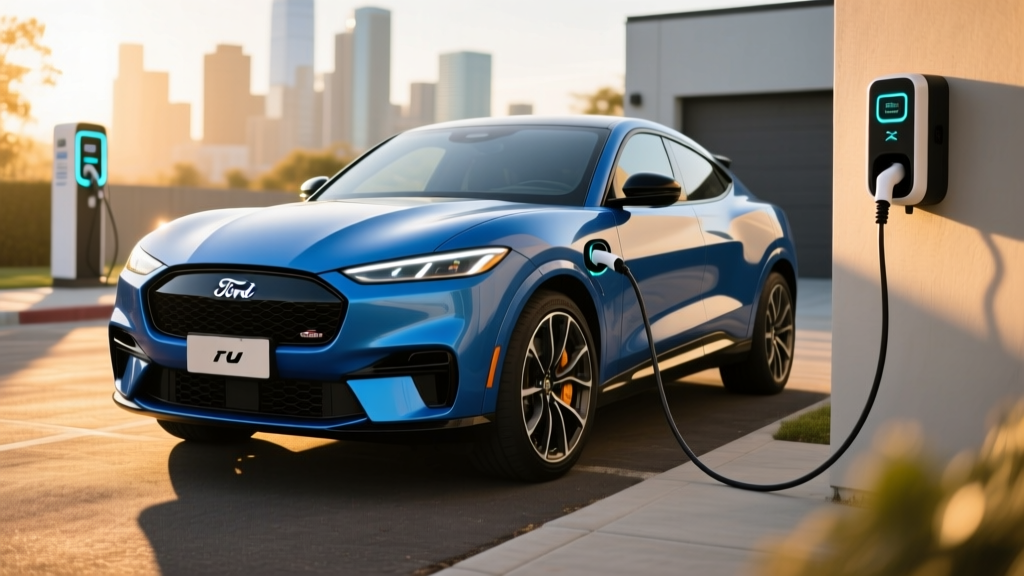
Quick Answer: The 2026 Ford Mustang Mach-E is a compelling electric crossover starting around $42,000 (Select trim) with up to 320 miles of EPA range (California Route 1 RWD). After the federal §30D tax credit—up to $7,500 if you meet income, MSRP, and battery-sourcing requirements—the effective price can drop to roughly $34,500. Compared to a gas Mustang EcoBoost or a similarly sized gas crossover, Mach-E owners save an estimated $1,200–$1,800 annually on fuel and maintenance, with a 5-year total cost of ownership that undercuts most gas rivals if you can charge at home. If you rely solely on public DC fast charging, those savings narrow considerably.
2026 Mustang Mach-E Lineup: Trims, Range, and Battery Specs
Ford has streamlined the Mach-E lineup for 2026. The current trims span from the volume-selling Select to the performance-oriented GT. Battery options remain the Standard Range (LFP chemistry) and Extended Range (NMC chemistry) packs. Here is what the EPA and Ford's official spec sheets tell us:
| Trim / Config | Battery (usable kWh) | Chemistry | EPA Range | HP / lb-ft | 0–60 mph | Base MSRP |
|---|---|---|---|---|---|---|
| Select RWD (SR) | ~72 kWh | LFP | 250 mi | 266 / 387 | 6.3 s | $42,000 |
| Premium RWD (ER) | ~91 kWh | NMC | 320 mi | 290 / 387 | 5.8 s | $48,500 |
| Premium eAWD (ER) | ~91 kWh | NMC | 290 mi | 346 / 428 | 5.1 s | $51,500 |
| GT eAWD (ER) | ~91 kWh | NMC | 280 mi | 480 / 634 | 3.5 s | $60,000 |
Chemistry matters here. The LFP (lithium iron phosphate) pack in the Standard Range trims is heavier and offers less range, but it tolerates daily 100% charging without accelerated degradation and typically has a longer cycle life. The NMC (nickel manganese cobalt) pack in Extended Range trims delivers higher energy density—hence the 320-mile figure—but Ford recommends charging to 80% for daily use and 100% only before long trips.
Real-World Range Reality Check: The EPA 320-mile sticker on the Premium RWD Extended Range assumes a mix of city and highway driving at moderate temperatures. In real-world highway testing at 70–75 mph, expect roughly 265–285 miles. In cold weather (below 30°F), range can drop 20–30%, putting a 320-mile rated Mach-E closer to 225–255 miles on a winter road trip. The LFP Standard Range models hold up slightly better in cold as a percentage, but the smaller battery means fewer absolute miles—plan for 190–210 real-world highway miles in winter.
Charging Speed: Home and DC Fast Charging Breakdown
Charging is where EV ownership is won or lost. The Mach-E supports J1772/CCS1 connectors natively, and Ford provides Tesla Supercharger access via a built-in NACS port (or adapter on earlier builds). Here is what charging looks like across all levels:
| Level | Power (kW) | Miles Added/Hour | Full Charge Time | Where |
|---|---|---|---|---|
| Level 1 (120V) | ~1.4 kW | ~3–4 mi/hr | ~36+ hours (ER) | Standard outlet |
| Level 2 (240V, 48A) | ~11.5 kW | ~30–34 mi/hr | ~8–9 hours (ER) | Home / workplace |
| DC Fast Charge | Peak ~150 kW | ~59 mi in 10 min | 10–80% in ~36 min | Public stations |
The charging curve caveat: The Mach-E Extended Range peaks at roughly 150 kW, but only between about 10–45% state of charge. Above 60%, power tapers progressively—dropping to ~80 kW by 70% and ~40 kW by 85%. This means a 10–80% session takes about 36 minutes, but pushing from 80–100% at a DC fast charger adds another 25–30 minutes. On road trips, plan stops around the 10–80% window to minimize time plugged in.
The LFP Standard Range pack charges at a lower peak (~115 kW DC) but has a flatter curve, meaning it sustains a higher percentage of its peak rate for longer. Its 10–80% time is roughly 33 minutes—not dramatically slower despite the lower peak number.
Mustang Mach-E vs Gas Crossover: Real Cost Comparison
The Mach-E competes against gas crossovers like the Honda Passport, Toyota Highlander Hybrid, and even Ford's own Explorer. Let's compare the Mach-E Premium RWD (ER) against a typical gas AWD crossover averaging 25 MPG combined over 5 years and 75,000 miles:
| Cost Category | Mach-E Premium RWD (ER) | Gas Crossover (25 MPG) |
|---|---|---|
| Purchase Price (MSRP) | $48,500 | $42,000 |
| Federal Tax Credit (§30D) | Up to –$7,500* | $0 |
| Effective Purchase Price | ~$41,000 | $42,000 |
| Fuel/Energy (5 yr, 75k mi) | $3,400 (home L2 avg) | $10,500 ($3.50/gal) |
| Maintenance (5 yr) | ~$1,200 | ~$3,800 |
| Insurance (5 yr avg) | ~$9,500 | ~$7,800 |
| 5-Year Total Cost | ~$55,100 | ~$64,100 |
Key takeaways from this comparison:
- The Mach-E's higher MSRP is largely offset by the §30D credit, bringing its effective purchase price near or below a comparable gas crossover.
- Energy savings are substantial—roughly $7,100 over 5 years when charging primarily at home at an average U.S. electricity rate of ~$0.16/kWh.
- Maintenance savings add another ~$2,600: no oil changes, fewer brake replacements (regen braking reduces pad wear), no transmission fluid.
- Insurance is the Mach-E's cost disadvantage. EV insurance premiums run 15–25% higher on average due to repair complexity and battery replacement costs. Budget an extra $1,700+ over 5 years.
*§30D tax credit eligibility depends on your modified adjusted gross income (≤$150K single / ≤$300K joint), the vehicle's MSRP (≤$80,000 for SUVs), and battery component/mineral sourcing rules that tighten annually. As of 2026, many EVs face partial or full credit reduction due to foreign entity of concern (FEOC) restrictions. Check the latest eligibility list at IRS.gov clean vehicle credits. The credit can now be transferred to the dealer at point of sale, reducing your out-of-pocket cost at purchase.
Real-World Ownership: What First-Time Mach-E Buyers Need to Know
Buying an electric vehicle Mustang means adjusting some habits. Here is what matters most in daily life:
Home Charging Access Is Non-Negotiable for Savings
The cost math above assumes 80%+ home charging on Level 2. If you rely on public DC fast charging at $0.35–$0.55/kWh (common on Electrify America and EVgo), your 5-year energy cost jumps to roughly $6,800–$9,500—cutting your fuel savings by more than half. Before buying, confirm you can install a 240V/48A circuit. A typical home Level 2 install runs $800–$2,200 depending on panel capacity and run length. If your panel needs upgrading from 100A to 200A, add $1,500–$3,000.
Cold-Weather Preconditioning Is Essential
The Mach-E's heat pump (standard on 2026 models) helps, but cold batteries charge slower and deliver less range. Use Ford's scheduled departure feature to precondition the cabin and battery while still plugged in. This warms the battery pack for faster regen braking and better efficiency on your commute—and if you arrive at a DC fast charger with a preconditioned battery, you'll hit peak charge rate sooner.
BlueCruise Is Level 2, Not Self-Driving
Ford's BlueCruise hands-free driving system is available on qualified highway sections (over 130,000 miles of divided highways as of 2026). It is an SAE Level 2 system: you must remain attentive, and the driver-monitoring camera will alert you if your eyes leave the road. It is not autonomous driving. Think of it as excellent adaptive cruise + lane centering with hands-off convenience on boring stretches—not a replacement for your attention.
SAE Automation Level Reminder: BlueCruise, Tesla Autopilot/FSD Supervised, GM Super Cruise—all are Level 2. The driver is responsible at all times. Only Waymo-style robotaxi services operating in geofenced areas without a driver present qualify as Level 4.
Battery Longevity, Warranty, and the Degradation Question
Ford covers the Mach-E's high-voltage battery with an 8-year / 100,000-mile warranty against defects and capacity loss below 70% of original. In practice, real-world degradation data from early Mach-E owners (2021–2023 models) suggests roughly 5–8% capacity loss over the first 100,000 miles for NMC packs, with LFP packs showing even less degradation thanks to their chemistry advantages.
For context, a 7% loss on the 91 kWh Extended Range pack means your 320-mile EPA range becomes roughly 298 miles after 100,000 miles—still very livable. Battery replacement out of warranty is expensive ($15,000–$22,000 depending on pack), but catastrophic failures remain rare. The bigger ownership concern is the 12V battery, which can die just like in any car and will prevent the vehicle from starting even if the main pack is full.
Common Misconceptions About the Electric Vehicle Mustang
| Myth | Fact |
|---|---|
| "The Mach-E isn't a real Mustang." | It carries the badge and Ford's performance tuning, with GT models doing 0–60 in 3.5s. Whether the name fits is subjective, but the performance is objective. |
| "EV batteries need replacing every few years." | Data shows most EV batteries retain 90%+ capacity after 100K miles. The 8-year/100K warranty backs this up. Full replacement is rare and usually covered. |
| "Public charging is unreliable everywhere." | Network uptime varies. Tesla Superchargers (now accessible to Mach-E via NACS) average 97%+ uptime. Electrify America and ChargePoint are improving but still trail—check fueleconomy.gov and PlugShare for route-specific reliability. |
| "The Mach-E won't qualify for the tax credit." | Eligibility shifts with FEOC battery-sourcing rules. As of early 2026, several Mach-E trims qualify for at least partial credit ($3,750–$7,500). Always verify on the IRS clean vehicle list before purchasing. |
| "Charging takes too long for road trips." | At 150 kW peak, 10–80% takes ~36 minutes. Paired with a rest stop, food, and a bathroom break, most drivers find this acceptable for 2–3 stops on a 600-mile trip. |
Decision Framework: Should You Buy the Mach-E?
Buy the Mach-E if:
- You have home Level 2 charging (or can install it) and drive 30–80 miles daily.
- You want a 280–320 mile EPA range for occasional road trips without frequent stops.
- You qualify for the §30D credit, bringing effective pricing below a gas crossover.
- You value instant torque, quiet acceleration, and one-pedal driving around town.
- You want BlueCruise hands-free highway driving for long commutes.
Consider a PHEV or gas alternative if:
- You live in an apartment or street-park with no home charging access.
- You regularly drive 400+ miles in cold weather and can't tolerate 30–40 minute charge stops.
- Your household income exceeds §30D caps ($150K single / $300K joint), eliminating the credit advantage.
- You tow frequently—the Mach-E is rated for only 1,500 lbs (SR) to 2,200 lbs (GT), far below a gas Explorer.
Frequently Asked Questions
Is the Ford Mustang Mach-E a good first EV?
Yes, for buyers with home charging access. The 250–320 mile EPA range eliminates daily range worry, the FordPass app is straightforward, and BlueCruise adds highway convenience. The main learning curve is understanding charge curves and preconditioning for road trips.
How much does it cost to charge a Mach-E at home?
At the U.S. average residential rate of ~$0.16/kWh, fully charging the 91 kWh Extended Range pack from 10% to 90% costs about $11.65 and adds roughly 260 miles of range. That's roughly $0.045 per mile—compared to $0.14/mile in a 25 MPG gas crossover at $3.50/gallon.
Can the Mach-E use Tesla Superchargers?
Yes. Ford transitioned to NACS charge ports and provides Supercharger network access through the FordPass app. As of 2026, the Supercharger network has 25,000+ stalls in North America, significantly expanding the Mach-E's road-trip charging options beyond CCS-only networks.
What is the Mach-E's real highway range?
For the Premium RWD Extended Range (EPA 320 mi), expect 265–285 miles at 70–75 mph in moderate weather. In winter conditions below freezing, plan for 225–255 miles. The GT eAWD sacrifices range for performance, delivering roughly 235–250 real-world highway miles.
Does the Mach-E qualify for the $7,500 federal tax credit in 2026?
It depends on the trim and current FEOC sourcing rules. Several Mach-E configurations qualify for the full $7,500, while others may receive $3,750 or none at all depending on battery component origin. Your personal income must also be within §30D limits. Verify on the IRS qualified vehicles list before committing to a purchase, and consider the point-of-sale transfer option to reduce your drive-off price.
How does the Mach-E compare to the Tesla Model Y?
The Model Y Long Range offers slightly more EPA range (~330 mi) and faster Supercharger speeds. The Mach-E counters with a more traditional interior layout, Apple CarPlay/Android Auto (which Tesla lacks), BlueCruise, and often better dealer-level service accessibility. Pricing is competitive after tax credits, making this a genuine head-to-head comparison for most buyers.