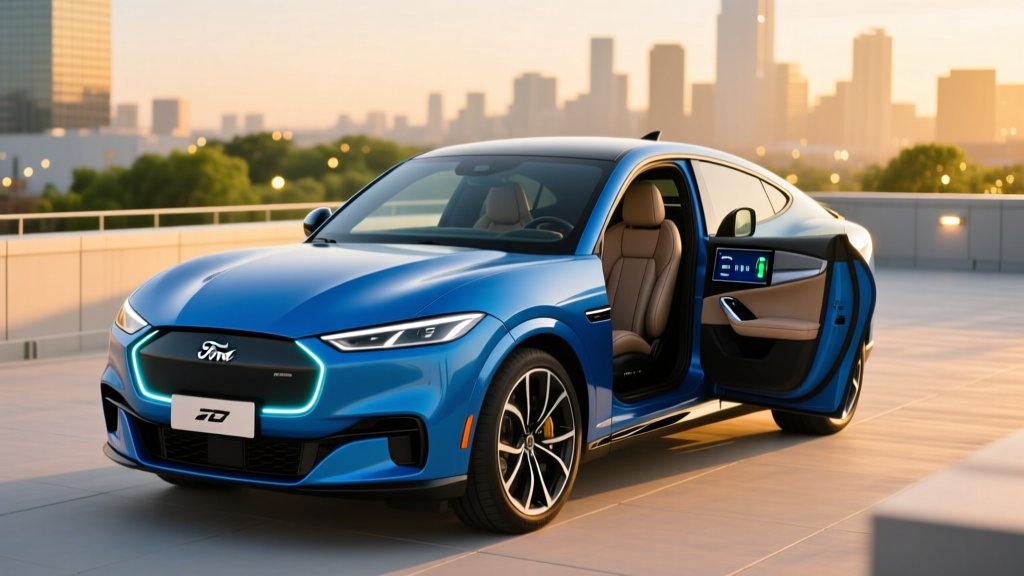
The Ford Mustang Mach-E has been one of the most compelling non-Tesla electric crossovers since its debut, and the 2026 model year refines the formula with updated battery options, expanded NACS charging access, and a starting price that undercuts several key rivals. If you're researching what the Ford Mustang Mach-E offers compared to the Hyundai Ioniq 5, Tesla Model Y, or Chevrolet Blazer EV, this deep-dive covers every number that matters — from real-world range and charging curves to out-the-door pricing after federal incentives.
2026 Ford Mustang Mach-E Quick Spec Overview
| Spec | Select RWD (Std Range) | Premium RWD (Ext Range) | GT AWD |
|---|---|---|---|
| EPA Range | 250 mi | 320 mi | 290 mi |
| Battery (usable) | 72 kWh (LFP) | 91 kWh (NMC) | 91 kWh (NMC) |
| Horsepower | 266 hp | 290 hp | 480 hp |
| 0-60 mph | 6.1 sec | 5.8 sec | 3.5 sec |
| Drivetrain | RWD (single motor) | RWD (single motor) | AWD (dual motor) |
| Max DC Fast Charge | 135 kW | 150 kW | 150 kW |
| 10-80% DC Time | ~38 min | ~41 min | ~41 min |
| Level 2 Rate | 10.5 kW (~30 mi/hr) | 10.5 kW (~30 mi/hr) | 10.5 kW (~30 mi/hr) |
| MPGe (combined) | 103 MPGe | 101 MPGe | 84 MPGe |
| Base MSRP | $36,495 | $44,495 | $55,995 |
Source: fueleconomy.gov and Ford Motor Company 2026 specifications. Figures reflect current model-year data.
EPA Range vs. Real-World Expectations
🛣️ Real-World Highway (70 mph, 75°F): Expect ~265–285 miles
❄️ Cold-Weather Highway (30°F): Expect ~215–240 miles
🏙️ City / Commuter Driving: Can meet or slightly exceed EPA rating thanks to regenerative braking
The 320-mile EPA figure on the Extended Range RWD trim is genuinely useful for a crossover in this price bracket. However, the Mach-E's aerodynamic profile and single-speed reduction gear mean highway efficiency drops noticeably above 70 mph. In our experience and consistent with independent testing, sustained interstate driving at 75–80 mph will consume roughly 33–36 kWh/100 mi compared to the EPA-rated 30 kWh/100 mi combined.
Cold weather compounds this. Without a standard heat pump on all trims (Ford offers a heat pump on higher trims and as a package option), cabin heating in sub-40°F conditions can reduce range by 20–30%. Buyers in northern climates should strongly consider the Extended Range battery or budget for a mid-trip DC fast charge on longer winter drives.
The Standard Range LFP battery on the Select trim delivers a more modest 250 miles EPA. Real-world highway testing typically yields 200–220 miles — adequate for commuting but limiting for road trips without planning.
Charging Speed: DC Fast, Level 2, and NACS Access
Ford transitioned the Mach-E to the North American Charging Standard (NACS) port starting with the 2025 model year, giving it native access to Tesla's Supercharger network — currently the largest and most reliable DC fast-charging network in the U.S. This is a significant practical advantage over CCS-equipped competitors that still require adapters.
| Charging Level | Power / Rate | Miles Added Per Hour | Notes |
|---|---|---|---|
| Level 1 (120V household) | 1.2 kW | ~3–4 mi/hr | Emergency / trickle only |
| Level 2 (240V, 48A) | 10.5 kW | ~30 mi/hr | Full charge overnight (~9–10 hrs for ER) |
| DC Fast (Std Range) | Peak 135 kW | ~160 mi in 30 min | 10-80% in ~38 min |
| DC Fast (Ext Range / GT) | Peak 150 kW | ~170 mi in 30 min | 10-80% in ~41 min; tapers above 80% |
Charging curve reality check: The Mach-E's peak 150 kW rate is not sustained across the full 10–80% window. Like most EVs using NMC chemistry, the charge curve peaks early (roughly 10–35% state of charge) and progressively tapers. From 60–80%, you'll see rates closer to 70–90 kW. This is why the 10–80% time of ~41 minutes for the Extended Range battery is longer than some competitors with 800V architectures (such as the Hyundai Ioniq 5, which can sustain higher rates and achieve 10–80% in roughly 18 minutes at a 350 kW charger).
For home Level 2 charging, Ford recommends a 48-amp hardwired wall connector on a 60-amp circuit. Installation costs typically range from $800–$2,000 depending on your electrical panel's capacity and the distance from panel to charger location. A panel upgrade to 200A, if needed, adds $1,500–$3,000. Always get a quote from a licensed electrician before committing.
Performance and Driving Dynamics
The Mach-E GT remains one of the quickest electric crossovers available under $60,000. Its 480 hp and 634 lb-ft of torque (with the Performance Upgrade package) deliver a 3.5-second 0–60 mph time that puts it in sports-car territory. The dual-motor AWD system provides confident traction in rain and light snow, though it's not a dedicated off-roader.
The single-motor RWD models are more efficiency-focused. The 266-hp Select trim with its LFP battery is the lightest variant and delivers the best efficiency at 103 MPGe combined (roughly 30 kWh/100 mi). For most commuters, the RWD Extended Range's 290 hp and 5.8-second 0–60 time offer plenty of passing power without the energy consumption penalty of dual motors.
Ride quality is firm but well-damped. Ford tuned the Mach-E with a sportier character than rivals like the Hyundai Ioniq 5 or Volkswagen ID.4, which prioritize comfort. The steering is precise, body roll is minimal for a crossover, and the low center of gravity (thanks to the floor-mounted battery pack) makes it feel planted in corners. One-pedal driving mode is effective and customizable, though the friction brake blending is occasionally abrupt at very low speeds.
Interior, Cargo Space, and Technology
The Mach-E's cabin is a blend of minimalist EV design and Ford familiarity. A 15.5-inch vertical touchscreen dominates the center stack, running Ford's SYNC 4A system with wireless Apple CarPlay and Android Auto. The interface is responsive, though some owners report that the lack of physical climate controls requires extra taps for simple adjustments.
Cargo and passenger dimensions:
- Rear cargo (behind 2nd row): 29.7 cu ft
- Cargo (2nd row folded): 59.7 cu ft
- Front trunk (frunk): 4.7 cu ft (drainable — useful for wet gear or tailgating)
- Front legroom: 43.3 inches
- Rear legroom: 38.9 inches
Compared to the Tesla Model Y, the Mach-E gives up some rear cargo volume (Model Y offers roughly 30.2 cu ft behind the second row, expanding to 76.2 cu ft with seats folded and available third row). However, the Mach-E's frunk is more practical than the Model Y's enclosed front trunk, and rear seat comfort is competitive.
Driver assistance: Ford's BlueCruise is available on select trims and enables hands-free driving on over 130,000 miles of pre-mapped divided highways. This is a SAE Level 2 system — the driver must remain attentive, and an interior camera monitors eye gaze. BlueCruise performs well on long highway stretches but does not handle city streets, construction zones, or unmapped roads. It is not a self-driving system.
Pricing, Trims, and Federal Tax Credit Eligibility
| Trim | Base MSRP | Est. After §30D Credit* | Key Equipment |
|---|---|---|---|
| Select (Std Range, RWD) | $36,495 | ~$28,995 | LFP battery, 15.5" screen, Ford Co-Pilot360 2.0 |
| Premium (Ext Range, RWD) | $44,495 | ~$36,995 | 320-mi range, heated seats, panoramic roof, BlueCruise capable |
| Premium (Ext Range, AWD) | $47,495 | ~$39,995 | Dual-motor AWD, 280-mi range, sport-tuned suspension |
| GT (AWD) | $55,995 | ~$48,495 | 480 hp, MagneRide dampers, Performance Upgrade available |
| Rally (AWD) | $58,995 | ~$51,495 | Rally-tuned suspension, underbody protection, 890 hp-ft torque |
*Estimated prices assume full $7,500 federal tax credit eligibility. Actual eligibility depends on multiple factors — see checklist below.
The Mach-E's sub-$37,000 starting price on the Select trim positions it as one of the most affordable electric crossovers on the market, especially when the federal tax credit applies. The Premium Extended Range RWD at roughly $37,000 after credit (if eligible) is the value sweet spot — 320 miles of range, strong feature content, and comfortable daily drivability.
Federal EV Tax Credit (§30D) Eligibility Checklist
- MSRP Cap: SUVs/crossovers must be under $80,000 — all Mach-E trims qualify ✅
- Buyer Income Cap: Modified AGI ≤ $150,000 (single) / $300,000 (joint) — verify with IRS rules
- Battery Component Sourcing: Percentage of battery components manufactured/assembled in North America must meet annual thresholds (100% for 2026) — Ford has been working to localize supply but confirm current-year eligibility with your dealer
- Critical Minerals: Percentage of critical minerals sourced from U.S. or FTA partners must meet annual thresholds — verify at point of sale
- Point-of-Sale Transfer: The credit can be transferred to the dealer at purchase for an immediate price reduction, rather than waiting to claim on your tax return
- Final Assembly: Vehicle must undergo final assembly in North America — the Mach-E is assembled in Cuautitlán, Mexico, which qualifies under USMCA ✅
Important caveat: Battery sourcing requirements have tightened significantly under the Inflation Reduction Act. For 2026, the critical minerals and battery component thresholds are at their strictest levels. Some EVs that previously qualified have lost partial or full eligibility. Always verify current eligibility with your dealer and cross-reference the IRS clean vehicle credit page before signing a purchase agreement. Tax professionals can provide guidance specific to your situation.
Who the Mach-E Suits Best (and Who Should Look Elsewhere)
- You want a sporty-handling electric crossover with strong performance (especially GT trim)
- You value NACS Supercharger access for road trips without adapters
- You need 300+ miles of EPA range on a sub-$50K budget (Premium Ext Range RWD)
- Hands-free highway driving via BlueCruise appeals to your commute
- Maximum cargo space is a priority (Tesla Model Y offers more volume)
- You need the fastest DC charging available (Hyundai Ioniq 5 / Kia EV6 with 800V architecture charge faster)
- You regularly tow — the Mach-E is rated for only 2,200 lbs (AWD), trailing competitors like the Rivian R2 or Model Y
- You need three rows of seating
Biggest Pros and Cons
- 320-mile EPA range on Premium Ext Range RWD is class-competitive
- Native NACS port = Tesla Supercharger access without adapter
- GT trim's 3.5-second 0–60 is thrilling for the price
- Starting MSRP of $36,495 is accessible for an electric crossover
- BlueCruise hands-free driving on 130K+ miles of highway
- Drainable frunk is genuinely useful
- Well-tuned chassis with engaging driving dynamics
- DC fast charging peaks at 150 kW — slower than 800V competitors
- Rear cargo space trails Model Y and Ioniq 5 (with seats folded)
- No physical climate controls — everything through the touchscreen
- Cold-weather range loss is significant without a heat pump on all trims
- Towing capacity limited to 2,200 lbs (AWD models)
- Road noise is noticeable at highway speeds compared to luxury EVs
- Battery sourcing rules may limit tax credit availability — verify before purchase
Warranty and Long-Term Ownership
Ford covers the Mach-E's battery and electric powertrain components for 8 years or 100,000 miles, whichever comes first. The battery warranty guarantees retention of at least 70% of original capacity during that period — consistent with industry standards from Hyundai, Tesla, and Volkswagen.
The bumper-to-bumper limited warranty is 3 years / 36,000 miles, which is average for the segment. Ford's dealer network is a practical advantage for service access compared to direct-sales-only brands, though EV-specific service training varies by location.
Long-term battery degradation data on the Mach-E's NMC Extended Range pack is still accumulating. Early model-year owners (2021–2023) report roughly 4–7% degradation over 50,000–70,000 miles, which is within expected norms. The LFP Standard Range battery should theoretically show slower degradation over time due to LFP chemistry's superior cycle life, though real-world long-term data on Ford's specific cells is still limited.
Frequently Asked Questions
What is the real-world range of the Ford Mustang Mach-E?
The EPA rates the Extended Range RWD at 320 miles, but real-world highway driving at 70–75 mph typically yields 265–285 miles in moderate temperatures. In cold weather (below 40°F), expect 215–240 miles on the highway. City driving with regenerative braking can meet or slightly exceed the EPA estimate.
How fast does the Mach-E charge at home and on the road?
At home on a 240V Level 2 charger (48A), the Mach-E adds roughly 30 miles of range per hour, achieving a full overnight charge in about 9–10 hours for the Extended Range battery. On DC fast chargers, it peaks at 150 kW (Extended Range/GT) or 135 kW (Standard Range), reaching 10–80% in approximately 38–41 minutes. Charge speed tapers significantly above 80% state of charge.
How much does the Mach-E cost after federal tax credits?
If you qualify for the full $7,500 §30D federal tax credit, the Select trim drops to approximately $28,995 and the Premium Extended Range RWD to about $36,995. Eligibility depends on your income, the vehicle's battery sourcing compliance, and MSRP caps. The point-of-sale transfer option lets you apply the credit as an immediate price reduction at the dealership. Always verify current-year eligibility with your dealer and consult the IRS clean vehicle credit page.
Is the Mach-E worth buying vs. the Tesla Model Y or Hyundai Ioniq 5?
It depends on your priorities. The Mach-E offers sportier driving dynamics than either rival and now has native Supercharger access. The Model Y wins on cargo volume and efficiency. The Ioniq 5 charges significantly faster (10–80% in ~18 minutes on a 350 kW charger) thanks to its 800V architecture. If driving engagement and Supercharger access matter most, the Mach-E is a strong choice. If charging speed or maximum cargo space is paramount, test-drive the Ioniq 5 and Model Y as well.
Does the Ford Mustang Mach-E qualify for the federal EV tax credit?
The Mach-E meets the MSRP cap ($80,000 for SUVs/crossovers) and final assembly requirements (Cuautitlán, Mexico, qualifying under USMCA). However, the battery component and critical minerals sourcing requirements for 2026 are stringent and subject to change. Ford has been localizing its battery supply chain, but you must confirm current-year eligibility at the point of sale. Buyer income must not exceed $150,000 (single filer) or $300,000 (joint filer). Check fueleconomy.gov and the IRS for the latest qualifying vehicle list.
What is the Mach-E's towing capacity?
AWD-equipped Mach-E models are rated to tow up to 2,200 pounds with the factory tow package. RWD models are rated lower. This is sufficient for a small utility trailer or a pair of dirt bikes, but it trails the Tesla Model Y (3,500 lbs) and is not suitable for boat or camper towing.
The 2026 Ford Mustang Mach-E offers a well-rounded package that balances range, performance, and price in a crowded electric crossover segment. Its strongest value proposition is the Premium Extended Range RWD at roughly $37,000 after the federal credit — delivering 320 miles of EPA range, Supercharger access, and BlueCruise capability. Just be realistic about highway and cold-weather range expectations, and verify your tax credit eligibility before signing.