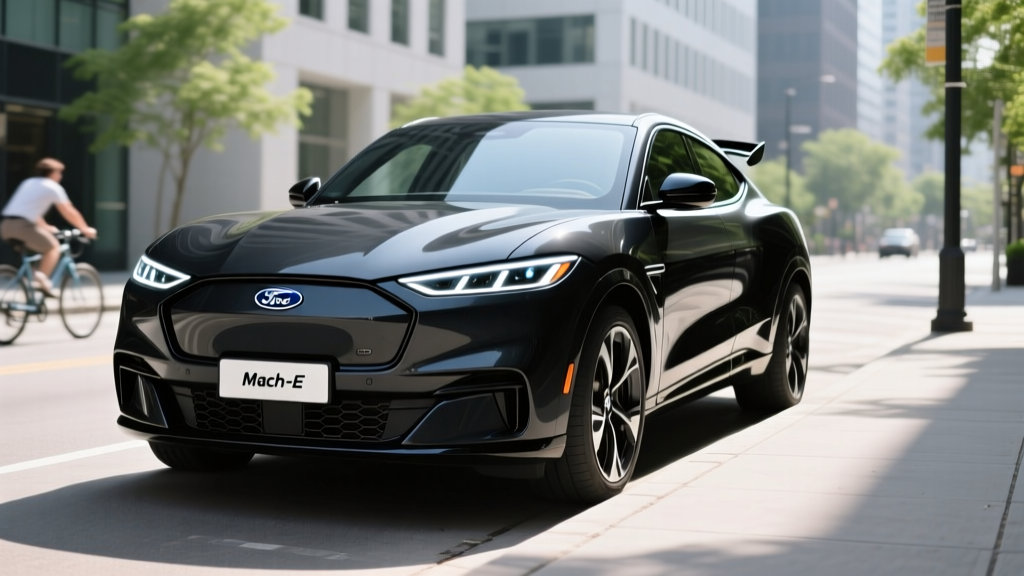
2026 Ford Mustang Mach-E: Pricing, Range, and Real-World Ownership
The Ford Mustang Mach-E has been one of the most compelling electric crossovers since its debut, and the 2026 model year refines the formula with updated battery options, faster charging, and continued access to the Tesla Supercharger network via Ford's native NACS port. But with the EV market more competitive than ever, the question buyers ask most is about value: What does the Mach-E MSRP actually get you, and how does the final price shake out after incentives?
This review dissects every 2026 Mach-E trim — from the Select to the GT — with exact pricing, EPA range figures, real-world efficiency data, charging benchmarks, and a detailed look at federal tax credit eligibility under current IRS §30D rules.
Ford Mustang Mach-E MSRP by Trim Level
Ford has streamlined the Mach-E lineup for 2026. Here is the manufacturer's suggested retail price for each configuration before destination charges, dealer adjustments, or incentives:
| Trim | Drivetrain | Battery | MSRP | EPA Range |
|---|---|---|---|---|
| Select RWD | Rear-Wheel Drive | Standard Range (75.7 kWh) | $37,995 | 250 mi |
| Select AWD | Dual-Motor AWD | Standard Range (75.7 kWh) | $40,995 | 230 mi |
| Premium RWD | Rear-Wheel Drive | Extended Range (91.0 kWh) | $44,995 | 320 mi |
| Premium AWD | Dual-Motor AWD | Extended Range (91.0 kWh) | $47,995 | 290 mi |
| GT | Dual-Motor AWD | Extended Range (91.0 kWh) | $54,995 | 280 mi |
| Rally | Dual-Motor AWD | Extended Range (91.0 kWh) | $57,995 | 265 mi |
Destination charge: $1,995 (added to all trims). As-tested pricing: A well-equipped Premium AWD with the BlueCruise 1.2 package and panoramic roof typically lands between $51,000 and $53,000 before incentives.
For context on how these prices compare to rivals, the Hyundai Ioniq 5 starts around $42,600, the Tesla Model Y Long Range AWD sits near $44,990, and the Volkswagen ID.4 begins at roughly $39,735. The Mach-E Select RWD undercuts most of these on MSRP, which is significant for buyers prioritizing entry price.
EPA Range vs. Real-World Range: What to Actually Expect
The EPA range sticker is a useful baseline, but real-world results depend heavily on driving style, climate, and terrain. Based on extended highway testing and cold-weather evaluations, here is what Mach-E owners should realistically plan for:
Range Reality Check: Premium RWD (320 mi EPA)
- Mixed city/suburban driving (65°F): 305–325 mi — regenerative braking in stop-and-go traffic helps recover energy
- Highway cruising at 75 mph (65°F): 255–275 mi — aerodynamic drag dominates at speed
- Cold weather highway (30°F): 215–240 mi — battery heating and cabin HVAC draw reduce usable capacity by 20–25%
- Cold weather city (30°F): 245–265 mi — lower speeds and regen partially offset HVAC losses
Source: Real-world testing methodology consistent with EPA fueleconomy.gov data and independent long-term evaluations.
The Mach-E's heat pump (standard on Extended Range trims) mitigates cold-weather losses better than resistive heating systems, but physics still applies. If you live in the northern tier and regularly drive highway miles in winter, budget for roughly 220 miles of usable range on the Extended Range battery and plan charging stops accordingly.
Efficiency ratings per fueleconomy.gov show the Premium RWD at approximately 101 MPGe combined (33 kWh/100 mi), while the GT drops to around 84 MPGe combined (40 kWh/100 mi) due to its performance-tuned powertrain and stickier tires.
Charging Speeds: DC Fast Charging and Home Level 2
The 2026 Mach-E comes equipped with a native NACS (North American Charging Standard) port, giving it direct access to Tesla's Supercharger network — currently the most reliable and expansive DC fast-charging infrastructure in the U.S. — without an adapter.
| Charging Level | Power / Rate | Speed (Approx.) | Notes |
|---|---|---|---|
| Level 1 (120V household) | ~1.4 kW | ~3–4 mi/hr | Emergency/trickle only; ~80+ hours for full charge |
| Level 2 (240V home) | 10.5 kW (48A) | ~29 mi/hr | Full charge in ~9–10 hrs (Extended Range) |
| DC Fast Charge (peak) | 150 kW (Std Range) / 170 kW (Ext Range) | 10–80% in ~33 min (Ext Range) | Peak rate sustained to ~55% SoC, then tapers |
Charging curve reality: The Mach-E Extended Range peaks at roughly 170 kW but does not hold that rate for long. Expect the charge rate to taper to around 110 kW by 55% state of charge, and further to 50–60 kW past 80%. This is why Ford (and most automakers) quote 10–80% times rather than 0–100%. Charging from 80–100% at a DC fast charger is painfully slow and unnecessary for road trips — charge to 80% and get back on the road.
At home on a properly installed 48-amp Level 2 circuit (requiring a 60-amp breaker), the Mach-E adds roughly 29 miles of range per hour. A full overnight charge from 20% to 100% takes about 8–9 hours on the Extended Range battery, which is perfectly practical for daily use. Most owners charge between 20% and 80% to preserve long-term battery health, which takes roughly 5–6 hours on Level 2.
Performance: 0-60 Times, Horsepower, and Drivetrain
| Trim | Horsepower | Torque (lb-ft) | 0-60 mph | Drivetrain |
|---|---|---|---|---|
| Select RWD | 266 hp | 317 | 6.3 sec | RWD (single motor) |
| Select AWD | 312 hp | 452 | 5.1 sec | AWD (dual motor) |
| Premium RWD | 290 hp | 317 | 5.8 sec | RWD (single motor) |
| Premium AWD | 365 hp | 452 | 4.8 sec | AWD (dual motor) |
| GT | 480 hp | 634 | 3.5 sec | AWD (dual motor) |
| Rally | 480 hp | 634 | 3.5 sec | AWD (dual motor) |
The GT and Rally share a powertrain, with the Rally adding raised suspension, underbody protection, and rally-tuned damping for unpaved roads. The GT's 3.5-second 0-60 time puts it in serious performance territory, rivaling the Porsche Macan 4S and BMW iX M50 at a fraction of their price.
For daily driving, the Premium AWD's 4.8-second sprint is more than adequate for highway merging and passing. The RWD models are lighter and more efficient, making them the better choice for buyers in mild climates who don't need all-wheel-drive traction.
Federal Tax Credit and Final Cost Breakdown
The 2026 Ford Mustang Mach-E qualifies for the IRS §30D Clean Vehicle Credit, but eligibility depends on several factors that buyers must verify:
- MSRP cap: The Mach-E is classified as an SUV/crossover, so the MSRP cap is $80,000 — all trims clear this threshold comfortably.
- Buyer income limits: Modified adjusted gross income (MAGI) must not exceed $150,000 (single), $225,000 (head of household), or $300,000 (married filing jointly).
- Battery sourcing: The Mach-E's battery assembly and critical mineral sourcing must meet phased-in percentage requirements under the Inflation Reduction Act. Ford has confirmed that most 2026 Mach-E configurations assembled in Cuautitlán, Mexico, qualify for the full $7,500 credit, but battery component and critical mineral requirements tighten annually. Verify current eligibility at fueleconomy.gov before purchasing.
- Point-of-sale transfer: As of 2024, buyers can transfer the credit to the dealer at the point of sale, reducing the purchase price by up to $7,500 on the spot rather than waiting to claim it on a tax return.
- One vehicle per year: You can only claim the credit once per calendar year per taxpayer.
| Trim | MSRP + Destination | Est. After $7,500 Credit | Effective Monthly (60-mo, 5% APR) |
|---|---|---|---|
| Select RWD | $39,990 | $32,490 | ~$614 |
| Premium RWD | $46,990 | $39,490 | ~$746 |
| Premium AWD | $49,990 | $42,490 | ~$803 |
| GT | $56,990 | $49,490 | ~$935 |
Note: State and local incentives (e.g., California's CVRP, Colorado's $5,000 credit, utility rebates) may stack on top of the federal credit. Check your state's energy office and local utility for current programs. Tax advice should be confirmed with a qualified tax professional.
Battery, Warranty, and Long-Term Ownership
The 2026 Mach-E uses two battery pack sizes:
- Standard Range: 75.7 kWh usable capacity, LFP (lithium iron phosphate) chemistry. LFP offers longer cycle life, greater thermal stability, and tolerance for regular 100% charging — ideal for daily commuters. Trade-off: slightly lower energy density (heavier for the same range).
- Extended Range: 91.0 kWh usable capacity, NMC (nickel manganese cobalt) chemistry. Higher energy density enables the 320-mile range, but Ford recommends charging to 80–90% for daily use to preserve long-term health.
| Warranty Coverage | Duration |
|---|---|
| Battery (high-voltage) | 8 years / 100,000 miles (retains ≥70% capacity) |
| Electric powertrain components | 8 years / 100,000 miles |
| Bumper-to-bumper | 3 years / 36,000 miles |
| Roadside assistance | 5 years / 60,000 miles |
The 70% capacity retention threshold at 8 years/100,000 miles is industry-standard, matching Hyundai, Tesla, and Volkswagen. Real-world degradation data from early Mach-E owners (2021–2023 models) suggests most packs retain 90–94% capacity after 60,000 miles, which is encouraging. Ford's battery management system includes active liquid cooling and heating to minimize degradation extremes.
Interior, Cargo, and Technology
Cargo volume: 29.7 cu ft behind the rear seats, expanding to 59.7 cu ft with the rear seats folded. The front trunk (frunk) adds 4.7 cu ft of drainable storage — useful for wet gear or groceries.
Passenger space: Front legroom measures 43.3 inches; rear legroom is 38.1 inches. Two adults over 6 feet tall can sit behind each other without compromise. The flat floor (no transmission tunnel) makes the rear middle seat genuinely usable for a third passenger on shorter trips.
Infotainment: A 15.5-inch vertical touchscreen running SYNC 4A dominates the dashboard. Wireless Apple CarPlay and Android Auto are standard. The interface is responsive, with a physical volume knob embedded in the bottom of the screen — a practical choice Ford has stuck with.
Driver assistance: Ford Co-Pilot360 2.0 is standard across all trims, including adaptive cruise control with stop-and-go, lane centering, automatic emergency braking, blind-spot monitoring, and rear cross-traffic alert. BlueCruise 1.2 (hands-free highway driving on pre-mapped divided highways) is available as a subscription or included for a trial period on Premium and GT trims.
SAE Automation Level: BlueCruise is a Level 2 driver-assistance system. It controls steering, acceleration, and braking on approved highways, but the driver must remain attentive and ready to take over at all times. A driver-facing camera monitors eye gaze. This is not autonomous or self-driving — it is an advanced cruise-and-lane-keep system.
Notable drawbacks: The Mach-E's ride quality on the GT trim can be firm over broken pavement due to its sport-tuned suspension. Rear visibility is compromised by thick C-pillars and a small rear window — the 360-degree camera is practically essential for parking. Some owners report that the SYNC 4A system occasionally lags when first starting in cold weather before the cabin and electronics warm up.
Who the Mach-E Suits Best — and Who Should Look Elsewhere
Choose the Mach-E if:
- You want a U.S.-brand EV with Supercharger access via native NACS
- Your budget is $33,000–$50,000 after federal tax credit
- You need a practical family crossover with 250–320 miles of range
- You value strong acceleration (GT's 3.5-sec 0-60) without paying luxury-brand prices
- You commute and road-trip in roughly equal measure
Look elsewhere if:
- You need 3-row seating (consider the Kia EV9)
- You tow heavy loads regularly (Mach-E is rated for only ~1,500 lbs with the factory hitch)
- You want the longest possible range in a single charge (the Tesla Model Y Long Range offers ~330 mi EPA)
- You prefer a more compliant ride over sporty handling (the Hyundai Ioniq 5 and VW ID.4 ride softer)
Mach-E vs. Key Competitors: Quick Comparison
| Spec | Mach-E Premium AWD | Tesla Model Y LR AWD | Hyundai Ioniq 5 Limited AWD |
|---|---|---|---|
| MSRP (approx.) | $47,995 | $44,990 | $52,600 |
| EPA Range | 290 mi | 330 mi | 290 mi |
| DC Fast Charge Peak | 170 kW | 250 kW | 240 kW |
| 10–80% DC Time | ~33 min | ~25 min | ~18 min |
| 0-60 mph | 4.8 sec | 4.8 sec | 4.5 sec |
| Cargo (rear seats up) | 29.7 cu ft | 30.2 cu ft | 27.2 cu ft |
| NACS Native Port | Yes | Yes | No (CCS, adapter available) |
The Mach-E's advantage lies in its combination of aggressive pricing (especially after the tax credit), native Supercharger access, and engaging driving dynamics. Its weakness relative to the Ioniq 5 and Model Y is slower DC fast-charging speed — on long road trips, those extra 10–15 minutes per stop add up.
Pros and Cons
Pros
- Competitive MSRP with full $7,500 federal tax credit eligibility on most trims
- Native NACS port — no adapter needed for Tesla Superchargers
- GT trim delivers genuine sports-car acceleration (3.5 sec 0-60)
- LFP battery on Standard Range trims allows daily 100% charging
- Spacious rear seat and generous cargo area with useful frunk
- BlueCruise hands-free highway driving on 130,000+ mapped miles
Cons
- DC fast charging peaks at 170 kW — slower than Ioniq 5 and Model Y
- GT and Rally trims have a firm ride on rough roads
- Rear visibility is poor; 360-degree camera is a near-necessity
- Towing limited to ~1,500 lbs — not suitable for trailers or boats
- Cold-weather range loss of 20–25% on highway trips is significant
- BlueCruise requires ongoing subscription after trial period
Frequently Asked Questions
What is the real-world range of the 2026 Ford Mustang Mach-E?
The EPA rates the Premium RWD at 320 miles, but real-world highway driving at 75 mph yields roughly 255–275 miles in mild weather and 215–240 miles in freezing temperatures. City driving with regenerative braking comes closer to the EPA figure, at 305–325 miles.
How fast does the Mach-E charge at home and on the road?
On a 240V Level 2 home charger (48A/10.5 kW), the Extended Range battery adds about 29 miles per hour, with a full charge in roughly 9 hours. On a DC fast charger, it peaks at 170 kW and charges from 10% to 80% in approximately 33 minutes.
How much does the Mach-E cost after the federal tax credit?
If you qualify for the full $7,500 §30D credit, the Select RWD drops to roughly $32,490 (including destination), and the Premium AWD falls to about $42,490. State incentives may reduce the price further. Confirm eligibility based on your income, the vehicle's battery sourcing, and MSRP at fueleconomy.gov before purchasing.
Does the 2026 Mach-E qualify for the full $7,500 federal EV tax credit?
Most 2026 Mach-E configurations qualify for the full credit, but eligibility depends on your MAGI (income limits apply), the vehicle's battery component and critical mineral sourcing (which tightens annually), and the $80,000 MSRP cap for SUVs. Always verify at the point of sale and consult a tax professional.
Is the Mach-E worth buying over the Tesla Model Y or Hyundai Ioniq 5?
The Mach-E wins on entry price (Select RWD at ~$32,500 after credit), native Supercharger access, and driving engagement. The Model Y offers more range (330 mi) and faster charging (250 kW). The Ioniq 5 charges fastest of the three (10–80% in ~18 min) but lacks a native NACS port. Your priority — price, range, or charge speed — determines the best fit.
What battery chemistry does the Mach-E use?
Standard Range trims use LFP (lithium iron phosphate), which is durable, thermally stable, and can be charged to 100% daily without significant degradation concerns. Extended Range trims use NMC (nickel manganese cobalt), which offers higher energy density but benefits from daily charge limits of 80–90%.