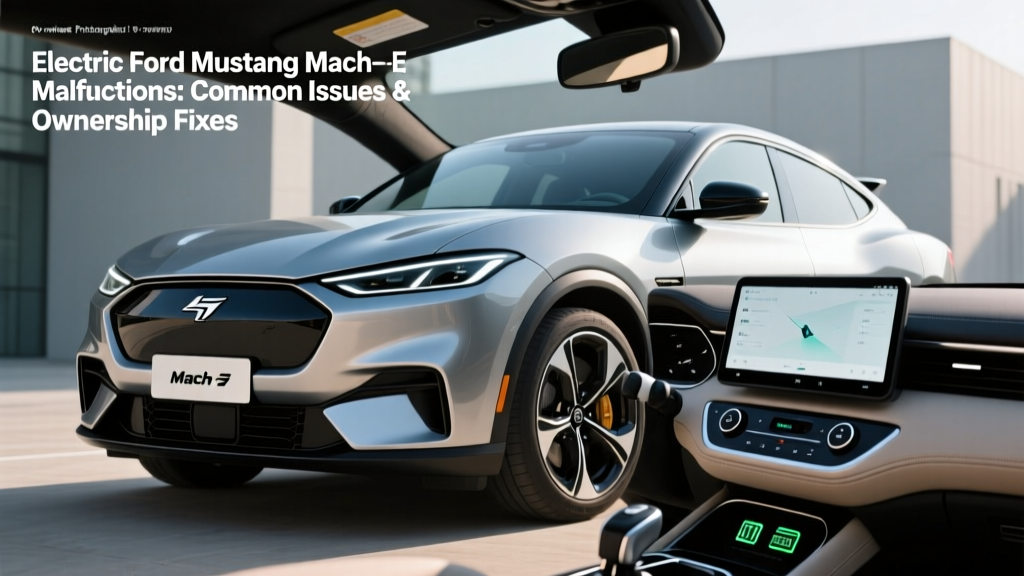
Quick Answer: What to Do When Your Mustang Mach-E Shows a Malfunction
The most common "malfunction" warnings on the Ford Mustang Mach-E (2021–2026 model years) typically trace back to three root causes: 12V auxiliary battery degradation (triggering cascading dashboard errors), software/firmware bugs in the SYNC 4A or vehicle control modules, and drive-motor or high-voltage battery contactor issues on early 2021–2022 builds. Before visiting a dealer, try a hard reset (disconnect the 12V battery for 10 minutes), ensure your SYNC software is current via Ford's Wi-Fi updates, and check for open recalls at NHTSA.gov using your VIN.
The Mustang Mach-E remains one of the more compelling electric crossovers on the market in 2026, with the current lineup offering up to 320 miles of EPA-estimated range, DC fast charging up to 150 kW, and a starting MSRP around $39,995 for the Select trim. But like any first-generation EV platform, owners have reported a recurring set of warnings and malfunctions that can be alarming — especially if you're transitioning from a gas vehicle where "check engine" lights have well-understood meanings.
This guide breaks down the most frequently reported Mach-E malfunctions, what they actually mean, what repairs cost, and how to decide whether the Mach-E's ownership profile makes sense for you compared to gas or hybrid alternatives.
The Most Common Mach-E Malfunctions (Ranked by Frequency)
Based on NHTSA complaint data, Ford-owner forum reports, and service-bulletin tracking, here are the malfunctions that Mach-E owners encounter most often:
1. 12V Battery Failure and "Electrical System Malfunction" Warnings
This is the single most reported issue across all Mach-E model years. The vehicle's 12V lead-acid auxiliary battery powers the computers, displays, and contactors that connect the high-voltage traction battery. When the 12V battery degrades — often within 18–24 months in hot climates or 24–36 months in moderate climates — it triggers a cascade of seemingly unrelated warnings: "Propulsion Power Reduced," "Electrical System Malfunction," "Park Brake Malfunction," and even complete no-start conditions.
Real-world cost: A replacement AGM 12V battery runs $180–$260 at a dealer, or $120–$160 for a quality aftermarket unit. Ford has issued extended-coverage guidance on some model years.
Pro tip: Many owners install a Bluetooth 12V battery monitor ($30–$40) to catch voltage drops before they strand you.
2. High-Voltage Battery Contactor Welding (2021–2022 Models)
Early-build Mach-E Extended Range models (with the 91 kWh usable NMC battery) experienced contactor welding inside the high-voltage battery pack. This is the issue behind Ford's recall 22S41, which affected approximately 49,000 vehicles. The symptom: a "Stop Safely Now" warning with sudden propulsion loss. Ford's fix involved a software update to monitor contactor health and, in confirmed cases, full battery-pack replacement under warranty.
If you own a 2021–2022 Mach-E ER: Verify recall completion at NHTSA.gov. The repair is free.
3. SYNC 4A Software Glitches and Phantom Warnings
The Mach-E's 15.5-inch portrait touchscreen runs Ford's SYNC 4A, which has seen numerous over-the-air (OTA) and Wi-Fi update cycles. Owners report intermittent blank screens, inaccurate range estimates, phantom ADAS (BlueCruise) disengagements, and false tire-pressure warnings. Most of these resolve with the latest software build — check under Settings > General > Software Update.
4. Drive Motor Whine and Bearing Noise (Select/California Route 1 AWD)
Some AWD Mach-E owners report a high-frequency whine from the rear drive unit above 55 mph. In most cases, this is normal motor inverter noise. In a minority of cases, it indicates a rear drive-unit bearing issue requiring warranty replacement (~$2,800 out of warranty, but covered under Ford's 5-year/60,000-mile powertrain warranty).
5. Heat Pump and Climate System Faults
Mach-E models equipped with the optional heat pump (standard on Extended Range trims from 2023 onward) can throw HVAC malfunction codes if the refrigerant valve actuator fails. Symptoms include reduced cabin heating and faster-than-expected range loss in cold weather. Dealer diagnosis and valve replacement typically runs $400–$700 out of warranty.
Cost of Ownership: Mach-E vs. Gas Mustang vs. Hybrid Alternatives
A malfunction concern only matters in context. Here's how the Mach-E stacks up on total cost over five years and 75,000 miles compared to a gas Mustang EcoBoost and a Toyota RAV4 Hybrid — the two cross-shops we see most often.
| Category | Mach-E Select (RWD) | Mustang EcoBoost (Gas) | RAV4 Hybrid AWD |
|---|---|---|---|
| Base MSRP | $39,995 | $32,515 | $33,425 |
| Est. Federal Tax Credit (§30D) | Up to $7,500* | $0 | $0 |
| Effective Purchase Price | ~$32,495 | $32,515 | $33,425 |
| Fuel / Electricity (75k mi) | $3,200 (home L2)** | $9,400 | $5,100 |
| Maintenance (5 yr) | $1,200 | $3,800 | $2,900 |
| Insurance (avg 5 yr) | $9,500 | $7,800 | $7,200 |
| Est. Depreciation | $14,000 | $12,500 | $10,800 |
| Total 5-Yr Cost | ~$60,395 | ~$66,015 | ~$58,625 |
*§30D credit eligibility depends on buyer AGI, MSRP caps, and battery-sourcing requirements. Verify current rules at IRS.gov. **Home charging at $0.14/kWh avg; public DC fast charging adds ~40% to electricity cost.
The Mach-E's higher insurance premiums and steeper depreciation partially offset the fuel savings, but the tax credit (if you qualify) and dramatically lower maintenance costs keep it competitive. The RAV4 Hybrid wins on depreciation and insurance — a common pattern when comparing BEVs to proven HEVs.
EV vs. Gas: What Malfunctions Actually Cost
A common misconception is that EV malfunctions are catastrophically expensive. Let's compare typical out-of-warranty repair bills:
| Repair | Mach-E (BEV) | Mustang EcoBoost (Gas) |
|---|---|---|
| 12V Battery | $180–$260 | $160–$220 |
| Brake Pads (axle set) | $200–$300 (rarely needed before 80k mi due to regen) | $250–$400 every 30–50k mi |
| Coolant Flush | $150–$200 (every 5 yr) | $120–$180 (every 3–5 yr) |
| Drive Motor / Engine Major | $5,000–$8,000 (rare) | $4,500–$7,500 (turbo failure, timing chain) |
| HV Battery Pack | $18,000–$25,000 (very rare; 8 yr/100k mi warranty) | N/A |
| Transmission | N/A (single-speed) | $3,500–$5,500 |
The Mach-E's high-voltage battery is the scary number, but Ford covers it for 8 years / 100,000 miles with a capacity-retention threshold of 70%. Catastrophic HV battery failures outside of the 2021–2022 contactor recall are exceedingly rare. Meanwhile, the gas Mustang's turbo, timing chain, and automatic transmission represent real failure points the Mach-E simply doesn't have.
Real-World Ownership Considerations Before You Buy
Malfunctions are one piece of the puzzle. Here's what actually determines whether the Mach-E works for your life:
Home Charging Access
The Mach-E accepts up to 10.5 kW on Level 2 (48A circuit, 60A breaker). A full overnight charge from 10% to 100% takes roughly 10 hours on the Extended Range (91 kWh usable) battery. If you can install a Level 2 charger at home ($500–$1,500 for equipment plus $500–$2,000 for electrician labor, depending on panel proximity), the Mach-E is a seamless daily driver.
If you lack home charging: The Mach-E's 150 kW DC fast charging means a 10–80% session takes approximately 40 minutes at a functional Electrify America or Tesla Supercharger (with NACS adapter, standard on 2025+ models). That's viable for road trips but tedious as a daily routine. Public charging reliability remains inconsistent — plan for 15% of sessions encountering out-of-service stalls.
Climate Impact on Range
The Mach-E Extended Range AWD carries an EPA rating of 305 miles. In real-world highway driving at 70 mph in moderate temperatures, expect 255–275 miles. In cold weather (below 30°F), range drops to 200–230 miles even with the heat pump engaged. If your daily commute exceeds 80 miles round-trip in a cold climate, the Extended Range battery is essential.
Driving Pattern Fit
The Mach-E rewards predictable, home-based charging routines. If you drive 30–60 miles daily and charge overnight, you'll rarely think about range. If you regularly drive 250+ miles in a single day, the 40-minute DC fast charging stops add meaningful trip time compared to a gas Mustang's 5-minute fill-up.
Common Mach-E Malfunction Myths vs. Facts
| Myth | Fact |
|---|---|
| "If the Mach-E throws a warning, the HV battery is dying." | Over 80% of dashboard warnings trace to the 12V battery or software — not the high-voltage pack. |
| "EV repairs always cost thousands." | The most common Mach-E fix (12V battery swap) costs under $260. HV battery failures under warranty are free. |
| "OTA updates cause more problems than they fix." | While some OTA updates have introduced bugs, the majority address real safety and performance issues. Skipping updates leaves you exposed to known faults. |
| "The Mach-E can't be repaired outside a Ford dealer." | 12V batteries, cabin air filters, wiper blades, tire rotations, and brake fluid are all owner- or independent-shop-serviceable. HV and drive-motor work requires EV-certified techs. |
| "The Mach-E is less reliable than a gas Mustang." | Early 2021–2022 builds had real issues (contactor recall). 2023–2026 models show markedly improved reliability, with fewer powertrain components to fail than any ICE vehicle. |
Decision Framework: Is the Mach-E Right for You?
Choose the Mach-E if:
- You have (or can install) Level 2 home charging
- Your daily driving is under 80 miles round-trip
- You qualify for the §30D federal tax credit (check income caps: $150k single / $300k joint) and your state offers additional incentives
- You value instant torque (0–60 in 3.5 seconds on GT), a quiet cabin, and minimal routine maintenance
- You're buying a 2023 or newer model year to avoid the early contactor issue
Choose a gas or hybrid alternative if:
- You lack home charging access and your area has sparse public DC infrastructure
- You regularly drive 300+ miles in a single day in cold weather
- You need maximum towing capacity (Mach-E is not rated for towing; consider the F-150 Lightning or a hybrid SUV)
- You plan to keep the vehicle 10+ years and want to minimize long-term battery-replacement risk
- Your budget is under $30,000 and you need a proven, low-risk commuter (RAV4 Hybrid or Corolla Hybrid)
Preventive Maintenance: Minimizing Mach-E Malfunctions
Based on owner experience and Ford's maintenance schedule, here's what keeps a Mach-E running cleanly:
- Replace the 12V battery proactively every 3 years ($120–$160 aftermarket AGM). This single step prevents the majority of phantom malfunction warnings.
- Keep SYNC 4A updated. Enable automatic Wi-Fi updates or manually check quarterly. Many ADAS and battery-management fixes arrive via OTA.
- Rotate tires every 6,000–8,000 miles. EVs wear tires 20–30% faster than gas cars due to instant torque and heavier curb weight (Mach-E: 4,400–4,900 lbs).
- Check brake fluid every 2 years. Regenerative braking saves pad life, but the hydraulic system still needs fluid flushes to prevent corrosion.
- Precondition the battery before DC fast charging. Use the Mach-E's built-in navigation to route to a charger — this triggers thermal preconditioning, which can shave 5–10 minutes off your 10–80% charge time in cold weather.
2026 Mach-E Specs at a Glance
| Spec | Select RWD | Premium ER AWD | GT |
|---|---|---|---|
| EPA Range | 250 mi | 305 mi | 280 mi |
| Battery (usable) | 70 kWh (NMC) | 91 kWh (NMC) | 91 kWh (NMC) |
| Horsepower | 266 hp | 346 hp | 480 hp |
| 0–60 mph | 6.1 sec | 4.8 sec | 3.5 sec |
| DC Fast Charge (peak) | 115 kW | 150 kW | 150 kW |
| 10–80% DC Time | ~38 min | ~40 min | ~40 min |
| Level 2 Rate | 10.5 kW | 10.5 kW | 10.5 kW |
| MPGe (combined) | 101 MPGe | 94 MPGe | 86 MPGe |
| Base MSRP | $39,995 | $48,995 | $59,995 |
| HV Battery Warranty | 8 yr / 100k mi | 8 yr / 100k mi | 8 yr / 100k mi |
Source: fueleconomy.gov and Ford Motor Company. Real-world range varies with temperature, speed, and terrain.
Frequently Asked Questions
What should I do if my Mach-E says "Stop Safely Now"?
Pull over immediately, turn off the vehicle, and call Ford Roadside Assistance (1-800-241-3673). This warning indicates a high-voltage system fault — it is not something you can reset at home. On 2021–2022 Extended Range models, this may be related to recall 22S41 (contactor welding). The tow and diagnosis are free under warranty or recall coverage.
Does the Mach-E qualify for the $7,500 federal tax credit in 2026?
It depends. The §30D credit requires the buyer's AGI to fall below $150,000 (single) or $300,000 (joint), the vehicle MSRP to be under $80,000 (SUVs/crossovers), and the battery to meet critical-mineral and component-sourcing thresholds that tighten annually. The Mach-E's eligibility has shifted across model years as Ford adjusted battery sourcing. Check the latest list at IRS.gov before purchasing, and ask the dealer about point-of-sale transfer, which lets you apply the credit as a down-payment reduction at signing.
How often does the Mach-E actually need dealer service?
Most owners report 1–2 dealer visits per year, typically for tire rotation, cabin air filter replacement, and software updates. Compared to a gas Mustang's oil changes, spark plugs, and transmission fluid, the Mach-E's maintenance calendar is dramatically simpler. Budget $200–$350 annually for routine maintenance.
Is the Mach-E more expensive to insure than a gas car?
Yes, typically 15–25% more. Average annual premiums run $1,800–$2,200 depending on your state and driving record, versus $1,400–$1,700 for a gas Mustang EcoBoost. The higher cost reflects the Mach-E's higher repair costs after collisions (specialized EV body shops, HV safety protocols) and its higher MSRP. Shop quotes from Geico, Progressive, and EV-specialty insurers like Lemonade or Root for the best rates.
Can I fix Mach-E software glitches myself?
For SYNC 4A issues, try: (1) a soft reset by holding the volume knob and next-track button for 10 seconds, (2) ensuring Wi-Fi updates are enabled and current, and (3) deleting and re-pairing your phone via Android Auto or Apple CarPlay. For propulsion, brake, or HV battery warnings, do not attempt DIY repairs — these require Ford EV-certified technicians and high-voltage safety protocols.