Ford Mustang Mach-E Interior: A Tech-Forward EV Cabin That Delivers
The Ford Mustang Mach-E interior has evolved since the 2021 launch into one of the most screen-dominant, software-driven cabins in the mainstream EV segment. For 2026, Ford continues to refine the digital experience with its latest SYNC 4A interface, a massive 15.5-inch portrait touchscreen, and a fully digital 10.2-inch instrument cluster — all wrapped in a minimalist layout that swaps traditional buttons for capacitive touch and voice commands. Whether you're cross-shopping against a Tesla Model Y, Hyundai IONIQ 5, or Chevrolet Equinox EV, the Mach-E's interior is a defining part of the ownership equation.
This review covers the full 2026 Mustang Mach-E lineup — from the Select trim through the GT and Rally — with precise EPA range figures, charging speeds, battery specs, and the real-world ownership data you need before signing a purchase agreement.
Spec Table: 2026 Mustang Mach-E at a Glance
| Spec | Select (RWD) | Premium (eAWD) | GT (eAWD) |
|---|---|---|---|
| EPA Range | 250 mi | 320 mi (Ext. Range) | 280 mi |
| Battery (usable) | 75.7 kWh (NMC) | 91 kWh (NMC) | 91 kWh (NMC) |
| Horsepower | 266 hp | 346 hp | 480 hp |
| 0–60 mph | 6.1 sec | 5.1 sec | 3.3 sec |
| Max DC Fast Charge | 150 kW | 150 kW | 150 kW |
| 10–80% DCFC Time | ~36 min | ~45 min | ~45 min |
| Level 2 Home Charge | 10.5 kW (~30 mi/hr) | 10.5 kW (~30 mi/hr) | 10.5 kW (~30 mi/hr) |
| MPGe (combined) | 101 MPGe | 98 MPGe | 84 MPGe |
| EPA Efficiency | 33 kWh/100 mi | 34 kWh/100 mi | 40 kWh/100 mi |
| Base MSRP | $39,995 | $48,995 | $57,995 |
| Battery Warranty | 8 yr / 100,000 mi | ||
Range & Efficiency: EPA Numbers vs. Real-World Expectations
The 2026 Mustang Mach-E lineup offers EPA-estimated range from 250 miles on the Standard Range Select (RWD) up to 320 miles on the Premium trim with the Extended Range battery and RWD. All-wheel-drive trims with the 91 kWh pack settle between 275 and 300 miles, while the performance-oriented GT drops to 280 miles due to its higher output and wider tires.
EPA estimates assume a mix of city and highway driving at moderate temperatures. In real-world highway cruising at 70–75 mph, expect roughly 10–15% less than the EPA sticker — so the 320-mile Premium Extended Range RWD delivers closer to 270–290 miles on a long interstate trip. In freezing conditions (below 30°F), cabin heating and battery thermal management can reduce range an additional 15–25%, bringing effective range down to 240–260 miles on the Extended Range pack. City driving with regenerative braking tends to match or slightly exceed EPA figures.
According to fueleconomy.gov, the Mach-E Premium Extended Range RWD achieves 98 MPGe combined (34 kWh/100 mi). The Select RWD is slightly more efficient at 101 MPGe (33 kWh/100 mi), while the GT's 480-hp output pushes consumption to 84 MPGe (40 kWh/100 mi). These are competitive numbers, though the Hyundai IONIQ 5 Long Range AWD edges ahead at 110 MPGe combined.
Battery Chemistry, Degradation & Warranty
Ford equips all Mach-E trims with nickel-manganese-cobalt (NMC) lithium-ion battery packs — not the lithium iron phosphate (LFP) chemistry found in some Tesla Model Y Standard Range variants or base Rivian configurations. NMC offers higher energy density, which is why Ford fits up to 91 kWh of usable capacity into the Mach-E's floor without compromising ground clearance or cabin space. The trade-off: NMC cells are more sensitive to sustained high-state-of-charge storage and extreme heat, meaning owners should aim to keep daily charging between 20–80% for long-term health.
Ford's high-voltage battery warranty covers 8 years or 100,000 miles (whichever comes first) against defects and capacity loss below 70% of original capacity. This is industry-standard and matches the coverage offered by Hyundai, Kia, and Volkswagen, though Tesla provides 8 years/120,000 miles on the Model Y Long Range.
Independent fleet data from Recurrent Auto suggests that NMC packs in liquid-cooled platforms like the Mach-E typically retain 90–93% of original capacity after 100,000 miles of mixed driving. Ford's active thermal management system — which preconditions and cools the pack during fast charging and extreme weather — is a key factor in this longevity.
Charging Speed: DC Fast Charging and Home Level 2
The Mach-E charges at a maximum of 150 kW on DC fast chargers using its native CCS connector (Ford has confirmed NACS adapter compatibility for Tesla Supercharger access). On a 150 kW or higher station, the Extended Range pack charges from 10% to 80% in approximately 45 minutes. The Standard Range pack completes the same session in roughly 36 minutes due to its smaller capacity.
| Charging Level | Power | Miles Added per Hour | Notes |
|---|---|---|---|
| Level 1 (120V household) | 1.4 kW | ~3–4 mi/hr | Emergency/trickle only |
| Level 2 (240V home) | 10.5 kW | ~30 mi/hr | Full charge in ~9 hr (91 kWh pack) |
| DC Fast Charge | 150 kW peak | ~180 mi in 30 min | Peak rate sustained to ~55% SoC, then tapers |
Charging curve reality: The 150 kW peak rate holds roughly from 10% to 55% state of charge, then tapers to around 80–90 kW through 80%, and slows further to 30–40 kW above 80%. This is why Ford (and most automakers) quote 10–80% times — the final 20% takes nearly as long as the first 70%. For road trips, plan charging stops around the 10–80% window and skip topping off unless you're near your destination.
At home on a 48-amp Level 2 circuit (the Ford Connected Charge Station or any quality J1772/NACS unit), the Mach-E adds approximately 30 miles of range per hour. A full overnight charge from 20% to 90% takes about 7–8 hours on the Extended Range pack — easily managed with scheduled charging during off-peak electricity rates.
The Mach-E Interior: Design, Space & Technology
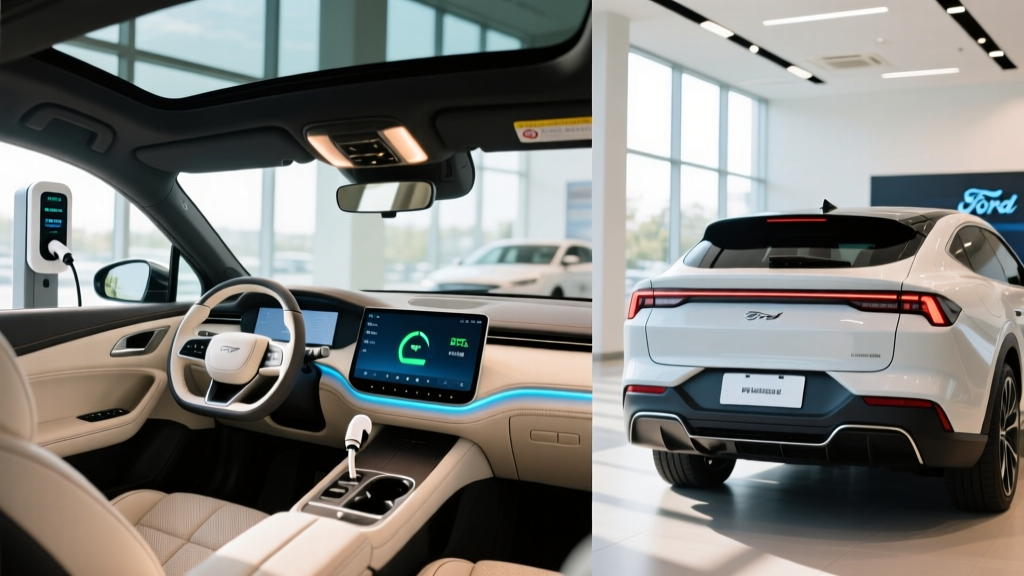
This is where the Ford Mustang Mach-E interior earns its search volume. The cabin is defined by three elements: a floating 15.5-inch portrait touchscreen running SYNC 4A, a 10.2-inch digital instrument cluster, and an available panoramic fixed-glass roof that floods the cabin with light. Ford eliminated the traditional gear lever in favor of a rotary dial on the center console, freeing up storage space.
Material quality is mixed. Upper trims (Premium, GT) feature ActiveX synthetic leather with contrast stitching and heated/ventilated front seats. Lower trims use cloth with vinyl accents. Hard plastics appear on the lower door panels and rear cargo area — a common complaint compared to the Hyundai IONIQ 5's more cohesive soft-touch surfaces. However, the minimalist approach keeps the cabin feeling open and uncluttered.
Cargo and Passenger Dimensions
- Front legroom: 43.3 inches
- Rear legroom: 38.1 inches
- Cargo (rear seats up): 29.7 cu ft
- Cargo (rear seats folded): 59.7 cu ft
- Front trunk (frunk): 4.7 cu ft (drainable, useful for wet gear or groceries)
The 38.1 inches of rear legroom is adequate for adults on shorter trips but falls short of the IONIQ 5's 39.4 inches and the Tesla Model Y's 40.5 inches. The 29.7 cu ft cargo area with seats up is competitive, and the drainable frunk is a genuinely useful feature absent from most rivals.
Infotainment and Driver Assistance
SYNC 4A supports wireless Apple CarPlay and Android Auto, over-the-air (OTA) updates, and Ford's BlueCruise hands-free driving system on compatible divided highways. BlueCruise is a Level 2 SAE driver-assistance system — it does not make the Mach-E self-driving. The driver must remain attentive, and the system monitors eye gaze via an infrared camera on the steering column. BlueCruise is available on over 130,000 miles of pre-mapped highways in the U.S. and Canada, with a subscription model after the initial trial period.
Standard safety tech includes Ford Co-Pilot360 2.0: automatic emergency braking with pedestrian detection, blind-spot monitoring, rear cross-traffic alert, lane-keeping assist, and evasive steering assist. The Mach-E earned an IIHS Top Safety Pick rating in recent model years.
Performance and Drivetrain
The Mach-E lineup spans from a comfortable commuter to a genuine performance machine. The Select RWD produces 266 hp and 317 lb-ft of torque from a single rear motor, hitting 0–60 mph in 6.1 seconds — brisk for daily driving. The Premium eAWD adds a front motor for 346 hp and 428 lb-ft, dropping the sprint to 5.1 seconds. The GT unleashes 480 hp and 634 lb-ft, reaching 60 mph in 3.3 seconds — territory occupied by the Porsche Taycan and Tesla Model Y Performance.
Ride quality leans firm, especially on the GT's 20-inch wheels and sport-tuned suspension. The Premium with 19-inch wheels offers the best balance of comfort and composure. All trims feature one-pedal driving mode with strong regenerative braking, though the regen aggressiveness is adjustable rather than the aggressive single-setting approach used by some competitors.
Pricing, Trims & Federal Tax Credit Eligibility
The 2026 Mustang Mach-E starts at $39,995 for the Select RWD with the Standard Range battery. The Premium Extended Range RWD — the sweet spot for range and value — lists at $48,995. The GT begins at $57,995, and the off-road-styled Rally variant sits at approximately $59,995. Destination charges add roughly $1,395.
| Trim | Base MSRP | Est. After §30D Credit |
|---|---|---|
| Select RWD | $39,995 | ~$32,495* |
| Premium Ext. Range RWD | $48,995 | ~$41,495* |
| GT eAWD | $57,995 | ~$50,495* |
| Rally eAWD | $59,995 | ~$52,495* |
*Estimated prices assume full $7,500 §30D credit eligibility. Actual credit depends on buyer income, vehicle MSRP caps, battery sourcing, and critical-mineral requirements per IRS guidelines. Consult a tax professional before purchase.
- MSRP cap: SUVs/crossovers must be ≤ $80,000 (all Mach-E trims qualify)
- Buyer income cap: AGI ≤ $150,000 (single) / $300,000 (joint)
- Battery sourcing: Critical minerals and battery components must meet escalating domestic/free-trade-agreement thresholds — verify current-year compliance on the IRS qualified vehicle list
- Point-of-sale transfer: Eligible buyers can apply the credit as an upfront discount at the dealership rather than waiting for tax filing
Pros, Cons & Who Should Buy the Mach-E
Pros
- 320 mi EPA range on Premium Ext. Range RWD
- Spacious, tech-forward cabin with massive 15.5" screen
- Drainable front trunk (frunk) — rare in this segment
- BlueCruise hands-free highway driving available
- Strong performance across trims (3.3 sec GT)
- All trims under the $80,000 MSRP credit cap
Cons
- 150 kW peak DCFC trails rivals (IONIQ 5: 350 kW)
- Rear legroom tighter than Model Y and IONIQ 5
- Some hard plastics in lower cabin areas
- BlueCruise requires paid subscription after trial
- No LFP battery option for cost-sensitive buyers
- 10–80% charge time of 45 min is slow vs. 800V platforms
Commuters & suburban families who value a tech-heavy cabin, hands-free highway assist, and a drainable frunk for active lifestyles. The Premium Extended Range RWD at 320 miles EPA is the ideal configuration for daily driving with occasional road trips. Performance enthusiasts will find the GT's 3.3-second 0–60 genuinely thrilling. Not ideal for: buyers who prioritize ultra-fast DC charging (look at Hyundai/Kia's 800V E-GMP platform) or maximum rear-seat space (the Model Y wins here).
Frequently Asked Questions
What is the real-world range of the Ford Mustang Mach-E?
The EPA rates the top-range configuration at 320 miles, but expect 270–290 miles in real-world highway driving and 240–260 miles in freezing weather. City driving with regenerative braking often matches or slightly exceeds the EPA figure.
How fast does the Mach-E charge at home and on DC fast chargers?
On a DC fast charger, the Mach-E peaks at 150 kW and charges from 10–80% in approximately 45 minutes (Extended Range) or 36 minutes (Standard Range). At home on a Level 2 240V charger at 10.5 kW, it adds about 30 miles of range per hour, with a full overnight charge taking 7–9 hours.
Does the 2026 Mustang Mach-E qualify for the $7,500 federal EV tax credit?
All Mach-E trims fall under the $80,000 MSRP cap for SUVs/crossovers, making them potentially eligible. However, the buyer must meet IRS income limits ($150K single / $300K joint AGI), and the vehicle's battery must satisfy critical-mineral and component-sourcing thresholds that tighten annually. Check the IRS qualified vehicle list before purchasing.
Is the Mach-E worth buying over the Tesla Model Y or Hyundai IONIQ 5?
The Mach-E wins on interior tech presentation (the 15.5-inch portrait screen is hard to beat), BlueCruise availability, and a drainable frunk. The Model Y offers more rear legroom and cargo space, access to the Supercharger network natively, and faster charging on V3/V4 stalls. The IONIQ 5 charges dramatically faster (10–80% in ~18 min on 350 kW chargers) and offers more rear-seat room. The Mach-E is the strong middle ground — especially if you prefer a traditional dealership experience and Ford's service network.
What battery chemistry does the Mach-E use?
All 2026 Mach-E trims use NMC (nickel-manganese-cobalt) lithium-ion cells with liquid thermal management. Ford does not currently offer an LFP option. NMC provides higher energy density but benefits from daily charging between 20–80% to maximize long-term health.