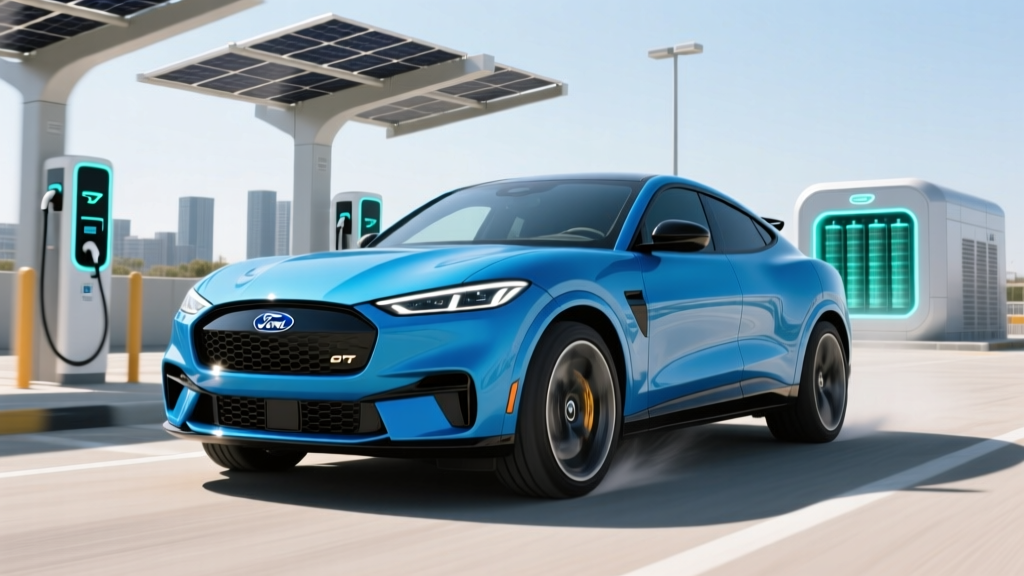
The Ford Mustang Mach-E GT has always been the performance answer to the question: "Can an electric SUV actually feel like a Mustang?" For 2026, Ford continues to refine the GT variant with updated software, improved thermal management for sustained performance, and the shift to the North American Charging Standard (NACS) port. But buyers searching for Ford Mach-E GT 0-60 times, real-world range, and daily usability need more than a launch-control headline. This review breaks down every number that matters.
Ford Mustang Mach-E GT: Core Specifications at a Glance
| Specification | 2026 Mach-E GT | 2026 Mach-E GT Performance Upgrade |
|---|---|---|
| 0-60 mph | 3.8 seconds | 3.3 seconds |
| Horsepower | 480 hp | 480 hp |
| Torque | 600 lb-ft | 700 lb-ft |
| Drivetrain | AWD (Dual-Motor) | AWD (Dual-Motor) |
| Battery (usable) | 91 kWh (NMC) | 91 kWh (NMC) |
| EPA Range | 290 miles | 265 miles |
| MPGe (combined) | 90 MPGe | 84 MPGe |
| Efficiency | 37 kWh/100 mi | 40 kWh/100 mi |
| Max DC Fast Charge | 150 kW | 150 kW |
| 10-80% DC Time | ~36 minutes | ~36 minutes |
| Level 2 Home Charge | 10.5 kW (~30 mi/hr) | 10.5 kW (~30 mi/hr) |
| Base MSRP | $59,995 | $65,995 |
| Battery Warranty | 8 yr / 100,000 mi | 8 yr / 100,000 mi |
Source: Ford Motor Company and EPA Fueleconomy.gov. Specs reflect 2026 model year.
The Ford Mach-E GT 0-60 Story: What 3.3 Seconds Actually Feels Like
The headline number buyers chase is the Ford Mach-E GT 0-60 time, and it splits into two tiers. The standard GT hits 60 mph in 3.8 seconds — genuinely quick by any measure and enough to gap most V8 muscle cars off the line. The optional Performance Upgrade package (a $6,000 addition) drops that to 3.3 seconds, primarily through the torque bump from 600 to 700 lb-ft and recalibrated launch control.
What the spec sheet doesn't convey is the sustained nature of electric torque. Unlike a turbocharged engine that needs to build boost, the Mach-E GT's dual permanent-magnet motors deliver peak torque from 0 RPM. In real-world roll-on passing (40-70 mph), the GT pulls with relentless, linear force — no gear hunting, no lag. The Performance Upgrade's MagneRide adaptive dampers also keep the chassis flat under hard acceleration, preventing the nose-lift you'd feel in a lesser electric SUV.
However, repeated hard launches will heat-soak the battery. Ford's thermal management system is competent — a 2026 software update improved coolant flow during Performance Mode — but expect 0-60 times to stretch by 0.3-0.5 seconds after three or four consecutive launches without cooldown. This is typical for NMC packs in this class and not a dealbreaker, but track-day buyers should note it.
Real-World Range vs. EPA Sticker
EPA Rating: 290 miles (GT) / 265 miles (GT Performance Upgrade)
Real-World Expectation: In mixed suburban/highway driving at 70°F, expect 250-270 miles from the standard GT and 230-250 from the Performance Upgrade. Sustained highway speeds above 75 mph reduce range by roughly 12-15%. In winter conditions (below 32°F), plan for 20-30% range loss, bringing the GT down to approximately 190-220 miles per charge without preconditioning.
Why the gap? The EPA test cycle includes generous city-regen segments that flatter EVs. The GT's wide 245/45R20 summer tires, aggressive aero profile, and 4,800+ lb curb weight all work against highway efficiency. Always precondition the battery using FordPass before cold-weather drives to minimize range loss.
Charging the Mach-E GT: Speeds, Connectors, and Real Curves
The 2026 Mach-E GT now ships with the NACS (Tesla-style) charge port as standard, replacing the CCS1 connector used on 2021-2025 models. This opens direct access to Tesla Supercharger V3 and V4 stalls without an adapter — a major practical upgrade for road-trippers. Ford also includes a Mobile Power Cord for Level 1 (120V) emergency trickle charging.
| Charging Level | Power / Voltage | Miles Added per Hour | Notes |
|---|---|---|---|
| Level 1 (120V) | 1.4 kW | ~3 mi/hr | Emergency / overnight top-up only |
| Level 2 (240V, 48A) | 10.5 kW | ~30 mi/hr | Full charge in ~9.5 hours (0-100%) |
| DC Fast Charge | Peak 150 kW | ~180 mi/hr (peak) | 10-80% in ~36 min; tapers sharply above 80% |
The Mach-E GT's 150 kW peak DC rate is the elephant in the room. Competitors like the Hyundai Ioniq 5 N (240 kW) and Tesla Model Y Performance (250 kW) charge significantly faster on the road. Ford's charge curve holds near 150 kW from roughly 10-40% State of Charge, then steps down to ~110 kW through 60%, and drops to under 50 kW past 80%. The 10-80% time of approximately 36 minutes is acceptable for a sit-down meal stop but noticeably slower than the 18-20 minute benchmarks set by 800V architectures.
Home charging setup: A 48-amp hardwired Level 2 station on a 60-amp circuit delivers the full 10.5 kW. Budget $500-$800 for a quality Wi-Fi-enabled station (ChargePoint Home Flex, Emporia Level 2, or Ford Connected Charge Station) plus $800-$2,000 for professional installation by a licensed electrician, depending on panel proximity. Homes with older 100-amp electrical panels may need a $1,500-$3,000 panel upgrade.
Interior, Cargo, and Daily Usability
Inside, the 2026 Mach-E GT carries over the vertically oriented 15.5-inch SYNC 4A touchscreen with wireless Apple CarPlay and Android Auto. The 10.2-inch digital cluster is clear and configurable. Ford's latest SYNC 4 software (updated via OTA) is responsive, though the climate controls buried in the touchscreen remain a common complaint — no physical knobs for temperature or fan speed.
Passenger space is generous for a midsize crossover:
- Front legroom: 43.3 inches
- Rear legroom: 38.9 inches
- Front headroom: 40.4 inches (with panoramic roof, slightly reduced)
- Rear headroom: 38.2 inches
Cargo volume measures 29.7 cubic feet behind the rear seats and 59.7 cubic feet with the 60/40 split folded. The front trunk (frunk) adds 4.7 cubic feet of drainable storage — useful for wet charging cables or gym bags. Compared to the Tesla Model Y (30.2 cu ft rear / 76.2 cu ft max), the Mach-E gives up some maximum cargo depth, but the frunk partially compensates.
Pricing, Tax Credits, and Total Cost
The 2026 Ford Mustang Mach-E GT starts at $59,995 (including destination). The Performance Upgrade package adds $6,000, bringing that variant to $65,995. Common option add-ons include the BlueCruise 1.2 subscription ($75/month or $800/year after the 90-day trial), premium paint ($700-$1,000), and the panoramic fixed-glass roof ($1,495).
Federal Tax Credit Eligibility (§30D)
- MSRP Cap: SUVs must be under $80,000 — the Mach-E GT qualifies at both trims.
- Buyer Income Cap: AGI must not exceed $150,000 (single) / $300,000 (married filing jointly) for the tax year of delivery or the prior year.
- Battery Sourcing: The Mach-E's NMC battery is assembled in Mexico. As of 2026, critical mineral and battery component sourcing requirements under §30D are subject to ongoing revisions. Consult the latest IRS guidance on irs.gov and verify the VIN on the IRS qualified vehicles list before purchase.
- Point-of-Sale Transfer: If eligible, you may transfer the credit to the dealer at purchase for an immediate price reduction — no need to wait until tax filing.
- Credit Amount: Up to $7,500 if both critical mineral and battery component requirements are met; $3,750 if only one is satisfied. Check the latest sourcing disclosures.
Tax credit rules change frequently. Always verify with a tax professional before relying on credit eligibility.
As-tested, a well-equipped GT Performance Upgrade with BlueCruise and premium paint lands around $68,000-$70,000 before any credits. If the full $7,500 credit applies, effective pricing drops to approximately $60,500-$62,500 — competitive with a loaded Tesla Model Y Performance but with a more distinctive design and (subjectively) better ride quality.
Technology, Driver Assists, and BlueCruise
The Mach-E GT comes with Ford Co-Pilot360 Assist 2.0 standard, including adaptive cruise control with stop-and-go, lane centering, evasive steering assist, and intersection assist. The optional BlueCruise system enables hands-free driving on over 130,000 miles of pre-mapped divided highways in the U.S. and Canada.
SAE Automation Level: BlueCruise is an SAE Level 2 driver-assistance system. Despite the "hands-free" marketing, you must remain attentive — the driver-monitoring camera tracks your eyes and will issue escalating warnings, eventually bringing the vehicle to a stop if you disengage. This is not self-driving (Level 4). You are legally responsible for the vehicle at all times.
In practice, BlueCruise 1.2 is smooth and confidence-inspiring on long highway stretches. Lane changes require manual activation (unlike Tesla's FSD Supervised auto-lane-change), but the system handles curves and speed adjustments well. The $75/month subscription after the trial period is a real ownership cost to budget for — or you can simply use the included Co-Pilot360 features at no extra charge.
The 15.5-inch portrait screen runs Ford's latest SYNC 4A with OTA updates, wireless CarPlay/Android Auto, and a configurable home screen. A 560-watt B&O 10-speaker audio system is standard on the GT. One persistent gripe: the absence of physical climate controls forces repeated screen taps, and the UI hierarchy isn't always intuitive.
Mach-E GT vs. the Competition: Is It Worth Buying?
The performance-EV-SUV segment is crowded in 2026. Here's how the Mach-E GT stacks up against its closest rivals:
| Spec | Ford Mach-E GT (Perf. Upgrade) | Tesla Model Y Performance | Hyundai Ioniq 5 N |
|---|---|---|---|
| 0-60 mph | 3.3 sec | 3.5 sec | 3.25 sec (w/ N Grin Boost) |
| EPA Range | 265 mi | 277 mi | 221 mi |
| Battery | 91 kWh (NMC) | ~78 kWh (NMC) | 84 kWh (NMC) |
| Max DC Charge | 150 kW | 250 kW | 240 kW |
| 10-80% DC Time | ~36 min | ~22 min | ~18 min |
| Base MSRP | $65,995 | $55,490 | $67,495 |
| Charging Port | NACS | NACS | CCS (NACS adapter avail.) |
Choose the Ford Mach-E GT if:
- You value ride comfort and MagneRide adaptive suspension over raw track pace
- You prefer a more traditional, muscular SUV design over Tesla's minimalism
- You want BlueCruise hands-free highway driving with a mature DMS
- You appreciate a physical instrument cluster and frunk storage
Choose the Tesla Model Y Performance if:
- Charging speed is your top priority (250 kW V3/V4 Superchargers)
- You want the lowest starting price and the largest Supercharger network
- You prefer OTA-first software with the most frequent feature updates
Choose the Hyundai Ioniq 5 N if:
- Track driving and simulated gear shifts (N e-Shift) are your main use case
- You want the fastest 10-80% DC charging in the segment (800V architecture)
- You don't mind sacrificing ~80 miles of range for peak performance
Pros, Cons, and the Bottom Line
Pros
- 0-60 in 3.3 seconds with Performance Upgrade — genuine supercar-slaying acceleration
- MagneRide suspension delivers an excellent ride/handling balance
- NACS port provides native Tesla Supercharger access (2026+ models)
- BlueCruise 1.2 is a top-tier Level 2 highway assist
- Generous rear legroom (38.9 in) and usable frunk
- 8-year/100,000-mile battery and powertrain warranty
- Eligible for up to $7,500 federal tax credit (verify sourcing/year)
Cons
- 150 kW peak DC charging is slow for the 2026 segment standard
- No physical climate controls — everything routes through the touchscreen
- Performance Upgrade sacrifices 25 miles of EPA range
- BlueCruise subscription ($75/mo) adds ongoing cost
- Winter range drops 20-30% without diligent preconditioning
- Rear cargo volume trails Model Y by ~16 cu ft (max)
The Ford Mustang Mach-E GT remains one of the most well-rounded performance EVs on the market. Its 3.3-second 0-60 time satisfies the muscle-car promise, MagneRide keeps daily driving composed, and the 2026 NACS port finally solves the charging-network gap. The 150 kW charging speed is its most measurable weakness, and buyers who road-trip frequently should weigh that against the Ioniq 5 N's 240 kW or Tesla's 250 kW alternatives. For the enthusiast who wants a daily-driver electric SUV that can still pin you to the seat, the Mach-E GT makes a compelling, well-built case.
Frequently Asked Questions
What is the real-world range of the Ford Mach-E GT?
The EPA rates the 2026 Mach-E GT at 290 miles (standard) and 265 miles (Performance Upgrade). Real-world mixed driving yields approximately 250-270 miles for the standard GT and 230-250 for the Performance Upgrade. Sustained highway speeds and cold weather will reduce these figures by 12-30%.
How fast does the Mach-E GT charge at home and on the road?
At home on a 240V Level 2 charger (48A), the Mach-E GT charges at 10.5 kW, adding roughly 30 miles per hour — a full 0-100% charge takes about 9.5 hours. On DC fast chargers, it peaks at 150 kW, reaching 10-80% in approximately 36 minutes.
How much does the Mach-E GT cost after federal tax credits?
The base GT starts at $59,995 and the GT Performance Upgrade at $65,995. If you qualify for the full $7,500 federal §30D credit (subject to income caps, MSRP caps, and battery-sourcing rules), effective pricing drops to roughly $52,495 / $58,495. Always verify eligibility on the IRS qualified vehicle list and consult a tax professional.
Does the Ford Mach-E GT qualify for the federal EV tax credit?
The Mach-E GT's MSRP falls under the $80,000 SUV cap, and its Mexico-assembled battery may satisfy certain sourcing requirements. However, §30D eligibility depends on critical mineral and battery component sourcing rules that change periodically. Check the current IRS list at irs.gov and confirm your AGI is under $150K (single) or $300K (joint).
Is the Mach-E GT worth buying over the Tesla Model Y Performance?
If charging speed, lowest price, and network breadth are your priorities, the Model Y Performance wins on paper ($55,490, 250 kW, 277 mi). If you value ride quality, a traditional SUV interior, MagneRide suspension, and BlueCruise highway assist, the Mach-E GT offers a more refined and distinctive ownership experience — at a higher price and slower charging speed.
What is the Mach-E GT's battery warranty?
Ford covers the high-voltage battery and electric powertrain components for 8 years or 100,000 miles, whichever comes first. The warranty guarantees the battery will retain a minimum capacity threshold (typically 70% of original capacity) during the coverage period.