The Mach-E Frunk: Dimensions, Drain, and Real-World Utility
If you've searched for Mach-E frunk dimensions, you're not alone. The front trunk is one of the most debated features on Ford's electric crossover — praised for its clever drain plug, criticized for being smaller than rivals. Let's settle the numbers once and for all.
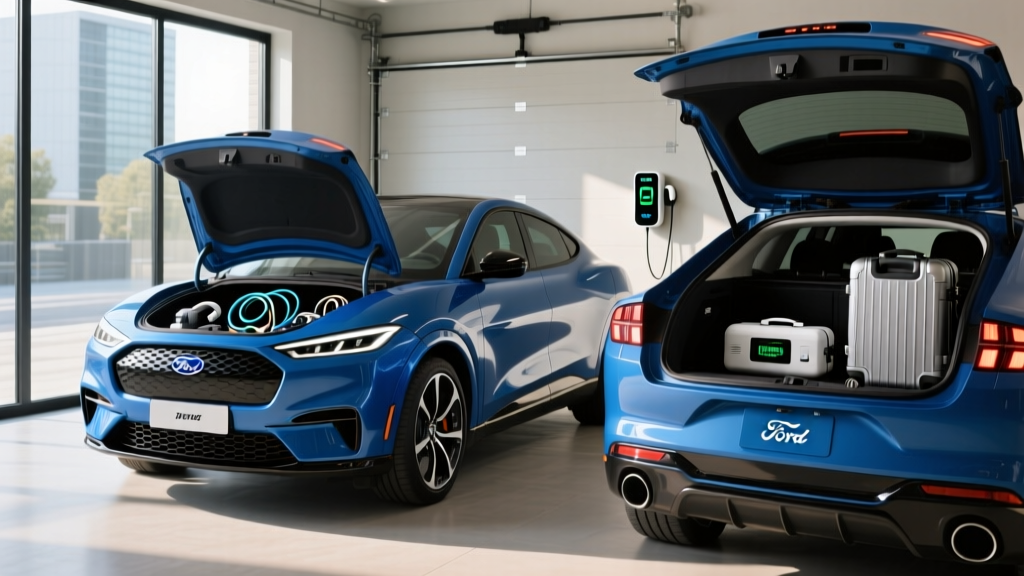
The 2026 Ford Mustang Mach-E provides 4.7 cubic feet of front-trunk storage. That's enough for a medium soft-sided cooler, a laptop bag and a few grocery sacks, or the included tire-inflator kit plus charging cables. It falls short of the Hyundai Ioniq 5's 0.85 cu ft (which is barely a shelf) but trails the Tesla Model Y's 4.1 cu ft frunk only marginally — and the Mach-E's advantage is its drain plug. Pop it open, dump ice and beverages inside, and drain the melt water out the bottom. Ford engineered it as a tailgate cooler, and it genuinely works.
| Vehicle | Frunk Volume | Drain Plug | Latch Type |
|---|---|---|---|
| Ford Mustang Mach-E | 4.7 cu ft | Yes | Power (interior + app) |
| Tesla Model Y | 4.1 cu ft | No | Power (screen + app) |
| Hyundai Ioniq 5 | 0.85 cu ft | No | Manual |
| Rivian R1S | 11.0 cu ft | No | Power |
| Cadillac Lyriq | None | N/A | N/A |
The frunk opens via a button on the driver's door panel, a tile on the 15.5-inch SYNC 4A touchscreen, or remotely through the FordPass app. There's no exterior physical button — a deliberate design choice to keep the grille clean, though it can frustrate passengers trying to access it from outside with the key fob nearby.
2026 Mach-E Full Specs: Range, Battery, and Efficiency
Beyond the frunk, the Mach-E remains one of the more balanced electric SUVs in the $40K–$55K bracket. For 2026, Ford carries over the updated battery pack introduced last year, offering two usable capacities across Select, Premium, and GT trims.
| Spec | Standard Range (RWD/AWD) | Extended Range (RWD/AWD) | GT (AWD) |
|---|---|---|---|
| Usable Battery (kWh) | 72 kWh (NMC) | 91 kWh (NMC) | 91 kWh (NMC) |
| EPA Range | 250 / 230 mi | 320 / 290 mi | 280 mi |
| Horsepower | 266 / 312 hp | 290 / 346 hp | 480 hp |
| Torque | 317 / 428 lb-ft | 317 / 428 lb-ft | 634 lb-ft |
| 0–60 mph | 6.3 / 5.2 sec | 5.8 / 4.8 sec | 3.5 sec |
| MPGe (combined) | 101 MPGe | 101 MPGe | 84 MPGe |
| kWh/100 mi | 33 kWh | 33 kWh | 40 kWh |
All 2026 Mach-E packs use NMC (nickel manganese cobalt) lithium-ion chemistry sourced from CATL and SK On, depending on trim. Ford does not currently offer an LFP option, which means the battery favors energy density over the ultra-long cycle life that LFP provides. Real-world implication: plan to keep daily charging between 20–80% for best longevity, rather than routinely hitting 100%.
EPA sticker says up to 320 miles (Extended Range RWD). Expect ~260–280 miles on sustained 75-mph highway runs in mild weather. In freezing temperatures (below 30°F), plan for 220–240 miles — a roughly 25–30% reduction due to cabin heating demand and increased battery resistance. City/regenerative driving in 50°F+ weather can exceed EPA estimates, occasionally hitting 330+ miles on the Extended Range pack.
Charging Speed: DC Fast, Level 2, and the Charge Curve
The 2026 Mach-E peaks at 150 kW on DC fast charging, unchanged from the prior generation. That's competitive but not class-leading — the Hyundai Ioniq 5 and Kia EV6 hit 240+ kW on 800V architectures, while the Tesla Model Y peaks around 250 kW on V3 Superchargers.
| Level | Max Power | Speed / Time | Connector |
|---|---|---|---|
| Level 1 (120V) | 1.4 kW | ~3 mi/hr | NACS (native, 2025+) |
| Level 2 (240V home) | 10.5 kW (48A) | ~28 mi/hr | NACS |
| DC Fast Charge | 150 kW peak | 10–80% in ~38 min | NACS |
Ford transitioned the Mach-E to the native NACS (Tesla-style) charge port starting with the 2025 model year, so 2026 buyers get direct access to Tesla Superchargers without an adapter. That's a substantial practical win: the Supercharger network remains the most reliable DC network in the U.S., and the Mach-E now plugs in natively.
Charging-curve reality: The 150 kW peak holds only between roughly 15–40% state of charge. Above 60%, the rate tapers to ~80 kW, and past 80% it drops below 40 kW. On a road trip, plan your stops from 10% to 80% — the last 20% takes nearly as long as the first 70%. Per fueleconomy.gov, the Extended Range RWD model averages 33 kWh per 100 miles, which translates to roughly $0.10–$0.14 per mile on home Level 2 charging depending on your local electricity rate.
Cargo, Passenger Space, and Interior Tech
Combine the 4.7 cu-ft frunk with the 29.7 cu-ft rear cargo area (seats up) and you get a total of 34.4 cu ft — expandable to 59.7 cu ft with the rear seats folded. That's solid for a two-row electric SUV, though the Model Y's 76 cu ft max still dominates the segment.
Passenger space is generous for four adults:
- Front legroom: 43.3 inches
- Rear legroom: 38.9 inches
- Front headroom: 40.4 inches (panoramic glass roof trims this slightly)
- Rear headroom: 38.2 inches
The cabin centerpiece is the portrait-oriented 15.5-inch SYNC 4A touchscreen running wireless Apple CarPlay and Android Auto, plus an embedded modem for OTA updates. The 10.2-inch digital instrument cluster handles speed, range, and navigation. Driver assistance comes via Ford Co-Pilot360 2.0, which includes adaptive cruise with stop-and-go, lane centering, evasive steering assist, and intersection assist. Note: BlueCruise (Ford's hands-free highway system) is available on Premium and GT trims with a subscription after the initial trial period. This is an SAE Level 2 system — you must remain attentive and keep eyes on the road at all times.
Pricing, Trims, and Federal Tax Credit Eligibility
The 2026 Mach-E lineup starts just under $40K and tops out near $55K before options. Here's how the pricing breaks down:
| Trim | Base MSRP | Est. §30D Credit | Net Price (if eligible) |
|---|---|---|---|
| Select SR RWD | $39,995 | Up to $7,500 | ~$32,495 |
| Select SR AWD | $42,995 | Up to $7,500 | ~$35,495 |
| Premium ER RWD | $47,995 | Up to $7,500 | ~$40,495 |
| Premium ER AWD | $50,995 | Up to $7,500 | ~$43,495 |
| GT ER AWD | $54,995 | Up to $7,500 | ~$47,495 |
Federal §30D tax credit caveat: As of 2026, the Mach-E may qualify for up to $7,500 under the IRS clean vehicle credit, but eligibility depends on three moving targets:
- MSRP cap: SUVs must be under $80,000 — all Mach-E trims clear this.
- Buyer income cap: AGI must not exceed $150K single / $300K joint filers.
- Battery sourcing: Critical minerals and battery components must meet escalating percentages from U.S. free-trade partners. Ford has shifted some sourcing, but verify the current-year compliance on the IRS qualified vehicles list before purchasing.
- Point-of-sale transfer: You can transfer the credit to the dealer at purchase, reducing your out-of-pocket cost immediately rather than waiting until tax filing.
Always confirm eligibility on the IRS qualified vehicle list before signing paperwork — battery sourcing rules have caused several models to move on and off the eligible list year to year.
Warranty, Ownership Costs, and Long-Term Outlook
Ford backs the Mach-E with a competitive warranty package:
- Battery: 8 years / 100,000 miles (retains ≥70% capacity)
- Electric powertrain components: 8 years / 100,000 miles
- Bumper-to-bumper: 3 years / 36,000 miles
- Roadside assistance: 5 years / 60,000 miles
The 70% capacity retention threshold is standard for the industry but worth noting: if your 91 kWh pack degrades to 63.7 kWh within 8 years, Ford will repair or replace it. In practice, NMC packs with active thermal management (which the Mach-E has) typically lose 8–12% over the first 100K miles based on fleet data — meaning most owners won't approach the warranty threshold.
Insurance costs tend to run 15–25% higher than comparable gas crossovers, per IIHS and industry data. Budget roughly $1,800–$2,400/year depending on your state and driving record. Maintenance savings are real — no oil changes, minimal brake wear thanks to regen — but tire replacement comes sooner due to the Mach-E's weight and instant torque.
Pros, Cons, and the Verdict
- Drained frunk is a genuine tailgate-party feature
- Native NACS port = direct Supercharger access
- GT trim delivers 3.5-sec 0–60 thrills
- Comfortable ride quality, composed handling
- Competitive pricing after potential tax credit
- BlueCruise hands-free highway driving (subscription)
- 150 kW peak DC charge rate lags 800V rivals
- No LFP battery option for heavy daily 100% charging
- Frunk smaller than Rivian, no exterior button
- Cargo space trails Model Y by ~16 cu ft max
- BlueCruise requires ongoing subscription after trial
- Real-world highway range ~15% below EPA sticker
Who Should Buy the 2026 Mach-E?
The Mach-E fits daily commuters and small families who want an engaging-driving electric SUV with native Supercharger access and don't need maximum cargo volume. The Select SR RWD at ~$32K after credit is one of the most affordable ways into a practical long-range EV. The GT suits driving enthusiasts who want Porsche-matching acceleration at half the price.
If you regularly haul large cargo, need 3-row seating, or want the fastest possible DC charging for frequent road trips, cross-shop the Tesla Model Y, Hyundai Ioniq 5, or Kia EV9. But if a drained frunk full of ice and cold drinks at the campsite sounds appealing, the Mach-E has no equal.
Frequently Asked Questions
What is the real-world range of the 2026 Mach-E?
The EPA rates the Extended Range RWD at 320 miles. Real-world highway driving in mild weather yields 260–280 miles; cold weather (below 30°F) drops that to 220–240 miles. City driving with regenerative braking can exceed 300 miles consistently.
How fast does the Mach-E charge at home and on DC fast chargers?
On a 48-amp Level 2 home charger, the Mach-E adds roughly 28 miles per hour (10.5 kW). A full charge from empty takes about 9–10 hours. On DC fast charging, it peaks at 150 kW and charges from 10–80% in approximately 38 minutes, with significant tapering above 60% state of charge.
Does the 2026 Mach-E qualify for the $7,500 federal EV tax credit?
Potentially, yes — but it depends on your income (≤$150K single / ≤$300K joint), the vehicle's battery sourcing compliance in the current year, and MSRP under $80K (all trims qualify). Check the IRS qualified vehicle list before purchasing, as eligibility can change with supply-chain updates.
Is the Mach-E worth buying over the Tesla Model Y or Ioniq 5?
The Mach-E wins on driving dynamics, frunk utility, and cabin comfort. The Model Y wins on cargo space (76 cu ft max), Supercharger ecosystem maturity, and sustained fast-charge speed. The Ioniq 5 wins on DC charge speed (240 kW) and design. Test-drive all three — the Mach-E appeals most to buyers who prioritize ride quality and Ford dealer service access.
What's the biggest drawback of the Mach-E frunk?
At 4.7 cubic feet, it's smaller than the Rivian R1S's 11 cu-ft frunk, and there's no exterior release button — you must use the interior button, touchscreen, or FordPass app. However, the integrated drain plug makes it the best frunk in the segment for use as a cooler.
Does the Mach-E have BlueCruise self-driving?
BlueCruise is an SAE Level 2 hands-free driver-assistance system, not self-driving. It operates on pre-mapped divided highways and requires continuous driver attention monitored by an in-cabin camera. You remain legally responsible for the vehicle at all times. BlueCruise is included for a trial period on Premium and GT trims, then requires a paid subscription.