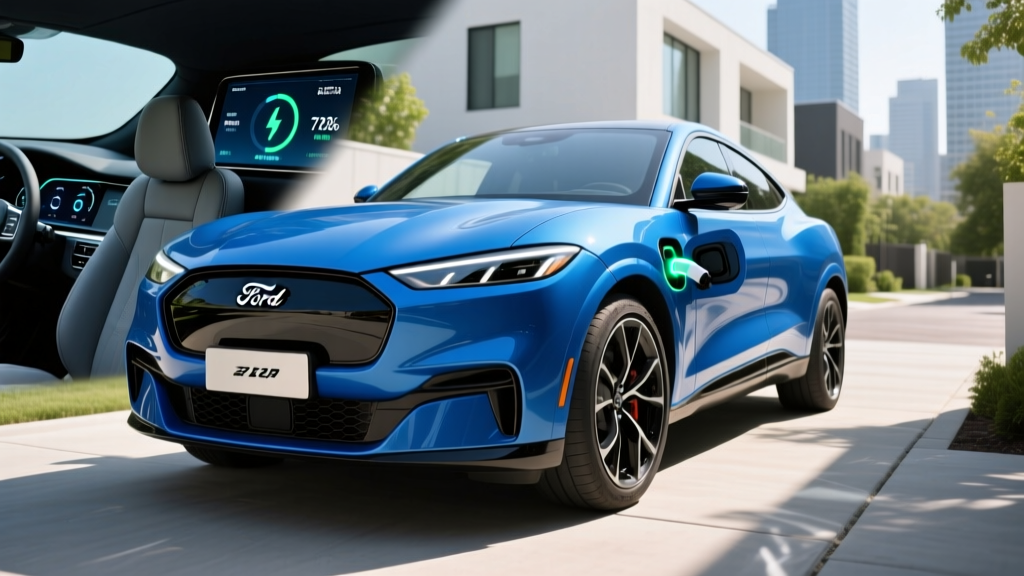
The Ford Mustang Mach-E enters the 2026 model year as one of the most established electric crossovers on the market, having accumulated years of real-world ownership data since its late-2020 launch. For buyers evaluating the Mach-E against a surging field of competitors — including the Tesla Model Y, Hyundai Ioniq 5, and Chevrolet Equinox EV — the financial picture matters as much as the spec sheet. Current Ford financing rates for the Mach-E, combined with shifting federal tax credit rules, can swing the effective monthly payment by hundreds of dollars depending on your credit tier and configuration.
This review breaks down the 2026 Mach-E's range, charging speed, performance, and ownership costs with the precision you need to decide whether to buy, lease, or finance — and exactly what you'll pay each month.
2026 Mach-E Quick Specs at a Glance
| Spec | Select (RWD) | Premium (AWD) | GT (AWD) |
|---|---|---|---|
| EPA Range | ~250 mi (Std Range) / ~320 mi (Ext Range) | ~290 mi (Ext Range) | ~280 mi (Ext Range) |
| Battery (usable) | 70 kWh (LFP) / 91 kWh (NMC) | 91 kWh (NMC) | 91 kWh (NMC) |
| Horsepower | 266 hp | 346 hp | 480 hp |
| 0-60 mph | ~6.3 sec | ~5.1 sec | ~3.5 sec |
| Max DC Charge Rate | 150 kW | 150 kW | 150 kW |
| 10-80% DC Time | ~36 min (Ext Range) | ~36 min | ~36 min |
| Base MSRP | $39,995 | $45,995 | $56,995 |
Note: Specs reflect 2026 model-year manufacturer estimates. Standard Range models use an LFP (lithium iron phosphate) battery; Extended Range models use NMC (nickel manganese cobalt) chemistry. Ford's transition to the NACS charge port means 2026 Mach-E models ship with native Tesla Supercharger compatibility — no adapter required.
Real-World Range: What the EPA Number Doesn't Tell You
EPA Estimate: Up to 320 miles (Select RWD, Extended Range)
Real-World Highway (70-80 mph): Expect ~250-275 miles in mild weather
Cold Weather (below 30°F): Expect ~200-230 miles on the Extended Range pack
City/Commuter Driving: Closer to EPA or slightly above, thanks to regenerative braking
The Mach-E Extended Range's 320-mile EPA figure is competitive within the midsize electric crossover segment, but real-world results depend heavily on your driving profile. In EPA testing published at fueleconomy.gov, the Select RWD Extended Range achieves approximately 101 MPGe combined, translating to roughly 33 kWh per 100 miles.
Highway driving at sustained speeds of 75-80 mph pushes consumption to 36-39 kWh/100 mi, cutting effective range to 250-275 miles on a full charge. Cold weather compounds this: lithium-ion cells lose efficiency in freezing temperatures, and cabin heating draws heavily from the 91 kWh pack. Owners in northern climates consistently report 25-35% range reduction in sub-30°F conditions. If your daily commute is under 60 miles round-trip, this won't matter. If you're planning 300-mile road trips in January, plan your charging stops accordingly.
The Standard Range LFP pack (70 kWh usable) offers about 250 miles EPA in the RWD Select trim. LFP chemistry trades energy density for longevity and thermal stability — it degrades more slowly over time and can be charged to 100% daily without the same wear concerns as NMC. For commuters with home charging, the Standard Range LFP is arguably the smarter long-ownership play.
Charging Speed: DC Fast Charge and Home Level 2
| Charge Level | Power | Speed (mi/hr added) | Notes |
|---|---|---|---|
| Level 1 (120V household) | ~1.4 kW | ~3-4 mi/hr | Emergency/trickle only; ~80+ hrs for full charge |
| Level 2 (240V home, 48A) | ~11.5 kW | ~28-32 mi/hr | Full charge overnight in ~9-10 hrs (Ext Range) |
| DC Fast Charge (peak) | 150 kW | ~60-65 mi in 10 min | 10-80% in ~36 min; tapers sharply above 80% |
The Mach-E's peak DC fast-charge rate of 150 kW places it behind the Hyundai Ioniq 5's 350 kW capability and the Tesla Model Y's ~250 kW peak, but ahead of older competitors like the Nissan Ariya (~130 kW). At a 150 kW station — widely available on Electrify America, EVgo, and the Tesla Supercharger network (now natively accessible via the NACS port) — the Extended Range pack charges from 10% to 80% in approximately 36 minutes.
Understanding the charge curve matters here: the Mach-E sustains close to its 150 kW peak from roughly 10-50% state of charge, then progressively tapers. Charging from 80% to 100% on DC can take nearly as long as the 10-80% session. On road trips, the practical strategy is to charge to 80% and move on — don't wait for a full top-up unless you're at your destination.
At home, the onboard 11.5 kW Level 2 charger (48 amps) is among the better setups in this class. Connected to a hardwired 60-amp circuit (installed by a licensed electrician), you'll add roughly 30 miles of range per hour of charging, meaning a depleted Extended Range pack replenishes fully in about 9-10 hours. Most owners who charge nightly never need DC fast charging for daily use.
Performance and Driving Dynamics
The Mach-E lineup spans a wide performance envelope. The base Select RWD with 266 hp and a single rear motor delivers a 0-60 mph time of approximately 6.3 seconds — adequate for merging and passing, if not thrilling. The Premium AWD dual-motor setup bumps output to 346 hp with a 5.1-second sprint, providing confident acceleration in all weather conditions.
The GT trim is the performance flagship: 480 hp, dual motors, and a 3.5-second 0-60 time that rivals sports sedans at twice the price. Ford's MagneRide adaptive suspension on the GT manages body motions well, though the 4,800+ lb curb weight is noticeable in tight corners. All trims feature one-pedal driving with adjustable regenerative braking intensity, allowing you to recapture energy in stop-and-go traffic without touching the brake pedal.
Cargo capacity is a practical strength: 29.7 cubic feet behind the rear seats and 59.7 cubic feet with the 60/40 split rear seats folded. A small front trunk (frunk) adds 4.7 cubic feet — useful for charging cables or a small bag. Rear legroom measures 38.1 inches, competitive with the Model Y and Ioniq 5 for adult passengers.
Pricing, Financing Rates, and Tax Credit Eligibility
The 2026 Mach-E pricing structure positions it as a premium-but-accessible electric crossover. Here's the current MSRP breakdown by trim:
| Trim | Base MSRP | Est. After §30D Credit | Est. Monthly (72-mo, 5.9% APR) |
|---|---|---|---|
| Select RWD (Std Range) | $39,995 | $32,495* | ~$530/mo |
| Select RWD (Ext Range) | $44,995 | $37,495* | ~$610/mo |
| Premium AWD (Ext Range) | $45,995 | $38,495* | ~$625/mo |
| GT (Ext Range) | $56,995 | $56,995** | ~$935/mo |
*Assumes full $7,500 federal tax credit applied at point of sale. **GT trim exceeds the $55,000 MSRP cap for SUVs under §30D and does not qualify for the new-vehicle credit.
Ford Motor Credit's promotional financing rates for the 2026 Mach-E have ranged from 3.9% to 6.9% APR for well-qualified buyers (typically FICO 720+) on 60- to 72-month terms, depending on the trim and promotional period. Buyers with credit scores in the 660-719 range may see rates between 7.5% and 9.9%. At 5.9% APR over 72 months on a $38,495 effective price (Premium AWD after credit), the monthly payment lands around $625 — before taxes, registration, and insurance.
Lease deals have periodically appeared in the $349-$449/mo range for the Select trim with $3,995 due at signing, though lease money factors vary by region and inventory levels. Always compare the total lease cost against financing to determine which is cheaper for your holding period.
Federal Tax Credit: §30D Eligibility Checklist
The IRS §30D Clean Vehicle Credit can reduce your effective purchase price by up to $7,500, but eligibility is not automatic. Current 2026 rules require:
- MSRP Cap: Vehicle base price must not exceed $80,000 for SUVs/pickups or $55,000 for sedans (Mach-E classifies as an SUV; all trims except GT qualify on price)
- Buyer Income Cap: Modified AGI must not exceed $150,000 (single), $225,000 (head of household), or $300,000 (joint filing)
- Battery Sourcing: Critical minerals and battery components must meet escalating domestic/free-trade-agreement sourcing percentages — Ford has worked to qualify the Mach-E's supply chain, but verify current-year compliance at purchase
- Point-of-Sale Transfer: You can transfer the credit to the dealer at purchase, reducing the sale price directly rather than waiting for a tax refund
- Final Assembly: Vehicle must be assembled in North America (Mach-E is built in Cuautitlán, Mexico — currently qualifying under USMCA provisions)
Consult a tax professional before relying on credit eligibility, as IRS rules and battery-sourcing compliance change periodically. The DOE's qualifying vehicle list at fueleconomy.gov is the most reliable real-time source.
Technology, Safety, and Driver Assistance
The Mach-E's centerpiece is a 15.5-inch vertical touchscreen running Ford's SYNC 4A system, which supports wireless Apple CarPlay and Android Auto, over-the-air updates, and Ford's BlueCruise hands-free driving assistant. BlueCruise operates on pre-mapped divided highways and allows hands-off driving with active eye monitoring — it is an SAE Level 2 system, meaning the driver must remain attentive and ready to resume control at all times. It is not autonomous driving.
BlueCruise provides hands-free highway driving with driver monitoring. The driver is responsible for supervision, lane-change decisions, and all non-highway driving. This is not Level 4 self-driving.
Ford Co-Pilot360 2.0 is standard across all trims, bundling automatic emergency braking with pedestrian detection, blind-spot monitoring with cross-traffic alert, lane-keeping assist, and rear parking sensors. The IIHS has historically rated the Mach-E as a Top Safety Pick, though 2026 model-year crash test results should be verified at iihs.org when published.
Notable drawbacks include the absence of a traditional instrument cluster (all driving info is on a compact 10.2-inch screen above the steering wheel, which some drivers find too small) and the lack of a physical volume knob — audio control is managed through the touchscreen or steering wheel buttons.
Warranty and Long-Term Ownership Costs
Ford backs the Mach-E with a 3-year/36,000-mile bumper-to-bumper warranty and an 8-year/100,000-mile battery and powertrain warranty. The battery warranty guarantees that the high-voltage pack will retain at least 70% of its original capacity during the coverage period. If degradation falls below that threshold, Ford will repair or replace the battery at no cost.
Long-term battery degradation data from early 2021-2022 Mach-E owners suggests the NMC Extended Range packs lose approximately 5-8% capacity over the first 60,000 miles — well within the warranty buffer. LFP Standard Range packs are expected to show even slower degradation based on chemistry characteristics, though Mach-E LFP data is still maturing.
A full battery replacement outside of warranty is estimated at $12,000-$18,000 depending on pack size, though this cost is expected to decline as battery manufacturing scales. Insurance premiums for the Mach-E average 10-15% higher than comparable gas-powered crossovers, reflecting higher repair costs for EV-specific components.
Pros, Cons, and Who Should Buy the Mach-E
- Up to 320 mi EPA range (Ext Range RWD)
- Native NACS port — Tesla Supercharger access
- Spacious cabin: 29.7 cu ft cargo, 38.1" rear legroom
- LFP option for longevity-minded buyers
- BlueCruise hands-free highway driving
- Competitive financing rates through Ford Credit
- 150 kW DC peak lags Ioniq 5 and Model Y
- No physical volume knob or large instrument cluster
- GT trim ineligible for §30D tax credit (MSRP cap)
- Insurance costs above gas-car average
- 36-min 10-80% time is mid-pack, not class-leading
- Daily commuters with home Level 2 charging who want 250+ miles of real-world range and don't need DC fast-charge speed
- Small families needing crossover cargo space and rear-seat room without stepping up to a larger (and pricier) EV SUV
- Performance seekers (GT trim) who want sub-4-second acceleration and are willing to forgo the tax credit for it
- Tesla-adjacent buyers who want Supercharger network access but prefer Ford's build quality and dealer service network
Frequently Asked Questions
What is the real-world range of the 2026 Ford Mach-E?
The Extended Range RWD Select achieves 320 miles EPA, but expect 250-275 miles on highway road trips and 200-230 miles in freezing weather. The Standard Range LFP delivers approximately 250 miles EPA, with similar proportional reductions in demanding conditions.
How fast does the Mach-E charge at home and on the road?
At home on a 240V Level 2 charger (48A), the Mach-E adds roughly 30 miles of range per hour, fully charging overnight. On DC fast chargers, it peaks at 150 kW, reaching 10-80% in about 36 minutes — adequate but not class-leading.
Does the 2026 Mach-E qualify for the $7,500 federal EV tax credit?
The Select and Premium trims qualify for up to $7,500 under IRS §30D, provided you meet income caps ($150K single / $300K joint), the battery sourcing requirements are met at time of purchase, and the credit hasn't been modified by Congress. The GT trim exceeds the $55,000 MSRP threshold for some classifications and may not qualify — verify with your dealer and a tax professional.
What financing rates is Ford offering on the Mach-E?
Ford Motor Credit promotional rates have ranged from 3.9% to 6.9% APR for buyers with excellent credit (FICO 720+) on 60-72 month terms. Rates for good credit (660-719) typically fall between 7.5% and 9.9%. Check Ford's current offers page or your local dealer for the latest promotional rates, as they change monthly.
How does the Mach-E compare to the Tesla Model Y and Hyundai Ioniq 5?
The Model Y offers slightly more range (~330 mi Long Range) and faster DC charging (~250 kW peak), but the Mach-E counters with a more traditional cabin layout, BlueCruise, and Ford's dealer network for service. The Ioniq 5 charges significantly faster (350 kW peak, 10-80% in ~18 min) and has a more distinctive design, but offers less rear cargo space. The Mach-E is the balanced choice for buyers who prioritize dealer support and proven reliability over cutting-edge charge speed.