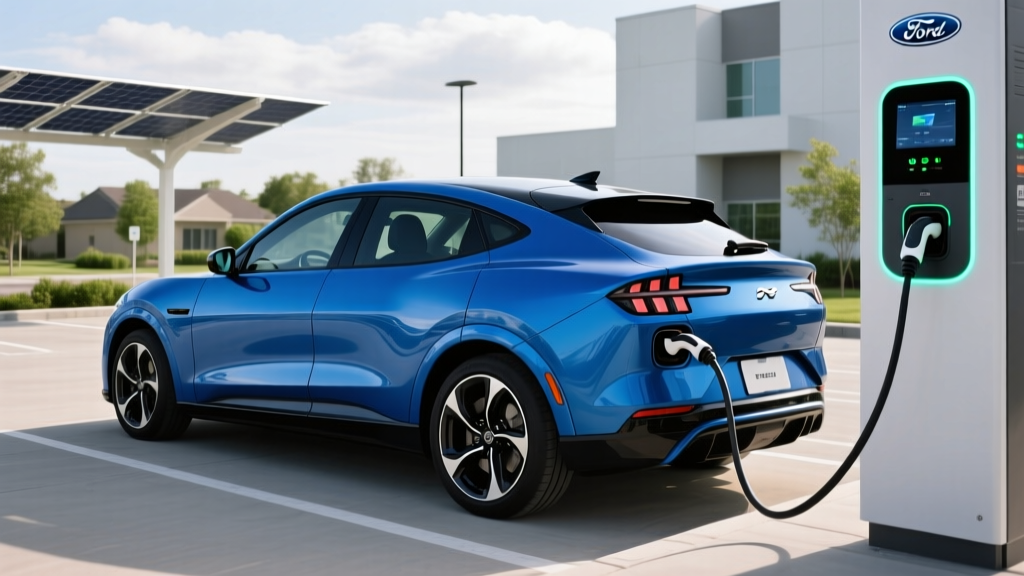
The Ford Mustang Mach-E has spent years proving that the Blue Oval can build a compelling electric crossover. For 2026, Ford has refreshed the lineup with updated battery chemistry options, a standard NACS charge port, and aggressive incentives designed to move metal. If you've been searching for Ford Mach-E finance specials, you're likely weighing manufacturer APR deals, lease cash, and federal tax credit eligibility against a competitive field that includes the Tesla Model Y, Hyundai Ioniq 5, and Chevrolet Blazer EV.
This review cuts through the marketing. We'll give you exact EPA range figures, real-world efficiency data, charging-curve realities, and a clear picture of what a Mach-E actually costs after incentives — so you can decide whether the current finance specials represent genuine value or just attractive-looking numbers.
2026 Mach-E Pricing, Trims & Finance Specials Breakdown
Ford's 2026 Mach-E lineup spans four trims, from the well-equipped Select to the performance-oriented GT. Manufacturer finance specials typically appear as low-APR offers (often 0.9%–2.9% for well-qualified buyers on 36–60 month terms) or lease cash incentives that reduce the capitalized cost. These rotate monthly, so always verify current offers on Ford's official site or with your local dealer.
| Trim | Drivetrain | Base MSRP | Est. After §30D Credit* |
|---|---|---|---|
| Select (Standard Range) | RWD | $39,995 | ~$32,495 |
| Select (Extended Range) | RWD | $45,995 | ~$38,495 |
| Premium (Extended Range) | AWD | $51,495 | ~$43,995 |
| GT (Extended Range) | AWD (Dual Motor) | $59,995 | ~$52,495 |
*Federal §30D tax credit eligibility requires meeting buyer income caps ($150K single / $300K joint), MSRP caps ($55,000 for SUVs — note: GT exceeds this), and battery critical-mineral/sourcing requirements. The credit can be transferred to the dealer at point of sale as a purchase-price reduction. Verify current-year rules at IRS.gov. A tax professional should confirm your personal eligibility.
Range, Battery & Real-World Efficiency
The 2026 Mach-E offers two battery packs. The Standard Range uses a 75.7 kWh (usable) lithium-ion battery with NMC (nickel-manganese-cobalt) chemistry. The Extended Range steps up to a 91.0 kWh usable NMC pack. Both feature liquid thermal management, which is critical for preserving battery health and maintaining charge speeds in temperature extremes.
| Trim / Battery | EPA Range | MPGe (Combined) | kWh/100 mi |
|---|---|---|---|
| Select Std Range RWD | 250 mi | 101 MPGe | 33 kWh |
| Select Ext Range RWD | 320 mi | 104 MPGe | 32 kWh |
| Premium Ext Range AWD | 290 mi | 98 MPGe | 34 kWh |
| GT Ext Range AWD | 270 mi | 90 MPGe | 37 kWh |
The EPA sticker on the Extended Range RWD says 320 miles. In mixed driving at 70 mph on the highway, expect 265–285 miles before you're hunting for a charger. In cold weather (below 30°F), range drops 20–30%, meaning a realistic winter highway range of 200–230 miles for the Extended Range. The Standard Range RWD, EPA-rated at 250 miles, delivers roughly 200–215 miles in real-world highway driving and can dip to 160–180 miles in freezing conditions. Plan road trips around these numbers, not the sticker.
Efficiency-wise, the Mach-E Extended Range RWD at 32 kWh/100 mi is competitive with the Hyundai Ioniq 5 (34 kWh/100 mi for the Long Range RWD) but trails the Tesla Model Y Long Range RWD (~28 kWh/100 mi). That difference of 4 kWh/100 mi translates to roughly $60–$80 more per year in electricity if you drive 12,000 miles annually at the national average of $0.16/kWh.
Charging Speeds: DC Fast, Level 2 & Home Setup
For 2026, the Mach-E comes equipped with a native NACS (North American Charging Standard) port, giving it direct access to Tesla's Supercharger network — currently the most reliable DC fast-charging network in the U.S. — without an adapter. This is a significant advantage over older CCS-equipped rivals that still require adapters for Supercharger access.
| Charging Level | Rate | Speed / Notes |
|---|---|---|
| Level 1 (120V household) | ~1.4 kW | ~3–4 mi/hr — emergency/trickle only |
| Level 2 (240V home, 48A) | 11.5 kW | ~30 mi/hr — full charge in ~8–10 hrs |
| DC Fast Charge (Std Range) | Peak 150 kW | 10–80% in ~36 min |
| DC Fast Charge (Ext Range) | Peak 170 kW | 10–80% in ~33 min |
A few things to understand about these numbers. The peak 170 kW rate on the Extended Range is exactly that — a peak. The Mach-E's charge curve tapers significantly above 60% state of charge (SoC). You'll see 150–170 kW from roughly 10–40%, then a step down to ~100 kW through 60%, and a steep taper to ~40 kW above 80%. This is why the 10–80% time is ~33 minutes rather than the ~22 minutes you'd calculate from a sustained 170 kW rate. If you're on a road trip, plan your stops around 10–80% top-ups; charging from 80–100% at a DC fast charger is painfully slow and wastes time.
For home charging, the Mach-E's 11.5 kW onboard charger is competitive. A 48-amp Level 2 wall connector on a 60-amp circuit will add roughly 30 miles per hour of charging. Most owners who drive 40–50 miles daily will wake up to a full battery every morning. Expect a home Level 2 installation to cost $800–$2,000 (charger + electrician + permit), potentially more if your electrical panel needs a service upgrade to 200 amps.
Performance, Drivetrain & Ride Quality
The Mach-E's performance varies significantly by trim. The base Select Standard Range RWD produces 266 horsepower and 317 lb-ft of torque, hitting 0–60 mph in approximately 6.3 seconds. That's adequate for commuting and merging, if not thrilling.
The Extended Range RWD bumps output to 290 hp and 317 lb-ft, dropping the 0–60 time to roughly 5.8 seconds. The Premium Extended Range AWD (dual motor) delivers 346 hp and 428 lb-ft for a 5.1-second sprint. The GT, with its dual-motor AWD setup tuned for performance, produces 480 hp and 634 lb-ft, reaching 60 mph in 3.5 seconds.
| Trim | Horsepower | Torque (lb-ft) | 0–60 mph | Drivetrain |
|---|---|---|---|---|
| Select Std Range | 266 hp | 317 | 6.3 sec | RWD |
| Select Ext Range | 290 hp | 317 | 5.8 sec | RWD |
| Premium Ext Range | 346 hp | 428 | 5.1 sec | AWD (Dual Motor) |
| GT | 480 hp | 634 | 3.5 sec | AWD (Dual Motor) |
The ride quality is firm but controlled — Ford tuned the Mach-E to lean into its "Mustang" branding with responsive steering and minimal body roll. It's not as plush as a Hyundai Ioniq 5, but it's more engaging on a back road. The GT's MagneRide adaptive dampers (standard on GT) do an impressive job of balancing comfort and sportiness. Regenerative braking offers multiple levels, including a true one-pedal driving mode that can bring the Mach-E to a complete stop without touching the brake pedal.
Interior, Cargo & Technology
The Mach-E's cabin is dominated by a massive 15.5-inch portrait-oriented touchscreen running Ford's SYNC 4A infotainment system. It supports wireless Apple CarPlay and Android Auto, over-the-air (OTA) updates, and includes a vertically oriented shortcut bar for climate and volume controls. The interface is responsive, though the reliance on touchscreen controls for basic functions like wiper adjustment can frustrate traditionalists.
Space is practical for a midsize crossover:
- Front legroom: 43.3 inches
- Rear legroom: 38.9 inches
- Cargo (rear seats up): 29.7 cu ft
- Cargo (rear seats folded): 59.7 cu ft
- Front trunk (frunk): 4.7 cu ft — drainable, useful for wet gear or groceries
Compared to the Tesla Model Y (30.2 cu ft rear cargo, 72.1 cu ft folded), the Mach-E gives up a bit of volume, but the frunk is more usable and the cabin materials feel more premium at the Premium and GT trims. The ActiveX synthetic leather upholstery is durable and easy to clean.
On the driver-assistance front, the Mach-E comes standard with Ford Co-Pilot360 Assist 2.0, which includes adaptive cruise control with stop-and-go, lane-centering, evasive steering assist, and intersection assist. Available BlueCruise enables hands-free driving on over 130,000 miles of pre-mapped divided highways.
BlueCruise is a Level 2 driver-assistance system per SAE International classification. Despite the "hands-free" label, you must remain attentive. An infrared driver-monitoring camera tracks your eyes, and the system will issue escalating warnings — then disengage — if you look away from the road. This is not autonomous (Level 4) driving like Waymo's robotaxi service. You are the driver, legally and practically, at all times.
Battery Warranty, Reliability & Ownership Costs
Ford backs the Mach-E's high-voltage battery and electric powertrain with an 8-year / 100,000-mile warranty (whichever comes first). The battery warranty guarantees replacement if capacity falls below 70% of original capacity during the coverage period — a fairly standard threshold, though some competitors (like Hyundai) offer a 70% retention guarantee with no time limit beyond the 10-year/100,000-mile mark.
The limited vehicle warranty covers 3 years / 36,000 miles, which is unremarkable. Roadside assistance runs 5 years / 60,000 miles.
Long-term battery degradation data on the Mach-E is still maturing, but NMC packs with active liquid thermal management typically lose 8–12% capacity over the first 100,000 miles based on industry averages. Ford's OTA updates have, in some cases, slightly improved range estimates by optimizing battery management parameters — a benefit of a connected EV platform.
Insurance costs for the Mach-E run higher than a comparable gas-powered Escape. Expect annual premiums of $1,800–$2,600 depending on your location, driving record, and trim (GT owners will pay more). Get quotes before purchasing.
✅ Pros
- Native NACS port — direct Tesla Supercharger access
- BlueCruise hands-free highway driving is well-implemented
- GT trim delivers genuine sports-car acceleration (3.5s 0–60)
- Drainable frunk adds practical utility
- Aggressive finance specials can significantly reduce cost
- Comfortable, well-appointed interior at Premium/GT trims
❌ Cons
- DC fast-charge speed (170 kW peak) lags Ioniq 5 (350 kW)
- Real-world highway range falls 35–55 mi below EPA sticker
- GT trim exceeds $55K MSRP cap for federal tax credit
- Rear cargo space trails Model Y
- Insurance premiums run 15–25% above gas equivalents
- Standard Range 10–80% charge time (~36 min) is slow for road trips
How the Mach-E Stacks Up Against Key Rivals
The Mach-E doesn't exist in a vacuum. Here's how it compares to the three cross-shops you're almost certainly considering:
| Spec | Ford Mach-E Ext Range RWD | Tesla Model Y LR RWD | Hyundai Ioniq 5 LR RWD | Chevy Blazer EV 2LT |
|---|---|---|---|---|
| EPA Range | 320 mi | 330 mi | 303 mi | 312 mi |
| Battery (usable) | 91.0 kWh NMC | ~78 kWh (est.) | 77.4 kWh NMC | 85.0 kWh NMC |
| Peak DC Charge | 170 kW | 250 kW | 350 kW | 190 kW |
| 10–80% Time | ~33 min | ~22 min | ~18 min | ~30 min |
| 0–60 mph | 5.8 sec | 5.8 sec | 7.2 sec | 6.0 sec |
| Base MSRP | $45,995 | $44,990 | $46,650 | $44,600 |
| Charge Port | NACS (native) | NACS (native) | NACS (2026+) | NACS (2026+) |
The takeaway: The Ioniq 5 charges fastest by a wide margin, which matters if you road-trip often. The Model Y offers the best efficiency and the most Supercharger-native ecosystem (though that gap is closing as other brands get NACS). The Mach-E's strengths are its driving dynamics, BlueCruise, and Ford dealer network accessibility — plus the finance specials that can make the effective price very competitive.
Who Should Buy the 2026 Mach-E?
Decision Framework
Choose the Mach-E if:
- You want a sporty-driving electric crossover with genuine handling engagement
- BlueCruise hands-free highway driving is a priority for your commute
- Ford's current finance special (low APR or lease cash) makes the effective price compelling vs. rivals
- You value a traditional dealer experience for service and support
- You need a drainable frunk for outdoor gear, wet items, or groceries
Look elsewhere if:
- You road-trip frequently and need the fastest possible DC charging (Ioniq 5's 350 kW wins)
- Maximum cargo space is critical (Model Y has more volume)
- You want the most efficient EV in the segment (Model Y uses fewer kWh per mile)
- You're eyeing the GT trim and need the federal tax credit (MSRP exceeds the $55K cap)
Frequently Asked Questions
What is the real-world range of the 2026 Ford Mach-E?
The Extended Range RWD is EPA-rated at 320 miles, but real-world highway driving at 70 mph yields roughly 265–285 miles. In cold weather (below 30°F), expect 200–230 miles. The Standard Range RWD delivers about 200–215 miles in real-world conditions.
How fast does the Mach-E charge at home and on the road?
On a 48-amp Level 2 home charger, the Mach-E charges at 11.5 kW, adding about 30 miles of range per hour. At a DC fast charger, the Extended Range peaks at 170 kW and charges from 10–80% in approximately 33 minutes. The Standard Range peaks at 150 kW with a 10–80% time of about 36 minutes.
Does the 2026 Mach-E qualify for the $7,500 federal EV tax credit?
It depends. The Select and Premium trims fall under the $55,000 MSRP cap for SUVs and may qualify for up to $7,500 under IRS §30D, provided you meet income limits ($150K single / $300K joint) and the vehicle meets battery critical-mineral and sourcing requirements. The GT trim exceeds the MSRP cap and does not qualify. Always verify current rules at IRS.gov and consult a tax professional.
How much does a Mach-E cost after tax credits and finance specials?
A Select Standard Range RWD at $39,995, with the full $7,500 credit applied at point of sale, drops to roughly $32,495. Combine that with a Ford 1.9% APR finance special on a 60-month loan, and your monthly payment could land around $555. An Extended Range RWD at $45,995 drops to ~$38,495 after credit, with payments around $655/mo at 1.9% for 60 months. Exact numbers depend on your down payment, trade-in, and dealer fees.
Is the Mach-E worth buying over the Tesla Model Y or Hyundai Ioniq 5?
It depends on your priorities. The Mach-E wins on driving engagement, BlueCruise availability, and dealer-network service accessibility. The Ioniq 5 wins on charging speed (350 kW peak). The Model Y wins on efficiency, cargo space, and Supercharger ecosystem maturity. If Ford's finance specials bring the Mach-E's effective cost below these rivals, it becomes a strong value play — just understand the charging-speed trade-off for road trips.
What is the Mach-E's battery warranty?
Ford covers the high-voltage battery and electric powertrain for 8 years or 100,000 miles, whichever comes first. The warranty covers battery replacement if capacity degrades below 70% of original capacity during the coverage period.
Does the 2026 Mach-E have a NACS charge port?
Yes. The 2026 Mach-E comes with a native NACS (Tesla-style) charge port, giving it direct access to Tesla Superchargers without an adapter. This is a major improvement over 2021–2024 models that used CCS and required an adapter for Supercharger access.
Sources: EPA range and efficiency data from fueleconomy.gov. Federal tax credit rules from IRS.gov §30D. Manufacturer specifications from Ford's official press materials. Safety ratings from IIHS and NHTSA. Pricing and incentive details are current as of the 2026 model year and subject to change — verify with your dealer and tax professional before purchasing.