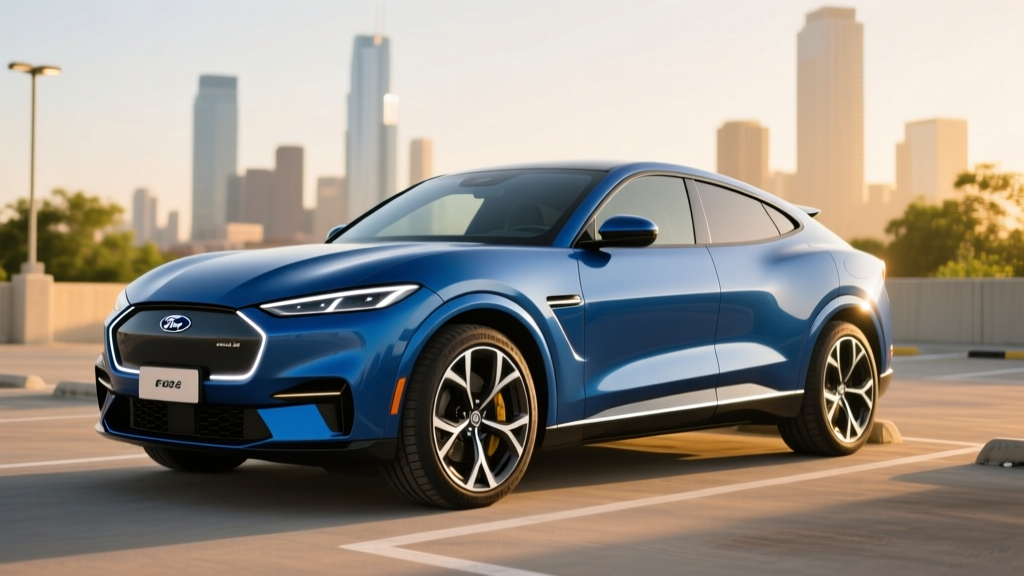
The Ford Mustang Mach-E has been one of the most recognizable electric crossovers since its launch, and as the 2026 model year rolls into dealerships, buyers are asking a very practical question: what does it actually cost to put one in your driveway? Between shifting federal tax credit rules, fluctuating interest rates, and a growing list of trim configurations, understanding the full financial picture of a Mach-E purchase requires more than a glance at the window sticker.
This guide breaks down the 2026 Ford Mustang Mach-E from a finance-first perspective — covering every trim's MSRP, how the IRS §30D federal EV tax credit applies (and who qualifies), real-world range and charging data that affect your daily operating costs, and how the Mach-E stacks up against key rivals on total cost of ownership. Whether you're comparing lease offers, running loan numbers, or deciding between the Select and GT trims, you'll find the exact figures you need here.
2026 Mach-E Trim Pricing and Federal Tax Credit Eligibility
Ford offers the 2026 Mustang Mach-E in four primary trims: Select, Premium, California Route 1, and GT. Pricing has shifted modestly from prior model years as Ford adjusted to competitive pressure and battery-cost changes. Here's the full MSRP breakdown by trim, drivetrain, and the tax-credit-adjusted effective price.
| Trim | Drivetrain | Base MSRP | Est. §30D Credit | Effective Price |
|---|---|---|---|---|
| Select (RWD) | RWD | $39,995 | Up to $7,500* | ~$32,495 |
| Select (AWD) | AWD | $42,995 | Up to $7,500* | ~$35,495 |
| Premium (eAWD) | AWD | $46,995 | Up to $7,500* | ~$39,495 |
| California Route 1 | RWD | $44,495 | Up to $7,500* | ~$36,995 |
| GT (eAWD) | AWD | $54,995 | Up to $7,500* | ~$47,495 |
| GT Performance Upgrade | AWD | $58,995 | Up to $7,500* | ~$51,495 |
*All trims fall under the $80,000 MSRP cap for SUVs/crossovers under IRS §30D. Credit amount depends on battery-sourcing and critical-minerals requirements, which phase in progressively. Verify current-year eligibility at IRS.gov before purchasing. The credit can now be transferred to the dealer at point of sale, reducing your out-of-pocket cost immediately rather than waiting for tax filing.
§30D Tax Credit Eligibility Checklist
- Vehicle MSRP cap: Must be ≤ $80,000 for SUVs, vans, and pickups (all Mach-E trims qualify)
- Buyer income cap: Modified AGI ≤ $150,000 (single), $225,000 (head of household), $300,000 (joint)
- Battery sourcing: Increasing percentages of battery components must be manufactured/assembled in North America, and critical minerals must be sourced from the U.S. or free-trade-agreement partners — these thresholds tighten annually
- Point-of-sale transfer: You can elect to transfer the credit to the dealer, receiving it as a down-payment reduction at purchase rather than a tax-time refund
- One credit per taxpayer per year: You cannot claim the new-vehicle credit if you've already claimed one for a different new EV purchase in the same calendar year
Finance tip: If your income exceeds the AGI caps, consider whether a lease structure might still pass savings through — some leasing companies receive the commercial clean vehicle credit (§45W) and may reflect that in reduced lease payments, though this is not guaranteed. Consult a tax professional for your specific situation.
Real-World Range, Battery, and Efficiency
Range is where the Mach-E's financial story intersects with daily usability. A longer range means fewer charging stops on road trips and more flexibility if you can't charge at home every night. The 2026 Mach-E continues with two battery pack options across its lineup.
Standard Range (75.7 kWh usable, NMC): EPA est. 250 mi (Select RWD)
Extended Range (91 kWh usable, NMC): EPA est. 320 mi (California Route 1 RWD)
Real-world expectation: Highway driving at 70+ mph typically yields 85-90% of EPA range (~210-270 mi depending on pack). In cold weather (below 30°F), expect a 15-30% reduction due to battery resistance and cabin heating demands. The Mach-E's heat pump (standard on Premium and above) helps mitigate cold-weather loss compared to resistance-heater EVs.
| Trim | Battery (usable kWh) | Chemistry | EPA Range | MPGe (combined) | kWh/100 mi |
|---|---|---|---|---|---|
| Select RWD (Std Range) | 75.7 kWh | NMC | 250 mi | 101 MPGe | 33 |
| Select eAWD (Std Range) | 75.7 kWh | NMC | 230 mi | 93 MPGe | 36 |
| Premium eAWD (Ext Range) | 91 kWh | NMC | 300 mi | 98 MPGe | 34 |
| CA Route 1 RWD (Ext Range) | 91 kWh | NMC | 320 mi | 104 MPGe | 32 |
| GT eAWD (Ext Range) | 91 kWh | NMC | 280 mi | 86 MPGe | 39 |
The Extended Range pack's NMC (nickel-manganese-cobalt) chemistry offers higher energy density than LFP, which is why the 91 kWh pack fits in the same physical footprint as the 75.7 kWh Standard Range. The trade-off: NMC cells benefit from staying between 20-80% state of charge for daily use, while LFP packs tolerate regular 100% charges. Ford's battery management system includes a buffer above and below the usable capacity to protect long-term health.
According to fueleconomy.gov, the California Route 1 RWD with the Extended Range pack delivers the best efficiency in the lineup at approximately 32 kWh per 100 miles — translating to roughly $0.10-$0.13 per mile at the national average residential electricity rate of $0.16/kWh. Compare that to a comparable gas crossover at 26 MPG combined and $3.40/gallon, which costs about $0.13 per mile. The per-mile fuel savings narrow when charging at home, but become dramatic if you have access to workplace or off-peak utility-rate charging.
Charging Speed: DC Fast Charging and Home Level 2
Charging speed is the single biggest factor in whether an EV works for road trips and apartment dwellers alike. The 2026 Mach-E uses the CCS1 connector for DC fast charging on non-Tesla networks, though Ford has secured Tesla Supercharger access for Mach-E owners via an included adapter (NACS port integration is expected in future model years).
| Charging Level | Power (kW) | Speed (miles of range/hr) | Notes |
|---|---|---|---|
| Level 1 (120V household) | ~1.4 kW | ~3-4 mi/hr | Emergency/trickle only; full charge in 3+ days |
| Level 2 (240V, 32A) | 7.7 kW | ~21 mi/hr | Standard mobile charger on 240V outlet |
| Level 2 (240V, 48A hardwired) | 11.5 kW | ~32 mi/hr | Requires Ford Connected Charge Station or equivalent; full charge in ~8.5 hr (Ext Range) |
| DC Fast Charge (peak) | 150 kW | ~52 mi in 10 min | 10-80% in ~45 min (Std Range), ~52 min (Ext Range) |
Charging curve reality: The Mach-E peaks at approximately 150 kW on DC fast chargers, but that peak is sustained only between roughly 10-30% state of charge. Above 50% SoC, the rate tapers to 80-100 kW, and above 80% it drops below 50 kW to protect battery health. This means a 10-80% session takes meaningfully longer than marketing materials suggest if you extrapolate peak rate linearly. Plan road-trip stops around the 10-80% window — charging to 100% at a DC station adds 30+ minutes for the last 20% of the battery.
For home charging, the 11.5 kW Level 2 rate (48 amps) is competitive with rivals. A full overnight charge easily replenishes even the Extended Range pack. Installation of a 48-amp hardwired Level 2 station typically costs $800-$2,000 including the unit, electrician labor, and permitting — though a panel upgrade to 200A service can push that to $3,000-$5,000 if your home has older 100A service.
Performance, Powertrain, and Driving Dynamics
The Mach-E's performance credentials vary sharply by trim, which has direct implications for both purchase price and insurance premiums.
| Trim | Motor Config | Horsepower | Torque (lb-ft) | 0-60 mph | Drivetrain |
|---|---|---|---|---|---|
| Select RWD | Single rear motor | 266 hp | 317 | 5.8 sec | RWD |
| Select eAWD | Dual motor | 312 hp | 417 | 5.1 sec | AWD |
| Premium eAWD | Dual motor | 346 hp | 428 | 4.8 sec | AWD |
| CA Route 1 RWD | Single rear motor | 290 hp | 317 | 5.5 sec | RWD |
| GT | Dual motor | 480 hp | 600 | 3.8 sec | AWD |
| GT w/ Performance Upgrade | Dual motor | 480 hp | 634 | 3.5 sec | AWD |
The GT with the Performance Upgrade is genuinely quick — 3.5 seconds to 60 mph puts it in sports-car territory. But from a finance perspective, that performance comes with trade-offs: the GT's EPA range drops to 280 miles, its efficiency falls to roughly 39 kWh/100 mi, and insurance premiums typically run 15-25% higher than the Select trim according to industry averages. If your priority is minimizing total cost of ownership, the Select RWD or California Route 1 RWD offers the best range-per-dollar ratio in the lineup.
Interior Space, Technology, and Driver Assistance
The Mach-E's cabin prioritizes a minimalist, tech-forward layout dominated by a 15.5-inch vertical touchscreen running Ford's SYNC 4A infotainment system. Wireless Apple CarPlay and Android Auto are standard across all trims.
Cargo and Passenger Dimensions
- Front headroom: 40.4 inches
- Front legroom: 43.3 inches
- Rear headroom: 38.9 inches
- Rear legroom: 38.1 inches
- Cargo volume (rear seats up): 29.7 cu ft
- Cargo volume (rear seats folded): 59.7 cu ft
- Front trunk (frunk): 4.7 cu ft (drainable, useful for wet gear or groceries)
The rear seat is comfortable for adults on longer drives, and the 29.7 cu ft of cargo space with seats up is competitive with the Hyundai Ioniq 5 (27.2 cu ft) and slightly behind the Tesla Model Y (30.2 cu ft). The drainable frunk is a practical differentiator — few competitors offer a front trunk that can handle ice and drinks at a tailgate.
Driver Assistance: Ford BlueCruise
Ford BlueCruise enables hands-free driving on pre-mapped divided highways (over 130,000 miles of qualified roads in North America). However, the driver must remain attentive at all times — a driver-facing camera monitors eye gaze and will issue escalating warnings if you look away. BlueCruise does not handle city streets, construction zones, or unmapped routes. You are legally and operationally responsible for the vehicle at all times.
BlueCruise is available on Premium and GT trims and can be added to the Select via the BlueCruise Prep Package. Ford typically includes a trial period (often 90 days to 1 year), after which a subscription is required — approximately $75/month or $800/year as of recent pricing. Factor this into your ownership budget if hands-free highway driving is a priority.
Warranty Coverage and Long-Term Battery Outlook
Ford backs the 2026 Mach-E with a warranty package that's standard for the segment, but understanding the specifics matters for your financial planning.
- Bumper-to-bumper: 3 years / 36,000 miles
- Powertrain: 5 years / 60,000 miles
- High-voltage battery: 8 years / 100,000 miles (capacity retention warranty — covers the battery if it degrades below 70% of original capacity)
- Corrosion perforation: 5 years / unlimited miles
- Roadside assistance: 5 years / 60,000 miles
The 70% capacity retention threshold over 8 years/100,000 miles is the industry standard for the NHTSA-mandated minimum, and Ford matches it. In practice, real-world data from earlier Mach-E model years and comparable NMC-pack EVs suggests most batteries retain 85-92% capacity at the 100,000-mile mark under normal use. Avoiding repeated DC fast charging to 100%, minimizing deep discharges below 10%, and using scheduled preconditioning before fast-charging sessions all help preserve long-term state of health.
Out-of-warranty battery replacement for the Extended Range pack currently runs $15,000-$20,000+ including labor — a figure to be aware of if you plan to keep the vehicle past 150,000 miles. That said, full pack replacement is rare; module-level repairs are often possible at lower cost.
Mach-E vs. Key Competitors: A Finance-First Comparison
The Mach-E competes in the most crowded segment of the EV market. Here's how it stacks up against its three primary rivals on the financial and spec metrics that matter most.
| Spec | Ford Mach-E (Select RWD) | Tesla Model Y (LR RWD) | Hyundai Ioniq 5 (SEL RWD) | VW ID.4 (Pro RWD) |
|---|---|---|---|---|
| Base MSRP | $39,995 | $44,990 | $42,600 | $39,735 |
| EPA Range (base/max) | 250 / 320 mi | 320 / 320 mi | 240 / 305 mi | 206 / 291 mi |
| Max DC Fast Charge | 150 kW | 250 kW | 240 kW | 175 kW |
| 10-80% DCFC Time | ~45-52 min | ~25-30 min | ~18-25 min | ~30-38 min |
| 0-60 mph (base) | 5.8 sec | 6.5 sec | 7.0 sec | 7.7 sec |
| §30D Credit Eligible | Yes (verify sourcing) | Yes (verify sourcing) | Yes (verify sourcing) | Yes (verify sourcing) |
| Battery Warranty | 8yr/100k mi (70%) | 8yr/120k mi (70%) | 10yr/100k mi (70%) | 8yr/100k mi (70%) |
- You want the lowest entry price among AWD-capable electric crossovers
- You value BlueCruise hands-free highway driving
- Driving dynamics and steering feel matter more than max charging speed
- You want a drainable frunk and traditional crossover styling
- DC fast-charge speed is your top priority (Ioniq 5 or Model Y charge significantly faster)
- You need a third row or maximum cargo volume (Model Y)
- You want the longest battery warranty coverage (Ioniq 5 at 10 years)
- You frequently road-trip in very cold climates without access to a garage
5-Year Total Cost of Ownership Estimate
Purchase price is just the start. Here's a simplified 5-year/75,000-mile TCO comparison for the Mach-E Select RWD versus a comparably priced gas crossover (e.g., Toyota RAV4 AWD at ~$33,000 MSRP).
| Cost Category | Mach-E Select RWD | Gas Crossover Baseline |
|---|---|---|
| Purchase (after credit) | ~$32,495 | ~$33,000 |
| Fuel/Energy (75k mi) | ~$3,400 (home charging) | ~$9,800 (26 MPG, $3.40/gal) |
| Maintenance | ~$1,200 | ~$3,500 |
| Insurance (avg) | ~$9,500 | ~$7,200 |
| Depreciation (est.) | ~$14,000 | ~$12,000 |
| 5-Year Total | ~$60,595 | ~$65,500 |
The Mach-E's fuel and maintenance savings are substantial — roughly $8,700 over five years if you charge primarily at home. Insurance premiums are the main offset, running $400-$600 more per year for EVs on average due to higher repair costs and parts pricing. Depreciation remains a wildcard; EV resale values have been volatile as price wars and credit changes shift demand. The net result: the Mach-E can break even or save modestly over five years compared to a gas equivalent, with savings growing significantly if you keep the vehicle longer or drive more miles annually.
Frequently Asked Questions
What is the real-world range of the 2026 Ford Mustang Mach-E?
The EPA rates the Extended Range RWD (California Route 1) at 320 miles and the Standard Range RWD (Select) at 250 miles. In real-world highway driving at 70-75 mph, expect roughly 270-290 miles from the Extended Range pack and 210-225 miles from the Standard Range. In winter conditions below 30°F, those figures can drop by 15-30%, making the Extended Range pack a wise choice if you live in cold climates or regularly drive longer routes.
How fast does the Mach-E charge at home and on the road?
At home on a 48-amp Level 2 station (11.5 kW), the Mach-E adds about 32 miles of range per hour — a full charge of the Extended Range pack takes approximately 8.5 hours overnight. On DC fast chargers, it peaks at 150 kW but tapers significantly above 50% SoC. A 10-80% session takes roughly 45 minutes for the Standard Range pack and 52 minutes for the Extended Range. This is noticeably slower than the Hyundai Ioniq 5 (~18-25 min) and Tesla Model Y (~25-30 min) on comparable chargers.
Does the 2026 Mach-E qualify for the $7,500 federal EV tax credit?
All Mach-E trims fall under the $80,000 MSRP cap for SUVs. However, the full $7,500 credit depends on meeting both battery-component manufacturing and critical-minerals sourcing thresholds under IRS §30D, which tighten each year. The Mach-E is assembled in Cuautitlán, Mexico, and Ford has been working to qualify its battery supply chain. Check the latest eligibility list at fueleconomy.gov and confirm with your dealer before finalizing a purchase. The credit can be transferred at point of sale, reducing your down payment immediately.
Is the Mach-E worth buying over the Tesla Model Y or Hyundai Ioniq 5?
It depends on your priorities. The Mach-E offers the lowest starting price in the segment (Select RWD at $39,995), engaging driving dynamics, and BlueCruise capability. The Model Y wins on Supercharger network access, DC fast-charge speed (250 kW peak), and cargo versatility. The Ioniq 5 leads in charging speed (800V architecture, up to 240 kW) and battery warranty length (10 years). If minimizing upfront cost and enjoying a car-like driving experience matter most, the Mach-E is compelling. If road-trip charging speed is paramount, the Ioniq 5 or Model Y are stronger choices.
What are the biggest pros and cons of the 2026 Mach-E?
- Lowest base price in its class at $39,995
- Engaging steering and ride quality for an EV crossover
- Drainable frunk is genuinely useful
- BlueCruise hands-free driving on 130k+ miles of highway
- All trims under §30D MSRP cap
- Competitive real-world range (up to ~290 mi highway)
- DC fast-charge speed (150 kW peak) trails key rivals
- 10-80% charge time of 45-52 min is slow for road trips
- BlueCruise requires ongoing subscription after trial
- No third-row option; cargo space slightly behind Model Y
- Rear visibility could be better (thick C-pillars)
- Insurance premiums run higher than gas equivalents
Who is the Mach-E best suited for?
The Mach-E is ideal for daily commuters and small families who want an engaging, well-priced electric crossover with enough range for most daily needs and occasional road trips. The Select RWD at ~$32,500 after the tax credit is a strong value play for budget-conscious EV adopters. The GT appeals to performance buyers who want sports-car acceleration in a practical package. It's less ideal for high-mileage road trippers who prioritize ultra-fast charging or large families needing maximum cargo space — those buyers should cross-shop the Ioniq 5 and Model Y respectively.