2026 Mustang Mach-E: The Finance-First EV Crossover
If you've been searching for Ford Mach-E finance deals in 2026, you're looking at one of the most competitively priced electric SUVs on the market — and one that has quietly matured since its 2021 debut. Ford has refined the battery pack options, expanded the NACS charging ecosystem access, and kept MSRPs in territory where the federal §30D tax credit still applies to several trims. The Mach-E remains a serious alternative to the Tesla Model Y, Hyundai Ioniq 5, and Kia EV6, particularly for buyers who want a traditional dealership purchase experience and Ford's BlueCruise hands-free driving tech.
This review breaks down every number that matters for your finance calculator: real-world range, charging speeds, battery chemistry, trim pricing, tax credit eligibility, and total cost of ownership. Let's get to the data.
Full Spec Sheet: 2026 Mustang Mach-E at a Glance
| Spec | Select (RWD) | Premium (AWD) | GT (AWD) |
|---|---|---|---|
| EPA Range | 250 mi | 290 mi (Std Range) / 320 mi (Ext Range) | 280 mi (Ext Range) |
| Battery (usable) | 70 kWh (LFP) | 70 kWh (LFP) / 91 kWh (NMC) | 91 kWh (NMC) |
| Drivetrain | RWD, single motor | AWD, dual motor | AWD, dual motor |
| Horsepower | 266 hp | 312 hp | 480 hp |
| 0–60 mph | 6.3 sec | 5.1 sec | 3.5 sec |
| Max DC Fast Charge | 115 kW | 115 kW (Std) / 150 kW (Ext) | 150 kW |
| 10–80% DC Time | ~38 min | ~38 min / ~33 min | ~33 min |
| Level 2 Home Charge | 10.5 kW (~30 mi/hr) | 10.5 kW (~30 mi/hr) | 10.5 kW (~30 mi/hr) |
| EPA Efficiency | 101 MPGe (33 kWh/100mi) | 98 MPGe (34 kWh/100mi) | 84 MPGe (40 kWh/100mi) |
| Base MSRP | $41,995 | $47,995 | $57,995 |
Sources: fueleconomy.gov, Ford Motor Company official specifications.
Real-World Range: What the EPA Sticker Doesn't Tell You
The Premium Extended Range AWD carries a 320-mile EPA estimate — the highest in the lineup. In real-world mixed driving at 70°F, expect roughly 285–305 miles. On sustained highway trips at 75 mph, plan for 255–275 miles before you'll want to stop. In cold weather (below 32°F), range drops to approximately 220–250 miles due to cabin heating demand and reduced battery efficiency.
The Standard Range LFP models (250 mi EPA) are more resilient to degradation over time but deliver closer to 210–230 miles highway and 175–200 miles in winter.
The Mach-E's LFP (lithium iron phosphate) battery packs, now standard on Select and available on Premium trims, sacrifice some energy density compared to the NMC (nickel manganese cobalt) Extended Range packs but gain in longevity. LFP chemistry tolerates regular 100% charging without accelerated degradation — a significant advantage for daily commuters who can charge at home every night. NMC packs should ideally be held at 80% for daily use and charged to 100% only before long trips.
For a deeper understanding of how these chemistries age, see our LFP vs. NMC degradation guide.
Charging Speed: DC Fast Charging and Home Setup
| Charging Level | Power / Rate | Miles Added per Hour | Best For |
|---|---|---|---|
| Level 1 (120V household) | ~1.4 kW | ~3–4 mi/hr | Emergency top-offs, PHEVs |
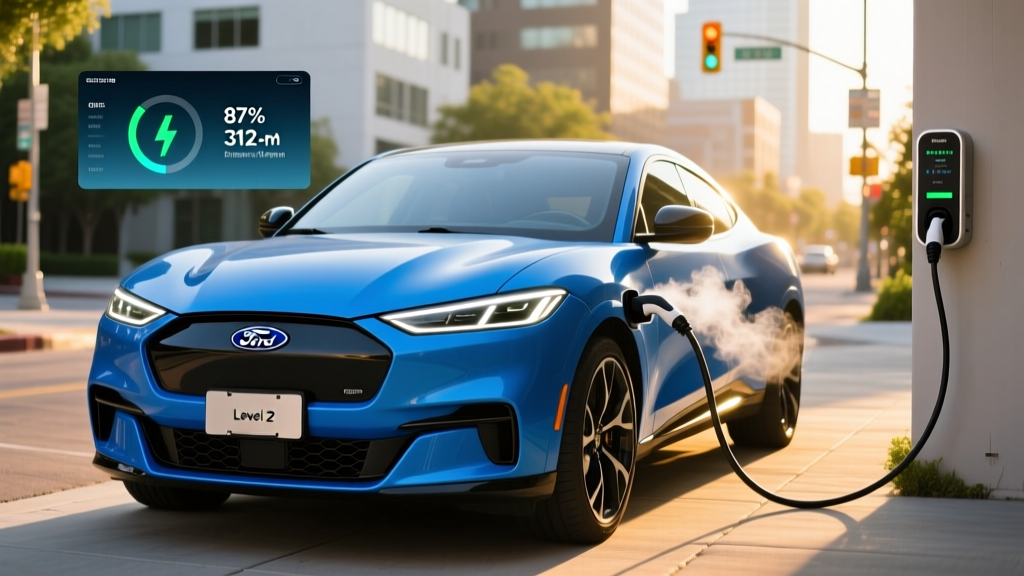
| Level 2 (240V home) | 10.5 kW | ~30 mi/hr | Daily home charging (overnight full charge) |
| DC Fast Charge (Std Range) | Peak 115 kW | ~250 mi/hr (peak) | Road trips; 10–80% in ~38 min |
| DC Fast Charge (Ext Range) | Peak 150 kW | ~330 mi/hr (peak) | Road trips; 10–80% in ~33 min |
A critical note on the Mach-E's charge curve: the Extended Range NMC pack peaks at 150 kW only between roughly 15–40% State of Charge (SoC). From 40–60%, it tapers to approximately 110 kW, and above 80% it drops further to under 50 kW. This is standard behavior for NMC packs managed by a conservative battery management system, but it means a 10–90% session takes significantly longer than a 10–80% session — plan your road-trip stops accordingly.
The 2026 Mach-E ships with the NACS (North American Charging Standard) connector, giving it native access to Tesla's Supercharger network — over 25,000 stalls across the U.S. — without an adapter. For Electrify America and other CCS networks, Ford provides a CCS adapter. This dual-network flexibility is a meaningful advantage for road-trippers.
For home charging, the Mach-E's onboard charger maxes at 10.5 kW (48 amps on a 60-amp circuit). A full charge from 10% on the Extended Range pack takes roughly 8.5 hours — easily accomplished overnight. Installation of a hardwired Level 2 station typically runs $800–$2,200 depending on panel capacity and conduit length; see our Level 2 installation cost guide for a detailed breakdown.
Trim Pricing, Finance Deals & Federal Tax Credit Eligibility
Understanding Ford Mach-E finance deals in 2026 requires looking at three layers: base MSRP, manufacturer incentives, and the federal §30D tax credit.
| Trim | Base MSRP | Est. After $7,500 Credit | Credit Eligible? |
|---|---|---|---|
| Select RWD (LFP) | $41,995 | ~$34,495 | Yes (subject to sourcing/income) |
| Premium AWD Std Range | $47,995 | ~$40,495 | Yes (subject to sourcing/income) |
| Premium AWD Ext Range | $52,995 | ~$45,495 | Yes (subject to sourcing/income) |
| GT AWD Ext Range | $57,995 | ~$50,495 | Yes (under $80K SUV cap) |
Key §30D tax credit rules for 2026 (per IRS.gov):
- MSRP cap: SUVs must be under $80,000 — all Mach-E trims qualify.
- Income cap: Modified AGI must not exceed $150,000 (single), $225,000 (head of household), or $300,000 (joint).
- Battery sourcing: At least 50% of critical minerals must be U.S.-sourced or from a free-trade-agreement partner; battery components must meet escalating domestic-content thresholds. Ford has worked to localize Mach-E battery supply, but verify current-year compliance at purchase — the rules tighten annually.
- Point-of-sale transfer: You can elect to transfer the credit to the dealer at purchase, reducing your out-of-pocket cost immediately rather than waiting to claim it on your tax return.
Ford's own finance arm, Ford Credit, frequently offers promotional APR rates (often 0.9%–3.9% for 36–60 months on well-qualified buyers) and lease cash incentives that stack with the federal credit. These deals rotate monthly — check Ford's current offers page and your local dealer for the latest. Combining a $7,500 point-of-sale credit with a low-APR Ford Credit promotion can make the Select RWD effectively one of the most affordable new EVs in the crossover segment.
Interior, Cargo & Tech: Daily Livability
The Mach-E's cabin prioritizes a large 15.5-inch portrait touchscreen running Ford's SYNC 4A infotainment system. Wireless Apple CarPlay and Android Auto are standard. The digital instrument cluster is a 10.2-inch display behind the wheel. Physical buttons are minimal — climate controls live in the screen, which draws polarized opinions but functions responsively.
Dimensions and space:
- Cargo behind rear seats: 29.7 cu ft
- Cargo with rear seats folded: 59.7 cu ft
- Front trunk (frunk): 4.7 cu ft with a drain plug (useful for tailgate ice storage)
- Rear legroom: 38.9 inches
- Front headroom: 40.4 inches
The Mach-E falls slightly short of the Tesla Model Y in cargo volume (Model Y: 30.2 cu ft rear / 72.1 cu ft folded), but the frunk and drain plug add practical versatility. Rear-seat space is comfortable for two adults on long trips; the center position is tighter.
Driver assistance: Ford's BlueCruise system is available on Premium and GT trims. BlueCruise is an SAE Level 2 hands-free driving system — it allows hands-off operation on pre-approved divided highways (over 130,000 miles mapped in the U.S. as of early 2026) but requires the driver to remain attentive, monitored by an interior-facing camera. This is not autonomous driving; you must be prepared to resume steering at any time. (NHTSA classifies all consumer-available systems this way.)
Warranty, Reliability & Ownership Costs
Ford backs the Mach-E with competitive warranty coverage:
- Battery & electric powertrain: 8 years / 100,000 miles (whichever comes first), covering defects and capacity loss below 70% of original capacity.
- Bumper-to-bumper: 3 years / 36,000 miles
- Corrosion perforation: 5 years / unlimited miles
The 70% capacity retention threshold is standard for the industry. Real-world degradation data from early Mach-E owners (2021–2023 models) suggests NMC Extended Range packs lose roughly 5–8% capacity over the first 60,000 miles, with the curve flattening thereafter. LFP packs show even less measurable degradation in the same timeframe, consistent with the chemistry's longer cycle life.
Estimated 5-year cost of ownership (Premium AWD Ext Range, 15,000 mi/yr, national average electricity rate of $0.16/kWh):
- Electricity cost: ~$4,080 (5 years)
- Comparable gas SUV fuel cost: ~$9,750 (at 25 MPG combined, $3.25/gal)
- Fuel savings: ~$5,670 over 5 years
- Maintenance savings: ~$2,500 (no oil changes, fewer brake replacements due to regen)
- Insurance: expect 10–20% higher premiums vs. a comparable gas SUV — factor ~$900–$1,200 additional over 5 years
Pros, Cons & the Competition
✅ Pros
- Up to 320 mi EPA range (Ext Range AWD)
- Native NACS connector — full Supercharger access without adapter
- LFP battery option for longevity and daily 100% charging
- BlueCruise hands-free highway driving (SAE Level 2)
- All trims under $80K MSRP cap for §30D credit
- Strong dealership network for service and support
- Competitive 0–60 performance across trims
❌ Cons
- DC fast-charge speed (150 kW peak) trails Ioniq 5 / EV6 (240 kW on 800V)
- Rear cargo volume slightly below Model Y
- Climate controls are screen-only — no physical knobs
- Ride quality is firm on larger wheel options
- BlueCruise requires a subscription after the free trial period
- LFP Standard Range models have limited highway range for road trips
Key competitors:
- Tesla Model Y: Slightly more cargo, faster Supercharger speeds, better efficiency — but less traditional service infrastructure and a more polarizing interior.
- Hyundai Ioniq 5: 800V architecture enables 240 kW DC charging (10–80% in ~18 min) — a significant road-trip advantage. Slightly less range on AWD trims.
- Kia EV6: Shares the Ioniq 5's 800V platform with sportier styling; similar charging and range trade-offs.
Who Should Buy the Mach-E?
Choose the Mach-E if: You want native Supercharger access, prefer a traditional dealership purchase and service experience, value BlueCruise for highway commuting, and want an LFP option for worry-free daily charging.
Look elsewhere if: You prioritize the fastest possible DC charging (Ioniq 5/EV6), need maximum cargo space (Model Y), or want physical climate controls.
Frequently Asked Questions
What is the real-world range of the Ford Mustang Mach-E?
The Premium Extended Range AWD achieves an EPA-estimated 320 miles. In real-world mixed driving, expect 285–305 miles. Sustained highway driving at 75 mph yields approximately 255–275 miles. In cold weather below 32°F, range drops to 220–250 miles due to battery chemistry limitations and cabin heating demand.
How fast does the Mach-E charge at home and on the road?
At home on a Level 2 (240V) charger, the Mach-E charges at 10.5 kW, adding roughly 30 miles per hour — a full overnight charge for any trim. On DC fast chargers, the Extended Range pack peaks at 150 kW (10–80% in ~33 minutes), while the Standard Range pack peaks at 115 kW (10–80% in ~38 minutes). Charge speed tapers significantly above 80% SoC.
How much does the Mach-E cost after tax credits?
The Select RWD starts at $41,995 MSRP and drops to approximately $34,495 after the full $7,500 federal §30D credit — assuming you meet income caps (under $150K single / $300K joint), the vehicle's battery sourcing qualifies in the current year, and you elect point-of-sale transfer. Higher trims similarly reduce: the Premium AWD Ext Range falls from $52,995 to ~$45,495.
Does the 2026 Mach-E qualify for the $7,500 federal EV tax credit?
All Mach-E trims are under the $80,000 SUV MSRP cap. Eligibility depends on your income (AGI limits apply), the battery's critical-mineral sourcing compliance for the current tax year, and domestic component content thresholds. These rules tighten annually. Verify with your tax professional and the dealer at point of sale. You can transfer the credit to the dealer to reduce your purchase price immediately. See IRS.gov for current rules.
Is the Mach-E worth buying vs. the Tesla Model Y or Ioniq 5?
The Mach-E is the strongest choice for buyers who want Supercharger access without an adapter, a traditional dealership experience, and BlueCruise for hands-free highway driving. The Model Y offers more cargo space and slightly better efficiency. The Ioniq 5 charges dramatically faster on road trips (240 kW vs. 150 kW). Your decision should hinge on which trade-off matters most for your driving pattern.
What's the difference between LFP and NMC batteries in the Mach-E?
LFP (lithium iron phosphate) packs, used in Standard Range models, offer longer cycle life, tolerate regular 100% charging, and are less prone to thermal runaway — but they are heavier and hold less energy, resulting in lower range. NMC (nickel manganese cobalt) packs in Extended Range models deliver higher energy density and more range but should be held at 80% for daily use and charged to 100% only before long trips.
Is BlueCruise self-driving?
No. BlueCruise is an SAE Level 2 driver-assistance system. It allows hands-free operation on pre-mapped divided highways, but the driver must remain attentive and ready to take over at any moment. An interior camera monitors driver engagement. This is fundamentally different from Level 4 autonomous services like Waymo, which operate without a human driver in geofenced areas.