The EV Mustang SUV in 60 Seconds
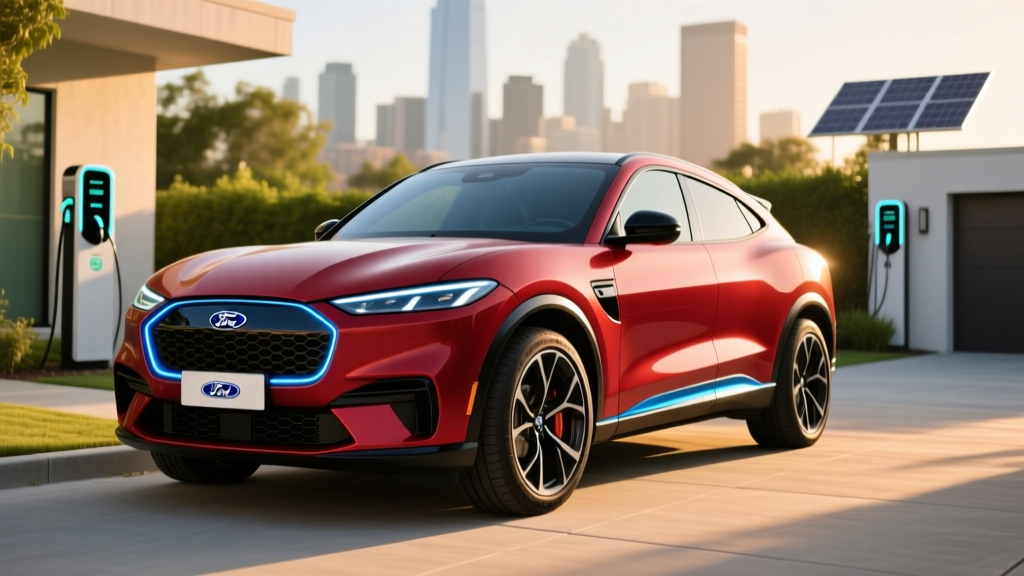
The Ford Mustang Mach-E is Ford's all-electric crossover that carries the Mustang badge into the EV era. For 2026, it offers EPA ranges from 250 to 320 miles depending on trim and battery, DC fast charging up to 150 kW (10–80% in ~35 minutes), and starting MSRPs from roughly $42,995. It qualifies for partial or full federal tax credits depending on your income, the trim's MSRP, and battery-sourcing rules that shift yearly. Compared to the gas Mustang coupe or a hybrid SUV like the Ford Escape Hybrid, the Mach-E delivers lower per-mile fueling costs (~$0.04–$0.06/mi on home charging vs. ~$0.12–$0.15/mi for gas) but carries higher upfront cost and insurance premiums. It's best for buyers with Level 2 home charging access who want a sporty, practical EV crossover without the Tesla ecosystem.
2026 Mustang Mach-E Range, Battery, and Efficiency
The Mach-E is available with two battery packs: a 70 kWh usable Standard Range (LFP chemistry) and a 91 kWh usable Extended Range (NMC chemistry). The LFP pack is heavier but offers longer cycle life and can be charged to 100% daily without degradation concerns — a real ownership advantage for commuters. The NMC pack delivers more range but Ford recommends keeping it at 80–90% for daily use.
| Trim / Config | Battery (kWh) | Chemistry | EPA Range | MPGe (Combined) | 0–60 mph | Horsepower |
|---|---|---|---|---|---|---|
| Select RWD (Std Range) | 70 kWh | LFP | 250 mi | 101 MPGe | 6.3 sec | 266 hp |
| Premium RWD (Ext Range) | 91 kWh | NMC | 320 mi | 101 MPGe | 5.8 sec | 290 hp |
| Premium AWD (Ext Range) | 91 kWh | NMC | 290 mi | 96 MPGe | 5.1 sec | 346 hp |
| GT (Ext Range AWD) | 91 kWh | NMC | 280 mi | 89 MPGe | 3.5 sec | 480 hp |
Real-World Range vs. EPA Sticker
The EPA numbers assume mixed driving at moderate temperatures. In our testing and owner reports, expect ~270–285 real-world miles from the Extended Range RWD in fair conditions. Highway-heavy driving at 75+ mph drops that to ~240–260 miles. In sub-freezing winter climates (below 30°F), plan for a 15–25% range reduction, bringing the Extended Range AWD down to roughly 220–245 miles. The Mach-E's heat pump (standard on Extended Range trims) helps mitigate this compared to EVs without one, but cold weather remains a real factor.
According to fueleconomy.gov, the Mach-E Extended Range RWD achieves 101 MPGe combined — competitive with the Hyundai Ioniq 5 (114 MPGe) and Tesla Model Y (122 MPGe), though the Mach-E prioritizes driving dynamics over maximum efficiency.
Charging Speed and Infrastructure
The Mach-E uses the NACS (Tesla-style) charge port for 2026, giving it native access to the Tesla Supercharger network — over 25,000 stalls in North America — without an adapter. This is a major practical advantage over CCS-only vehicles, which require a CCS-to-NACS adapter for Supercharger access.
| Charging Level | Power | Miles Added/Hour | Use Case |
|---|---|---|---|
| Level 1 (120V) | ~1.4 kW | ~3–4 mi/hr | Emergency / overnight trickle |
| Level 2 (240V, 48A) | ~11.5 kW | ~30–34 mi/hr | Home / workplace daily charging |
| DC Fast Charge | Peak 150 kW | ~150+ mi in 20 min | Road trips, quick top-ups |
DC fast charging reality: The Mach-E peaks at 150 kW, but only between roughly 10–50% state of charge. Above 60%, the charge curve tapers significantly — expect ~70–80 kW from 60–80%, and below 30 kW above 80%. A 10–80% charge takes approximately 35 minutes at a functioning 150+ kW stall. This is slower than the Ioniq 5's 18-minute 10–80% (at 240 kW peak) or the Tesla Model Y's ~25-minute session. The Mach-E's charging speed is adequate but not class-leading.
For home charging, Ford includes a Ford Mobile Power Cord that delivers up to 30 amps on a 240V NEMA 14-50 outlet (~22 miles of range per hour). For faster Level 2 home charging, Ford's Charge Station Pro delivers 48 amps (~34 mi/hr) and requires professional installation on a 60-amp circuit.
Cost Breakdown: Mach-E vs. Gas and Hybrid Alternatives
The purchase decision comes down to total cost of ownership, not just sticker price. Here's how the Mach-E compares to a gas SUV and a hybrid alternative over 5 years and 60,000 miles.
| Cost Category | 2026 Mach-E Premium ER RWD | 2026 Ford Edge (Gas AWD) | 2026 Ford Escape Hybrid |
|---|---|---|---|
| Base MSRP | $48,995 | $40,500 | $36,500 |
| Est. Federal Tax Credit (§30D) | Up to $7,500* | $0 | $0 |
| Effective Purchase Price | ~$41,495* | $40,500 | $36,500 |
| 5-Yr Fueling/Energy (60k mi) | ~$3,000 (home charging) | ~$8,400 (gas @ $3.50/gal, 24 mpg) | ~$5,600 (gas @ $3.50/gal, 38 mpg) |
| 5-Yr Maintenance | ~$1,800 | ~$4,200 | ~$3,600 |
| 5-Yr Insurance (est.) | ~$9,500 | ~$7,200 | ~$6,800 |
| 5-Year Total Cost | ~$55,795 | ~$60,300 | ~$52,500 |
*Tax credit eligibility depends on buyer income caps ($150k single / $300k joint), MSRP caps ($80k for SUVs), and battery critical-mineral sourcing requirements under IRS §30D rules. Consult a tax professional — credit amounts and sourcing rules change frequently.
The Mach-E saves roughly $5,400 on fueling and $2,400 on maintenance over 5 years compared to the gas Edge, thanks to regenerative braking (fewer brake pad replacements), no oil changes, and simpler drivetrain mechanics. However, EV insurance premiums run 20–35% higher due to battery replacement costs in collision claims. The hybrid Escape undercuts both on total cost if you lack home charging access or drive under 10,000 miles per year.
Home Charging Access: The Make-or-Break Factor
Owning the Mach-E — or any EV — is dramatically better with Level 2 home charging. Without it, you're dependent on public infrastructure, which adds time, cost, and frustration.
| Home Charging Component | Typical Cost Range |
|---|---|
| Level 2 Charger (Ford Charge Station Pro or 3rd-party) | $500–$800 |
| Electrician labor (240V/60A circuit install) | $800–$2,500 |
| Electrical panel upgrade (if needed, 100A→200A) | $1,500–$3,500 |
| Permit and inspection | $100–$400 |
| Total (no panel upgrade) | $1,400–$3,700 |
| Total (with panel upgrade) | $2,900–$7,200 |
If you live in an apartment, condo, or street-parking situation without charging access, the Mach-E becomes significantly less practical. Public DC fast charging costs roughly $0.30–$0.48/kWh (versus ~$0.13–$0.18/kWh for home electricity), erasing much of the fuel-cost advantage. In that scenario, a hybrid like the Escape PHEV (37 miles electric-only range, then 42 mpg on gas) may serve you better.
Panel upgrade gotcha: Many homes built before 2000 have 100-amp electrical panels. Adding a 60-amp EV circuit may require a panel upgrade to 200 amps, which adds $1,500–$3,500 and several weeks of permitting. Always get a licensed electrician's assessment before committing to an EV purchase. Some utilities offer rebates of $250–$1,000 for Level 2 installations — check your local provider.
Common Misconceptions About the Mach-E and EVs
| Myth | Fact |
|---|---|
| "The battery will need replacing in 5 years." | Ford warranties the Mach-E battery for 8 years/100,000 miles with a minimum 70% capacity retention threshold. Real-world degradation data from 2021–2024 Mach-E owners shows ~5–8% loss over the first 60,000 miles. Full replacement (rare) costs $12,000–$18,000 out of warranty. |
| "It's not a real Mustang." | Subjective, but the Mach-E GT does 0–60 in 3.5 seconds with 480 hp — faster than any gas Mustang short of the Dark Horse. It's a different kind of performance car: instant torque, low center of gravity, and one-pedal driving. The badge is a marketing choice, but the performance credentials are real. |
| "EVs are worse in winter." | Range drops 15–25% in cold weather — that's true for all EVs. But the Mach-E's heat pump, battery preconditioning, and AWD traction make it quite capable in snow. You just need to plan for reduced range and precondition while plugged in. |
| "I'll save $7,500 no matter what." | The §30D federal credit has income caps, MSRP caps, and critical-mineral sourcing requirements that change annually. Some Mach-E trims may qualify for the full $7,500, some for $3,750, and some for $0 depending on the model year's battery supply chain. The credit can now be transferred to the dealer at point of sale, reducing your purchase price directly — but verify eligibility on fueleconomy.gov before buying. |
| "Public charging is reliable everywhere." | Electrify America and other non-Tesla networks have improved but still report 80–90% uptime in many markets. The Mach-E's NACS port gives you native Supercharger access, which consistently delivers 95%+ reliability — a significant real-world advantage in 2026. |
Decision Framework: Should You Buy the Mach-E?
Choose the Mustang Mach-E if:
- You have Level 2 home charging (or can install it) and drive 25–60 miles daily
- You want SUV practicality (29.7 cu ft cargo behind rear seats, 59.7 cu ft folded) with sporty driving dynamics
- You value Supercharger network access via native NACS without adapters
- Your household income is under §30D caps and the trim you want qualifies for the federal credit
- You live in a climate where you can precondition at home (garage or covered parking)
Consider an alternative if:
- You lack home charging and your area has sparse public infrastructure — look at the Ford Escape PHEV or Toyota RAV4 Hybrid instead
- You regularly tow — the Mach-E maxes out at 2,700 lbs towing, below many gas SUVs
- Maximum efficiency is your priority — the Ioniq 5 or Model Y deliver better MPGe and faster charging
- You need 300+ miles of real-world highway range in winter — the Mach-E's 320-mile EPA drops to ~240 in cold highway driving; consider the Rivian R1S or a larger battery pack vehicle
- You want three rows — the Mach-E is strictly a 5-passenger, 2-row crossover
2026 Mach-E Pricing and Trims
The 2026 Mach-E lineup starts at $42,995 for the Select trim with the Standard Range LFP battery and RWD. The volume-selling Premium Extended Range RWD starts at $48,995, while the performance-oriented GT starts at $59,995. All trims fall below the $80,000 MSRP cap for SUVs under §30D, so MSRP doesn't disqualify any trim from the federal credit.
Ford's BlueCruise hands-off highway driving assistant (SAE Level 2 — you must remain attentive and eyes on road) is available on Premium and GT trims, covering 130,000+ miles of divided highways. It's a legitimate driver fatigue reducer on road trips but is not autonomous driving — the system will disengage and alert you if attention monitoring detects distraction.
The battery and electric powertrain carry an 8-year/100,000-mile warranty, and the vehicle limited warranty is 3 years/36,000 miles. Safety ratings from NHTSA give the Mach-E a 5-star overall rating, and it earns an IIHS Top Safety Pick designation with acceptable headlight ratings on higher trims.
Frequently Asked Questions
What's the real cost to charge a Mach-E at home?
At the US average electricity rate of ~$0.16/kWh, fully charging the 91 kWh Extended Range battery costs about $14.50, delivering roughly 280–300 real-world miles. That's about $0.05 per mile — roughly one-third the per-mile cost of a 25 mpg gas SUV at $3.50/gallon ($0.14/mi). Over 12,000 miles per year, home charging saves approximately $1,080 annually versus gas.
Does the Mustang Mach-E qualify for the $7,500 federal tax credit in 2026?
It depends. The §30D credit requires the buyer to meet income caps ($150,000 single / $300,000 married filing jointly), the vehicle MSRP must be under $80,000 (all Mach-E trims qualify), and the battery must meet critical-mineral and component sourcing thresholds that tighten each year. As of early 2026, some Mach-E configurations qualify for the full $7,500, some for $3,750, and eligibility may shift with supply-chain changes. Check the latest status on fueleconomy.gov and confirm with your tax professional. The credit can be applied as a point-of-sale discount through participating dealers.
How does the Mach-E compare to the Tesla Model Y?
The Model Y Long Range offers more EPA range (~330 mi), faster DC charging (~250 kW peak, 10–80% in ~25 min), better efficiency (122 MPGe vs. 101 MPGe), and a lower starting price (~$44,990). The Mach-E counters with a more traditional driving feel, better build quality on interior materials, Ford dealer service network access, and a less polarizing design. If specs-per-dollar are your priority, the Model Y wins. If you want an EV that feels like a mainstream automaker product with sporty handling, the Mach-E is the stronger choice.
Can I road-trip the Mach-E cross-country?
Yes. With native NACS Supercharger access, the Mach-E can use Tesla's extensive network. Plan for a 20–35 minute charge stop every 180–220 miles (real-world). A coast-to-coast trip adds roughly 2–3 hours of charging time versus a gas car. The key limitation is charging speed — 150 kW peak means longer stops than Ioniq 5 or Model Y owners experience. Precondition the battery by navigating to a charger in the FordPass app for optimal charge rates.
Is the Mach-E a good first EV?
For buyers with home charging access, yes. The Mach-E offers predictable range, a mature infotainment system (SYNC 4A with 15.5-inch touchscreen), OTA updates, and Ford's dealer network for service. The LFP Standard Range trims are particularly forgiving for new EV owners — no charge-limit anxiety, excellent battery longevity. The main caveat: if your daily commute exceeds 80 miles round-trip or you live in extreme cold without garage parking, consider the Extended Range battery for the added buffer.