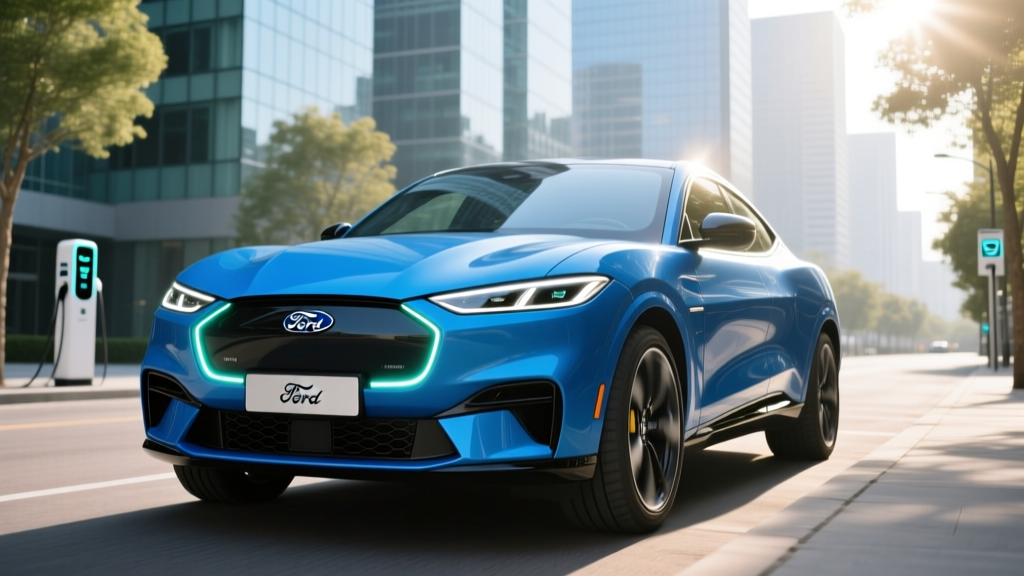
If you're searching for an electric blue Mustang, you're almost certainly looking at the Ford Mustang Mach-E — Ford's all-electric crossover that wears the iconic pony badge and offers a striking "Eruption Blue" (and previously "Grabber Blue") exterior. For 2026, the Mach-E starts at $39,995 (Select trim), delivers up to 320 miles of EPA-estimated range (Extended Range RWD), and is eligible for the $7,500 federal tax credit under IRS §30D when purchased new — which can be applied as a point-of-sale rebate. It charges at up to 150 kW DC fast charging (10–80% in roughly 36 minutes) and comes with Ford's BlueCruise Level 2 hands-free driving system. The Mach-E is a practical, performance-oriented EV that competes directly with the Tesla Model Y, Hyundai IONIQ 5, and Chevrolet Blazer EV.
Quick Answer: Is the Electric Blue Mustang Mach-E Worth It?
Yes, if you want a sporty, mid-size electric SUV with strong range, access to the Tesla Supercharger network (via NACS adapter), and up to $7,500 in federal tax incentives. Consider alternatives if you need three rows of seating, tow more than 3,500 lbs, or lack access to home or workplace charging.
2026 Ford Mustang Mach-E: Range, Battery, and Efficiency
The 2026 Mach-E is offered with two battery packs and multiple drivetrain configurations. Here's the full spec breakdown:
| Trim / Config | Battery (kWh usable) | Chemistry | EPA Range | HP / lb-ft | 0–60 mph | MSRP |
|---|---|---|---|---|---|---|
| Select RWD | 70 kWh (Standard Range) | LFP | 250 mi | 266 / 387 | 5.8 sec | $39,995 |
| Premium RWD | 91 kWh (Extended Range) | NMC | 320 mi | 290 / 387 | 5.5 sec | $48,995 |
| Premium eAWD | 91 kWh (Extended Range) | NMC | 290 mi | 346 / 428 | 4.8 sec | $51,995 |
| GT eAWD | 91 kWh (Extended Range) | NMC | 280 mi | 480 / 634 | 3.5 sec | $59,995 |
| Rally | 91 kWh (Extended Range) | NMC | 265 mi | 480 / 700 | 3.4 sec | $61,995 |
Real-world range caveat: EPA estimates assume mixed driving. On sustained highway trips at 70+ mph, expect the Extended Range RWD to deliver roughly 260–280 miles. In cold weather (below 30°F), range can drop 20–30%, bringing the 320-mile pack down to approximately 225–255 miles. The Mach-E's heat pump (standard on Extended Range trims) helps mitigate this loss compared to resistive heating systems.
Efficiency for the Premium RWD Extended Rate is rated at approximately 101 MPGe combined (EPA fueleconomy.gov), which translates to roughly 33 kWh per 100 miles.
Real-World Range Reality Check
EPA sticker: 320 miles (Premium RWD Extended Range)
Highway driving (75 mph, 70°F): ~265–280 miles
Cold weather (20°F, mixed driving): ~225–255 miles
Mountainous terrain: Varies; regenerative braking on descents can recover 5–10% of uphill energy loss.
Charging Speed and Infrastructure
Understanding charging is the single most important factor in EV satisfaction. Here's what the Mach-E delivers across charging levels:
| Level | Power (kW) | Connector | Charge Time | Miles Added/Hour |
|---|---|---|---|---|
| Level 1 (120V) | 1.4 kW | J1772 / NACS | ~50+ hours (full) | ~3–4 mi/hr |
| Level 2 (240V, 48A) | 11.5 kW | J1772 / NACS | ~8–10 hours (full) | ~30–35 mi/hr |
| DC Fast Charge | 150 kW peak | CCS1 / NACS (adapter) | 10–80% in ~36 min | ~180–220 mi/hr (peak) |
Charging curve reality: The Mach-E peaks at 150 kW but does not sustain that rate. The charge curve tapers significantly above 80% State of Charge (SoC) to protect battery health. For road trips, plan stops at 10–80% rather than topping off to 100% — you'll save 15–20 minutes per stop.
NACS / Tesla Supercharger access: Starting in 2025, Ford provides a NACS adapter enabling Mach-E owners to use the Tesla Supercharger network (17,000+ stalls in the US). For 2026 models, Ford has transitioned to a native NACS charge port, eliminating the need for an adapter. This is a major infrastructure advantage over CCS-only vehicles.
Electric Blue Mustang vs. Gas Mustang vs. Gas SUV: The Cost Comparison
Many buyers cross-shop the Mach-E against either the traditional gas Mustang or mid-size gas SUVs like the Ford Explorer. Here's a 5-year total cost of ownership (TCO) comparison using realistic assumptions:
| Cost Factor | Mach-E Premium RWD ($48,995) | 2026 Gas Mustang EcoBoost ($32,500) | 2026 Ford Explorer ($39,000) |
|---|---|---|---|
| Purchase Price (after incentives) | $41,495* | $32,500 | $39,000 |
| Fuel/Energy (5 yrs, 60k mi) | $3,600 (home charging) | $9,400 (25 MPG, $3.50/gal) | $10,500 (22 MPG, $3.50/gal) |
| Maintenance (5 yrs) | $1,200 | $3,800 | $4,200 |
| Insurance (5 yrs, avg) | $8,500 | $7,200 | $7,800 |
| Estimated Depreciation | ~50% | ~45% | ~48% |
| 5-Year Total (approx.) | ~$55,000 | ~$55,000 | ~$62,000 |
*Assumes full $7,500 federal tax credit via point-of-sale transfer. Actual eligibility depends on income caps, battery sourcing, and MSRP limits under IRS §30D rules.
Key takeaway: The Mach-E's higher sticker price is largely offset by fuel and maintenance savings over 5 years. However, EV insurance premiums run 15–25% higher on average, and depreciation remains a wildcard as the EV market matures.
Federal Tax Credit and Incentive Eligibility
For 2026, the Mustang Mach-E qualifies for the full $7,500 federal tax credit under §30D when purchased new, subject to these requirements:
- Buyer income caps: AGI ≤ $150,000 (single), $225,000 (head of household), $300,000 (married filing jointly)
- MSRP cap: SUVs/vans/pickups ≤ $80,000; sedans ≤ $55,000. All Mach-E trims qualify.
- Battery sourcing: Critical minerals and battery components must meet phased-in domestic/free-trade requirements. Ford confirms 2026 Mach-E compliance.
- Point-of-sale transfer: You can apply the $7,500 as an immediate dealer discount rather than waiting for tax filing.
Always verify current eligibility with your tax professional and check the latest IRS guidance, as sourcing rules tighten annually.
Ownership Considerations: What First-Time EV Buyers Must Know
Before committing to the Mach-E — or any EV — honestly assess these factors:
Home Charging Access
Level 2 home charging (240V, 48A) is the backbone of convenient EV ownership. A professional installation of a Ford Charge Station Pro or equivalent Level 2 unit typically costs $800–$2,500 depending on panel capacity and wiring distance. If your home has a 200-amp panel, you're likely fine. A 100-amp panel may require a $1,500–$3,000 upgrade.
If you lack home charging: Public DC fast charging costs roughly 2–3× more per mile than home charging. Relying exclusively on public charging erodes the Mach-E's cost advantage and adds time friction. Apartment dwellers should explore workplace charging or lobby for building-level infrastructure before purchasing.
Climate and Driving Patterns
The Mach-E's liquid-cooled battery and available heat pump handle cold weather better than earlier EVs, but physics is physics. If you live in Minnesota, North Dakota, or similar climates, budget for 20–30% winter range loss. The 320-mile Extended Range pack gives you enough buffer that even with degradation and cold loss, you'll retain practical daily usability.
Battery Warranty and Longevity
Ford covers the Mach-E's high-voltage battery for 8 years / 100,000 miles (whichever comes first), guaranteeing it retains at least 70% of original capacity. Real-world data from 2021–2024 Mach-E fleets shows average degradation of approximately 5–8% over 100,000 miles — well within warranty thresholds. LFP chemistry on the Standard Range pack offers even slower degradation and higher cycle life, at the cost of lower energy density.
Common Misconceptions About the Electric Mustang
| Myth | Fact |
|---|---|
| "It's not a real Mustang." | The Mach-E GT does 0–60 in 3.5 seconds with 480 hp. Ford engineered it with Mustang performance DNA, independent rear suspension, and selectable drive modes. It's different from a coupe, but it's legitimately quick and engaging. |
| "The battery will need replacing in a few years." | Modern NMC and LFP packs are designed to last 15–20 years with gradual, manageable degradation. Replacement costs (if ever needed out of warranty) run $12,000–$18,000, but most owners will never face this. |
| "EVs are worse in the cold." | EVs start instantly in cold weather (no cranking), and preconditioning while plugged in warms the cabin and battery before departure. Range drops, but daily usability remains strong with a large enough pack. |
| "I'll be stranded without charging stations." | With native NACS access to 17,000+ Tesla Superchargers plus Electrify America, EVgo, and ChargePoint networks, the Mach-E has access to the most robust charging infrastructure of any non-Tesla EV. |
| "The tax credit is gone." | As of 2026, the Mach-E still qualifies for the full $7,500 under §30D, available as a point-of-sale rebate. Ford has not hit the 200,000-vehicle manufacturer cap (which was eliminated anyway under the Inflation Reduction Act). |
BlueCruise and Driver-Assistance Technology
The Mach-E comes equipped with Ford Co-Pilot360 and available BlueCruise, Ford's hands-free highway driving system. It's essential to understand what this is and isn't:
SAE Level 2 — Driver Supervision Required
BlueCruise is a Level 2 driver-assist system, not autonomous driving. It provides hands-free steering, acceleration, and braking on pre-mapped divided highways (130,000+ miles of BlueCruise Hands-Free Zones). However, the driver camera monitors your eyes and requires you to remain attentive. You are legally and practically responsible for the vehicle at all times.
BlueCruise is included free for 90 days on most trims, then requires a subscription ($75/month or $800/year as of 2026). Competitors like GM's Super Cruise and Tesla's Autopilot operate at the same SAE Level 2 classification.
Decision Framework: Is the Electric Blue Mustang Right for You?
Choose the Mach-E If:
- You have home Level 2 charging (or can install it)
- Your daily commute is under 80 miles round-trip
- You want a sporty, quick EV with crossover practicality (29.7 cu ft cargo behind rear seats)
- You value Tesla Supercharger access without owning a Tesla
- You qualify for the $7,500 federal tax credit and want point-of-sale savings
- You want Ford dealer service familiarity in your area
Look Elsewhere If:
- You need three rows of seating (check the Kia EV9 or Rivian R1S)
- You tow more than 3,500 lbs (Mach-E max towing is limited)
- You live in an apartment with zero charging access and no workplace charging
- You regularly drive 400+ miles in a single day in extreme cold (consider a PHEV like the Jeep Wrangler 4xe for flexibility)
- You want a traditional Mustang coupe experience (the gas Mustang EcoBoost/GT remains an option)
Frequently Asked Questions
What color options include blue for the 2026 Mach-E?
Ford offers "Eruption Blue Metallic" on Premium, GT, and Rally trims for 2026. Previous model years offered "Grabber Blue" and "Atlas Blue." Availability varies by trim — confirm with your dealer's build-and-price tool.
Can I charge the Mach-E at Tesla Superchargers?
Yes. 2025 and later Mach-E models feature a native NACS charge port. 2021–2024 models use a Ford-provided NACS-to-CCS adapter. Both provide access to the full Tesla Supercharger network.
How much does it cost to charge the Mach-E at home?
At the US average electricity rate of ~$0.16/kWh, fully charging the 91 kWh Extended Range battery costs approximately $14.50, yielding 320 miles of range — roughly $0.045 per mile. Compare this to a gas Mustang at $0.14/mile (25 MPG, $3.50/gal).
Is the Mach-E eligible for state incentives too?
Possibly. States like California, Colorado, New York, and others offer additional rebates or tax credits ranging from $1,000–$7,500. These vary by jurisdiction, income, and vehicle eligibility. Check your state's energy office or AFDC state incentive database.
What happens if the battery fails out of warranty?
Full battery replacement runs $12,000–$18,000 depending on pack size. However, industry data shows modern EV batteries rarely fail catastrophically — they degrade gradually. Most owners sell or trade the vehicle before reaching the point where replacement makes economic sense.
How does the Mach-E compare to the Tesla Model Y?
The Model Y Long Range AWD offers slightly more range (330 mi EPA), faster DC charging (250 kW peak), and a more mature software ecosystem. The Mach-E counters with a more conventional interior layout, physical controls, BlueCruise hands-free driving, and a lower starting price on base trims. Both are strong choices — the decision often comes down to interface preference and brand loyalty.