Quick Verdict: The Mach-E AWD Earned Its Mustang Badge
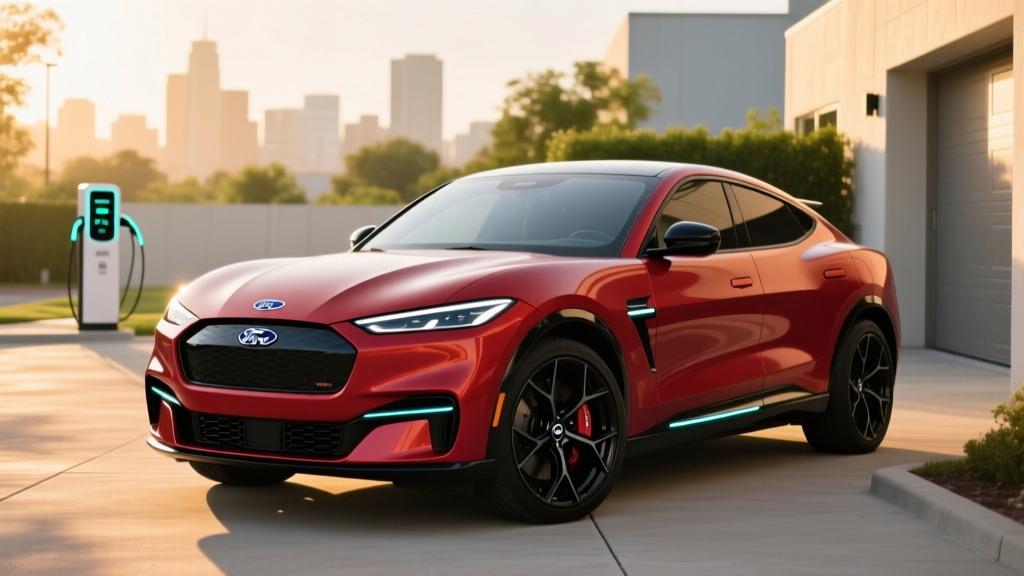
The Ford Mustang Mach-E AWD occupies a specific niche in the midsize electric crossover segment: it's the dual-motor option for buyers who want all-weather traction without stepping up to the premium pricing of a Tesla Model Y Long Range or the polarizing design of a Hyundai Ioniq 5. For the 2026 model year, Ford has refined the Mach-E lineup with updated battery chemistry options, a native NACS charge port, and revised pricing that keeps it competitive against a rapidly evolving field.
After spending time with the Mach-E AWD in mixed driving conditions — including highway cruising, sub-freezing commutes, and repeated DC fast-charging sessions — the picture is clear. This is a competent, well-rounded electric crossover that delivers on its EPA range promises in moderate weather, charges at respectable (if not class-leading) speeds, and offers one of the most intuitive infotainment systems in the segment. Its limitations are equally clear: rear-seat headroom is tight for taller passengers, and peak DC charging speeds trail the 800V architectures found in Hyundai/Kia rivals.
Range, Battery, and Real-World Efficiency
The 2026 Mustang Mach-E AWD is available with two battery pack options. The Standard Range AWD pairs a 75.7 kWh usable lithium-ion NMC (nickel manganese cobalt) pack with dual motors producing a combined 266 horsepower and 417 lb-ft of torque. The Extended Range AWD steps up to a 91.0 kWh usable NMC battery, bumping output to 346 horsepower and 428 lb-ft of torque.
| Specification | Standard Range AWD | Extended Range AWD |
|---|---|---|
| EPA Range | 250 miles | 290 miles |
| Usable Battery Capacity | 75.7 kWh (NMC) | 91.0 kWh (NMC) |
| Horsepower (combined) | 266 hp | 346 hp |
| Torque | 417 lb-ft | 428 lb-ft |
| 0–60 mph | 5.8 seconds | 5.1 seconds |
| Drivetrain | Dual-motor AWD | Dual-motor AWD |
| EPA Efficiency | 101 MPGe (33 kWh/100mi) | 101 MPGe (33 kWh/100mi) |
| Max DC Fast Charge | 150 kW | 150 kW |
| 10–80% DC Charge Time | ~34 minutes | ~38 minutes |
| Level 2 Home Charge Rate | 10.5 kW (~30 mi/hr) | 10.5 kW (~30 mi/hr) |
| Base MSRP | $43,995 | $48,995 |
EPA estimates are measured under controlled laboratory conditions. In real-world driving, expect the Extended Range AWD to deliver approximately 260–275 miles on a mix of highway and city driving at moderate temperatures (60–80°F). Sustained highway driving at 75+ mph reduces efficiency to roughly 235–250 miles due to aerodynamic drag. In cold weather (below 32°F), range can drop 20–30%, putting the Extended Range AWD at approximately 200–230 miles per charge without preconditioning. Using the Mach-E's built-in battery preconditioning and seat/steering wheel heaters (rather than cabin heat) mitigates some of this loss. Source: fueleconomy.gov.
Efficiency lands at 101 MPGe combined (33 kWh per 100 miles) for both AWD variants, according to the EPA. That's competitive with the Tesla Model Y Long Range AWD (roughly 106 MPGe) but slightly behind the Hyundai Ioniq 5 AWD (110 MPGe). In practical terms, the Mach-E AWD consumes about 0.33 kWh per mile, meaning a full 91 kWh Extended Range battery holds roughly $11–$15 of electricity at national average residential rates ($0.16/kWh), translating to roughly 4–5 cents per mile — a fraction of what a comparable gas crossover costs at $3.50/gallon.
Charging Speed: DC Fast Charging and Home Setup
The Mach-E AWD charges through a native NACS (North American Charging Standard) port on 2026 models, giving it direct access to Tesla's Supercharger network — now the largest and most reliable DC fast-charging network in the U.S. — without an adapter. For owners of earlier CCS-equipped Mach-E models, Ford provides a CCS-to-NACS adapter.
| Charging Level | Power / Voltage | Speed (Extended Range AWD) | Typical Use Case |
|---|---|---|---|
| Level 1 (120V household) | 1.4 kW | ~3 miles per hour | Overnight trickle; emergency top-up |
| Level 2 (240V home/public) | 10.5 kW | ~30 miles per hour | Daily home charging; full charge in ~9 hours |
| DC Fast Charge | Peak 150 kW | 10–80% in ~38 min; ~100 mi in 15 min | Road trips; rapid top-ups |
A critical detail for road-trippers: the Mach-E AWD's DC fast-charging curve is not flat. The 150 kW peak is achieved at low states of charge (roughly 10–30% SoC) and tapers progressively. By 60% SoC, charge rates typically drop to around 90–100 kW, and above 80%, charging slows significantly to protect battery longevity. This means the 10–80% time of approximately 38 minutes for the Extended Range is realistic, but adding the final 20% (80–100%) can take an additional 30+ minutes. Plan road-trip stops around the 10–80% window for maximum efficiency.
At home, the onboard 10.5 kW charger is a strong point. Connected to a 48-amp Level 2 wall connector (hardwired on a 60-amp circuit), the Extended Range AWD adds roughly 30 miles of range per hour, meaning a depleted battery reaches full in about 9 hours — easily overnight. Ford's Mobile Power Cord, included with the vehicle, can deliver up to 30 amps on a 240V NEMA 14-50 outlet (~7.2 kW, ~21 mi/hr), which is sufficient for most daily driving needs if a full wall connector installation isn't immediately feasible.
Performance and Driving Dynamics
The dual-motor AWD system in the Mach-E provides genuinely confident acceleration. The Extended Range AWD's 346 hp and 428 lb-ft of torque deliver a 5.1-second 0–60 mph time — quick enough to merge onto fast-moving highways without hesitation and entertaining enough to justify the Mustang nameplate. The Standard Range AWD's 5.8-second run is hardly slow, and the instant torque delivery makes both variants feel quicker than their numbers suggest in around-town driving.
Ford's AWD system uses independent front and rear motors with no mechanical linkage. Under light-load cruising, the Mach-E can operate primarily on the rear motor for efficiency, engaging the front motor when slip is detected or when acceleration demands it. The system is seamless — there's no perceptible lag when the front motor engages.
Ride quality is firm but controlled, with a slight sport bias that suits the Mustang branding. The low center of gravity (battery pack under the floor) keeps body roll minimal through corners. Regenerative braking offers multiple levels, including a true one-pedal driving mode that can bring the car to a complete stop without touching the brake pedal — a feature that, once acclimated, most EV owners prefer for city and suburban driving.
Interior, Cargo, and Technology
The Mach-E's cabin is dominated by a 15.5-inch vertical touchscreen running Ford's SYNC 4A infotainment system. The interface is one of the better-executed touch-based systems in the industry, with logical menus, wireless Apple CarPlay and Android Auto, and over-the-air update capability. Physical controls are minimal — climate settings are embedded in the touchscreen, which some drivers find distracting. A small rotary dial on the screen's lower edge handles volume and serves as a secondary input.
Passenger space is adequate but not class-leading:
- Front headroom: 40.4 inches
- Front legroom: 43.3 inches
- Rear headroom: 38.2 inches (tight for passengers over 6'1")
- Rear legroom: 38.9 inches
Cargo volume behind the rear seats measures 29.7 cubic feet, expanding to 59.7 cubic feet with the rear seats folded. The front trunk (frunk) adds 4.7 cubic feet of drainable storage — useful for charging cables, gym bags, or groceries that might leak. Compared to the Tesla Model Y (30.2 cu ft rear, 76.2 cu ft total), the Mach-E gives up some maximum cargo capacity, primarily due to its more sloping roofline.
Driver-assistance technology includes Ford's BlueCruise system, which enables hands-free driving on pre-mapped divided highways (SAE Level 2). A driver-facing camera monitors attention, and the system will prompt the driver to re-engage if eyes wander. BlueCruise is not autonomous driving — the driver remains responsible for the vehicle at all times. It's comparable to GM's Super Cruise in capability but covers a broader road network. A 90-day trial is included; after that, a subscription is required (approximately $75/month or $800/year as of 2026).
Ford BlueCruise is an SAE Level 2 driver-assistance system. It provides combined steering, acceleration, and braking support on qualified highways, but the driver must remain attentive and ready to take over immediately. It is not self-driving. Only SAE Level 4 services (e.g., Waymo robotaxis in designated geofenced areas) operate without a human driver.
Pricing, Trims, and Federal Tax Credit Eligibility
The 2026 Mustang Mach-E AWD is offered in three trims for the dual-motor configuration:
- Select AWD (Standard Range): $43,995 MSRP
- Premium AWD (Extended Range): $48,995 MSRP
- GT AWD (Extended Range, 480 hp): $59,995 MSRP
The GT variant bumps output to 480 hp and 634 lb-ft with a 3.5-second 0–60 time, but sacrifices range to 260 miles EPA. All trims include the NACS charge port, BlueCruise hardware, and Ford's Co-Pilot360 2.0 safety suite as standard.
| Trim | MSRP | Est. Federal Credit (§30D) | Effective Price (before state incentives) |
|---|---|---|---|
| Select AWD (Std Range) | $43,995 | Up to $7,500* | ~$36,495* |
| Premium AWD (Ext Range) | $48,995 | Up to $7,500* | ~$41,495* |
| GT AWD (Ext Range) | $59,995 | Up to $7,500* | ~$52,495* |
*Federal tax credit eligibility under IRS §30D is subject to multiple requirements that change periodically. As of 2026, the key criteria include:
- MSRP cap: SUVs/crossovers must have an MSRP at or below $80,000 (all Mach-E AWD trims qualify).
- Buyer income cap: Modified adjusted gross income must not exceed $150,000 (single), $225,000 (head of household), or $300,000 (joint filers).
- Battery sourcing: A percentage of critical minerals and battery components must be sourced from the U.S. or free-trade-agreement partners. The exact credit amount ($3,750 or $7,500) depends on whether the vehicle meets the critical-minerals requirement, the battery-components requirement, or both. These thresholds tighten annually.
- Point-of-sale transfer: Buyers can elect to transfer the credit to the dealer at purchase, reducing the upfront cost rather than waiting for a tax refund.
Always verify current eligibility on the IRS clean vehicle credits page and consult a tax professional before relying on the credit in your purchase decision. Battery-sourcing requirements have disqualified some previously eligible vehicles mid-year in past cycles.
Warranty and Long-Term Ownership
Ford backs the Mach-E with a competitive warranty package:
- Bumper-to-bumper: 3 years / 36,000 miles
- Powertrain (including electric motors): 5 years / 60,000 miles
- Battery pack: 8 years / 100,000 miles (retains at least 70% of original capacity)
The 70% capacity retention threshold is industry-standard and aligns with Tesla, Hyundai, and GM. In practical terms, a 91 kWh Extended Range battery at 70% health still holds roughly 63.7 kWh — enough for approximately 200 miles of real-world range. Data from early 2021–2023 Mach-E owners tracked on EV forums and fleet data suggests average annual degradation of roughly 1.5–2.5% under normal use, meaning most owners will retain 85–90% battery health at the 5-year mark. DC fast-charging exclusively (rather than primarily Level 2 home charging) and routinely charging to 100% can accelerate degradation — Ford recommends setting a daily charge limit of 80–90% for NMC batteries and reserving 100% charges for road trips.
Insurance costs for the Mach-E AWD tend to run 10–20% higher than comparable gas-powered crossovers, consistent with the broader EV segment. Average annual premiums range from $1,800–$2,400 depending on trim, location, and driver profile. Always obtain quotes before purchasing.
Pros
- Native NACS port with Supercharger network access
- Strong 10.5 kW Level 2 onboard charger
- Intuitive SYNC 4A infotainment with wireless CarPlay/Android Auto
- Competitive real-world range in moderate weather
- BlueCruise hands-free highway driving on extensive road network
- Drainable frunk for practical storage
- Eligible for full $7,500 federal credit (subject to §30D rules)
Cons
- 150 kW peak DC charge rate trails 800V rivals (Ioniq 5: 240 kW)
- Rear headroom tight for tall passengers (38.2 in)
- Less total cargo volume than Tesla Model Y
- Climate controls buried in touchscreen — no physical knobs
- BlueCruise requires paid subscription after trial
- NMC battery requires charge-limit discipline for longevity (no LFP option)
- Insurance premiums above segment average
How It Compares: Mach-E AWD vs. Key Rivals
| Spec | Ford Mach-E AWD (Ext Range) | Tesla Model Y LR AWD | Hyundai Ioniq 5 AWD |
|---|---|---|---|
| EPA Range | 290 mi | 330 mi | 290 mi |
| Battery | 91.0 kWh (NMC) | ~78 kWh (NMC) | 77.4 kWh (NMC) |
| Peak DC Charge | 150 kW | 250 kW | 240 kW (800V) |
| 10–80% DC Time | ~38 min | ~25 min | ~18 min |
| 0–60 mph | 5.1 sec | 4.8 sec | 5.1 sec |
| Horsepower | 346 hp | 384 hp | 320 hp |
| Cargo (rear seats up) | 29.7 cu ft | 30.2 cu ft | 27.2 cu ft |
| Base MSRP (AWD) | $48,995 | $48,990 | $50,850 |
| NACS Native | Yes (2026) | Yes | No (CCS; adapter available) |
The Mach-E AWD's closest rival remains the Tesla Model Y Long Range AWD. The Model Y offers more range (330 vs. 290 miles), faster DC charging (250 kW vs. 150 kW), and slightly more cargo space — all at a nearly identical MSRP. Where the Mach-E fights back is build quality consistency, a more traditional dealership service network, and an infotainment system that many buyers find more approachable than Tesla's minimalist approach.
Against the Hyundai Ioniq 5 AWD, the Mach-E trades charging speed for range. The Ioniq 5's 800V architecture delivers a remarkable 10–80% charge in roughly 18 minutes at a capable 350 kW charger — nearly half the Mach-E's time. However, the Ioniq 5 AWD's EPA range matches the Mach-E at 290 miles, and its cargo area is slightly smaller. The Ioniq 5 also still uses a CCS port natively, requiring an adapter for Supercharger access.
Decision Framework: Who Should Buy the Mach-E AWD?
Choose the Mach-E AWD if: You prioritize a traditional dealership purchase and service experience, want native Supercharger access without adapters, value an intuitive infotainment system over minimalist design, and your daily driving plus road-trip habits can accommodate a 150 kW charge rate and 38-minute fast-charge stops.
Look elsewhere if: Maximum DC charging speed is a priority (Ioniq 5 AWD charges twice as fast), you need maximum cargo capacity (Model Y wins), you want over 300 miles of EPA range (Model Y Long Range), or you prefer LFP battery chemistry for its longer cycle life and 100% daily charging tolerance (neither Mach-E nor these rivals currently offer LFP in AWD trims).
Frequently Asked Questions
What is the real-world range of the Ford Mustang Mach-E AWD?
The Extended Range AWD carries a 290-mile EPA estimate. In mixed real-world driving at moderate temperatures, expect 260–275 miles. Highway-heavy driving at 75+ mph drops this to roughly 235–250 miles. In freezing conditions, anticipate 200–230 miles without preconditioning. The Standard Range AWD's 250-mile EPA figure translates to approximately 220–235 miles in mixed real-world use.
How fast does the Mach-E AWD charge at home and on the road?
On a 48-amp Level 2 home charger (240V), the onboard 10.5 kW charger adds about 30 miles of range per hour, fully charging the Extended Range battery in roughly 9 hours. On DC fast chargers, the Mach-E AWD peaks at 150 kW, charging from 10–80% in approximately 38 minutes. At Tesla Superchargers (via native NACS port on 2026 models), real-world charge speeds are consistent with other 150 kW-capable vehicles on the network.
Does the 2026 Mach-E AWD qualify for the $7,500 federal EV tax credit?
The Mach-E AWD's MSRP falls well under the $80,000 SUV cap, making it potentially eligible. However, the actual credit amount ($3,750 or $7,500) depends on current-year battery-sourcing and critical-minerals requirements under IRS §30D, which tighten annually. Buyer income caps also apply ($150K single / $300K joint). The credit can be transferred to the dealer at point of sale. Always confirm eligibility on IRS.gov at the time of purchase and consult a tax professional.
Is the Mach-E AWD worth buying over the Tesla Model Y or Ioniq 5?
It depends on your priorities. The Model Y Long Range AWD offers more range (330 mi) and faster DC charging (250 kW) at a similar price — it's the efficiency and road-trip champion. The Ioniq 5 AWD charges dramatically faster (18 min, 10–80%) thanks to 800V architecture but matches the Mach-E on range. The Mach-E AWD wins on infotainment usability, BlueCruise highway assist coverage, and traditional dealer service access. Test-drive all three before deciding.
How long will the Mach-E battery last?
Ford warranties the battery for 8 years or 100,000 miles against dropping below 70% capacity. Real-world degradation data from early Mach-E owners suggests roughly 1.5–2.5% annual capacity loss under normal use (mix of Level 2 and occasional DC fast charging). At that rate, the battery should retain 85–90% of its original capacity at 5 years and 75–82% at 10 years — well within the warranty threshold for most owners. Avoiding routine 100% charges and exclusive DC fast charging helps maximize longevity.
Can the Mach-E AWD tow?
Yes. When equipped with the optional tow package, the Mach-E AWD is rated for up to 2,300 pounds — sufficient for a small utility trailer, a pair of dirt bikes, or a lightweight teardrop camper. Note that towing significantly reduces range; expect a 30–50% reduction depending on trailer weight and aerodynamics.