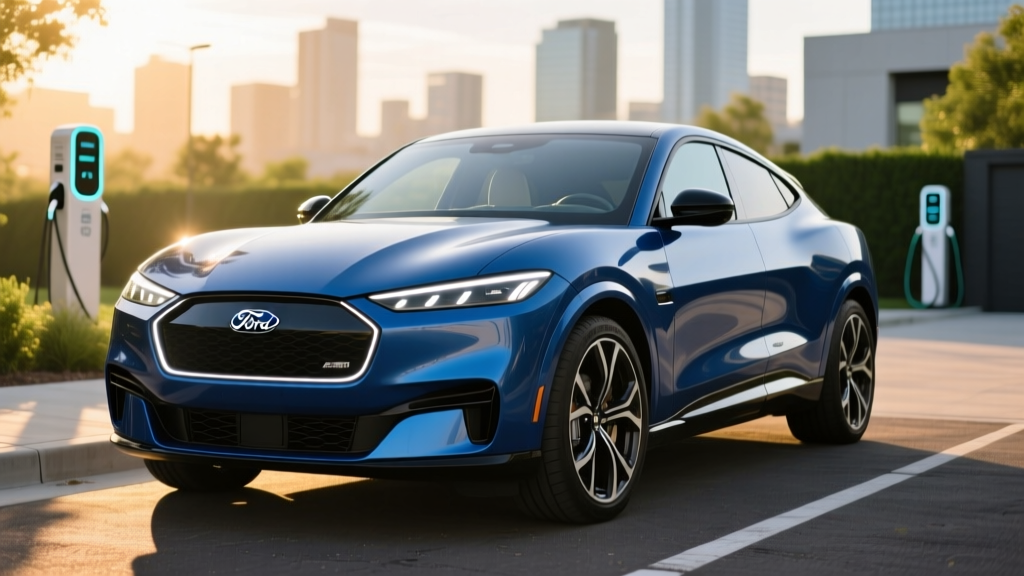
When Ford attached the Mustang nameplate to an electric crossover in 2021, enthusiasts howled. Five years later, the Mustang Mach-E has become one of the most recognizable EVs on American roads — and with the 2026 model year, Ford has refined the formula with NACS charging access, updated battery chemistry options, and a competitive starting price that undercuts several rivals. If you've been searching for a Ford Mustang Mach-E review — or if you arrived here after searching for the classic Ford Mustang Mach 1 1971 and are curious how Ford's modern electric muscle compares — you're in the right place. This is a data-driven, owner-perspective breakdown of the 2026 Mach-E: range, charging, pricing, tax credits, and whether it still holds up against the Tesla Model Y, Hyundai Ioniq 5, and Chevrolet Blazer EV.
2026 Ford Mustang Mach-E at a Glance
Before we dig into real-world impressions, here are the headline numbers every buyer needs. The 2026 Mach-E carries over the extended-range battery option and now ships with a native NACS (Tesla-style) charge port on all trims, eliminating the adapter that earlier models required for Supercharger access.
| Spec | Select (Std Range RWD) | Premium (Ext Range RWD) | GT (Ext Range AWD) |
|---|---|---|---|
| EPA Range | 250 mi | 320 mi | 280 mi |
| Usable Battery | 72 kWh (LFP) | 91 kWh (NMC) | 91 kWh (NMC) |
| Horsepower | 266 hp | 290 hp | 480 hp |
| 0–60 mph | 6.1 sec | 5.7 sec | 3.5 sec |
| Drivetrain | RWD single motor | RWD single motor | AWD dual motor |
| Max DC Fast Charge | 135 kW | 150 kW | 150 kW |
| 10–80% DCFC Time | ~34 min | ~36 min | ~36 min |
| Level 2 Home Charge | 10.5 kW (~30 mi/hr) | 10.5 kW (~30 mi/hr) | 10.5 kW (~30 mi/hr) |
| MPGe (Combined) | 101 MPGe | 104 MPGe | 89 MPGe |
| Base MSRP | $42,995 | $48,995 | $57,995 |
Sources: fueleconomy.gov, Ford Motor Company 2026 spec sheets.
Real-World Range: What the EPA Sticker Doesn't Tell You
- Mixed city/suburban driving (65°F): ~290–310 mi achievable with moderate regen
- Highway cruising (75 mph, 75°F): ~245–265 mi — aerodynamic drag cuts efficiency 15–20%
- Cold weather (30°F, highway): ~200–225 mi — expect 25–35% range loss without preconditioning
- Cold weather with heat pump + preconditioning: ~235–250 mi
The 320-mile EPA figure is achievable in ideal city conditions, but plan for ~250 miles on road trips and budget conservatively in freezing temperatures.
The 2026 Mach-E Premium with the extended-range pack uses an NMC (nickel manganese cobalt) chemistry in the 91 kWh usable pack. NMC offers higher energy density than LFP, which is how Ford packs this much range into the Mach-E's footprint. The trade-off: NMC cells degrade slightly faster over time and prefer not to sit at 100% state of charge for extended periods. Ford recommends daily charging to 80–90% for NMC packs and saving 100% for road trips.
The Select trim's LFP (lithium iron phosphate) 72 kWh pack sacrifices range but gains longevity — LFP chemistry tolerates regular 100% charges, has a longer cycle life, and avoids cobalt sourcing concerns. For buyers who commute under 60 miles daily and charge at home nightly, the LFP Select is arguably the smarter long-term ownership play.
Charging Speed: NACS Native and Supercharger Access
The biggest practical upgrade for 2026: the Mach-E now ships with a native NACS charge port, meaning direct plug-in access to the Tesla Supercharger network (now over 20,000 stalls in North America) without any adapter. This is a significant reliability and convenience advantage over CCS-only vehicles in 2026.
| Charging Level | Power (kW) | Miles Added per Hour | Notes |
|---|---|---|---|
| Level 1 (120V household) | 1.2 kW | ~3–4 mi/hr | Emergency/top-up only |
| Level 2 (240V, 48A home) | 10.5 kW | ~30 mi/hr | Full charge overnight (~9 hrs for 91 kWh) |
| DC Fast (peak) | 150 kW | ~190 mi in 20 min | Peak rate; tapers above 80% SoC |
| DC Fast (10–80%) | Avg ~95 kW | ~36 min total | Sustained average across curve |
Charging curve reality check: The Mach-E's 150 kW peak is reached between roughly 15–45% state of charge on an extended-range pack. Above 60%, the rate tapers to ~100 kW, and above 80% it drops sharply to ~40–50 kW. This is normal lithium-ion behavior, but it means the advertised "10–80% in 36 minutes" assumes a well-preconditioned battery at a functioning 150+ kW stall. In practice, at Electrify America or Supercharger V3/V4 stalls, expect 38–45 minutes if arriving cold.
The heat pump (standard on all 2026 trims) helps with battery preconditioning in cold weather, but Ford's preconditioning for DC fast charging still lags behind Tesla's and Hyundai/Kia's E-GMP platform in speed. If you road-trip frequently in winter, factor in an extra 5–10 minutes per stop.
Performance, Ride, and the Mach 1 Legacy Question
If you landed here searching for a Ford Mustang Mach 1 1971 — the 429 Cobra Jet, the shaker hood, the 375-horsepower icon — the Mach-E GT won't replicate that analog brutality. What it does offer is a different kind of muscle: 480 horsepower, 634 lb-ft of torque, and a 3.5-second 0–60 time that would embarrass a 1971 Mach 1 off the line. The GT's eAWD dual-motor setup delivers instantaneous torque with no gear shifts, no turbo lag, and no exhaust note (though Ford's optional "Mustang sound" tries).
For most buyers, the Premium RWD at 290 hp is the sweet spot — it's quick enough for confident highway merging (5.7 seconds to 60), and the single-motor rear-drive layout gives the Mach-E a surprisingly engaging, tail-happy character that feels more "Mustang" than you'd expect from a crossover.
Ride quality is firm but compliant. The Mach-E's ~4,800-lb curb weight (GT) is well-managed by Ford's suspension tuning, though you'll feel expansion joints more than in a Hyundai Ioniq 5. Steering is precise but numb — a common EV complaint. The GT's MagneRide adaptive dampers (optional) noticeably improve ride compliance on rough pavement.
Interior, Cargo, and Technology
The 2026 Mach-E interior carries over Ford's vertical 15.5-inch SYNC 4A touchscreen, which remains one of the better EV infotainment systems — responsive, logically laid out, and with physical volume and climate controls that some rivals have deleted. Wireless Apple CarPlay and Android Auto are standard.
| Dimension | Measurement |
|---|---|
| Front headroom | 40.4 in |
| Rear headroom | 38.9 in |
| Front legroom | 43.3 in |
| Rear legroom | 38.1 in |
| Cargo (rear seats up) | 29.7 cu ft |
| Cargo (rear seats folded) | 59.7 cu ft |
| Frunk (front trunk) | 4.7 cu ft (drainable, good for wet gear) |
Cargo space trails the Tesla Model Y (76 cu ft max) and Hyundai Ioniq 5 (59.3 cu ft is comparable, but the Ioniq 5 has a flat floor advantage). The Mach-E's frunk is small but practical — the drainable design makes it ideal for ice, wet sports gear, or muddy boots.
Driver assistance: Ford Co-Pilot360 Assist 2.0 is standard, including adaptive cruise with stop-and-go, lane centering, and evasive steering assist. Ford's BlueCruise hands-free highway driving (SAE Level 2) is available on Premium and GT trims with a subscription (~$75/month or $800/year after the initial trial). It works on over 130,000 miles of pre-mapped divided highways and is competitive with GM's Super Cruise — though it still requires driver attention monitoring and is not autonomous driving.
BlueCruise is an SAE Level 2 driver-assistance system. You must remain alert, keep eyes on the road (monitored by an infrared camera), and be prepared to take over at any time. It is not Level 4 autonomous driving like Waymo's driverless robotaxi service.
Pricing, Trims, and Federal Tax Credit Eligibility
The 2026 Mach-E lineup starts at $42,995 for the Select RWD with the LFP battery and climbs to $57,995 for the GT. The best-value trim for most buyers is the Premium Ext Range RWD at $48,995 — it delivers 320 miles of EPA range, the NACS port, BlueCruise eligibility, and qualifies for the full federal tax credit.
| Trim | Base MSRP | §30D Federal Credit | Est. Net Price |
|---|---|---|---|
| Select RWD (Std Range) | $42,995 | Up to $7,500* | ~$35,495 |
| Premium RWD (Ext Range) | $48,995 | Up to $7,500* | ~$41,495 |
| Premium AWD (Ext Range) | $52,995 | Up to $7,500* | ~$45,495 |
| GT AWD (Ext Range) | $57,995 | Up to $7,500* | ~$50,495 |
*Federal tax credit under IRS §30D is subject to multiple eligibility requirements:
- MSRP cap: SUVs/crossovers must be under $80,000 — all Mach-E trims qualify ✓
- Buyer income cap: AGI ≤ $150,000 (single) / $300,000 (joint) / $225,000 (head of household)
- Battery sourcing: Critical minerals and battery components must meet phased-in domestic/free-trade sourcing thresholds — verify current-year compliance at purchase
- Point-of-sale transfer: As of 2024+, buyers can transfer the credit to the dealer for an immediate price reduction at purchase (no need to wait for tax filing)
- Final assembly: Vehicle must undergo final assembly in North America — the Mach-E is built in Cuautitlán, Mexico ✓
Important: Battery-sourcing rules tighten annually. Confirm the specific VIN's credit eligibility with your dealer and cross-reference against the fueleconomy.gov credit lookup tool before signing. Tax credit rules are subject to legislative change; consult a tax professional for your personal situation.
Pros, Cons, and Who Should Buy the Mach-E
✅ Pros
- Native NACS port = direct Supercharger access (20,000+ stalls)
- 320 mi EPA range on Premium Ext Range is class-competitive
- LFP battery option on Select for longevity-focused buyers
- Engaging RWD driving dynamics; GT is genuinely quick
- Physical climate controls + strong SYNC 4A infotainment
- Drainable frunk is genuinely useful
- Federal tax credit eligible on most trims
❌ Cons
- DC fast charging (150 kW peak) trails Hyundai/Kia's 350 kW capability
- Cargo space trails Tesla Model Y significantly
- Rear seat is tight for tall adults on long trips
- BlueCruise requires ongoing subscription after trial period
- Cold-weather range loss is above average vs. heat-pump-equipped rivals
- Insurance premiums run 15–25% higher than comparable gas SUVs
Who this EV suits best:
- Daily commuters (20–60 mi round trip): Ideal. Home Level 2 charging means you start every day with a full battery. The Select LFP at ~$35,500 after credit is a strong value.
- Families needing a primary vehicle: The Premium Ext Range works if cargo needs are moderate. If you need maximum cargo, compare against the Model Y.
- Road trippers: NACS/Supercharger access makes the Mach-E viable for highway travel, but 150 kW charging means longer stops than an Ioniq 5 or EV6. Plan accordingly.
- Performance enthusiasts: The GT delivers sports-car acceleration in a practical package. It won't sound like a V8 Mach 1, but it will outrun one to 60.
Choose the Mach-E if...
- You want Supercharger access without an adapter
- You prefer a traditional dealership experience and service network
- You value physical controls and proven SYNC infotainment
- You want an LFP battery option for maximum battery longevity
Look elsewhere if...
- Maximum cargo space is non-negotiable (→ Tesla Model Y)
- Fastest DC charging is your priority (→ Hyundai Ioniq 5 / Kia EV6)
- You need three rows of seating (→ Kia EV9)
Warranty and Long-Term Ownership
Ford covers the 2026 Mach-E with:
- Bumper-to-bumper: 3 years / 36,000 miles
- Powertrain: 5 years / 60,000 miles
- Battery pack: 8 years / 100,000 miles (capacity retention ≥ 70% of original)
The 8-year/100,000-mile battery warranty is industry-standard and matches Tesla, Hyundai, and most competitors. Ford's 70% capacity retention threshold means if your 91 kWh pack drops below ~63.7 kWh usable capacity within the warranty period, Ford will repair or replace it. Based on current NMC degradation data from fleets and high-mileage owners, most Mach-E packs should retain 85–90% capacity at 100,000 miles under normal use — well above the warranty floor.
For LFP-equipped Select models, degradation is expected to be even lower — LFP chemistry routinely shows 90%+ retention at 150,000+ miles in commercial fleet data.
Frequently Asked Questions
What is the real-world range of the 2026 Mustang Mach-E?
The EPA rates the Premium Ext Range RWD at 320 miles. In real-world mixed driving at moderate temperatures, expect 290–310 miles. Highway driving at 75 mph drops this to ~250 miles, and cold weather (below freezing) can reduce range to 200–225 miles without preconditioning. The Select LFP trim's 250-mile EPA rating translates to roughly 220–240 miles in mixed real-world use.
How fast does the Mach-E charge at home and on the road?
On a 240V Level 2 home charger (48A), the Mach-E adds about 30 miles of range per hour, fully charging the 91 kWh pack in roughly 9 hours overnight. On DC fast chargers, it peaks at 150 kW and charges from 10–80% in approximately 36 minutes under ideal conditions. At Tesla Superchargers, expect similar speeds — the native NACS port means no adapter needed.
Does the 2026 Mach-E qualify for the $7,500 federal tax credit?
Most trims qualify, but eligibility depends on your income (≤$150K single / ≤$300K joint), the vehicle's battery-sourcing compliance for the current year, and MSRP under $80K (all trims clear this). The credit can be transferred to the dealer at point of sale for an immediate price reduction. Always verify your specific VIN's eligibility on fueleconomy.gov before purchasing, as sourcing rules change annually.
How does the Mach-E compare to the Tesla Model Y and Hyundai Ioniq 5?
The Model Y offers more cargo space (76 vs. 59.7 cu ft) and faster charging via the Supercharger network (though the Mach-E now has native access too). The Ioniq 5 charges significantly faster on DC (up to 350 kW, 10–80% in ~18 min) but uses CCS, requiring an adapter for Superchargers. The Mach-E's advantages are its traditional dealer service network, physical interior controls, LFP battery option, and engaging RWD dynamics. It's a strong all-rounder that doesn't lead in any single category but competes well across all of them.
Is the Mach-E GT a worthy successor to the 1971 Mach 1?
In raw acceleration, the Mach-E GT (3.5 sec 0–60, 480 hp) far exceeds the 1971 Mach 1 (approximately 6.5 sec with the 429 Cobra Jet). But the Mach 1 was about visceral engagement — sound, vibration, mechanical feedback — that no EV replicates. The Mach-E GT is a legitimately fast electric performance SUV; it's a different kind of thrill. If you want modern daily-driver performance with zero emissions, the GT delivers. If you want analog soul, the 1971 Mach 1 still wins that argument.
What does it cost to charge a Mach-E at home vs. buying gas?
At the US average residential electricity rate of ~$0.17/kWh, fully charging the 91 kWh extended-range pack costs about $15.50, yielding roughly 320 miles — or about $0.048 per mile. A comparable gas SUV at 25 MPG and $3.40/gallon costs $0.136 per mile. Over 15,000 miles per year, home charging saves approximately $1,320 annually vs. gasoline. Public DC fast charging is more expensive (~$0.30–0.48/kWh) and narrows the savings gap, so home charging access is key to maximizing EV economics.