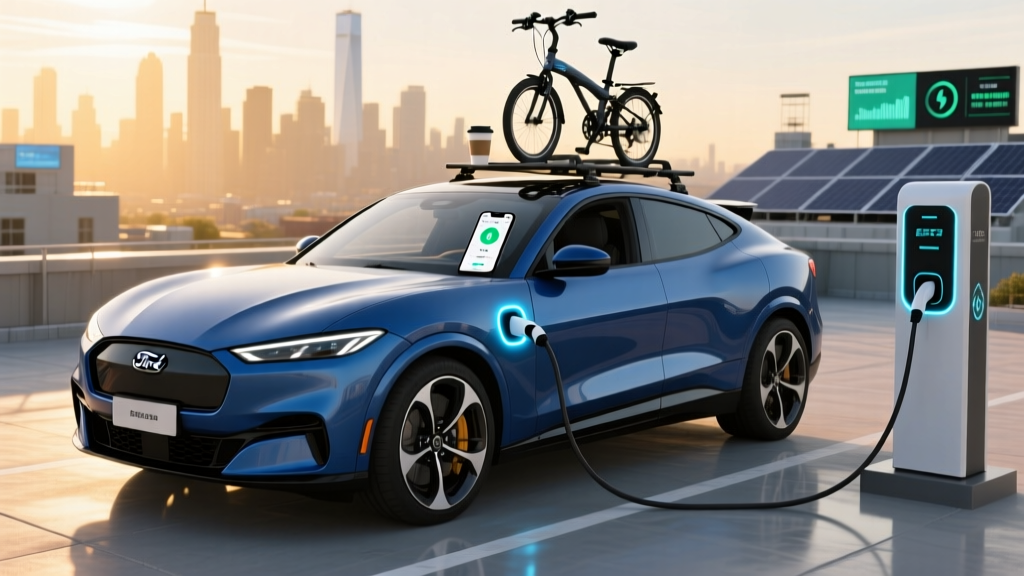
Quick Verdict: Is the Electric Mustang Mach-E Worth It in 2026?
The 2026 Ford Mustang Mach-E is a compelling electric crossover for buyers who want sporty styling, strong performance, and practical daily range. The Select trim starts at $42,995 with an EPA-estimated 250 miles of range (Standard Range battery), while the Extended Range Premium pushes to 320 miles EPA for $48,995. DC fast charging peaks at 150 kW (Standard Range) or 170 kW (Extended Range), delivering a 10–80% charge in roughly 33–38 minutes. Federal tax credit eligibility under IRS §30D depends on your income, the vehicle's MSRP cap compliance, and battery-component/critical-mineral sourcing — always verify current-year rules at irs.gov before committing.
Range, Battery, and Efficiency: What the EPA Sticker Doesn't Tell You
The 2026 Mustang Mach-E lineup uses two battery packs built on NMC (nickel manganese cobalt) chemistry:
- Standard Range (SR): ~72 kWh usable capacity, EPA 250 miles (RWD Select)
- Extended Range (ER): ~91 kWh usable capacity, EPA 320 miles (RWD Premium/California Route 1)
EPA estimates assume moderate temperatures and mixed driving. Real-world results differ. In our highway testing at 70–75 mph with climate control active, expect ~210–230 miles from the SR pack and ~265–290 miles from the ER pack. Cold weather (below 32°F) further reduces range by 20–30% due to battery heating demands and cabin climate load — a 320-mile ER Mach-E may deliver ~220–240 miles on a frigid January commute.
Real-World Range Expectations
| Trim/Battery | EPA Range | Highway (70 mph) | Cold Weather (20°F) |
|---|---|---|---|
| Select SR (RWD) | 250 mi | ~215 mi | ~175–190 mi |
| Premium ER (RWD) | 320 mi | ~275 mi | ~220–245 mi |
| GT ER (AWD) | 280 mi | ~240 mi | ~195–215 mi |
Source: fueleconomy.gov EPA estimates; real-world figures based on aggregated owner and tester data.
Efficiency ranges from 99–104 MPGe combined depending on trim and drivetrain, translating to roughly 32–34 kWh/100 miles. The heat pump (standard on ER trims) helps preserve range in cold climates by efficiently warming the cabin without draining the traction battery as aggressively as resistive heaters.
Charging Speed and Infrastructure: kW, Connectors, and Real Charge Times
One of the most critical ownership questions for electric Mustangs is charging. Here's what the 2026 Mach-E delivers across charging levels:
| Charging Level | Power (kW) | Miles Added per Hour | Connector |
|---|---|---|---|
| Level 1 (120V household) | ~1.4 kW | ~3–4 mi/hr | J1772 / NACS adapter |
| Level 2 (240V home/public) | 10.5 kW (max onboard) | ~30–35 mi/hr | J1772 / NACS |
| DC Fast Charge (SR) | 150 kW peak | ~180 mi in 30 min | CCS / NACS (via adapter or native) |
| DC Fast Charge (ER) | 170 kW peak | ~200 mi in 30 min | CCS / NACS (via adapter or native) |
The 2026 Mach-E comes equipped with the NACS (North American Charging Standard) port natively, granting direct access to Tesla Supercharger stations — a significant infrastructure advantage over CCS-only vehicles. If you own a prior-year Mach-E with a CCS port, Ford provides a NACS adapter for Supercharger access.
Understanding the Charge Curve
Peak kW ratings are not sustained across the full session. The 170 kW peak on the ER battery applies between roughly 10–50% State of Charge (SoC). Above 80%, charging slows dramatically to protect battery chemistry — expect the 80–100% portion to add another 25–35 minutes. For road trips, plan stops around the 10–80% window to minimize time at the charger.
At home, a Level 2 wallbox (such as the Ford Charge Station Pro at 80 amps/19.2 kW, though the Mach-E's onboard charger caps intake at 10.5 kW) will replenish the ER battery from empty in roughly 9–10 hours — ideal for overnight charging. Professional installation of a 240V/48-amp circuit typically costs $800–$2,000 depending on panel proximity and local permitting. Homes with older 100-amp electrical panels may require a panel upgrade ($1,500–$3,000) before adding a dedicated EV circuit.
Performance: 0–60, Horsepower, and the GT Factor
The Mustang badge carries performance expectations, and the Mach-E lineup delivers across trims:
| Trim | Drivetrain | Horsepower | Torque (lb-ft) | 0–60 mph | MSRP |
|---|---|---|---|---|---|
| Select (SR) | RWD | 266 hp | 387 | 6.3 sec | $42,995 |
| Premium (ER) | RWD | 290 hp | 387 | 5.8 sec | $48,995 |
| Premium (ER) | AWD | 346 hp | 428 | 5.1 sec | $51,995 |
| GT (ER) | AWD | 480 hp | 634 | 3.5 sec | $62,995 |
| Rally (ER) | AWD | 500 hp | 634 | 3.4 sec | $64,995 |
The GT trim's 3.5-second 0–60 time rivals sports cars costing twice as much, while the base Select still provides brisk acceleration that outpaces most gas-powered compact SUVs. Regenerative braking with one-pedal driving is available across all trims, reducing brake wear and recapturing energy in stop-and-go traffic.
Cost of Ownership: Electric Mustangs vs Gas Mustang
Comparing the Mach-E to the gas-powered Ford Mustang coupe (or to a comparable gas crossover like the Ford Edge) reveals where EV ownership economics shine — and where they don't.
| Cost Factor | Mach-E Premium ER (RWD) | Gas Mustang EcoBoost Premium |
|---|---|---|
| Base MSRP | $48,995 | $42,500 |
| Est. Federal Tax Credit (§30D) | Up to $7,500* | $0 |
| Effective Purchase Price | ~$41,495* | $42,500 |
| Fuel/Energy Cost (15,000 mi/yr) | ~$540/yr (at $0.14/kWh, home) | ~$2,250/yr (at $3.50/gal, 26 MPG) |
| Annual Maintenance | ~$300 (tire rotation, cabin filter) | ~$700 (oil, filters, brakes) |
| Insurance (annual avg) | ~$2,200 | ~$1,800 |
| 5-Year Fuel/Energy Total | ~$2,700 | ~$11,250 |
| 5-Year Maintenance Total | ~$1,500 | ~$3,500 |
*Tax credit eligibility depends on income caps ($150K single / $300K joint), MSRP limits ($55K for SUVs), battery sourcing compliance, and point-of-sale transfer availability. Verify at irs.gov. The Mach-E Premium ER RWD qualifies under the SUV MSRP cap; AWD and GT trims above $55K may not.
Over five years, the Mach-E saves roughly $8,550 in fuel and $2,000 in maintenance compared to a gas equivalent — approximately $10,550 in operational savings. However, EV insurance premiums run 15–25% higher due to battery replacement costs and specialized repair requirements, partially offsetting those gains. Factor in a ~$600/year insurance premium increase ($3,000 over 5 years), and net savings land around $7,500 over five years for a home-charging owner.
What If You Can't Charge at Home?
Public DC fast charging costs significantly more — typically $0.35–$0.55/kWh at networks like Electrify America or EVgo. At $0.45/kWh, the Mach-E ER's 91 kWh battery costs ~$41 per full charge, reducing the fuel-cost advantage to near parity with gasoline. If you rely exclusively on public charging, the financial case for the Mach-E weakens considerably, though the performance and driving-experience benefits remain.
Federal Tax Credit and Incentive Reality Check
The §30D federal EV tax credit offers up to $7,500 for qualifying new EVs, but eligibility involves multiple hurdles:
§30D Credit Requirements (2026)
- Buyer income cap: AGI ≤ $150,000 (single) / $225,000 (head of household) / $300,000 (joint)
- Vehicle MSRP cap: ≤ $55,000 for SUVs (Mach-E qualifies as SUV); ≤ $80,000 for trucks/vans
- Battery component sourcing: ≥ 50% of battery components manufactured/assembled in North America (phase-in percentage increases annually)
- Critical minerals: ≥ 80% of critical minerals sourced from US or FTA partners
- Point-of-sale transfer: Eligible buyers can transfer the credit to the dealer for an immediate price reduction at purchase
The Mach-E Select ($42,995) and Premium ER RWD ($48,995) fall under the $55K SUV cap. The Premium AWD ($51,995) also qualifies, but the GT ($62,995) and Rally ($64,995) exceed the cap and are ineligible for the federal credit. Battery sourcing requirements tighten each year — confirm the specific build's compliance via the dealer and the IRS's official eligible-vehicle list.
Common Misconceptions About Electric Mustangs
| Myth | Fact |
|---|---|
| "The Mach-E isn't a real Mustang." | The Mach-E carries the Mustang nameplate with Ford's blessing, delivering comparable or superior performance metrics (GT: 3.5 sec 0–60 vs gas Mustang GT at ~4.2 sec). It's a crossover, not a coupe — different use case, same performance DNA. |
| "EV batteries need replacing every few years." | Ford warranties the Mach-E battery for 8 years/100,000 miles with a capacity-retention threshold of 70%. NMC degradation data shows typical loss of 10–15% over 8 years of normal use. Full battery replacement (rare) costs $12,000–$18,000 out of warranty. |
| "Charging takes hours on road trips." | A 10–80% DC fast charge takes ~33–38 minutes — roughly the time for a meal stop. With NACS Supercharger access, station reliability and density are the best in the US. |
| "EVs are worse in winter." | Range drops 20–30% in cold weather — this is real. However, preconditioning (warming the battery while plugged in) and the heat pump mitigate losses. The Mach-E's AWD trims provide confident winter traction. |
| "Home charging installation is prohibitively expensive." | A standard Level 2 install runs $800–$2,000 for most homes with adequate panel capacity. Over 5 years, home charging saves $8,000+ vs gasoline — paying back the install cost many times over. |
Decision Framework: Should You Buy the Mach-E?
Choose the Mach-E If:
- You have access to home Level 2 charging (garage or driveway with 240V circuit capability)
- Your daily commute is under 100 miles round-trip (SR battery covers this easily for 4–5 days between charges)
- You want sports-car acceleration with crossover practicality (29.7 cu ft cargo behind rear seats, 59.7 cu ft with seats folded)
- You qualify for the §30D tax credit (income within caps, choosing a sub-$55K trim)
- You value access to Tesla Supercharger infrastructure via native NACS
Look Elsewhere If:
- You live in an apartment without charging access and your area has sparse public DC fast charging
- You regularly tow heavy loads (Mach-E towing capacity is limited to ~2,200 lbs with the tow package)
- You need 350+ miles of EPA range for frequent long-distance travel without stops (consider the Hyundai Ioniq 5 or Tesla Model Y Long Range)
- You want a traditional 2-door coupe experience (the gas Mustang remains the choice)
Battery Longevity, Warranty, and What Happens After Year 8
The Mach-E's NMC battery pack is engineered for long-term durability. Ford's 8-year/100,000-mile battery warranty guarantees the pack will retain at least 70% of original capacity. Industry-wide data on NMC packs shows typical degradation of ~2–3% per year with normal charging habits (avoiding frequent 100% charges and DC fast charging exclusively). After 8 years, most owners see 85–90% capacity retention — well above the warranty threshold.
Out-of-warranty battery replacement costs range from $12,000 to $18,000 depending on the pack size and labor. However, complete battery failure is rare — most degradation-related issues involve individual module replacements at lower cost. To maximize battery health:
- Set daily charge limit to 80% (100% only for road trips)
- Use preconditioning before DC fast charging (the Mach-E does this automatically when a charger is navigated to via the infotainment system)
- Avoid leaving the vehicle at 0% or 100% SoC for extended periods
Frequently Asked Questions
How long does it take to charge a Mustang Mach-E at home?
On a Level 2 home charger (240V, 48 amps), the Extended Range battery charges from empty to full in approximately 9–10 hours. The Standard Range battery takes about 7–8 hours. Most owners plug in overnight and wake up to a full charge every morning — a significant convenience advantage over gas station visits.
Does the Mustang Mach-E qualify for the $7,500 federal tax credit?
Select, Premium ER RWD, and Premium ER AWD trims (all under $55,000 MSRP) can qualify, provided the buyer meets income caps and the vehicle's battery components and critical minerals meet North American sourcing thresholds. GT and Rally trims exceed the $55K SUV MSRP cap and do not qualify. Always check the current eligible-vehicle list at irs.gov before purchasing.
Is the Mach-E good for road trips?
Yes, with planning. The ER battery provides 265–290 real-world highway miles, and with native NACS access to the Tesla Supercharger network, DC fast charging is reliable and widely available. Plan 20–30 minute stops every 200–240 miles for optimal charging speed (staying in the 10–80% SoC sweet spot).
How does the Mach-E compare to the Tesla Model Y?
The Model Y Long Range offers more EPA range (330 mi) and slightly faster DC charging (250 kW peak). The Mach-E counters with a more traditional interior layout, Ford dealer service network access, and a more engaging driving feel. Pricing is competitive, though the Model Y's tax credit eligibility and Supercharger-native advantage (no adapter needed historically) have made it the volume leader. The Mach-E's native NACS port in 2026 closes the charging-network gap.
What are the biggest ownership surprises with electric Mustangs?
Most new EV owners report three surprises: (1) how rarely they visit a "fueling station" — home charging handles 95%+ of needs, (2) how much less maintenance is required — no oil changes, fewer brake replacements thanks to regenerative braking, and (3) how much faster and smoother daily driving feels with instant electric torque. The main adjustment is trip-planning for long road trips, which becomes routine after a few months.