What Is the Ford Mustang Mach-E 1400?
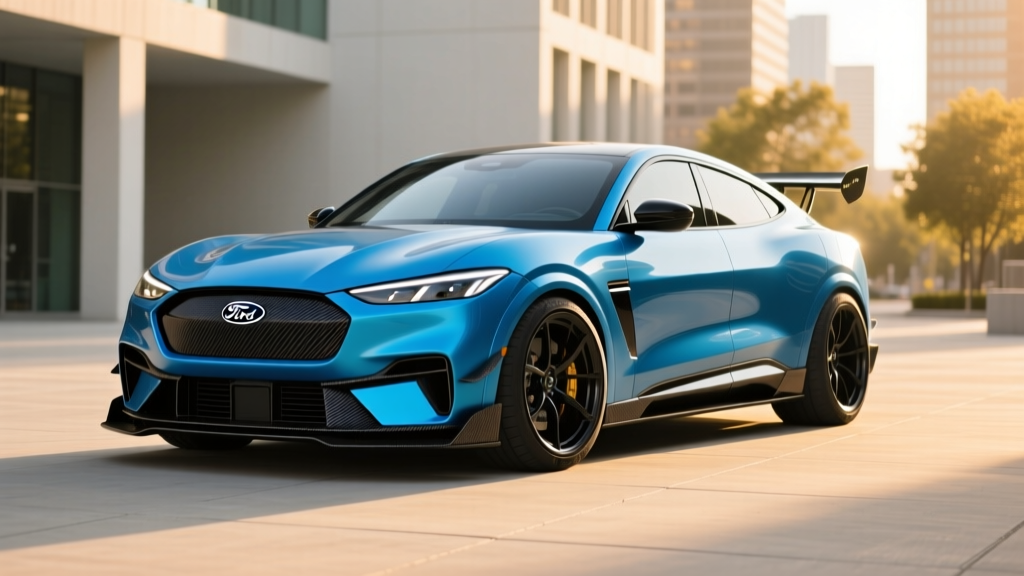
The Ford Mustang Mach-E 1400 is not a production vehicle you can buy at a dealership. It is a one-off, track-focused electric prototype built by Ford Performance in collaboration with RTR Vehicles, first unveiled in mid-2020. Ford created it as a technology showcase — a rolling laboratory to stress-test electric powertrain architectures, thermal management under extreme load, and advanced torque-vectoring strategies that could eventually trickle down to production models like the Mach-E GT.
If you landed here hoping to configure a 1,400-horsepower Mach-E on Ford's website, this article will save you time: the Mach-E 1400 exists as a single hand-built demonstrator. But understanding what's under its carbon-fiber skin reveals a lot about where Ford's EV engineering is headed — and it gives context for evaluating the production Mach-E lineup that you actually can buy in 2026.
Powertrain and Performance Specs
The headline number — 1,400 peak horsepower — comes from an unusual configuration: seven electric motors, three mounted at the front axle and four at the rear, all fed from a single high-voltage battery pack. This is far beyond any production EV architecture and was chosen specifically to enable granular, independent torque vectoring at each wheel position.
| Spec | Value |
|---|---|
| Peak Power | 1,400 HP (combined) |
| Motor Count | 7 (3 front / 4 rear) |
| Drivetrain | AWD with independent torque vectoring |
| Battery Capacity | ~88 kWh (NMC pouch cells) |
| Battery Chemistry | Nickel Manganese Cobalt (NMC) |
| 0–60 mph (est.) | Low 3-second range (track-tuned, not drag-optimized) |
| Top Speed | Not published (aero-limited for track use) |
| Curb Weight (est.) | ~5,000+ lbs (added motors, cooling, cage) |
| Production Status | One-off prototype — not for sale |
Ford published limited performance data for the Mach-E 1400. The 0–60 mph time sits in the low 3-second range — impressive, but not the sub-2-second figures you see from drag-optimized EVs like the Tesla Model S Plaid or Lucid Air Sapphire. That's because the Mach-E 1400 was engineered for road-course handling and drift control, not straight-line launches. Its seven-motor layout enables torque distribution strategies that a conventional dual-motor AWD system simply cannot replicate.
Battery, Thermal Management, and Charging
The prototype uses an ~88 kWh NMC (nickel manganese cobalt) pouch-cell battery, similar in chemistry to the extended-range pack found in the production Mach-E GT. NMC chemistry was chosen for its high energy density and discharge-rate capability — critical when seven motors are pulling maximum current simultaneously during track sessions.
Thermal management is where the Mach-E 1400 prototype does its most important work. Seven motors generating 1,400 HP produce enormous waste heat. Ford Performance developed a dedicated liquid-cooling circuit for the powertrain that goes well beyond the production Mach-E's thermal architecture. The lessons learned here — particularly around sustained high-load cooling and battery preconditioning under extreme discharge — have informed Ford's next-generation EV platform development.
Because the Mach-E 1400 is a one-off, it does not have published DC fast-charge or Level 2 charging specs. The production Mach-E GT, by contrast, supports up to 150 kW DC fast charging (10–80% in approximately 36 minutes on a compatible charger) and 10.5 kW Level 2 home charging, which adds roughly 30–32 miles of range per hour of charging.
What This Means for Production Mach-E Buyers in 2026
Since you cannot buy the Mach-E 1400, here is how the production 2025/2026 Ford Mustang Mach-E lineup stacks up — the cars that actually carry forward the engineering lessons from the prototype.
| Trim | Drivetrain | Battery (usable kWh) | EPA Range | HP | 0–60 mph | Base MSRP |
|---|---|---|---|---|---|---|
| Select RWD | RWD | 72 kWh (LFP) | 250 mi | 266 | ~6.0s | ~$39,995 |
| Premium RWD | RWD | 91 kWh (NMC) | 320 mi | 290 | ~5.8s | ~$46,495 |
| Premium AWD | AWD dual-motor | 91 kWh (NMC) | 290 mi | 346 | ~5.1s | ~$49,495 |
| GT AWD | AWD dual-motor | 91 kWh (NMC) | 280 mi | 480 | 3.8s | ~$55,995 |
| Rally | AWD dual-motor | 91 kWh (NMC) | 265 mi | 480 | 3.8s | ~$59,995 |
Source: Ford.com and fueleconomy.gov. Prices and specs reflect the latest model year available; verify at purchase time as trims and pricing change annually.
Real-World Range Expectations
EPA estimates assume a mix of city and highway driving at moderate temperatures. In real-world ownership:
- Highway-heavy driving (70–80 mph): Expect 10–15% less than EPA. A GT rated at 280 miles may deliver 240–250 miles on a flat interstate run.
- Cold weather (below 32°F): Range loss of 20–30% is typical for NMC packs without aggressive preconditioning. The GT could drop to 195–220 miles in freezing conditions.
- City driving with regen: Often exceeds EPA by 5–10%, especially in mild weather. Owners report 290–300+ miles from the Premium RWD's 320-mile pack in stop-and-go traffic at 50–65°F.
Charging the Production Mach-E
All current production Mach-E models with the extended-range pack support 150 kW peak DC fast charging via a CCS1 connector. Ford has been transitioning to the NACS (Tesla-style) connector for newer models; verify the connector on the specific model year you're evaluating. On a 150 kW charger, the 91 kWh pack charges from 10–80% in roughly 36 minutes, with the charge curve tapering significantly above 80% — a normal behavior for NMC chemistry to protect cell longevity.
Level 2 home charging at 10.5 kW (48A on a 60A circuit) adds about 30–32 miles per hour, meaning an overnight session of 8–10 hours fully replenishes even the largest pack.
Technology and Driver-Assistance Features
The Mach-E 1400 prototype featured a stripped, track-oriented interior with a roll cage, racing seats, and a simplified telemetry display — not the SYNC 4A infotainment system you'd find in the production car. The production Mach-E, however, carries forward a different kind of tech story:
- SYNC 4A with a 15.5-inch vertical touchscreen, wireless Apple CarPlay/Android Auto, and over-the-air (OTA) update capability.
- Ford BlueCruise (available on higher trims): an SAE Level 2 hands-free highway driving system on pre-mapped divided highways. The driver must remain attentive and eyes-on-road — this is not autonomous driving. BlueCruise covers 130,000+ miles of compatible roads in the US and Canada.
- Intelligent Range estimation that factors in weather, terrain, and driving style to provide more accurate range predictions than a simple %-of-battery readout.
- Phone As A Key (PAAK): unlock and start the vehicle via Bluetooth from your smartphone.
Pricing, Tax Credits, and Ownership Costs
Because the Mach-E 1400 is a one-off prototype, it has no MSRP and is not eligible for any tax credit. For the production Mach-E, federal tax credit eligibility under IRS §30D depends on several factors that change annually:
- MSRP cap: SUVs (including the Mach-E) must have an MSRP ≤ $80,000.
- Buyer income cap: Modified AGI ≤ $300,000 (joint), $225,000 (head of household), $150,000 (single).
- Battery sourcing: Critical minerals and battery components must meet escalating domestic-content and FEOC (Foreign Entity of Concern) thresholds that tighten each year. These rules have disqualified several previously eligible models.
- Point-of-sale transfer: Eligible buyers can transfer the credit to the dealer at purchase, reducing the out-of-pocket price directly rather than waiting for a tax refund.
- Assembly: Vehicle must undergo final assembly in North America (all Mach-E models are built in Cuautitlán, Mexico — qualifying).
The maximum credit is $7,500, but partial credits ($3,750) apply if only one of the two sourcing requirements is met. Always verify current eligibility on fueleconomy.gov and consult a tax professional, as rules change frequently.
Warranty Coverage
The production Mach-E carries Ford's standard EV warranty:
- Battery: 8 years / 100,000 miles (whichever comes first), covering capacity loss below 70% of original.
- Electric powertrain components: 8 years / 100,000 miles.
- Bumper-to-bumper: 3 years / 36,000 miles.
The Mach-E 1400 prototype, being a non-production vehicle, carries no consumer warranty.
Mach-E 1400 vs. the Competition: Prototype Context
As a prototype, the Mach-E 1400 doesn't compete in any showroom. But it's useful to understand where it sits in the landscape of extreme-performance EVs and what that means for the production Mach-E GT's competitive position:
| Vehicle | Status | HP | Motors | Purpose |
|---|---|---|---|---|
| Ford Mach-E 1400 | Prototype (1-off) | 1,400 | 7 | R&D / drift / track demo |
| Ford F-150 Lightning SuperTruck | Prototype (1-off) | ~1,600 | 3 | Pikes Peak hill climb |
| Tesla Model S Plaid | Production | 1,020 | 3 | Street / drag / track |
| Lucid Air Sapphire | Production | 1,234 | 3 | Luxury / track |
| Hyundai Ioniq 5 N | Production | 641 | 2 | Track-focused crossover |
| Mach-E GT (production) | Production | 480 | 2 | Daily / spirited driving |
The Mach-E 1400's seven-motor layout is an outlier. Even the most extreme production EVs use two or three motors. The prototype's value to Ford was never about selling cars — it was about proving that independent multi-motor torque vectoring can produce handling behaviors impossible with conventional differentials and stability control. Watch for elements of this approach to appear in Ford's future performance EVs, potentially including next-generation Mustang-branded electric models.
Who Should Buy a Production Mach-E (and Who Should Look Elsewhere)
✅ The Mach-E GT Is Right for You If:
- You want a sporty electric crossover with genuine performance (3.8s 0–60) and daily usability.
- You need 280+ miles of EPA range with room for a family (front legroom: 43.3 in, rear: 38.1 in).
- You value Ford's dealer network for service and warranty work.
- You want BlueCruise for highway commutes on compatible roads.
- Cargo space matters: 29.7 cu ft behind rear seats, 59.7 cu ft with seats folded, plus a 4.7 cu ft front trunk (frunk).
❌ Look Elsewhere If:
- You need 350+ miles of range — consider the Tesla Model Y Long Range (320 mi) or Hyundai Ioniq 5 (310 mi), or wait for next-gen platforms.
- You want the fastest possible EV — the Model S Plaid and Lucid Air Sapphire are quicker, though far more expensive.
- You need serious towing capacity — the Mach-E is rated for only 1,500 lbs (with the handling package); trucks and larger SUVs do better.
- DC fast charging speed is a priority — the Mach-E's 150 kW peak trails the Hyundai Ioniq 5's 240 kW (10–80% in ~18 min) and the Tesla ecosystem's 250 kW Superchargers.
Frequently Asked Questions
Can I buy the Ford Mustang Mach-E 1400?
No. The Mach-E 1400 is a single, hand-built prototype created by Ford Performance and RTR Vehicles. It was never intended for production or sale. Ford uses it for engineering research, marketing events, and motorsport demonstrations.
What is the real-world range of the production Mach-E GT?
The EPA rates the Mach-E GT at 280 miles. Real-world highway driving at 70–80 mph typically yields 240–250 miles. In freezing weather, expect 195–220 miles. City driving with regenerative braking in mild weather can push past 290 miles.
How fast does the production Mach-E charge?
The extended-range Mach-E supports 150 kW peak DC fast charging (CCS1 or NACS depending on model year), reaching 10–80% in approximately 36 minutes. Level 2 home charging at 10.5 kW adds about 30–32 miles per hour. The charge curve tapers significantly above 80% SoC to protect the NMC battery cells.
Does the production Mach-E qualify for the federal EV tax credit?
Eligibility under IRS §30D depends on the specific model year, trim MSRP (must be ≤ $80,000 for SUVs), buyer income (≤ $300K joint / $150K single), and battery-component/critical-mineral sourcing requirements that tighten each year. The Mach-E is assembled in Mexico (North America), which satisfies the assembly requirement. Always check fueleconomy.gov for the current eligibility list and consult a tax professional.
Is the Mach-E GT worth it vs. the Tesla Model Y Performance or Hyundai Ioniq 5 N?
It depends on your priorities. The Mach-E GT offers strong performance (480 HP, 3.8s 0–60), a comfortable interior, and BlueCruise. The Model Y Performance has access to the Tesla Supercharger network and slightly more range. The Ioniq 5 N is the track enthusiast's pick, with 641 HP in N Grin Boost mode, simulated gear shifts, and faster 240 kW DC charging — but less range and a higher starting price. Test-drive all three; the decision usually comes down to charging ecosystem preference, interior feel, and whether you value track capability over daily comfort.
Will Ford ever sell a 1,400-HP production EV?
Ford has not announced any production vehicle based directly on the Mach-E 1400. However, the multi-motor torque-vectoring technology the prototype demonstrated could appear in future Ford Performance EVs. The auto industry is trending toward 1,000+ HP production EVs (Lucid, Tesla, Rivian, Mercedes-AMG), so it's plausible — but nothing is confirmed as of 2026.