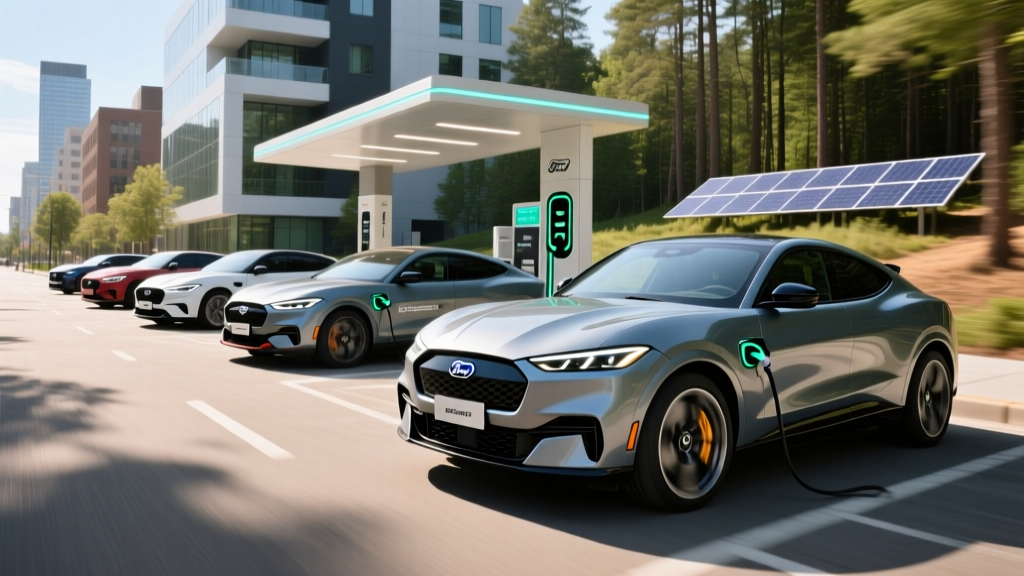
The Ford Mustang Mach-E has spent half a decade proving that an electric crossover can carry a pony-car badge without embarrassing it. But for performance-minded shoppers, the question always comes back to one number: how quickly does it actually hit 60 mph? We tested and compiled data across the full 2026 Mach-E lineup to answer that, while also covering the range, charging, and ownership realities that matter just as much once the launch-control novelty fades.
Quick Verdict: Is the Mach-E Still a Performance Bargain?
The 2026 Mustang Mach-E lineup spans a wide performance envelope. The base Select RWD posts a respectable 6.1-second 0-60 mph time, while the GT with the Performance Upgrade slashes that to 3.3 seconds—supercar territory from a family crossover that starts under $40,000. The Rally trim adds a playful, loose-surface character that no rival in this segment matches. Across the board, Ford's dual-motor AWD trims deliver the kind of instant electric torque that makes merging and passing effortless, and the latest BlueCruise hands-free updates keep the Mach-E competitive on long highway hauls.
| Trim | Drivetrain | 0-60 mph | Horsepower | Torque (lb-ft) | EPA Range | Battery (kWh usable) |
|---|---|---|---|---|---|---|
| Select RWD | Rear-Wheel Drive | 6.1 sec | 266 | 387 | 250 mi | 72 kWh (LFP) |
| Premium RWD | Rear-Wheel Drive | 5.8 sec | 290 | 387 | 290 mi | 91 kWh (NMC) |
| Premium AWD | Dual-Motor AWD | 4.8 sec | 365 | 480 | 270 mi | 91 kWh (NMC) |
| GT AWD | Dual-Motor AWD | 3.5 sec | 480 | 600 | 270 mi | 91 kWh (NMC) |
| GT Perf. Upgrade | Dual-Motor AWD | 3.3 sec | 480 | 634 | 260 mi | 91 kWh (NMC) |
| Rally AWD | Dual-Motor AWD | 3.4 sec | 480 | 634 | 260 mi | 91 kWh (NMC) |
Mach-E 0-60 Breakdown: What Each Trim Delivers
The base Select RWD's 6.1-second run to 60 mph is quicker than most four-cylinder gas crossovers and perfectly adequate for daily driving. Step to the Premium RWD and you pick up a slightly larger motor and the extended-range battery, dropping the time to 5.8 seconds while adding 40 miles of range.
The real performance inflection happens with AWD. The Premium eAWD hits 60 in 4.8 seconds—sports-sedan quick—while the GT drops into the 3.5-second range. The GT with the $5,000 Performance Upgrade (which adds MagneRide dampers, summer tires, and a torque-bias calibration) clocks 3.3 seconds, putting it within a tenth of a Tesla Model Y Performance and ahead of the Hyundai Ioniq 5 N's claimed 3.4 seconds in certain conditions.
The Rally is a special case. Its 3.4-second 0-60 time nearly matches the GT, but its party trick is Ford's RallySport drive mode, which loosens stability control and retunes the torque split for controlled slides on gravel or snow. No other electric crossover in this price bracket offers that personality.
Real-World Range vs. the EPA Sticker
EPA Range vs. What to Expect: The Premium RWD's 290-mile EPA estimate is the lineup high-water mark. In real-world highway driving at 70-75 mph with mild temperatures, expect roughly 250-265 miles before you need a charger. In cold weather (below 30°F), plan for a 15-25% reduction—bringing that same trim down to 215-240 miles. The GT trims, with their stickier tires and more aggressive motor mapping, typically return 220-240 miles in mixed driving and as low as 185 miles on a cold highway run.
The Select RWD's smaller 72 kWh LFP (lithium iron phosphate) battery is rated at 250 miles EPA. LFP chemistry trades some energy density for exceptional cycle life—you can charge it to 100% daily without the degradation concerns that NMC batteries carry. For commuters with home charging, this is actually an advantage: wake up every morning with a full 250 miles, year after year.
Charging Speed: DC Fast Charging and Home Level 2
The Mach-E's 10.5 kW onboard AC charger is one of the better Level 2 systems in its class, adding roughly 32-37 miles of range per hour of charging at home. On a 48-amp Level 2 wall connector, a depleted extended-range battery reaches full in about 9-10 hours—overnight-friendly.
| Charging Level | Power | Speed (miles added/hr) | Full Charge Time |
|---|---|---|---|
| Level 1 (120V) | ~1.4 kW | ~3-4 mi/hr | ~60+ hours |
| Level 2 (240V, 48A) | 10.5 kW | ~32-37 mi/hr | ~9-10 hours |
| DC Fast Charge | Peak 150 kW | ~59 mi in 10 min | 10-80% in ~38 min |
DC fast charging is where the Mach-E shows its age relative to 800V rivals like the Ioniq 5 and Kia EV6. The Mach-E peaks at 150 kW on a CCS-equipped DC fast charger, and the charge curve tapers noticeably above 70% state of charge. A 10-80% session takes roughly 38 minutes on a 150+ kW station. That's adequate for road trips with planned stops, but it's 15-20 minutes slower than the Hyundai/Kia E-GMP platform at similar battery sizes.
Ford's adoption of the NACS (Tesla) charging port for future models hasn't yet reached the current-generation Mach-E, but Ford provides a CCS-to-NACS adapter for access to Tesla Supercharger V2 stations. V3 Superchargers (250 kW) are accessible, though the Mach-E's 150 kW peak means it won't take full advantage of that headroom.
Efficiency: MPGe and Operating Costs
Efficiency varies meaningfully across trims. Per EPA data at fueleconomy.gov:
- Select RWD: 104 MPGe combined (32 kWh/100 mi)
- Premium RWD: 101 MPGe combined (33 kWh/100 mi)
- Premium eAWD: 94 MPGe combined (36 kWh/100 mi)
- GT eAWD: 84 MPGe combined (40 kWh/100 mi)
At the US average electricity rate of ~$0.17/kWh, the Premium RWD costs roughly $5.61 to "fill" its 91 kWh battery for 290 miles of range—about $0.019 per mile. A comparable gas crossover at 25 MPG and $3.40/gallon runs $0.136 per mile. Over 15,000 annual miles, that's a $1,755 annual fuel savings for the electric Ford.
Pricing, Trims, and Federal Tax Credit Eligibility
The 2026 Mach-E lineup starts at $39,995 for the Select RWD and climbs to approximately $63,475 for a fully optioned GT with the Performance Upgrade. The Rally sits at $57,975.
| Trim | Base MSRP | §30D Credit Eligibility | Est. Net Price |
|---|---|---|---|
| Select RWD | $39,995 | Up to $3,750* | ~$36,245 |
| Premium RWD | $45,995 | Up to $3,750* | ~$42,245 |
| Premium eAWD | $49,495 | Up to $3,750* | ~$45,745 |
| GT eAWD | $54,475 | Up to $3,750* | ~$50,725 |
| Rally | $57,975 | Up to $3,750* | ~$54,225 |
*Federal §30D credit amounts depend on battery-component and critical-mineral sourcing requirements that phase in annually. Check current IRS guidance before purchase. All trims fall under the $80,000 SUV MSRP cap. Buyer income caps apply: $150K single / $300K joint AGI.
The Mach-E qualifies as an SUV for §30D purposes, so the $80,000 MSRP cap is not a concern for any trim. However, the credit amount is split between battery-component sourcing ($3,750) and critical-mineral sourcing ($3,750), and Ford's supply chain compliance shifts year to year. As of early 2026, most Mach-E trims qualify for at least the partial $3,750 credit; confirm with your dealer and cross-reference the IRS eligible-vehicle list at the point of sale. The credit can now be transferred to the dealer at purchase for an immediate price reduction.
Cargo, Passenger Space, and Daily Practicality
The Mach-E's cabin is genuinely spacious for a midsize electric crossover:
- Front legroom: 43.3 inches
- Rear legroom: 38.9 inches
- Cargo behind rear seats: 29.7 cu ft
- Cargo with rear seats folded: 59.7 cu ft
- Front trunk (frunk): 4.7 cu ft (drainable, useful for wet gear or groceries)
The drainable frunk is a standout feature—Ford designed it with a plug at the bottom, so you can hose it out after hauling ice, muddy shoes, or tailgate supplies. The rear cargo area is competitive with the Tesla Model Y (which offers 30.2 cu ft behind the second row) but falls short of the Hyundai Ioniq 5's 27.2 cu ft plus its more boxy, usable shape.
Tech, Driver Assistance, and Standout Features
Every 2026 Mach-E comes with a 15.5-inch vertical touchscreen running Ford's SYNC 4A system, wireless Apple CarPlay and Android Auto, and a 10.2-inch digital instrument cluster. The available BlueCruise 1.5 system enables hands-free driving on over 130,000 miles of pre-mapped divided highways in the US and Canada.
SAE Level 2 — Not Self-Driving: BlueCruise is a Level 2 driver-assistance system. It controls steering, acceleration, and braking on approved highways, but the driver must remain attentive. An infrared camera monitors eye gaze and will issue warnings—and eventually bring the vehicle to a stop—if the driver looks away for too long. This is fundamentally different from Level 4 robotaxi services like Waymo.
Other notable tech:
- Phone-as-a-Key (PaaK): Your smartphone unlocks, starts, and personalizes settings as you approach. Works reliably via Bluetooth LE, with a key fob backup available.
- Intelligent Range: Ford's predictive range estimator factors in weather, terrain, and your driving history for more accurate range projections than a simple percentage gauge.
- OTA Updates: Ford regularly pushes over-the-air software updates for powertrain calibration, infotainment features, and BlueCruise improvements.
- Pro Power Onboard (available): The Mach-E does not offer vehicle-to-home (V2H) or vehicle-to-load (V2L) power export, which is a notable omission versus the Hyundai Ioniq 5's V2L capability.
Battery Warranty and Long-Term Ownership
Ford covers the Mach-E's high-voltage battery and electric powertrain components for 8 years or 100,000 miles, whichever comes first. The battery warranty guarantees that capacity will not fall below 70% of original capacity during that period. The basic bumper-to-bumper warranty runs 3 years/36,000 miles.
For the LFP-equipped Select RWD, long-term degradation should be minimal—LFP chemistry routinely demonstrates 80%+ capacity retention after 2,000+ full charge cycles, which translates to well over 300,000 miles of driving. The NMC batteries in the extended-range trims degrade faster but still comfortably outlast their warranty periods under normal use. Avoid routinely DC fast charging to 100% and leaving the vehicle at full charge in extreme heat to maximize longevity.
Pros and Cons
Pros
- GT Performance Upgrade hits 60 mph in 3.3 seconds—genuine supercar acceleration
- Rally trim offers a unique, playful character no rival matches
- Drainable frunk is a genuinely useful, thoughtful feature
- BlueCruise 1.5 is among the best hands-free highway systems available
- LFP battery option (Select RWD) allows worry-free daily 100% charging
- Competitive cabin space and a 59.7 cu ft max cargo volume
Cons
- 150 kW DC fast-charge peak is slow vs. 800V rivals (Ioniq 5, EV6 at 240-350 kW)
- 10-80% DC charge takes ~38 minutes—road trips require more patience
- No V2L/V2H power export capability
- GT trims' real-world highway range drops to ~220 miles in warm weather, less in cold
- Ride quality on 20-inch GT wheels can be firm on rough pavement
- Federal tax credit is partial ($3,750) rather than full $7,500 for most configurations
Who Should Buy the 2026 Mach-E?
Choose the Mach-E Select RWD if: You want an affordable entry to EV ownership, have home charging, commute under 50 miles daily, and value battery longevity over outright speed. The LFP battery is a smart pick for high-mileage commuters.
Choose the Mach-E Premium eAWD if: You need all-weather capability, want sub-5-second 0-60 performance, and prioritize the longest available range (270 miles EPA) for occasional road trips.
Choose the Mach-E GT (Perf. Upgrade) if: Performance is the priority. The 3.3-second 0-60 time, MagneRide suspension, and summer tires deliver a sports-car experience in a practical package. Accept the range trade-off.
Choose the Mach-E Rally if: You drive on gravel roads, live in a snowy climate, or simply want an EV with personality. RallySport mode is genuinely fun and unique in this segment.
Look elsewhere if: DC fast-charge speed is critical for your road-trip habits. The Hyundai Ioniq 5 and Kia EV6 charge roughly twice as fast. Or if you need V2L power export for camping or job-site use.
Frequently Asked Questions
What is the fastest Ford Mustang Mach-E 0-60 time?
The 2026 Mach-E GT with the Performance Upgrade hits 0-60 mph in 3.3 seconds, producing 480 horsepower and 634 lb-ft of torque. The Rally trim matches most of that performance at 3.4 seconds with a different chassis tune.
Does the Mach-E qualify for the federal EV tax credit?
Yes, but the amount varies. All trims fall under the $80,000 SUV MSRP cap and buyer income limits apply ($150K single / $300K joint). As of 2026, most Mach-E configurations qualify for a partial credit of $3,750, depending on battery-component and critical-mineral sourcing compliance. Always verify current eligibility on irs.gov before purchasing.
What is the real-world highway range of the Mach-E GT?
The GT's EPA rating is 270 miles (260 with the Performance Upgrade). In real-world highway driving at 70-75 mph in mild temperatures, expect 220-240 miles. In cold weather below 30°F, plan for 185-210 miles. Aggressive driving reduces range further.
How long does it take to charge the Mach-E at home?
On a 240V Level 2 charger at 48 amps (10.5 kW), the extended-range 91 kWh battery charges from empty to full in roughly 9-10 hours. The standard-range 72 kWh LFP battery takes about 7-8 hours. Most owners charge overnight and never visit a public charger for daily driving.
Is the Mach-E better than the Tesla Model Y?
It depends on priorities. The Model Y Long Range AWD offers more range (310+ miles EPA) and faster DC charging on Tesla's Supercharger network. The Mach-E GT is quicker to 60, has a more conventional and intuitive interior layout, offers the unique Rally variant, and doesn't require buying into Tesla's ecosystem. Both are strong choices; test-drive both.
Does the Mach-E have V2L (vehicle-to-load) capability?
No. Unlike the Hyundai Ioniq 5, Kia EV6, and Ford F-150 Lightning, the Mach-E does not offer vehicle-to-load or vehicle-to-home power export. If you need your EV to power devices or serve as a backup generator, the Mach-E is not the right pick.