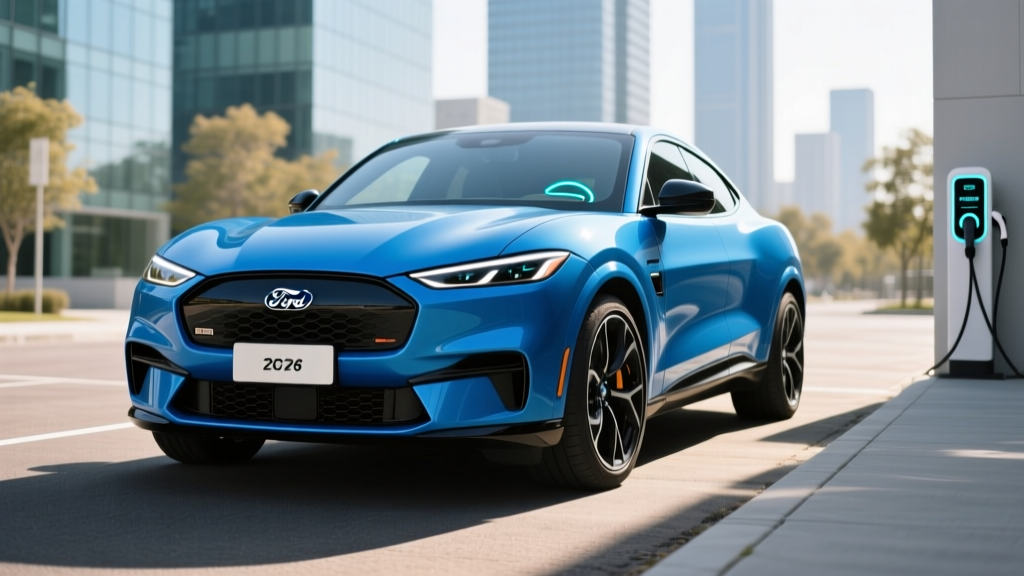
The Ford Mustang Mach-E has spent years proving that a legacy automaker can build an electric crossover with genuine performance credentials. For 2026, Ford has refined the lineup with updated battery management, slightly improved efficiency, and a sharper infotainment stack. But for buyers cross-shopping against the Tesla Model Y, Hyundai Ioniq 5, and Kia EV6, the questions are specific: How quick is it really? What range can you count on outside the EPA sticker? And does the tax credit still apply?
This review breaks down every Mach-E trim's acceleration, efficiency, charging behavior, and ownership economics with the exact numbers you need to make a decision.
2026 Mustang Mach-E Performance: 0-60 Times by Trim
Acceleration is where the Mach-E's electric powertrain delivers its most visceral punch. Ford offers three distinct performance tiers in 2026, each tied to specific battery and motor configurations.
| Trim | Drivetrain | Horsepower | Torque (lb-ft) | 0-60 mph | Top Speed |
|---|---|---|---|---|---|
| Select RWD | Rear-Wheel Drive | 266 hp | 317 | 6.1 sec | 112 mph |
| Select/Premium eAWD | Dual-Motor AWD | 312 hp | 377 | 5.1 sec | 112 mph |
| GT eAWD | Dual-Motor AWD | 480 hp | 600 | 3.8 sec | 126 mph |
| GT Performance Upgrade | Dual-Motor AWD | 480 hp | 700 | 3.3 sec | 130 mph |
The GT with the Performance Upgrade (which includes Ford's MagneRide dampers and a unique torque calibration) hits 60 mph in 3.3 seconds—putting it in the same territory as a Porsche Cayenne E-Hybrid and only a few tenths behind the Tesla Model Y Performance. The standard GT's 3.8-second run is already quicker than most gas-powered sport SUVs at this price point.
For daily driving, even the base RWD model's 6.1-second sprint feels responsive. Electric motors deliver peak torque at 0 RPM, so the Mach-E launches with an immediacy that a 266-hp gas engine could never match. The eAWD models add confidence in wet and snowy conditions with their dual-motor torque distribution.
Battery, Range, and Real-World Efficiency
Ford offers two battery packs for 2026: a Standard Range (70 kWh usable) and an Extended Range (91 kWh usable). Both use NMC (nickel manganese cobalt) lithium-ion chemistry, which provides higher energy density than LFP but requires more careful thermal management and benefits from keeping state of charge between 20-80% for daily driving longevity.
The Extended Range eAWD carries an EPA-estimated 305 miles of range. In real-world mixed driving, expect 260–285 miles depending on conditions. Sustained highway speeds above 70 mph reduce range by roughly 10-15%. In freezing temperatures (below 32°F), plan for a 20-30% reduction, bringing effective range to 215–245 miles on a full charge. The RWD Extended Range model, rated at EPA 320 miles, typically delivers 275–300 miles in moderate weather.
| Configuration | Battery (usable kWh) | EPA Range | MPGe (combined) | kWh/100 mi |
|---|---|---|---|---|
| Select RWD (Extended Range) | 91 kWh NMC | 320 mi | 101 MPGe | 33 |
| eAWD (Extended Range) | 91 kWh NMC | 305 mi | 95 MPGe | 35 |
| GT eAWD (Extended Range) | 91 kWh NMC | 280 mi | 84 MPGe | 40 |
The GT's lower efficiency is the trade-off for its performance calibration. Aggressive acceleration and higher sustained speeds drain the pack faster. If you prioritize range over 0-60 times, the eAWD Premium with Extended Range offers the best balance: 305 EPA miles with a respectable 5.1-second sprint.
According to fueleconomy.gov, the Mach-E Extended Range RWD achieves 101 MPGe combined, which translates to roughly 33 kWh per 100 miles. At a national average electricity rate of $0.17/kWh, that's about $5.61 per 100 miles—roughly one-third the cost of a comparable gas SUV at $3.50/gallon.
Charging Speed: DC Fast Charge and Home Level 2
Charging speed remains one of the Mach-E's competitive advantages, and Ford has maintained the hardware that makes it viable for road trips.
| Charging Level | Connector | Max Rate | Speed / Time |
|---|---|---|---|
| Level 1 (120V household) | J1772 / NACS adapter | 1.4 kW | ~3 mi/hr |
| Level 2 (240V home) | J1772 / NACS | 10.5 kW (48A) | ~30 mi/hr; full charge in ~10 hr |
| DC Fast Charge | CCS1 / NACS | 150 kW peak | 10–80% in ~41 min (Extended Range) |
The 150 kW peak DC fast-charge rate is the headline number, but the charge curve tells the fuller story. The Mach-E sustains roughly 115–140 kW between 10% and 50% state of charge, then begins a gradual taper. From 50% to 80%, expect rates between 70–90 kW. Above 80%, charging slows significantly to protect the NMC cells—plan on 15–20 additional minutes if you need to charge past 80% on a road trip.
Ford now equips the Mach-E with a NACS (North American Charging Standard) port on 2026 models, giving native access to Tesla's Supercharger network—the most reliable and expansive DC fast-charging network in the US. This eliminates the need for the CCS-to-NACS adapter that earlier model years required.
For home charging, the 10.5 kW Level 2 onboard charger adds approximately 30 miles of range per hour. A full overnight charge from 20% to 100% takes about 8–10 hours on a 48-amp Level 2 station. Most owners who install a home Level 2 charger (typically $500–$1,200 for equipment plus $500–$2,000 for electrician installation, depending on panel capacity) wake up to a full battery every morning, eliminating the need for routine public charging.
Pricing, Trims, and Federal Tax Credit Eligibility
The 2026 Mach-E lineup spans from practical commuter to legitimate performance machine, with pricing that reflects the spread.
| Trim | Configuration | MSRP (incl. destination) | Est. After §30D Credit |
|---|---|---|---|
| Select | RWD, Standard Range | $39,995 | $32,495* |
| Select | RWD, Extended Range | $44,995 | $37,495* |
| Premium | eAWD, Extended Range | $51,495 | $43,995* |
| GT | eAWD, Extended Range | $57,995 | $50,495* |
*Estimated prices assume full $7,500 federal tax credit eligibility. Actual credit depends on buyer income, tax liability, and battery sourcing compliance.
The IRS §30D Clean Vehicle Credit provides up to $7,500 for qualifying new EVs, but eligibility hinges on several requirements that buyers must verify:
- MSRP cap: SUVs must have an MSRP at or below $80,000. All Mach-E trims qualify.
- Buyer income limits: Modified adjusted gross income must not exceed $150,000 (single), $225,000 (head of household), or $300,000 (joint filers).
- Battery sourcing: A percentage of critical minerals and battery components must be sourced from the US or free-trade-agreement countries. These thresholds increase annually. Verify current-year compliance on the IRS qualified vehicles list before purchasing.
- Point-of-sale transfer: As of 2024, buyers can transfer the credit to the dealer at purchase, receiving the $7,500 as an immediate price reduction rather than waiting for a tax refund. This requires the dealer to be registered with the IRS Energy Credits portal.
The Mach-E's base price under $40,000 (before credit) makes it one of the more accessible electric SUVs with 300+ miles of range, particularly once the $7,500 credit is applied. However, buyers should confirm their specific eligibility with a tax professional, as credit availability depends on individual tax situations and annual rule updates.
Interior Space, Cargo, and Daily Practicality
The Mach-E is a midsize crossover, and its dimensions reflect that positioning. Ford has optimized the interior packaging to take advantage of the EV skateboard platform, though the lack of a traditional frunk (there's a small front trunk with a drain plug—useful for wet items) means cargo space is primarily in the rear.
| Measurement | Specification |
|---|---|
| Cargo volume (rear seats up) | 29.7 cu ft |
| Cargo volume (rear seats folded) | 59.7 cu ft |
| Front trunk (frunk) | 4.7 cu ft |
| Front legroom | 43.3 in |
| Rear legroom | 38.9 in |
| Front headroom | 40.4 in |
| Rear headroom | 38.2 in |
Rear legroom is adequate for adults on longer trips, though it falls a couple of inches short of the Hyundai Ioniq 5's more spacious back seat. The 29.7 cubic feet of cargo space with seats up is competitive with the Model Y and EV6, and the 60/40 split-folding rear seats expand that to nearly 60 cubic feet for larger loads.
The frunk, while small, includes a drain plug—a practical touch for hauling ice, wet gear, or muddy equipment. It's not large enough for a carry-on suitcase, but it's ideal for charging cables and small items you want separated from the main cargo area.
Technology and Driver Assistance
The 2026 Mach-E runs Ford's latest SYNC 4A infotainment on a 15.5-inch portrait touchscreen. The interface is responsive, supports wireless Apple CarPlay and Android Auto, and includes native navigation with real-time charging station routing. Over-the-air updates continue to add features and refine performance post-purchase.
Ford Co-Pilot360 Assist 2.0 comes standard and includes:
- Adaptive cruise control with stop-and-go
- Lane centering assist
- Evasive steering assist
- Blind-spot monitoring with cross-traffic alert
- Automatic emergency braking with pedestrian detection
Ford Co-Pilot360 and available BlueCruise are SAE Level 2 driver-assistance systems. The driver must remain attentive, keep hands on or near the wheel (BlueCruise permits hands-free on pre-mapped divided highways but monitors driver attention via an interior camera), and is responsible for all vehicle operation at all times. This is not autonomous or self-driving capability.
BlueCruise, Ford's hands-free highway driving system, is available as a subscription or included for a trial period on higher trims. On qualified divided highways, it handles steering, acceleration, and braking while the driver-monitoring camera ensures you're paying attention. It works well in practice, but coverage is limited to approximately 130,000 miles of pre-mapped roads in the US and Canada.
Warranty Coverage
Ford backs the Mach-E with competitive warranty terms for the EV segment:
- Bumper-to-bumper: 3 years / 36,000 miles
- Powertrain (including electric motors): 5 years / 60,000 miles
- High-voltage battery: 8 years / 100,000 miles (retains ≥70% capacity)
The battery warranty guarantees that the pack will retain at least 70% of its original capacity over 8 years or 100,000 miles. This is industry-standard and aligns with federal requirements. Real-world degradation data from earlier Mach-E model years suggests NMC packs in this application lose approximately 8-12% capacity over the first 100,000 miles under normal use patterns, well within the warranty threshold.
Pros and Cons
✓ Pros
- GT Performance Upgrade hits 0-60 in 3.3 seconds—genuine sports-SUV acceleration
- Native NACS port provides direct Tesla Supercharger access
- Up to 320 EPA miles (RWD Extended Range) with strong real-world efficiency
- Competitive pricing under $40K base; eligible for full $7,500 federal credit
- Spacious cargo area with practical frunk drain plug
- BlueCruise hands-free driving on mapped highways
✗ Cons
- 150 kW peak DC charge rate trails Hyundai Ioniq 5 / Kia EV6 (240+ kW on 800V)
- 10-80% DC fast charge takes ~41 minutes—slower than top competitors
- Rear legroom slightly tighter than Ioniq 5 and Model Y
- GT trim's 280-mile EPA range limits road-trip range versus Premium eAWD
- BlueCruise subscription adds ongoing cost after trial period expires
- No LFP battery option for buyers who prefer 100% daily charging without degradation concerns
Who Should Buy the 2026 Mustang Mach-E?
Choose the Mach-E Select RWD if: You want a practical daily commuter with 320 miles of range, sub-$33K pricing after the tax credit, and don't need all-wheel drive.
Choose the Mach-E Premium eAWD if: You need a family crossover with all-weather capability, 305 miles of range, and a quick 5.1-second 0-60 for confident highway merging.
Choose the Mach-E GT if: You prioritize 3.3-second acceleration and performance handling, accept the 280-mile range trade-off, and want a legitimate alternative to the Tesla Model Y Performance.
Look elsewhere if: You need the fastest possible DC charging (Ioniq 5/EV6 charge 10-80% in ~18 minutes on 350 kW chargers), maximum rear-seat space (Ioniq 5), or an LFP battery for worry-free 100% daily charging.
Frequently Asked Questions
What is the real-world range of the Mustang Mach-E?
The Extended Range RWD model carries an EPA estimate of 320 miles. In real-world mixed driving at moderate temperatures, expect 275–300 miles. Highway-heavy driving at 75+ mph reduces this to roughly 260–280 miles. In freezing conditions, plan for 220–250 miles on a full charge.
How fast does the Mach-E charge at home and on DC fast chargers?
On a Level 2 home charger (240V, 48A), the Mach-E charges at up to 10.5 kW, adding about 30 miles of range per hour—a full charge overnight. On a DC fast charger, it peaks at 150 kW and charges from 10% to 80% in approximately 41 minutes. Charging slows significantly above 80% to protect battery health.
Does the 2026 Mustang Mach-E qualify for the $7,500 federal tax credit?
All Mach-E trims fall under the $80,000 SUV MSRP cap for the IRS §30D credit. However, buyer eligibility depends on income limits ($150K single / $300K joint), battery sourcing compliance (which changes annually), and having sufficient tax liability. The credit can be transferred to the dealer at point of sale for an immediate price reduction. Verify current-year eligibility on the IRS qualified vehicles page before purchasing.
Is the Mach-E worth buying versus the Tesla Model Y or Hyundai Ioniq 5?
The Mach-E competes well on range, pricing, and driving dynamics, especially in GT form. The Model Y offers a larger Supercharger-native ecosystem and slightly more cargo space. The Ioniq 5 charges significantly faster (18 minutes 10-80% on 800V architecture) and has a roomier rear seat. The Mach-E's advantages include its NACS Supercharger access, Ford dealer service network, and the GT's sub-3.5-second 0-60 time. Your choice depends on whether charging speed, interior space, or outright acceleration matters most.
What is the Mach-E GT's 0-60 time?
The 2026 Mustang Mach-E GT with the Performance Upgrade hits 0-60 mph in 3.3 seconds, producing 480 horsepower and 700 lb-ft of torque. The standard GT (without the Performance Upgrade) achieves 0-60 in 3.8 seconds with 600 lb-ft of torque.
How long will the Mach-E battery last?
Ford warranties the high-voltage battery for 8 years or 100,000 miles against capacity loss below 70%. Based on real-world data from 2021–2025 Mach-E owners, NMC packs in this application typically lose 8-12% capacity over the first 100,000 miles. With proper charging habits (avoiding frequent 100% charges, using DC fast charging sparingly, leveraging battery preconditioning), the pack should provide reliable service well beyond 150,000 miles.