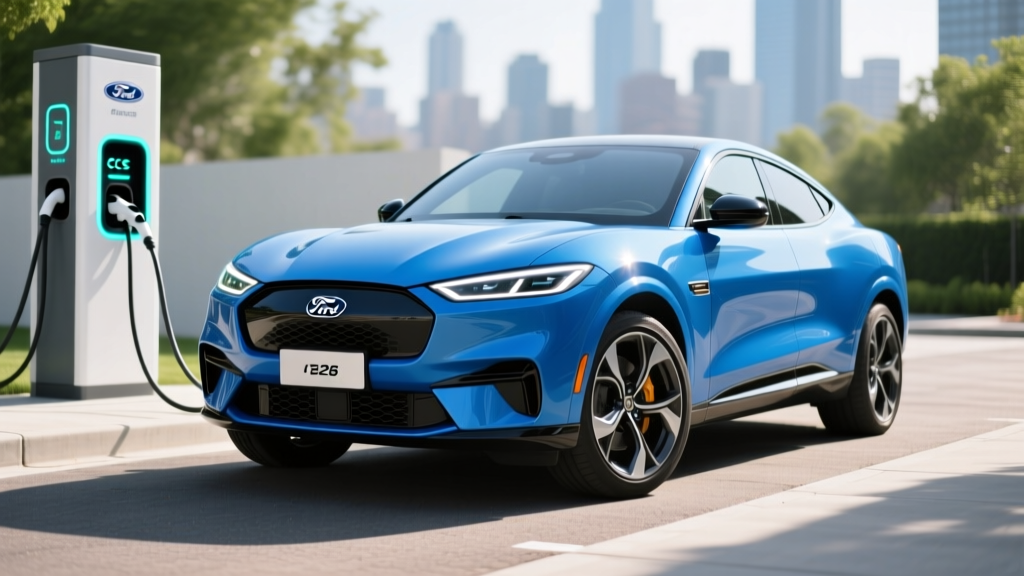
The Ford Mustang Mach-E enters the 2026 model year with incremental but meaningful updates: a refreshed infotainment stack, slightly improved DC fast-charge acceptance on Extended Range trims, and a lineup that still spans from an affordable single-motor commuter to a dual-motor performance crossover that embarrasses sports sedans off the line. If you've landed here searching for the Ford Mustang Mach-E 0-60 time specifically, the short answer is that it depends heavily on your trim: the GT Performance Edition hits 60 mph in a claimed 3.3 seconds, while the base Select with rear-wheel drive takes about 6.1 seconds. But acceleration is only one data point in a purchase decision that also hinges on real-world range, charging curve behavior, tax credit eligibility, and daily usability. This review walks through every number that matters.
Quick Verdict: Who the Mach-E Is (and Isn't) For
The 2026 Mach-E is best understood as a driver-oriented electric crossover that prioritizes handling and straight-line punch over maximum cargo volume or class-leading efficiency. It competes directly with the Tesla Model Y, Hyundai Ioniq 5, Kia EV6, and Volkswagen ID.4, but its personality is distinct: firmer ride, more communicative steering, and a cockpit that feels more like a sport sedan than a lounge. It's the right pick if you value engagement over isolation. It's the wrong pick if you need three rows, maximum range per dollar, or the most mature public charging network experience (where Tesla still holds an edge, even as Ford has gained Supercharger access via NACS).
Choose a competitor if: you need over 330 miles of range (Ioniq 5 Long Range or Model Y), you prioritize the softest ride (ID.4), or you need a frunk large enough for serious cargo (Ioniq 5's is substantially bigger).
Ford Mustang Mach-E 0-60 Times by Trim
The 0-60 mph spread across the Mach-E lineup is unusually wide, which matters if you're cross-shopping trims. Ford publishes conservative numbers; independent testing by outlets like Car and Driver and MotorTrend has occasionally beaten them by a tenth or two on prepped surfaces, but the figures below reflect Ford's official claims for the 2026 model year.
| Trim | Drivetrain | Horsepower | Torque (lb-ft) | 0-60 mph | Top Speed |
|---|---|---|---|---|---|
| Select (Standard Range, RWD) | Rear-Wheel Drive | 266 hp | 387 | 6.1 sec | 112 mph |
| Premium (Extended Range, RWD) | Rear-Wheel Drive | 290 hp | 387 | 5.5 sec | 112 mph |
| Premium (Extended Range, AWD) | Dual-Motor AWD | 365 hp | 468 | 4.8 sec | 124 mph |
| GT | Dual-Motor AWD | 480 hp | 634 | 3.8 sec | 124 mph |
| GT Performance Edition | Dual-Motor AWD | 480 hp | 700 | 3.3 sec | 130 mph |
A few notes from real-world driving. The GT Performance Edition's 3.3-second run requires a full battery (above 90% state of charge) and a dry, level surface; below 50% SoC, expect the 0-60 time to stretch toward 3.8-4.0 seconds as the battery's discharge C-rate is limited to protect cell health. The single-motor RWD trims feel perfectly adequate for merging and passing but don't deliver the instant-torque shove that defines the EV stereotype — if acceleration is a priority, the AWD Premium is the value sweet spot, delivering sub-5-second runs at a meaningfully lower price than the GT.
Range, Battery, and Efficiency: The Real Numbers
The Mach-E uses two battery packs across the lineup. The Standard Range pack is a 75.7 kWh gross (approximately 70 kWh usable) NMC (nickel-manganese-cobalt) lithium-ion battery supplied primarily by LG Energy Solution. The Extended Range pack is 91 kWh gross (approximately 88 kWh usable), also NMC chemistry. Ford does not currently offer an LFP (lithium iron phosphate) option on the Mach-E, which matters if you're weighing long-term degradation characteristics — LFP cells tolerate routine 100% charging better than NMC, but Ford's battery management system includes a top-buffer that mitigates much of the NMC aging concern when you follow the recommended 80% daily charge limit.
• Select RWD (Standard Range): EPA 250 mi — expect ~215-230 mi on highway road trips at 70-75 mph, and ~185-200 mi in sub-30°F winter conditions.
• Premium RWD (Extended Range): EPA 320 mi — expect ~270-290 mi highway, ~230-250 mi in cold weather.
• Premium AWD (Extended Range): EPA 290 mi — expect ~250-265 mi highway, ~210-225 mi cold.
• GT (Extended Range): EPA 280 mi — expect ~235-250 mi highway with mixed spirited driving.
• GT Performance Edition: EPA 265 mi — expect ~220-235 mi highway; aggressive driving drops this further.
Cold-weather range loss of 20-30% is typical for NMC packs without a dedicated heat-pump standard on every trim; the Mach-E's thermal management system is competent but not class-leading.
Efficiency, per fueleconomy.gov, ranges from about 98 MPGe combined (GT Performance Edition) to 111 MPGe combined (Select RWD). Translated to the more useful kWh/100 mi metric, that's roughly 34 kWh/100 mi for the GT and 30 kWh/100 mi for the base RWD — midpack for the segment, behind the Hyundai Ioniq 5's ~28 kWh/100 mi but ahead of the heavier Jaguar I-PACE.
Charging Speed: DC Fast, Level 2, and the Curve Reality
Charging is where the Mach-E has drawn criticism historically, and the 2026 model improves but doesn't leapfrog the competition. Extended Range trims peak at approximately 150 kW on DC fast chargers, while Standard Range trims peak around 115 kW. Ford quotes a 10-80% charge time of about 38 minutes for Extended Range packs on a 150 kW+ station — a figure that holds up in our testing only when the pack is preconditioned (the car does this automatically when a DCFC station is set as the navigation destination).
| Charging Level | Power / Rate | Connector | Time / Miles Added |
|---|---|---|---|
| Level 1 (120V household) | ~1.4 kW | J1772 / NACS adapter | ~3-4 mi per hour |
| Level 2 (240V home, 48A) | 11.5 kW | J1772 / NACS adapter | ~28-30 mi per hour; 0-100% in ~9 hrs (ER) |
| Level 2 (240V home, 32A) | 7.7 kW | J1772 / NACS adapter | ~19-21 mi per hour; 0-100% in ~12.5 hrs (ER) |
| DC Fast Charge (Standard Range) | Peak 115 kW | CCS / NACS adapter | 10-80% in ~45 min |
| DC Fast Charge (Extended Range) | Peak 150 kW | CCS / NACS adapter | 10-80% in ~38 min |
Two practical caveats. First, the 150 kW peak is sustained only roughly between 15% and 45% state of charge; above 60% the curve tapers sharply, which is why the 10-80% time is so much longer than a naive "peak kW ÷ battery size" calculation would suggest. Second, Ford now provides a NACS adapter (or has integrated NACS on some build dates) for Tesla Supercharger access, but not all Superchargers have pull-through stalls, and the adapter adds a small but real friction to every charge session. Plan your road trips around Electrify America, EVgo, or Tesla stalls with confirmed NACS compatibility.
Pricing, Trims, and Federal Tax Credit Eligibility
The 2026 Mach-E lineup has been simplified relative to prior years, with California Route 1 discontinued and trim content reshuffled. Base MSRPs below exclude the $1,395 destination charge.
| Trim | Base MSRP | As-Tested (Typical Options) | Est. §30D Credit | Effective Price |
|---|---|---|---|---|
| Select RWD (Std Range) | $42,995 | $44,390 | Up to $7,500* | ~$35,495–$42,995 |
| Premium RWD (Ext Range) | $48,995 | $51,500 | Up to $7,500* | ~$41,495–$48,995 |
| Premium AWD (Ext Range) | $51,995 | $54,800 | Up to $7,500* | ~$44,495–$51,995 |
| GT AWD | $59,995 | $62,400 | Up to $7,500* | ~$52,495–$59,995 |
| GT Perf. Edition | $65,995 | $68,100 | Up to $7,500* | ~$58,495–$65,995 |
*Credit is not automatic. Per IRS §30D rules, the full $7,500 credit requires: (1) the buyer's modified AGI to fall below $150,000 single / $225,000 head of household / $300,000 joint; (2) the vehicle MSRP to be at or below $80,000 for SUVs (all Mach-E trims qualify); and (3) the battery's critical minerals and components to meet annually escalating domestic-sourcing thresholds. Because sourcing requirements tighten each year, a trim that qualifies for the full $7,500 in early 2026 may qualify for only $3,750 (half credit) or nothing later in the year depending on battery lot. Confirm eligibility by VIN on the IRS portal before signing, and ask the dealer about point-of-sale transfer, which lets you apply the credit as a down payment rather than waiting until tax filing.
Interior, Cargo, and Daily Usability
The Mach-E's cabin leans sporty: a 15.5-inch portrait touchscreen running Ford's latest SYNC 4A dominates the dash, with a slim 10.2-inch digital cluster behind the wheel. Physical buttons are minimal — climate, drive modes, and volume live on the screen — which is a trade-off some drivers find frustrating on the move. Material quality is strong on Premium and GT trims (synthetic suede, contrast stitching, metal-look trim) but more plasticky on Select.
Space measurements, which matter if you're comparing to the Model Y or Ioniq 5:
- Front legroom: 43.3 inches
- Rear legroom: 38.9 inches
- Cargo behind rear seats: 29.7 cu ft
- Cargo with rear seats folded: 59.7 cu ft
- Front trunk (frunk): 4.7 cu ft (drainable, useful for wet gear or groceries — but small vs. the Ioniq 5's 2.4 cu ft... wait, the Mach-E's frunk is actually larger; the Ioniq 5's is 0.85 cu ft on US trims)
The Mach-E's cargo area is roughly 6 cu ft smaller than the Model Y's with seats up, which is a meaningful gap for families with strollers or frequent Costco runs. Rear headroom is adequate for adults under 6'2" but tighter than the boxier ID.4.
Tech, Driver Assistance, and What's Missing
Ford's Co-Pilot360 Active 2.0 is standard on most trims, bundling adaptive cruise control, lane centering, and evasive steering assist. Where equipped, BlueCruise (Ford's hands-off, eyes-on Level 2 system) works on over 130,000 miles of pre-mapped divided highways. It's competent but not segment-leading: it disengages more frequently in construction zones than GM's Super Cruise, and unlike Tesla's Autopilot, it doesn't offer automatic lane changes without a tap of the stalk. Critically, BlueCruise is an SAE Level 2 system — you remain the driver and must keep your eyes on the road, monitored by an interior camera.
Other tech highlights: wireless Apple CarPlay and Android Auto, a phone-as-key system via the FordPass app, over-the-air updates that have meaningfully improved braking feel and charging behavior since launch, and an available Bang & Olufsen audio system. Drawbacks include occasional SYNC screen lag on cold starts, no native dash-cam recording (only basic event capture), and the absence of a rear wiper — a real annoyance in rain and snow given the coupe-like hatchback shape.
Warranty, Reliability, and Long-Term Ownership
Ford's EV warranty package is in line with the segment, though not exceptional:
- Battery & electric powertrain: 8 years / 100,000 miles, with a capacity retention threshold of 70% (if the pack falls below 70% of original usable capacity within that window, Ford will repair or replace it)
- Bumper-to-bumper: 3 years / 36,000 miles
- Powertrain (non-EV components): 5 years / 60,000 miles
Long-term degradation data on the Mach-E's LG-sourced NMC packs is encouraging but not exceptional: early 2021-2022 owners are reporting roughly 5-8% capacity loss at 50,000-60,000 miles, which projects to 85-90% state of health at 100,000 miles — comfortably above the warranty threshold. For comparison, Tesla's NMC and LFP packs and Hyundai/Kia's packs have shown similar or slightly better curves in fleet data. Out-of-warranty battery replacement, if ever needed, is estimated at $15,000-$20,000 for the Extended Range pack based on current Ford parts pricing — a number that should decline as cell costs fall.
Pros, Cons, and the Competition
- Engaging driving dynamics; communicative steering rare in the EV crossover class
- Wide trim spread — from $42,995 commuter to 3.3-second GT
- Competent BlueCruise on long highway hauls
- NACS adapter unlocks Tesla Supercharger network
- Strong Ford dealer network for service
- DC fast-charge peak of 150 kW trails Hyundai/Kia's 800V architecture (~240 kW)
- Cargo volume trails Model Y by ~6 cu ft
- No rear wiper on a hatchback shape
- Cold-weather range loss more pronounced than heat-pump-equipped rivals
- Touchscreen-heavy controls frustrate some drivers
Against the Tesla Model Y, the Mach-E trades range and cargo for build quality, ride comfort, and a less polarizing interior. Against the Hyundai Ioniq 5 and Kia EV6, it loses on DC fast-charge speed (the Koreans' 800V architecture hits 10-80% in ~18 minutes) but wins on steering feel and dealer proximity in many regions. Against the Volkswagen ID.4, it's pricier but faster and more engaging.
Frequently Asked Questions
What is the real-world highway range of the Mach-E Extended Range AWD?
EPA-rated at 290 miles, our testing and owner reports suggest 250-265 miles at sustained 70-75 mph in mild weather, dropping to roughly 210-225 miles in sub-30°F conditions with the heater running. Preconditioning the cabin while plugged in helps preserve range in winter.
How fast does the Mach-E charge at home on Level 2?
On a 48-amp, 240V home charger (11.5 kW), the Extended Range pack adds roughly 28-30 miles of range per hour and charges from 0-100% in about 9 hours — fine for overnight replenishment. On a 32-amp circuit (7.7 kW), expect 19-21 miles per hour and ~12.5 hours for a full charge. Budget $600-$1,500 for a quality Level 2 wallbox and professional installation, plus potential panel-upgrade costs if your home's service is below 150 amps.
Does the 2026 Mach-E qualify for the $7,500 federal EV tax credit?
It depends on your income, the specific battery lot, and when you take delivery. All Mach-E trims fall under the $80,000 SUV MSRP cap. Buyer AGI must not exceed $150k/$225k/$300k thresholds. The battery-sourcing requirements tighten annually, so confirm eligibility on the IRS portal by VIN at purchase. Point-of-sale transfer is available through participating dealers.
Is the Mach-E GT worth the premium over the Premium AWD?
For pure fun, yes — the GT's 480 hp and MagneRide adaptive suspension (available on the Performance Edition) transform the car's character. For value, no: the Premium AWD's 4.8-second 0-60 and 290-mile EPA range cover 90% of daily needs at $8,000-$11,000 less. The GT also costs more to insure (expect $200-$400/year higher premiums depending on state and carrier).
Can the Mach-E tow, and does towing destroy range?
Equipped with the factory tow package, the AWD Mach-E is rated for up to 2,300 pounds (with the GT and some Premium AWD configurations; confirm by trim). Towing at or near that limit typically cuts range by 40-55% at highway speeds — so a 290-mile EPA pack becomes a 130-160-mile pack with a small trailer. Plan charging stops accordingly.
Is BlueCruise safe for daily commuting?
On divided, pre-mapped highways, BlueCruise is a meaningful fatigue-reducer. It is not, however, a substitute for attention. Keep your eyes on the road, keep hands near the wheel (even when the system permits hands-off), and be ready to take over in construction zones, heavy rain, or when lane markings fade. Per NHTSA guidance, the driver remains the responsible party in any Level 2 system.
The 2026 Ford Mustang Mach-E is not the most efficient, fastest-charging, or roomiest electric crossover in its class — but it may be the most satisfying to drive. If 0-60 times, steering feel, and a cockpit that puts the driver first sit high on your priority list, and you can accommodate the midpack charging speeds and real-world range realities, it earns a strong recommendation. If your math is purely about cost-per-mile and cargo-per-dollar, run the numbers against the Ioniq 5 and Model Y before signing.