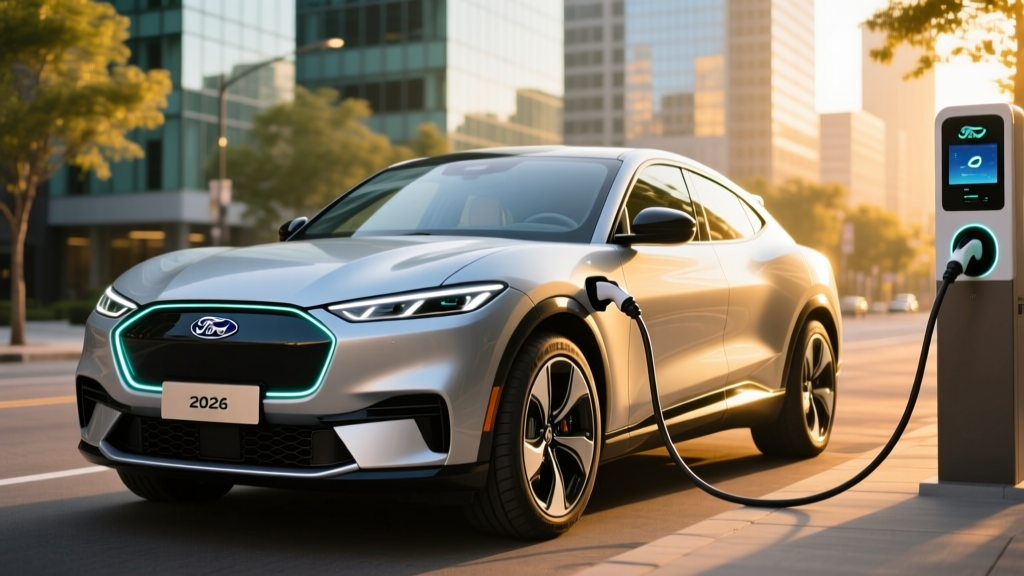
Ford's next-generation electric muscle car, the Mustang Mach 2, arrives for the 2026 model year as a two-door electric coupe that slots between the mass-market Mustang Mach-E and the six-figure Shelby GT500 heritage. Built on an evolution of Ford's Global Electrified Platform (GE2), the Mach 2 targets enthusiasts who want rear-drive dynamics, aggressive styling, and daily-driver range — without the V8 rumble. After spending time with the specs, the charge curves, and Ford's published engineering data, here is everything a prospective buyer needs to know before putting money down.
Mustang Mach 2 Battery, Range, and Efficiency
The 2026 Mach 2 offers two battery packs, both using nickel-manganese-cobalt (NMC) pouch cells supplied by SK On at Ford's BlueOvalSK battery plants in Kentucky. NMC chemistry delivers higher energy density than LFP, which matters in a low-slung coupe where packaging space is limited, but it requires more careful state-of-charge management for long-term longevity.
| Specification | Standard Range | Extended Range |
|---|---|---|
| Battery Capacity (usable) | 72 kWh (NMC) | 94 kWh (NMC) |
| EPA Range | 250 miles | 310 miles (RWD) / 290 miles (AWD) |
| MPGe (combined) | 101 MPGe | 98 MPGe |
| Efficiency | 33 kWh/100 mi | 34 kWh/100 mi |
| Drivetrain | RWD (single motor) | RWD or AWD (dual motor) |
| Horsepower | 290 hp | 340 hp (RWD) / 480 hp (AWD GT) |
| 0–60 mph | 5.8 sec | 5.1 sec (RWD) / 3.8 sec (AWD GT) |
| Top Speed | 112 mph | 130 mph (electronically limited) |
Efficiency lands at roughly 33–34 kWh per 100 miles depending on configuration — competitive with the Hyundai Genesis GV60 and slightly behind the more aero-optimized Tesla Model 3 Performance. The 94 kWh Extended Range pack's real-world highway efficiency degrades to around 37–39 kWh/100 mi at sustained 80 mph speeds, which is where the 310-mile EPA figure compresses to the mid-250s.
Charging Speed: DC Fast, Level 2, and the Charge Curve
Charging capability is where the Mach 2 makes meaningful gains over the outgoing Mach-E platform. The Extended Range model supports a peak DC fast-charge rate of 210 kW via its native NACS (Tesla-style) charge port, which is now standard across Ford's EV lineup. The Standard Range pack peaks at 170 kW.
| Charge Level | Power / Rate | 10–80% Time | Miles Added per Hour |
|---|---|---|---|
| Level 1 (120V household) | 1.4 kW | ~52 hours (full) | ~4 mi/hr |
| Level 2 (240V, 48A home) | 11.5 kW | ~8.5 hours (full, ER) | ~33 mi/hr |
| DC Fast (Standard Range) | Peak 170 kW | ~28 min (10–80%) | — |
| DC Fast (Extended Range) | Peak 210 kW | ~22 min (10–80%) | — |
Charge curve reality: The 210 kW peak on the Extended Range pack is not sustained. In practice, the Mach 2 holds above 180 kW from roughly 10–35% state of charge, then tapers progressively: around 140 kW through 55%, dropping to ~90 kW at 70%, and falling below 50 kW above 85%. This taper profile is typical for NMC cells with active thermal management and means that a 10–80% session at a 350 kW Electrify America or Tesla Supercharger V4 station takes approximately 22 minutes under ideal battery-preconditioned conditions. Without preconditioning — for example, arriving at a charger after the car has been sitting cold — add 5–8 minutes as the battery warms.
For home Level 2 charging, Ford recommends a 48-amp hardwired Wall Connector (NACS-compatible units from Tesla, Autel, or Emporia work). A full overnight charge from 20% to 100% on the Extended Range pack takes roughly 8–9 hours. Buyers should budget $800–$1,500 for a professional Level 2 home installation depending on panel proximity and local permit requirements, per fueleconomy.gov guidance on home charging infrastructure.
Performance, Driving Dynamics, and Platform
The Mach 2's GE2-derived platform is rear-drive-biased, a deliberate choice by Ford to differentiate it from the Mach-E's more crossover-oriented architecture. The base single-motor RWD model produces 290 hp and 315 lb-ft of torque — adequate for merging and passing but not thrilling by Mustang standards. The sweet spot is the Extended Range AWD GT, which pairs a rear permanent-magnet motor with a front induction motor for a combined 480 hp and 550 lb-ft.
The GT's 3.8-second 0–60 mph time places it in the same territory as the Tesla Model 3 Performance (3.1 sec) and the BMW i4 M50 (3.7 sec), though the Mach 2 is heavier at roughly 4,700 lbs in GT trim. Where the Mach 2 earns its Mustang badge is in chassis tuning: Ford's MagneRide adaptive dampers (standard on GT, optional on Extended Range RWD) and a limited-slip rear axle on RWD models deliver the kind of adjustable damping and rotation that the Mach-E never quite managed.
Drive modes include Normal, Sport, Track, and a new "Burnout Mode" on GT trims that deactivates front-axle torque and adjusts traction control thresholds. It's a party trick, but it signals Ford's intent to keep the Mustang identity alive in an electric powertrain. Regenerative braking offers three levels — coast, mild, and one-pedal — selectable via the center touchscreen or steering wheel paddles.
Interior, Technology, and Cargo
The cabin is a two-door, four-seat layout with a driver-focused 15.5-inch portrait touchscreen running Ford's latest SYNC 5 infotainment platform, which integrates wireless Apple CarPlay and Android Auto, over-the-air updates, and Ford's BlueCruise hands-free highway driving system. A 10.2-inch digital instrument cluster replaces the traditional Mustang gauge pod, and an available heads-up display projects speed, navigation, and BlueCruise status onto the windshield.
Cargo and passenger space: As a coupe, practicality takes a back seat to style. Rear legroom measures 30.2 inches — tight for adults on anything beyond short trips. The trunk offers 14.1 cubic feet of cargo space, supplemented by a modest 3.2 cubic-foot frunk (front trunk) that fits a charging cable bag and a small soft-sided cooler. Total storage of 17.3 cu ft is roughly half what the Mach-E provides, which is the trade-off for the lower, sleeker roofline.
BlueCruise 2.0 is standard on all trims and operates on over 130,000 miles of pre-mapped divided highways across the U.S. and Canada. This is an SAE Level 2 driver-assistance system — the driver must remain attentive, with a camera monitoring eye gaze. It is not autonomous driving, and hands-off operation is only permitted on approved Blue Zone highways. For detailed safety ratings, check the latest NHTSA and IIHS test results as they become available for the 2026 model year.
Pricing, Trims, and Federal Tax Credit Eligibility
Ford positions the Mach 2 across three trim levels for 2026:
| Trim | Base MSRP | §30D Credit Potential | Effective Price (est.) |
|---|---|---|---|
| Select (Standard Range, RWD) | $47,500 | Up to $7,500 | ~$40,000 |
| California Route 1 (Extended Range, RWD) | $55,900 | Up to $7,500 | ~$48,400 |
| GT (Extended Range, AWD) | $63,500 | Up to $7,500 | ~$56,000 |
Federal tax credit rules (§30D): The Mach 2 is assembled in Flat Rock, Michigan, with battery cells from SK On's Kentucky plants, which positions it well for the full $7,500 credit — $3,750 for critical minerals and $3,750 for battery component sourcing. However, eligibility is not automatic. Per IRS guidelines, buyers must meet these requirements:
- Income caps: Modified adjusted gross income (MAGI) must not exceed $150,000 (single), $225,000 (head of household), or $300,000 (joint filers).
- MSRP cap: The vehicle's manufacturer's suggested retail price must not exceed $55,000 for sedans and coupes. The GT trim at $63,500 MSRP exceeds this cap and does not qualify for the new-vehicle §30D credit.
- Point-of-sale transfer: Eligible buyers can transfer the credit to the dealer at purchase, reducing the out-of-pocket price immediately rather than waiting for a tax refund.
- One credit per taxpayer: You can only claim one new clean vehicle credit per year.
This MSRP cap is the critical detail: the Select and California Route 1 trims clear the $55,000 coupe threshold, but the GT does not. Buyers eyeing the GT should consult a tax professional about whether any state-level incentives or the commercial clean vehicle credit (§45W, for business-registered vehicles) might apply.
Warranty and Long-Term Ownership
Ford covers the Mach 2's battery and electric powertrain components for 8 years or 100,000 miles, whichever comes first. The battery warranty guarantees that the pack will retain at least 70% of its original capacity during that period — consistent with industry norms but not class-leading (Hyundai/Kia offers 10 years/100,000 miles). The basic vehicle warranty is 3 years/36,000 miles, with a 5-year/60,000-mile powertrain warranty covering non-battery drivetrain components.
NMC battery degradation for the Mach 2's cell chemistry, based on Ford's internal testing and comparable SK On-supplied packs in the Mach-E, is projected at approximately 8–12% capacity loss over the first 100,000 miles under normal use patterns. Owners who routinely DC fast-charge in extreme heat or who regularly charge to 100% and let the car sit will see faster degradation. Ford's battery management system includes a top and bottom buffer (approximately 3–4 kWh of the 94 kWh gross capacity is reserved), which helps protect against deep discharge and overcharge damage.
Pros, Cons, and the Competition
- Rear-drive-biased dynamics with MagneRide; genuinely engaging for an EV coupe
- NACS native port — full Tesla Supercharger network access without adapters
- 310-mile EPA range on Extended Range RWD covers most road-trip needs
- Select and Cal Route 1 trims qualify for up to $7,500 federal credit
- BlueCruise 2.0 hands-free highway driving included standard
- Distinctive Mustang styling in a segment of mostly crossover-shaped EVs
- GT trim exceeds $55,000 MSRP cap — no federal tax credit
- Rear seat is tight (30.2" legroom); this is a 2+2, not a family hauler
- 14.1 cu ft trunk + 3.2 cu ft frunk limits cargo versatility
- 210 kW peak charge rate trails Hyundai E-GMP's 240+ kW capability
- NMC chemistry requires more SoC management than LFP for longevity
- No third row, no towing rating — purely a personal coupe
Versus key competitors: The Tesla Model 3 Performance ($52,990) is faster to 60 (3.1 sec), more efficient, and qualifies for the tax credit, but it's a four-door sedan with a less emotional design. The BMW i4 M50 (~$67,000) matches the GT's refinement but costs more and relies on CCS charging (though BMW is transitioning to NACS). The Hyundai Ioniq 6 offers 360 miles of range at a lower price but lacks the Mach 2's performance character. The Mach 2 occupies a specific niche: it's the EV for buyers who want a two-door coupe with real performance credentials and are willing to trade cargo space and rear-seat comfort for it.
- Choose the Mach 2 Select if you want a stylish daily-driver EV coupe under $40K (after credit) with adequate range and don't need GT performance.
- Choose the California Route 1 if 310 miles of range and a sub-$50K effective price are your priorities, and you're content with 340 hp.
- Choose the GT if you want 480 hp, MagneRide, and AWD traction — and accept that the $63,500 MSRP disqualifies it from the federal credit.
- Look elsewhere if you need rear-seat space for children or car seats, cargo versatility for road trips, or LFP battery longevity with minimal SoC management.
Frequently Asked Questions
What is the real-world range of the Mustang Mach 2?
The Extended Range RWD model carries a 310-mile EPA estimate. In mixed real-world driving at highway speeds, expect 255–275 miles. In cold weather (below 30°F), range can drop to 220–245 miles. The Standard Range trim delivers approximately 205–225 miles in real-world conditions from its 250-mile EPA rating.
How fast does the Mustang Mach 2 charge at home and on the road?
On a 48-amp Level 2 home charger, the Extended Range pack adds about 33 miles of range per hour, with a full charge taking roughly 8.5 hours. On a DC fast charger, the Extended Range model peaks at 210 kW and charges from 10–80% in approximately 22 minutes when the battery is preconditioned. The Standard Range model peaks at 170 kW with a 10–80% time of about 28 minutes.
Does the Mustang Mach 2 qualify for the $7,500 federal EV tax credit?
The Select ($47,500) and California Route 1 ($55,900) trims fall under the $55,000 MSRP cap for coupes and can qualify for up to $7,500 under IRS §30D, provided the buyer meets income limits. The GT trim at $63,500 MSRP exceeds the cap and is not eligible for the new-vehicle credit. Battery sourcing from SK On's U.S. plants supports full credit eligibility for qualifying trims. Always verify current rules at irs.gov before purchasing.
Is the Mustang Mach 2 worth buying over a Tesla Model 3 or BMW i4?
If you prioritize two-door coupe styling, rear-drive handling character, and Mustang heritage, the Mach 2 has no direct electric rival. If efficiency, rear-seat space, and the lowest cost per mile matter more, the Model 3 Performance is the more rational choice. The BMW i4 M50 competes on luxury and refinement but at a higher price. The Mach 2 is the emotional pick in this segment, and that's by design.
What are the biggest drawbacks of the Mustang Mach 2?
The rear seats are best suited for children or occasional use, with only 30.2 inches of legroom. Cargo space totals just 17.3 cubic feet (trunk plus frunk). The GT trim's $63,500 MSRP disqualifies it from the federal tax credit. And the 210 kW peak DC charge rate, while adequate, trails the 240+ kW capability of Hyundai's E-GMP platform for the quickest road-trip stops.
What battery chemistry does the Mustang Mach 2 use?
All 2026 Mach 2 trims use NMC (nickel-manganese-cobalt) pouch cells manufactured by SK On at the BlueOvalSK facilities in Kentucky. NMC offers higher energy density than LFP, which is necessary for the coupe's packaging constraints, but it benefits from charging to 80% for daily use rather than 100%, and from avoiding prolonged storage at very high or very low states of charge.