The Short Answer on Ford's Midsize Electric Truck
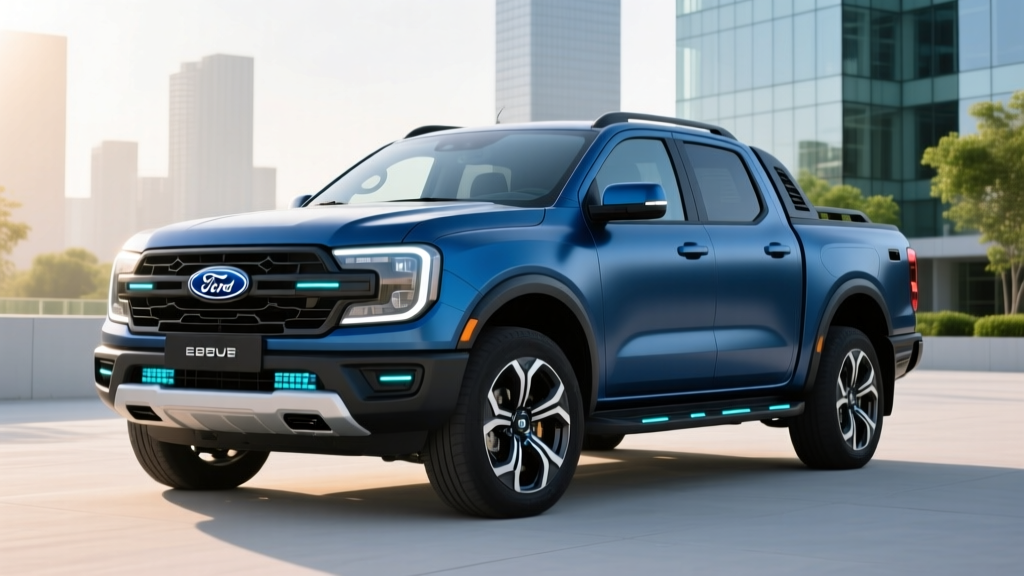
Ford has confirmed it is developing a midsize electric pickup, widely expected to wear the Ranger nameplate, targeting a late-2026 reveal with sales beginning in the 2027 model year. Based on Ford's public statements and supply-chain reporting, expect an EPA range target of 250–320 miles, a starting MSRP in the low-to-mid $40,000s, DC fast charging at up to 150–180 kW, and eligibility for up to $7,500 in federal tax credits under current IRS §30D rules — provided battery sourcing and buyer income requirements are met. No final specs are published yet; everything below is based on Ford's announced platform direction, F-150 Lightning architecture lessons, and industry analysis.
Why Ford Is Building a Midsize Electric Truck
The midsize pickup segment — dominated by the Toyota Tacoma, Ford Ranger, Chevrolet Colorado, and Nissan Frontier — sells roughly 700,000 units annually in the U.S. alone. It's a high-volume, high-loyalty segment where Ford currently competes with the gas-only Ranger. An electric entry would give Ford a first-mover advantage against a Toyota Tacoma that remains hybrid-only (no plug) and a Chevrolet Colorado with no electrified variant.
Ford CEO Jim Farley has repeatedly signaled that the company's next-generation EVs will be smaller, more affordable, and built on a dedicated "Universal EV" platform designed to undercut competitors on cost. The midsize truck is expected to slot below the F-150 Lightning in both size and price, targeting buyers who want truck utility without full-size footprint or full-size pricing.
Projected Specs: Range, Battery, and Charging
Until Ford publishes official figures, here's what the evidence points to — based on the Universal EV platform's stated goals, the F-150 Lightning's architecture, and segment requirements:
| Spec | Projected Figure | Context |
|---|---|---|
| EPA Range (target) | 250–320 miles | Varies by battery pack option |
| Battery Chemistry | LFP (standard) / NMC (extended) | LFP cuts cost; NMC boosts range |
| Battery Capacity (est.) | 75–100 kWh usable | Smaller than F-150 Lightning's 98–131 kWh |
| DC Fast Charge (peak) | 150–180 kW | 10–80% in roughly 25–35 minutes |
| Level 2 Charge Rate | 11.5–19.2 kW | Full overnight charge on 48A circuit |
| 0–60 mph (est.) | 5.0–6.5 seconds | Dual-motor AWD variants |
| Horsepower (est.) | 300–450 hp | Depending on single/dual motor |
| Towing Capacity (est.) | 5,000–7,500 lbs | Midsize segment typical range |
| Payload (est.) | 1,400–1,800 lbs | Battery weight eats into payload vs gas |
| Bed Length | 5–6 ft | Midsize standard |
Real-World Range Reality Check
If Ford hits a 300-mile EPA target, plan for approximately 240–260 miles of real-world highway range at 70–75 mph, and potentially 180–210 miles in sub-freezing winter conditions. Towing a 5,000-lb trailer will cut range roughly in half — to around 130–160 miles. This is physics, not a Ford problem: every electric truck experiences the same aerodynamic and thermal losses. The F-150 Lightning with its 320-mile EPA pack averages closer to 230–250 miles in mixed real-world driving, per fueleconomy.gov data and independent testing.
EV vs Gas vs Hybrid: Midsize Truck Cost Comparison
The core buying decision comes down to total cost over five years. Here's how a projected Ford midsize EV truck stacks up against the current gas Ford Ranger and the Toyota Tacoma Hybrid:
| Factor | Ford Midsize EV (Proj.) | Ford Ranger Gas (2025) | Toyota Tacoma Hybrid (2025) |
|---|---|---|---|
| Starting MSRP | ~$42,000–$45,000 | ~$34,000 | ~$41,000 |
| Federal Tax Credit (§30D) | Up to $7,500* | $0 | $0 (HEV, not plug-in) |
| Effective Starting Price | ~$34,500–$37,500 | ~$34,000 | ~$41,000 |
| Fuel/Energy Cost (5 yr / 75K mi) | ~$3,000–$4,500† | ~$8,500–$10,000 | ~$6,500–$7,500 |
| Maintenance (5 yr) | ~$1,500–$2,000 | ~$3,500–$4,500 | ~$3,000–$4,000 |
| Insurance (5 yr avg) | ~$9,000–$11,000 | ~$7,000–$8,500 | ~$7,500–$9,000 |
| Est. 5-Year Total Cost | ~$48,000–$55,000 | ~$53,000–$57,000 | ~$58,000–$61,500 |
* §30D credit eligibility depends on MSRP caps (trucks: $80,000), buyer income limits ($150K single / $300K joint), and battery critical-mineral sourcing requirements. Rules can change; verify at irs.gov before purchasing. Point-of-sale transfer is available at participating dealers.
† EV energy cost assumes 70% home charging at $0.14/kWh and 30% public DC fast charging at $0.40/kWh. Actual costs vary by utility rate and charging behavior.
Real-World Ownership: What First-Time EV Truck Buyers Must Know
Home Charging Is Non-Negotiable for Most Owners
Public DC fast charging works for road trips, but daily EV ownership lives or dies on home charging access. A Level 2 home charger (240V, 48 amps) delivers roughly 11.5 kW — enough to fully recharge a ~90 kWh battery in 8–9 hours, meaning you wake up to a full "tank" every morning.
Installation costs vary dramatically:
| Component | Low End | High End | Notes |
|---|---|---|---|
| Level 2 Charger (hardware) | $350 | $700 | ChargePoint Home Flex, Wallbox, Emporia |
| Electrician labor | $500 | $2,000 | Depends on panel proximity and conduit run |
| Permit & inspection | $50 | $300 | Varies by municipality |
| Panel upgrade (if needed) | $1,500 | $4,000 | Required if existing panel lacks capacity |
| Total (no panel upgrade) | $900 | $3,000 | Most installations fall here |
| Total (with panel upgrade) | $2,400 | $7,000 | Older homes with 100A service |
If you live in an apartment, condo, or street-parking situation without charging access, an electric truck is a significantly harder ownership proposition. Public-only charging is feasible but adds time, cost, and unpredictability to your routine.
Climate Matters More Than You Think
Battery chemistry responds to temperature. LFP (lithium iron phosphate) batteries — likely the standard-range option — are more resistant to thermal degradation over time but lose a similar percentage of range in extreme cold as NMC batteries. If you live in northern-tier states where winters regularly dip below 20°F, budget for 25–35% range loss during the coldest months. A 300-mile EPA truck becomes a ~200-mile truck in a Minnesota January.
Preconditioning — warming the battery while still plugged in before departure — recovers some of this loss and is critical for maintaining DC fast-charge speeds in cold weather. Ford's EV platforms support scheduled preconditioning through the FordPass app.
Towing and Payload: The Honest Trade-Off
Electric trucks carry heavy battery packs. The F-150 Lightning's extended-range battery alone weighs roughly 1,800 lbs. A midsize electric truck will have a smaller battery, but the weight penalty still compresses payload capacity compared to a gas Ranger. If you regularly haul 1,500+ lbs in the bed or tow near maximum capacity, an electric midsize truck will serve you — but expect range to drop sharply under load. Towing 5,000 lbs at highway speeds typically halves an EV truck's range.
Ford Midsize EV Truck vs. the Competition
The midsize electric truck field is thin but growing. Here's where Ford's entry would land:
| Vehicle | Status | Est. Range | Est. Price | Key Advantage |
|---|---|---|---|---|
| Ford Midsize EV (Ranger EV) | Announced / Pre-production | 250–320 mi | ~$42,000+ | Dealer network, BlueCruise, fleet relationships |
| Rivian R2 | Expected 2026–2027 | 275–330 mi | ~$45,000+ | R1T-proven platform, adventure positioning |
| Tesla Cybertruck (base RWD) | Announced, delayed repeatedly | ~250 mi | ~$60,000+ (est.) | Supercharger network, stainless design |
| Toyota Tacoma (Hybrid i-FORCE MAX) | Available now | N/A (gas/hybrid) | ~$41,000+ | Proven reliability, no plug-in needed |
Ford's edge is its dealer and service network — over 2,800 U.S. locations — which matters for truck buyers in rural areas where Rivian's service centers are sparse. The available BlueCruise hands-free highway driving system (SAE Level 2 — driver must remain attentive) is also one of the most capable in the segment.
BlueCruise Is Not Self-Driving
Ford's BlueCruise is an SAE Level 2 driver-assistance system. It can control steering, acceleration, and braking on pre-qualified highway sections, but the driver must remain engaged and ready to take over at any moment. A driver-monitoring camera ensures your eyes stay on the road. This is fundamentally different from Level 4 robotaxi services like Waymo, which operate without a human driver in geofenced areas. Never treat BlueCruise — or any current consumer vehicle system — as autonomous.
Tax Credit Eligibility: What You Actually Need to Qualify
The federal §30D clean vehicle credit can reduce your effective purchase price by up to $7,500 — but eligibility is a multi-factor test, not a guarantee. Here's the checklist as of current IRS rules:
- MSRP Cap: Trucks, SUVs, and vans must have an MSRP at or below $80,000. A midsize Ford EV truck should clear this easily.
- Buyer Income Cap: Modified adjusted gross income must not exceed $150,000 (single filer), $225,000 (head of household), or $300,000 (married filing jointly).
- Battery Sourcing: A percentage of critical minerals and battery components must be sourced from the U.S. or free-trade-agreement countries. These thresholds increase annually. Ford's ability to meet them will determine whether buyers get the full $7,500, a partial $3,750, or nothing.
- Final Assembly: Vehicle must undergo final assembly in North America. A Ford U.S. plant build satisfies this.
- Point-of-Sale Transfer: You can transfer the credit to the dealer at purchase, reducing your out-of-pocket cost immediately — rather than waiting to claim it on your tax return.
- One Credit Per VIN: The credit applies once per vehicle. If you buy used, different rules (and a $4,000 cap) apply under §25E.
These rules have shifted multiple times since the Inflation Reduction Act passed. Always verify current requirements at irs.gov and consult a tax professional before counting on the credit in your purchase budget.
Common Misconceptions About Electric Trucks
| Myth | Fact |
|---|---|
| "Electric trucks can't tow anything useful." | Midsize EV trucks are projected to tow 5,000–7,500 lbs — enough for most boat, camper, and utility trailers. Range drops significantly under load, but capability is real. |
| "The battery will need replacing in 5 years." | Modern EV batteries are designed for 150,000–200,000+ miles with 70–80% capacity retention. Ford's battery warranty is expected to cover 8 years / 100,000 miles (the federal minimum for emissions-related components). LFP chemistry further extends cycle life. |
| "Charging takes hours on road trips." | At 150–180 kW DC fast charging, a 10–80% session takes roughly 25–35 minutes — comparable to a sit-down meal stop. The charge curve tapers significantly above 80%, which is why fast-charging to full is rarely recommended. |
| "EVs cost more to insure, always." | EV insurance premiums are typically 10–25% higher than comparable gas vehicles due to repair complexity and parts cost, but the gap is narrowing. Shop quotes from multiple carriers before assuming worst-case. |
| "I need a special electrical service at home." | Most homes with a 200-amp panel can support a 48-amp Level 2 charger without a panel upgrade. A licensed electrician can assess your capacity in a $100–200 site visit. |
Decision Framework: Is the Ford Midsize Electric Truck Right for You?
Choose the Ford Midsize EV Truck If:
- You have access to home Level 2 charging (garage, driveway, or employer-installed charger)
- Your daily commute and errands fall within 100–150 miles round trip
- You want lower per-mile operating costs and don't mind a higher upfront price offset by tax credits
- You tow occasionally but not daily, and can plan charging around longer hauls
- You value instant torque, quiet operation, and a frunk (front trunk) for secure storage
- You're willing to wait for a 2027 model year launch and potential early-production quirks
Stick With the Gas Ranger or Tacoma Hybrid If:
- You lack reliable home or workplace charging access
- You regularly tow heavy loads over long distances where charging infrastructure is sparse
- You live in an area with extreme cold and limited DC fast-charging options
- You need maximum payload and can't accept the battery weight trade-off
- You prefer to buy a proven, available vehicle today rather than wait for an announced model
- Your budget is strictly under $35,000 and you can't leverage tax credits to bridge the gap
What to Watch For Before You Commit
Ford is expected to reveal official specs, trim levels, and pricing in late 2026 or early 2027. Between now and then, pay attention to:
- Battery sourcing announcements: These determine §30D credit eligibility — the difference between a $42,000 truck and a $34,500 truck.
- Charging connector: Ford has committed to NACS (Tesla-style) for future EVs. The midsize truck should ship with a native NACS port, granting access to Tesla Superchargers without an adapter.
- Real-world range testing: Once EPA figures are published on fueleconomy.gov, compare them to independent road-trip tests from EV reviewers.
- Production timeline: Ford's EV launches have faced delays (the F-150 Lightning ramp took months to reach volume). Early reservation slots may carry a premium or limited trim availability.
- Insurance quotes: Get real quotes for your ZIP code before budgeting. EV truck insurance varies significantly by carrier and region.
Frequently Asked Questions
When will the Ford midsize electric truck be available to buy?
Ford has confirmed the vehicle is in development but has not published a firm on-sale date. Industry consensus points to a late-2026 reveal with customer deliveries beginning in the first half of the 2027 model year. Reservations may open before the official reveal.
Will it use the same platform as the F-150 Lightning?
Unlikely. Ford's next-generation EVs are being built on a new, cost-optimized "Universal EV" platform designed for smaller, more affordable vehicles. The F-150 Lightning uses a modified version of the F-150's body-on-frame architecture. The midsize truck is expected to use a dedicated EV skateboard platform, potentially with unibody construction to save weight and cost.
What connector will it use — CCS or NACS?
Ford has announced that all future EVs will use the NACS (North American Charging Standard) connector, the same plug used by Tesla. This gives access to the Tesla Supercharger network — currently the largest and most reliable DC fast-charging network in the U.S. — without an adapter.
How much will it cost to charge at home vs. a gas Ranger's fuel cost?
At the U.S. average residential electricity rate of ~$0.16/kWh (EIA, 2025), fully charging a ~90 kWh battery costs roughly $14.40 for ~270 miles of range — about $0.053 per mile. A gas Ranger getting 22 MPG combined at $3.40/gallon costs ~$0.155 per mile. Over 15,000 miles per year, that's roughly $795 in electricity vs. $2,318 in gasoline — a savings of ~$1,500 annually. Your actual savings depend on local electricity rates and driving patterns.
Will the battery last the life of the truck?
Based on current lithium-ion degradation data, most EV batteries retain 85–90% of original capacity after 100,000 miles and 80–85% after 150,000 miles. LFP chemistry, expected on the standard-range variant, typically shows even slower degradation. Ford's battery warranty is expected to guarantee at least 70% capacity retention over 8 years / 100,000 miles, consistent with industry standards and federal requirements. Full battery replacement — rarely needed — would likely cost $10,000–$18,000 depending on pack size, though prices continue to decline.
Is it better to wait for the Ford EV truck or buy a Rivian R2?
Both target the same price and size bracket, but they serve different buyers. Ford offers a vast dealer and service network, fleet purchasing support, and BlueCruise. Rivian offers a proven adventure-oriented platform (from the R1T), a growing but smaller service footprint, and the Rivian Adventure Network of chargers. If service accessibility and resale confidence matter most, Ford has the edge. If off-road capability and brand ethos are priorities, the R2 may fit better. Wait for both vehicles' official specs before deciding.