Quick Verdict: Does the Ford Mach-E Qualify for the Federal EV Tax Credit?
The short answer: yes, select 2026 Ford Mustang Mach-E trims qualify for up to $7,500 under IRS §30D, but eligibility hinges on your income, the vehicle's MSRP, and battery critical-mineral sourcing requirements that shift yearly. Ford has worked aggressively to shift battery component and critical-mineral supply chains to USMCA free-trade partners, keeping the Mach-E in the credit's good graces through 2026. However, not every buyer will see the full amount — and the point-of-sale transfer option means you can apply it as a down-payment reduction at the dealer rather than waiting for a tax refund.
Below, we walk through the exact eligibility mechanics, 2026 pricing across trims, and what the Mach-E actually delivers in range, charging, and daily ownership.
Ford Mach-E Tax Credit Eligibility: The §30D Checklist
The federal EV tax credit under IRS §30D is not a blanket $7,500 for every buyer and every EV. It's a multi-gate test. Here's how the 2026 Mach-E stacks up against each requirement:
- Vehicle MSRP cap: SUVs, vans, and pickups must have an MSRP ≤ $80,000. The Mach-E is classified as an SUV — every 2026 trim (Select, Premium, California Route 1, GT) starts well under this cap, with the GT topping out around $65,000 fully loaded. Pass.
- Buyer income cap (modified AGI): $150,000 single / $225,000 head of household / $300,000 joint filers. If your income exceeds these thresholds, you are ineligible regardless of the vehicle. Varies by buyer.
- Battery components (≥ 100% North American assembly in 2026): Ford sources battery packs from its BlueOval SK joint venture plants in Kentucky and Tennessee, meeting domestic assembly requirements. Pass.
- Critical minerals (≥ 80% from US or FTA partners in 2026): Ford has publicly confirmed compliance with critical-mineral sourcing thresholds for the Mach-E's NMC and LFP cells. Pass for qualifying battery packs.
- Final assembly in North America: The Mach-E is built at Ford's Cuautitlán plant in Mexico, which qualifies under USMCA. Pass.
- Point-of-sale transfer: You can transfer the credit to the dealer at purchase, reducing your out-of-pocket cost immediately — no need to wait until tax filing. Available.
Bottom line: If your modified AGI is under the cap, you should see the full $7,500 on eligible 2026 Mach-E trims. Verify the specific VIN with your dealer and cross-check the fueleconomy.gov tax credit database before signing.
2026 Ford Mach-E Pricing: Before and After the Tax Credit
| Trim | Drivetrain | Base MSRP | After $7,500 Credit |
|---|---|---|---|
| Select (Standard Range) | RWD | $39,995 | $32,495 |
| Select (Extended Range) | RWD | $43,995 | $36,495 |
| Premium (Extended Range) | AWD | $49,995 | $42,495 |
| California Route 1 | AWD | $48,495 | $40,995 |
| GT (Extended Range) | AWD | $59,995 | $52,495 |
Prices include destination charge. Tax credit applied as point-of-sale reduction. State and local incentives may stack on top — check your jurisdiction's DMV or energy office for specifics.
Range, Battery, and Real-World Efficiency
The 2026 Mach-E offers two battery packs across its lineup:
- Standard Range: 72 kWh usable capacity, LFP (lithium iron phosphate) chemistry — heavier but more cycle-life durable and tolerant of daily 100% charges.
- Extended Range: 91 kWh usable capacity, NMC (nickel manganese cobalt) chemistry — higher energy density for maximum range.
| Trim / Battery | EPA Range | MPGe (Combined) | kWh/100 mi |
|---|---|---|---|
| Select SR / RWD (72 kWh LFP) | 250 mi | 100 MPGe | 34 |
| Select ER / RWD (91 kWh NMC) | 320 mi | 101 MPGe | 33 |
| Premium ER / AWD (91 kWh NMC) | 290 mi | 93 MPGe | 36 |
| GT ER / AWD (91 kWh NMC) | 280 mi | 86 MPGe | 39 |
The Mach-E's heat pump (standard on all 2026 trims) helps mitigate cold-weather cabin energy draw, but battery chemistry and physics still dominate. Preconditioning the battery while plugged in — using the FordPass app to schedule departure times — is essential for preserving range and enabling fast DC charging in cold conditions.
Charging Speed: DC Fast, Level 2, and Level 1
Charging infrastructure access is the single biggest variable in EV satisfaction. Here's what the Mach-E can accept at each level:
| Charging Level | Connector / Power | Rate | Miles Added per Hour | Notes |
|---|---|---|---|---|
| Level 1 (120V) | NACS (Tesla standard, adapter included) | ~1.4 kW | ~3–4 mi/hr | Emergency / overnight trickle only |
| Level 2 (240V home) | NACS / J1772 adapter | 10.5 kW (48A) | ~30–35 mi/hr | Full charge overnight (~8–9 hrs for ER) |
| DC Fast Charge | NACS (Supercharger native) | Peak 150 kW (SR) / 150 kW (ER) | ~180+ mi in 30 min | 10–80% in ~35 min; tapers above 80% |
A critical detail for 2026: Ford transitioned the Mach-E to the NACS (North American Charging Standard) port, giving native access to Tesla's Supercharger network — now the largest and most reliable DC fast-charging network in the US. This eliminated the CCS-to-NACS adapter hassle that earlier Mach-E owners dealt with.
Charging curve reality: The Mach-E peaks at 150 kW roughly between 10–50% State of Charge, then progressively tapers. From 80–100%, charging slows dramatically to protect battery longevity. On road trips, plan your stops around 10–80% cycles — the last 20% can take as long as the first 70%.
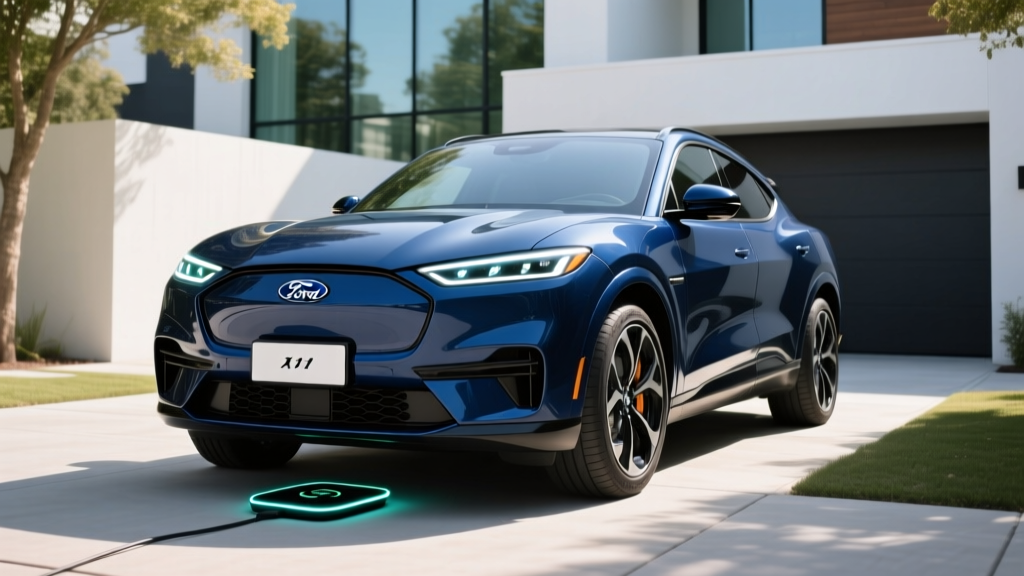
For home Level 2 charging, Ford recommends the Ford Connected Charge Station (48A hardwired), which adds about 30 miles of range per hour. A standard 240V/50A circuit with a 6-gauge wire run is typical. Expect home installation costs of $500–$2,000 depending on panel proximity and whether your electrical panel needs an upgrade from 100A to 200A service.
Performance: 0-60, Horsepower, and Drivetrain
| Trim | Motor Config | Horsepower | Torque (lb-ft) | 0-60 mph |
|---|---|---|---|---|
| Select SR | Single Motor RWD | 266 hp | 387 | 6.1 sec |
| Select ER / Premium ER | Dual Motor AWD | 346 hp | 428 | 5.1 sec |
| GT | Dual Motor AWD | 480 hp | 634 | 3.5 sec |
The GT trim's 3.5-second 0-60 puts it squarely in performance-SUV territory, rivaling the Porsche Macan Electric and well ahead of the Hyundai Ioniq 5's AWD variant. The single-motor RWD models are more than adequate for commuting and highway merging, and they deliver the best efficiency of the lineup.
All trims feature one-pedal driving with adjustable regenerative braking levels. The GT includes Ford's MagneRide adaptive dampers and a dedicated "Unbridled Extend" drive mode that loosens stability control for track use — a rarity in this price segment.
Interior, Cargo, Tech, and Driver Assistance
Cargo volume: 29.7 cu ft behind the rear seats, expanding to 59.7 cu ft with the 60/40 split rear seats folded. The front trunk (frunk) adds 4.7 cu ft of drainable, lockable storage — useful for muddy gear or groceries that might leak.
Passenger space: Front legroom is 43.3 inches; rear legroom is 38.9 inches. Two adults over 6 feet sit comfortably in the back, though the sloping roofline cuts into headroom for taller passengers compared to boxier competitors like the Kia EV9.
Infotainment: The 15.5-inch vertical touchscreen runs SYNC 4A with wireless Apple CarPlay and Android Auto, over-the-air updates, and built-in navigation. The interface is responsive but occasionally buries climate controls behind menus — a physical volume knob is present, but temperature adjustment requires the screen.
Driver assistance: Ford BlueCruise (hands-free highway driving on pre-mapped divided highways) is available on Premium and GT trims, with a subscription required after the initial trial period. This is an SAE Level 2 system — your eyes must remain on the road, and the driver-monitoring camera will alert you if attention drifts. BlueCruise covers over 130,000 miles of qualified highways and handles lane centering, adaptive cruise, and lane changes competently, but it does not navigate complex urban environments or construction zones autonomously.
Warranty and Long-Term Ownership
- Bumper-to-bumper: 3 years / 36,000 miles
- Powertrain: 5 years / 60,000 miles
- High-voltage battery: 8 years / 100,000 miles (capacity retention guaranteed above 70% of original)
- Corrosion perforation: 5 years / unlimited miles
The 8-year/100,000-mile battery warranty is industry-standard and matches what Hyundai, Tesla, and Volkswagen offer. Ford's 70% capacity retention threshold means that if your battery degrades below 70% of its original kWh within the warranty period, Ford will repair or replace it. In practice, NMC packs in liquid-cooled systems like the Mach-E's typically lose 8–12% over 8 years based on long-term fleet data, well within the warranty buffer. LFP packs (Standard Range) tend to degrade even more slowly, though they are heavier and offer less total range.
Pros, Cons, and Who Should Buy the Mach-E
Pros
- Full $7,500 federal tax credit eligibility on most trims (verify VIN)
- Native NACS port with Tesla Supercharger access — no adapter needed
- GT trim offers genuine sports-SUV performance (3.5s 0-60)
- Generous frunk + competitive cargo volume for the segment
- BlueCruise hands-free driving on 130,000+ miles of highways
- LFP battery option for buyers who want daily 100% charging without degradation worry
Cons
- DC fast-charge peak of 150 kW trails Hyundai Ioniq 5's 240 kW capability
- Rear headroom compromised by coupe-like roofline for tall passengers
- Climate controls require screen interaction — no physical dials for temperature
- BlueCruise requires ongoing subscription after trial period
- Cold-weather range loss on NMC Extended Range models is noticeable (~25%)
- Commuters and suburban families who want a car-like driving feel with SUV practicality and home Level 2 charging convenience.
- Buyers prioritizing tax credit savings — the Mach-E's sub-$80K MSRP across all trims and confirmed §30D compliance make it one of the most credit-accessible EVs in its class.
- Performance enthusiasts drawn to the GT's 480 hp and adaptive suspension who also need daily usability.
- You take frequent 400+ mile road trips and want the fastest possible DC charging (consider the Ioniq 5 or Tesla Model Y).
- You need three-row seating or max cargo volume (check the Kia EV9 or Rivian R1S).
- Your household income exceeds the §30D AGI caps — you'll pay full MSRP.
How the Mach-E Stacks Up Against Key Competitors
The Mach-E competes directly with the Tesla Model Y, Hyundai Ioniq 5, and Volkswagen ID.4. Here's how the numbers compare at the mid-trim AWD level:
| Spec | Ford Mach-E Premium ER AWD | Tesla Model Y LR AWD | Hyundai Ioniq 5 AWD |
|---|---|---|---|
| EPA Range | 290 mi | 310 mi | 290 mi |
| Battery (usable) | 91 kWh NMC | 78 kWh NMC | 77.4 kWh NMC |
| Peak DC Fast Charge | 150 kW | 250 kW | 240 kW |
| 10–80% DCFC Time | ~35 min | ~25 min | ~18 min |
| 0–60 mph | 5.1 sec | 4.8 sec | 5.1 sec |
| Base MSRP (mid-trim AWD) | $49,995 | $47,990 | $50,850 |
| Federal Tax Credit | Up to $7,500 | Up to $7,500 | Up to $7,500 |
| Charging Network | NACS (Supercharger native) | NACS (Supercharger native) | NACS (adapter or native 2026) |
The Mach-E trades charging speed for a slightly more car-like ride quality and a more traditional dealership purchase experience. If DC fast-charge speed is your top priority for frequent road trips, the Ioniq 5's 800V architecture delivers a meaningful advantage. If you value Supercharger-native access, both the Mach-E and Model Y have it — but the Model Y's efficiency (more range from a smaller battery) is harder to beat.
Frequently Asked Questions
Does the Ford Mach-E qualify for the full $7,500 federal EV tax credit in 2026?
Yes, eligible 2026 Mach-E trims qualify for up to $7,500 under IRS §30D, provided the buyer meets income caps ($150K single / $300K joint), the MSRP is under $80,000 (all trims qualify), and the battery meets critical-mineral and component sourcing thresholds. Ford has confirmed compliance for 2026 model-year vehicles. You can transfer the credit to the dealer at point of sale, reducing your purchase price immediately.
What is the real-world range of the Ford Mach-E?
The EPA rates the Extended Range RWD at 320 miles, but expect 270–285 miles on sustained highway driving and roughly 225–250 miles in cold weather (below 30°F). The Standard Range LFP model delivers about 250 miles EPA, with real-world highway figures around 210–225 miles.
How fast does the Mach-E charge at home and on the road?
At home on a Level 2 (240V/48A) charger, the Mach-E accepts up to 10.5 kW, adding about 30–35 miles per hour — a full overnight charge. On DC fast chargers, it peaks at 150 kW, completing a 10–80% charge in roughly 35 minutes. Charging slows significantly above 80% to protect the battery.
Is the Ford Mach-E worth buying over the Tesla Model Y or Hyundai Ioniq 5?
It depends on your priorities. The Mach-E offers a more car-like driving experience, a traditional dealership service network, and full tax-credit eligibility. The Model Y wins on efficiency and Supercharger integration. The Ioniq 5 dominates on DC charging speed. All three qualify for the $7,500 credit, so the decision comes down to driving feel, charging habits, and service preferences.
Does the Mach-E use NACS or CCS for charging?
The 2026 Mach-E uses the NACS (Tesla) charging port natively, giving it direct access to Tesla Superchargers without an adapter. A J1772 adapter is included for older public Level 2 stations that haven't yet transitioned to NACS.
What battery chemistry does the Mach-E use?
The Standard Range model uses LFP (lithium iron phosphate) — durable, safe, and tolerant of daily 100% charges. The Extended Range model uses NMC (nickel manganese cobalt) — higher energy density for maximum range but best kept between 20–80% for daily use to minimize degradation.
Can I charge my Mach-E at Tesla Superchargers?
Yes. The 2026 Mach-E has a native NACS port and is fully compatible with the Tesla Supercharger network, which operates at V3 stalls (up to 250 kW, though the Mach-E caps at 150 kW). This access is included with the vehicle — no additional subscription required for Supercharger use beyond standard per-kWh pricing.