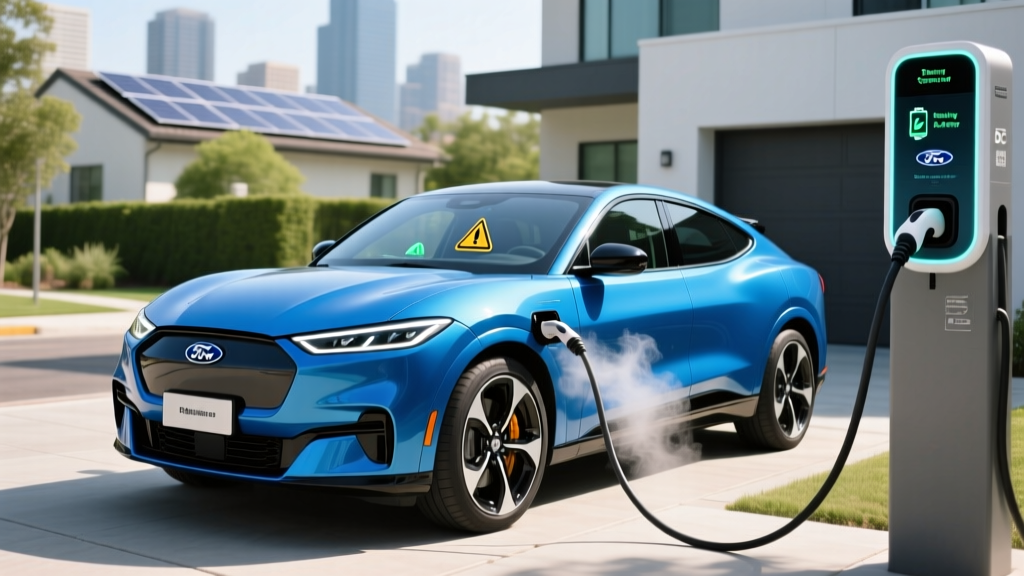
Searches for "Ford Mach-E malfunction" have persisted since the crossover launched, driven largely by a small number of high-profile recalls and forum chatter. If you are considering a new or used Mustang Mach-E in 2026, the headline isn't whether the car is fundamentally flawed—it isn't—but whether Ford has addressed the specific failures that plagued early 2021-2022 builds. This profile pairs our standard data-driven review (range, charging, price, §30D credit eligibility) with a clear-eyed look at the malfunctions owners actually report, so you can decide if the Mach-E belongs on your shortlist.
Ford Mach-E Malfunction History: What Actually Failed
Three categories dominate the malfunction conversation. Understanding them separates legitimate concerns from internet noise.
1. High-Voltage Battery Contactor (2021-2022 models, NHTSA Recall 22V-412). The most serious issue: under repeated full-throttle acceleration or repeated DC fast-charging cycles, the main battery contactor could overheat, weld closed, or fracture—potentially causing a loss of motive power while driving. Ford's remedy involved a software update that monitors contactor temperature and limits power if thresholds are exceeded, plus physical replacement of the contactor assembly on affected VINs. For 2023 and later builds, Ford revised the contactor hardware and thermal-management logic from the factory.
2. 12V Auxiliary Battery Drain. A common complaint on 2021-2023 models: the 12V battery dies after the car sits for several days, leaving the vehicle unstartable even though the high-voltage pack is charged. Root cause: parasitic draw from telematics and cloud-connected features when the vehicle is in deep-sleep mode. Ford issued multiple OTA updates to improve sleep-state management; owners report the issue is largely resolved on 2024+ software.
3. Brake-System Software Glitches (Recall 23V-805). Certain 2023 models experienced unexpected deactivation of the ABS and stability-control module due to a software fault in the integrated brake system. Remedy: OTA software update. No loss of base hydraulic braking occurred, but driver-assist features dependent on the module became unavailable until restart.
Verdict: Nearly every documented Mach-E malfunction traces to software or a single hardware component (contactor) that Ford has since redesigned. NHTSA complaint volumes for the Mach-E remain moderate relative to sales—far below the viral-recall tier occupied by early Bolt or early Ioniq 5 vehicles. See the NHTSA recall database to verify a specific VIN's open campaigns before purchase.
2026 Mustang Mach-E: Specs at a Glance
| Specification | Select / Premium (RWD) | Premium (AWD eAWD) | GT | GT Performance Edition |
|---|---|---|---|---|
| EPA Range | ~320 mi (Ext. Range) | ~290 mi (Ext. Range) | ~280 mi | ~265 mi |
| Battery (usable) | 91 kWh NMC | 91 kWh NMC | 91 kWh NMC | 91 kWh NMC |
| Standard-Range Battery | 70 kWh NMC (~250 mi) | 70 kWh NMC (~230 mi) | N/A | N/A |
| Horsepower | 266 hp | 312 hp | 480 hp | 480 hp |
| Torque | 317 lb-ft | 428 lb-ft | 600 lb-ft | 634 lb-ft |
| 0-60 mph | 6.1 sec | 5.1 sec | 3.7 sec | 3.5 sec |
| Drivetrain | RWD single-motor | Dual-motor AWD | Dual-motor AWD | Dual-motor AWD |
| Efficiency (MPGe) | 103 MPGe combined | 97 MPGe combined | 84 MPGe combined | 82 MPGe combined |
| Base MSRP (2026) | ~$42,000 | ~$49,500 | ~$57,500 | ~$63,500 |
Note: Ford trims and pricing shift annually; verify current-year figures at ford.com before configuring.
Real-World Range: What the EPA Sticker Doesn't Tell You
EPA Sticker: up to 320 miles (Select RWD Extended Range).
Real-World Expectation:
- Highway cruising at 70-75 mph: ~250-270 miles
- Mixed city/suburban: ~285-305 miles
- Cold weather (below 32°F): subtract 20-30%, so ~190-230 miles
- Towing (max 2,300 lb): expect ~150-175 miles
The Mach-E's NMC pack delivers strong range on paper, but highway aerodynamics and Ford's conservative thermal strategy mean you will not match EPA numbers at sustained interstate speeds. The heat pump, standard on Extended Range trims, mitigates cold-weather losses compared to earlier model years, but preconditioning the battery while still plugged in remains the single biggest range-preserving habit you can adopt. Check official efficiency figures at fueleconomy.gov.
Charging Speed: DC Fast and Home Level 2
| Charging Level | Power | Rate / Time | Notes |
|---|---|---|---|
| Level 1 (120V) | ~1.4 kW | ~3 mi/hr | Emergency top-off only |
| Level 2 (240V, 48A) | 10.5 kW | ~31 mi/hr; 0-100% in ~10 hr | Home wall connector (Ford Connected Charge Station or equivalent) |
| Level 2 (240V, 32A mobile) | 7.7 kW | ~23 mi/hr; 0-100% in ~13 hr | Included mobile cord on NEMA 14-50 |
| DC Fast Charge (Std Range) | Peak 115 kW | 10-80% in ~38 min | CCS1 (NACS adapter available) |
| DC Fast Charge (Ext Range) | Peak 150 kW | 10-80% in ~36 min | CCS1; taper begins at ~80% SoC |
Important nuance: the Mach-E's peak charge rate is modest by 2026 standards (Hyundai/Kia platforms run 240-350 kW on 800V architectures). On a road trip, expect ~25-minute stops for 150-180 miles of added range. The charge curve is relatively flat between 20-70% SoC, then tapers sharply above 80%—typical NMC behavior that protects long-term cell health. Ford provides a NACS adapter so owners can access the Tesla Supercharger network, which dramatically improves public-charging reliability on long trips.
Interior, Cargo, and Daily Practicality
The Mach-E's interior is dominated by a vertically oriented 15.5-inch touchscreen running SYNC 4A, paired with a 10.2-inch digital instrument cluster. The UI is responsive, supports wireless Apple CarPlay and Android Auto, and receives regular OTA updates. Physical controls are minimal—climate and volume are embedded in the touchscreen, which some drivers find distracting.
Cargo volume: 29.7 cu ft behind the rear seats; 59.7 cu ft with the 60/40 rear seats folded. The front trunk ("frunk") adds 4.7 cu ft and includes a drain plug—useful for tailgating or ice storage. Rear-seat legroom is 38.9 inches, competitive with the Model Y and Ioniq 5, though the sloping roofline cuts into headroom for passengers over six feet.
Drawbacks: the panoramic glass roof lacks a shade, contributing to cabin heat soak on sunny days; Ford removed the traditional door handles in favor of push-button E-latches, which have generated complaints about intuitiveness and occasional failure in extreme cold.
Pricing, Tax Credits, and Ownership Economics
| Trim | Base MSRP | Max §30D Credit | Effective Price (if eligible) |
|---|---|---|---|
| Select RWD Standard Range | ~$42,000 | Up to $7,500 | ~$34,500 |
| Premium RWD Extended Range | ~$49,500 | Up to $7,500 | ~$42,000 |
| GT AWD | ~$57,500 | Up to $7,500 | ~$50,000 |
§30D eligibility caveats (2026 rules, per IRS.gov):
- Buyer AGI cap: $150,000 single / $225,000 head of household / $300,000 joint
- Vehicle MSRP cap: $80,000 for SUVs (Mach-E qualifies as an SUV under IRS classification)
- Battery-critical-minerals and battery-component sourcing requirements must be met for the full $7,500; partial credit ($3,750) applies if only one threshold is met
- Credit is available as a point-of-sale transfer to the dealer, reducing your out-of-pocket at delivery
Ford has worked to localize battery sourcing, and most 2026 Mach-E builds qualify for at least partial credit—but confirm the specific VIN's eligibility on the IRS qualified-vehicles list before signing paperwork. Tax advice varies by individual situation; consult a tax professional.
Warranty, Safety, and Driver Assists
Warranty: 3-year/36,000-mile bumper-to-bumper; 5-year/60,000-mile powertrain; 8-year/100,000-mile high-voltage battery (capacity retention threshold: 70% of original). Ford's battery warranty is industry-standard and matches most competitors.
Safety: the Mach-E has earned IIHS Top Safety Pick status in prior model years and 5-star overall NHTSA ratings. Standard driver-assist is Ford Co-Pilot360 2.0, including automatic emergency braking, lane-keeping, blind-spot monitoring, and rear cross-traffic alert.
BlueCruise (available on Premium and GT trims, standard on some packages) is a hands-off, eyes-on Level 2 system operational on ~130,000 miles of pre-mapped divided highways. It is not autonomous driving—SAE Level 2 requires continuous driver supervision. The system performs well in clear conditions but will disengage in construction zones, heavy rain, or faded lane markings. A subscription (~$75/month or $800/year) applies after the initial trial period.
Should You Buy the Mach-E vs. Competitors?
Pros
- Strong real-world range (250+ mi highway on Ext. Range)
- NACS adapter unlocks Tesla Supercharger network
- GT Performance Edition delivers sports-car acceleration (3.5s 0-60)
- Spacious frunk with drain; practical cargo area
- Ford dealer network = easier service access than startup brands
Cons
- DC fast-charge rate (150 kW peak) lags Hyundai/Kia/Rivian
- Early-model contactor recall creates used-car due diligence
- No physical climate buttons; screen-heavy UI
- Panoramic glass roof without shade
- E-latch door handles polarize owners
Choose the Mach-E if: you want a mainstream-brand EV with strong dealer support, value Supercharger access via adapter, and prioritize a sporty driving feel without stepping into Tesla's ecosystem.
Look at the Hyundai Ioniq 5 or Kia EV6 if: DC fast-charge speed matters most (800V architecture, 10-80% in ~18 min on 350 kW chargers).
Look at the Tesla Model Y if: native Supercharger integration, OTA polish, and the lowest cost-per-mile of range are your top priorities.
Look at the Rivian R1S or Hyundai Ioniq 5 three-row variant if: you need more than five seats.
FAQ: Ford Mach-E Malfunction and Ownership Questions
Is the Ford Mach-E reliable in 2026?
Current model-year reliability data is encouraging. The contactor recall affected primarily 2021-2022 builds, and Ford's remedy—both software and hardware—has been widely deployed. J.D. Power and Consumer Reports place the Mach-E in the mid-pack among EVs: not trouble-free, but not a problem child. Pre-purchase inspection on any used example should confirm recall 22V-412 has been performed.
How do I check if a specific Mach-E has an open recall?
Enter the VIN at NHTSA.gov/recalls or the Ford owner portal. Dealers perform recall remedies at no cost.
Does the Mach-E qualify for the $7,500 federal tax credit?
Most 2026 Mach-E trims qualify for at least partial credit, provided the buyer meets income caps and the vehicle's battery sourcing satisfies §30D rules. Always verify the specific VIN on the IRS qualified-vehicle list before purchase.
How much does it cost to charge a Mach-E at home?
At the U.S. average residential rate of ~$0.16/kWh, fully recharging a 91 kWh Extended Range pack from 10% to 100% costs roughly $13-$15—about 5 cents per mile. Compare that to $0.12-$0.18 per mile for a 25 MPG gas SUV at $3.50/gallon.
What happens if the 12V battery dies?
The high-voltage pack cannot engage without 12V power to close the contactors. Jump-starting the 12V battery (using a lithium-safe jump pack, per Ford's owner manual) typically restores function. A 12V failure does not indicate a high-voltage system malfunction.
Is the Mach-E good for road trips?
Yes, with planning. Supercharger-network access via NACS adapter is a major advantage. Expect 25-35 minute DC fast-charge stops every 180-200 highway miles. Route-planning apps like A Better Routeplanner account for the Mach-E's specific charge curve.