Ford Focus Electric Distance: The Short Answer
The Ford Focus Electric delivers an EPA-estimated 76 miles of range for 2012–2016 models (23 kWh battery) and 115 miles for the 2017–2018 models (33.5 kWh battery). In real-world driving, expect roughly 60–65 miles from earlier models and 90–100 miles from the refreshed version, especially at highway speeds or in cold weather. Ford discontinued the Focus Electric after the 2018 model year, so every example on the market today is a used vehicle — and battery degradation will further reduce these distances by roughly 10–20% depending on age and usage history.
If you're researching the Ford Focus Electric distance because you're considering one as an affordable used EV, you're looking at a vehicle that was genuinely ahead of its time — and also one that shows its age in 2026. With used prices hovering between $6,000 and $14,000 depending on year, mileage, and battery condition, the Focus Electric occupies an interesting niche: it's one of the cheapest ways to get into a battery-electric vehicle, but its limited range and aging DC fast-charge capabilities demand realistic expectations. Let's walk through every number that matters.
Ford Focus Electric Range by Model Year
Ford made a significant battery upgrade midway through the Focus Electric's production run, and that single change defines which version is worth buying. Here are the official EPA figures alongside what you'll actually experience on the road.
| Specification | 2012–2016 Models | 2017–2018 Models |
|---|---|---|
| Battery Capacity (usable) | 23 kWh | 33.5 kWh |
| EPA Range | 76 miles | 115 miles |
| Real-World Range (mixed driving) | 60–70 miles | 90–105 miles |
| Cold-Weather Range (below 32°F) | 45–55 miles | 70–80 miles |
| EPA Efficiency (MPGe combined) | 105 MPGe | 107 MPGe |
| Energy Consumption | 32 kWh/100 mi | 30 kWh/100 mi |
| Battery Chemistry | NMC (LG Chem) | NMC (LG Chem) |
| DC Fast Charge (peak kW) | ~43 kW (CHAdeMO) | ~50 kW (CHAdeMO) |
| Level 2 Charge Rate | 6.6 kW | 6.6 kW |
| Level 2 Full Charge Time | ~3.5–4 hours | ~5–5.5 hours |
| 0–60 mph | ~8.1 seconds | ~8.1 seconds |
| Horsepower | 143 hp | 143 hp |
Sources: EPA Fuel Economy, Ford Motor Company specifications.
The CHAdeMO Problem: Charging in 2026
Here's where the Focus Electric's age becomes a genuine ownership challenge. Ford equipped the Focus Electric with a CHAdeMO DC fast-charging connector — the same standard used by the Nissan Leaf. In 2026, the North American charging landscape has shifted decisively toward NACS (Tesla's connector, now adopted by Ford, GM, Rivian, and most major automakers) and, to a lesser extent, CCS1.
What does this mean for Focus Electric owners?
- Fewer CHAdeMO stations: Networks like Electrify America and EVgo have progressively deprioritized CHAdeMO connectors on new installations. While existing CHAdeMO stations still operate, finding one reliably can require multiple app checks.
- No Supercharger access: The Focus Electric cannot use Tesla Superchargers, even with adapters — Ford's Supercharger access program applies only to its NACS-equipped models (F-150 Lightning, Mustang Mach-E 2025+).
- Slow peak charge rates: Even at a functioning CHAdeMO station, the Focus Electric peaks at roughly 43–50 kW. A 10–80% charge takes approximately 30–40 minutes — far slower than modern EVs that charge at 150–350 kW.
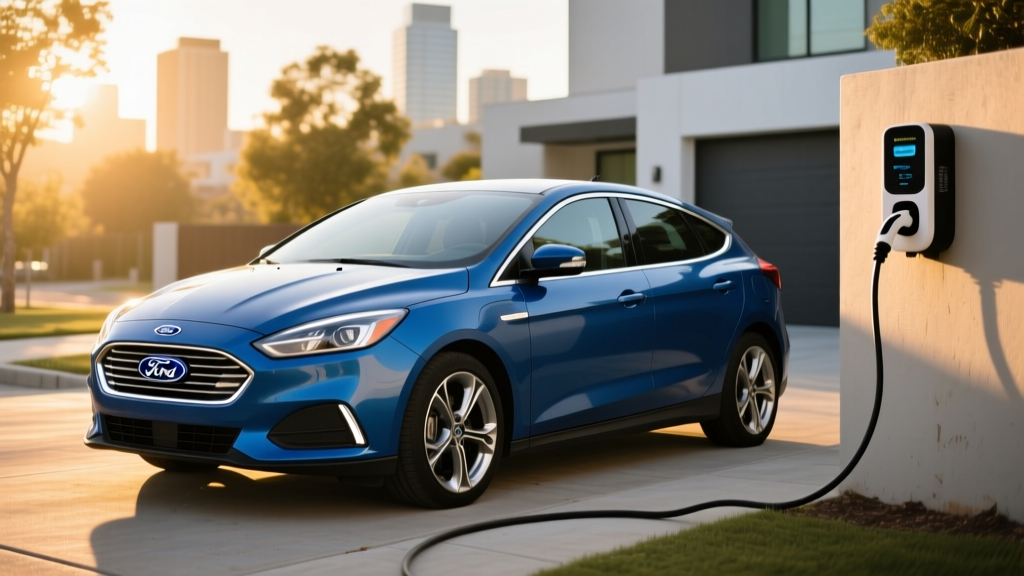
For daily driving, most Focus Electric owners rely on Level 2 home charging at 6.6 kW. A full charge from empty takes about 3.5 hours (23 kWh model) or 5.5 hours (33.5 kWh model). This is perfectly adequate for overnight charging but means you need reliable home or workplace charging access.
Focus Electric vs. Gas Car: Cost Comparison
The primary reason anyone considers a used Focus Electric in 2026 is economics. Let's compare the total cost against a conventional gas compact car — say, a used 2017 Ford Focus gasoline model — over a typical ownership period.
| Cost Category | Ford Focus Electric (2017–2018) | Ford Focus Gas (2017, 30 MPG combined) |
|---|---|---|
| Purchase Price (average used) | $9,000–$12,000 | $10,000–$13,000 |
| Fuel/Energy (5 years, 60,000 mi) | $2,400–$3,600 (home charging at $0.14/kWh) | $7,000–$8,500 (gas at $3.50/gal) |
| Maintenance (5 years) | $800–$1,200 (tires, cabin filter, brake fluid) | $2,500–$3,500 (oil, filters, brakes, belts) |
| Insurance (5 years, average) | $5,500–$7,000 | $4,800–$6,200 |
| Estimated Battery Replacement Risk | $0–$6,500 (if out of warranty) | $0 |
| Estimated 5-Year Total | $17,700–$30,300 | $24,300–$31,200 |
The fuel savings are substantial — roughly $4,000–$5,000 over five years if you charge primarily at home. Maintenance savings add another $1,500–$2,000. However, insurance tends to run 10–15% higher on EVs, and the looming question of battery replacement cost (roughly $5,500–$7,000 for a refurbished pack) can erase the savings if you're unlucky. Ford's original battery warranty was 8 years/100,000 miles, meaning most 2012–2016 models are now out of warranty coverage, and 2017–2018 models are approaching expiration.
Battery Degradation: What to Expect from a 7-Year-Old EV
Every lithium-ion battery loses capacity over time. The Focus Electric uses NMC (nickel-manganese-cobalt) chemistry from LG Chem, which was mainstream for its era but shows measurable degradation with age and charge cycles.
Typical degradation for a Focus Electric in 2026:
- 2012–2014 models (12+ years old): Expect 15–25% capacity loss. A car that originally delivered 76 EPA miles may now provide only 57–65 miles on a full charge.
- 2015–2016 models (10–11 years old): Expect 12–20% loss. Usable range drops to roughly 60–67 miles.
- 2017–2018 models (8–9 years old): Expect 8–15% loss. Real-world range falls to approximately 80–95 miles.
Before purchasing any used Focus Electric, request a battery health report. Some dealerships can pull State of Health (SoH) data via OBD-II diagnostics, and third-party tools like LeafSpy (with an appropriate adapter) can read battery metrics. A Focus Electric with less than 85% SoH should be priced accordingly — or avoided entirely.
Common Misconceptions About the Focus Electric
| Myth | Fact |
|---|---|
| "It qualifies for the $7,500 federal tax credit." | The §30D federal credit applies to new EV purchases only. Used EVs may qualify for up to $4,000 under the used clean vehicle credit (§25E), but the vehicle must cost $25,000 or less, the buyer must meet income caps ($75,000 single / $150,000 joint), and the sale must be through a licensed dealer. See IRS guidelines. |
| "The range is fine for my commute." | If your round-trip commute is under 45 miles and you can charge at home every night, yes. If your commute exceeds 50 miles one-way or you lack home charging, the Focus Electric is not practical as a primary vehicle. |
| "I can fast-charge it anywhere." | CHAdeMO infrastructure is declining in North America. You'll need to verify CHAdeMO availability on your routes via PlugShare or ChargePoint apps before relying on public DC charging. |
| "EV batteries need replacing every 5 years." | NMC batteries typically retain 80–90% capacity after 8–10 years. Degradation is gradual, not catastrophic. However, a full replacement does cost $5,500–$7,000 if the pack fails outside warranty. |
| "It charges as fast as modern EVs." | The Focus Electric peaks at 43–50 kW DC — roughly 5–7x slower than a Hyundai Ioniq 5 or Tesla Model 3 at a 250+ kW station. A 10–80% session takes 30–40 minutes, not 15–18. |
Who Should (and Shouldn't) Buy a Used Focus Electric
Decision Framework
Buy the Ford Focus Electric if:
- Your daily round-trip driving is under 50 miles (2012–2016) or under 80 miles (2017–2018)
- You have reliable Level 2 home charging (garage or driveway with a 240V outlet)
- You live in a mild climate (Southern California, Florida, Texas) where cold-weather range loss is minimal
- You want the cheapest possible entry into EV ownership and accept the range trade-off
- You're buying a 2017–2018 model with a verified battery SoH above 85%
- You have a second gas or hybrid vehicle for longer trips
Skip the Ford Focus Electric if:
- Your commute exceeds 45 miles one-way
- You rely exclusively on street parking or apartment living without charging access
- You live in a cold northern climate where winter range drops below 50 miles
- You need a single-vehicle household solution for road trips
- You cannot verify battery health before purchase
- You want access to modern fast-charging networks (NACS/Supercharger)
Alternatives to Consider
If the Focus Electric's range limitations give you pause, several used EVs from the same era offer meaningfully better distance and charging infrastructure compatibility:
- Chevrolet Bolt EV (2017–2019): 238 miles EPA range, CCS1 fast charging, ~$11,000–$16,000 used. Significantly more practical.
- Nissan Leaf SV/SL (2018+, 60 kWh): 226 miles EPA range, also CHAdeMO, but newer battery chemistry. ~$13,000–$17,000 used.
- Hyundai Kona Electric (2019–2020): 258 miles EPA range, CCS1, ~$16,000–$20,000 used. Best-in-class efficiency.
- Volkswagen e-Golf (2017–2019): 125 miles EPA range, CCS1, ~$12,000–$16,000. Slightly more range, much better charging network access.
Each of these alternatives costs more upfront but delivers substantially more daily usability and better long-term charging infrastructure support.
Frequently Asked Questions
What is the maximum distance a Ford Focus Electric can travel on a full charge?
The 2017–2018 Ford Focus Electric has an EPA-estimated range of 115 miles on a full charge of its 33.5 kWh battery. The earlier 2012–2016 models with the 23 kWh battery are rated at 76 miles. Real-world conditions — highway speeds, cold weather, battery age — reduce these figures by 15–35%.
How long does it take to charge a Ford Focus Electric?
On a 240V Level 2 charger at 6.6 kW, the 33.5 kWh model takes approximately 5–5.5 hours from empty to full. On a CHAdeMO DC fast charger, a 10–80% charge takes roughly 30–40 minutes at peak rates of 43–50 kW. Level 1 (120V household outlet) charging adds about 3–4 miles of range per hour.
Is the Ford Focus Electric still in production?
No. Ford discontinued the Focus Electric after the 2018 model year. Ford's current EV lineup includes the Mustang Mach-E and F-150 Lightning. If you want a new Ford EV in 2026, those are your options — and both offer 230+ miles of range and NACS charging compatibility.
Can I get a tax credit for buying a used Ford Focus Electric?
You may qualify for the used clean vehicle credit (§25E) of up to $4,000 (or 30% of the sale price, whichever is less). Requirements include: purchase price of $25,000 or less, buyer income below $75,000 (single) or $150,000 (joint), purchase from a licensed dealer, and the vehicle must be at least two model years old. The credit is non-refundable and can only be claimed once per buyer in a three-year period. Verify current rules at IRS.gov.
How much does it cost to replace the battery in a Ford Focus Electric?
A replacement battery pack for the Focus Electric typically costs $5,500–$7,000 including parts and labor at an independent EV shop, or potentially more at a Ford dealership. Ford's original battery warranty covered 8 years/100,000 miles, so most examples are now beyond warranty coverage. Before purchasing, always verify the battery's State of Health (SoH) — a pack above 85% capacity has years of usable life remaining.
Is the Ford Focus Electric a good first EV?
It can be — but only under specific conditions. If you have home charging, a short commute under 40 miles round-trip, a mild climate, and a second vehicle for longer trips, the Focus Electric is one of the cheapest ways to experience EV ownership. If you need a single vehicle that handles 200-mile road trips, apartment-only living without charging access, or harsh winters, look at a used Chevrolet Bolt EV or Hyundai Kona Electric instead.