The Bottom Line on the Ford Focus Electric Hatchback
The Ford Focus Electric hatchback was discontinued after the 2018 model year, so in 2026 you'll only find it on the used market. With an EPA-estimated range of just 76 miles (115 miles for 2017-2018 models with the upgraded 33.5 kWh battery), a CHAdeMO DC fast-charging port, and modest cargo space, this EV is best suited as a low-cost second car for short urban commutes where reliable home Level 2 charging is available. Expect to pay between $8,000 and $16,000 depending on model year and battery condition. It does not qualify for the federal §30D new-vehicle tax credit, and the used-EV credit (up to $4,000) applies only if purchased from a licensed dealer and income caps are met.
What Is the Ford Focus Electric Hatchback?
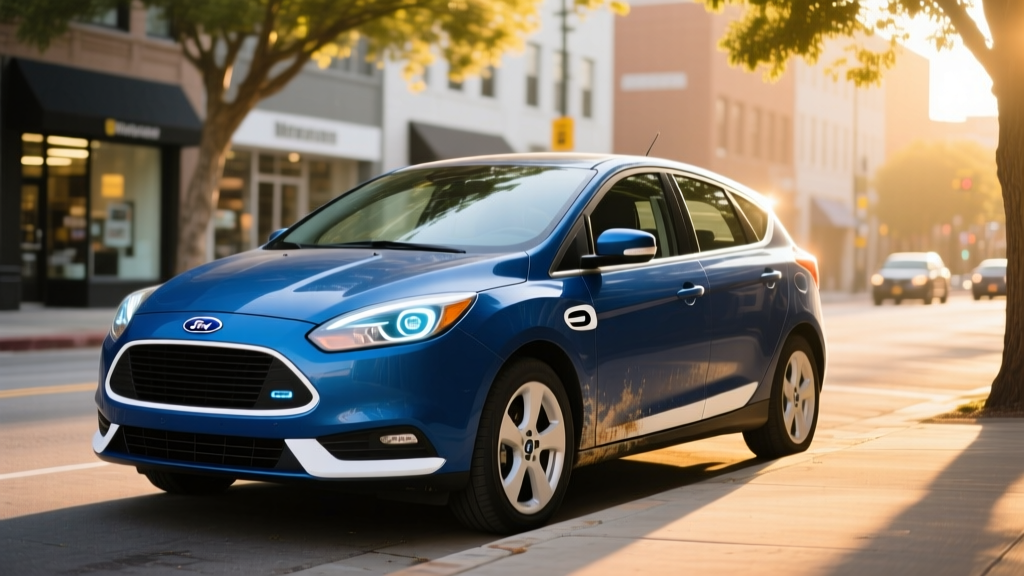
Ford produced the Focus Electric from 2012 through 2018 as its first mass-market battery-electric vehicle. Built on the same platform as the third-generation gasoline Focus hatchback, it replaced the internal-combustion powertrain with a front-mounted electric motor and a liquid-cooled lithium-ion battery pack mounted under the rear seats and cargo floor. The result was a compact five-door hatchback that drove like a conventional Focus but with zero tailpipe emissions and a fraction of the running cost.
Two distinct battery generations define the model:
- 2012–2016: 23 kWh usable battery (out of ~23 kWh total, with a small buffer), 76 miles EPA range, 107 kW (143 hp) motor.
- 2017–2018: 33.5 kWh usable battery, 115 miles EPA range, same 107 kW motor, added DC fast-charging capability via CHAdeMO connector.
The 2017 refresh was a meaningful upgrade. Ford added a CCS-compatible CHAdeMO DC fast-charge port (50 kW peak), a revised infotainment system with SYNC 3, and a heat pump for improved cold-weather efficiency. If you're shopping today, the 2017–2018 models are substantially more practical.
Range, Efficiency, and Real-World Expectations
Here's where honesty matters most. The EPA ratings for the Focus Electric were competitive when the car was new, but by 2026 standards they're severely limited.
| Specification | 2012–2016 | 2017–2018 |
|---|---|---|
| Usable Battery Capacity | ~19.5 kWh (23 kWh gross) | ~29 kWh (33.5 kWh gross) |
| EPA Range | 76 miles | 115 miles |
| EPA Combined MPGe | 105 MPGe | 107 MPGe |
| Energy Consumption | 32 kWh/100 mi | 29 kWh/100 mi |
| Motor Output | 107 kW / 143 hp | 107 kW / 143 hp |
| 0–60 mph | ~8.1 seconds | ~8.1 seconds |
Real-World Range Reality
EPA sticker: 115 miles (2017–2018). In practice, expect 90–105 miles in mixed driving during mild weather. Sustained highway speeds above 65 mph will drop that to roughly 75–85 miles. In freezing temperatures (below 32°F), plan for 60–80 miles of usable range due to cabin heating demands and battery chemistry limitations, even with the heat pump. Battery degradation on an 8-year-old pack can shave another 10–15% off these figures, so request a State of Health (SoH) report from the seller or a third-party diagnostic tool like LeafSpy-compatible OBD readers adapted for Ford.
Charging Speeds and Connector Compatibility
Understanding what you're plugging into is critical before you buy.
| Charging Level | Connector | Power (kW) | Time / Rate |
|---|---|---|---|
| Level 1 (120V household) | J1772 | ~1.2 kW | ~18–24 hours for full charge (2017–2018) |
| Level 2 (240V home/public) | J1772 | 6.6 kW (onboard charger) | ~4.5–5 hours (10–100%) |
| DC Fast Charge | CHAdeMO (2017–2018 only) | 50 kW peak | ~30 min (10–80%); 2012–2016 models lack DCFC |
Key charging considerations:
- 2012–2016 models have no DC fast charging. You are limited to Level 1 and Level 2 only. A full charge on a standard 120V outlet takes over 20 hours. This makes home Level 2 installation essentially mandatory.
- The 6.6 kW onboard charger is adequate for overnight home charging but means public Level 2 stations won't fill the battery any faster than that rate, even if the station delivers 19.2 kW.
- CHAdeMO is a legacy connector in North America. As of 2026, Tesla's NACS dominates and Electrify America has shifted to CCS/NACS. CHAdeMO stations are declining. If DC fast charging is important to you, recognize that infrastructure for this connector is shrinking.
- kW vs. kWh reminder: The battery stores energy measured in kWh (33.5 kWh total for 2017–2018). The charger delivers power measured in kW. A 6.6 kW Level 2 charger delivers 6.6 kilowatt-hours of energy per hour of charging.
Cost Breakdown: Purchase, Charging, Maintenance, and Insurance
One of the strongest arguments for a used Focus Electric is the low entry price and minimal running costs. Here's a realistic five-year ownership projection.
| Cost Category | Focus Electric (Used, 2017–2018) | Comparable Gas Hatchback (e.g., 2018 Focus Gas) |
|---|---|---|
| Purchase Price (2026 used market) | $10,000–$16,000 | $12,000–$17,000 |
| Annual Fuel/Energy (12,000 mi/yr) | ~$480–$650 (at $0.14/kWh avg) | ~$1,440–$1,800 (at $3.20/gal, 28 MPG) |
| Annual Maintenance | ~$200–$350 (tires, cabin filter, wipers, brake fluid) | ~$600–$900 (oil, filters, spark plugs, brakes) |
| Annual Insurance (avg) | ~$1,100–$1,500 | ~$1,000–$1,400 |
| 5-Year Energy/Fuel Total | $2,400–$3,250 | $7,200–$9,000 |
| 5-Year Maintenance Total | $1,000–$1,750 | $3,000–$4,500 |
| Estimated 5-Year Total (excl. purchase) | ~$8,900–$14,000 | ~$15,200–$21,700 |
Used-EV tax credit (IRC §25E): If you purchase a used Focus Electric from a licensed dealer for $25,000 or less and meet income thresholds (modified AGI ≤ $75,000 single / $150,000 joint), you may qualify for a credit of up to $4,000 or 30% of the sale price, whichever is less. Since most used Focus Electrics sell for $10,000–$16,000, the credit would typically be 30% of the purchase price — roughly $3,000–$4,800, capped at $4,000. Verify current-year rules at IRS.gov. This credit is not available for private-party sales.
EV vs. Gas vs. Hybrid: Where Does the Focus Electric Fit?
| Factor | Ford Focus Electric (2017–2018) | Ford Focus Gas (2018, 2.0L) | Toyota Prius Prime (used PHEV) |
|---|---|---|---|
| EPA Range / MPG | 115 mi / 107 MPGe | ~30 MPG combined | 25 mi EV + 54 MPG gas |
| Annual Energy Cost (12k mi) | ~$560 | ~$1,600 | ~$700–$1,100 |
| Road-Trip Practicality | Poor (75–105 mi real range, CHAdeMO) | Excellent (350+ mi, 5-min refill) | Excellent (gas backup) |
| Cold-Weather Penalty | 30–40% range loss | Negligible | Moderate (EV range drops, gas unaffected) |
| Home Charging Needed? | Essential | No | Helpful but not essential |
| Cargo Volume | 14.5 cu ft (battery intrudes) | 23.3 cu ft | 19.8 cu ft |
| Best Use Case | Urban commuter / second car | All-purpose daily driver | Single-car household, mixed driving |
The Focus Electric wins on operating cost but loses badly on flexibility. If you need one car to do everything — commuting, road trips, winter driving in cold climates — a used PHEV like the Prius Prime or a conventional hybrid gives you far more versatility. The Focus Electric makes sense only when your driving patterns are predictable and short, and you have dependable home charging.
Common Misconceptions: Myth vs. Fact
| Myth | Fact |
|---|---|
| "The battery will need replacing and cost $15,000." | Ford's original battery warranty was 8 years/100,000 miles (in CARB states, 10 years/150,000 miles). Most 2017–2018 packs show 85–92% State of Health today. A full replacement from Ford was quoted around $14,000–$16,000 when new, but third-party refurbished packs and module-level repairs are available for $4,000–$7,000 in 2026. Most packs don't need full replacement. |
| "It charges at any public station." | 2012–2016 models have no DC fast charging at all. All years use J1772 for Level 2. The 2017–2018 CHAdeMO DC port is incompatible with CCS or NACS chargers without an adapter, and CHAdeMO infrastructure is declining. |
| "I'll get 115 miles no matter what." | The 115-mile EPA figure assumes moderate temperatures and mixed driving. Highway speeds, cold weather, and battery degradation reduce real-world range to 60–105 miles depending on conditions. See the real-world callout above. |
| "Used EVs don't qualify for any tax credits." | The IRC §25E used clean vehicle credit offers up to $4,000 for eligible buyers purchasing from a dealer. Income and price caps apply. Check IRS guidelines. |
| "It's basically a golf cart." | The Focus Electric produces 143 hp and 184 lb-ft of instant torque, with a 0–60 time around 8.1 seconds. It's a peppy, comfortable highway-capable car — just one with limited range. |
What First-Time EV Buyers Must Know Before Purchasing
If you're considering a used Focus Electric as your entry into EV ownership, here's a practical checklist grounded in real ownership experience:
- Confirm your home charging setup first. A Level 2 (240V) home charger is nearly essential. Installation typically costs $800–$2,500 depending on your electrical panel capacity and the run length from panel to garage. If you're in an apartment without charging access, this car is a poor choice.
- Request a battery health report. Ask the seller for a State of Health (SoH) percentage. A reading below 80% means noticeably reduced range and may indicate the need for module replacement within a few years. Some Ford dealers can run a diagnostic; third-party EV shops can as well.
- Verify the model year carefully. The difference between a 2016 (76-mile range, no DC fast charging) and a 2017 (115-mile range, CHAdeMO DCFC) is enormous in daily usability. Check the VIN and battery label.
- Map your daily driving. If your round-trip commute plus errands exceeds 70 miles regularly, the 2012–2016 models will leave you anxious. The 2017–2018 models handle up to ~90 miles comfortably in fair weather.
- Check your climate. If you live where winters regularly drop below freezing, plan for 30–40% range loss. A garage-kept car with access to Level 2 preconditioning helps significantly.
- Factor in the CHAdeMO reality. DC fast-charging on the road is possible but increasingly inconvenient as networks pivot to CCS and NACS. Plan road trips around the remaining CHAdeMO stations, or accept that this is a local-driving car.
- Review the vehicle history. Check for battery-related service records, recall completions (Ford issued a recall for certain 2012–2014 battery packs), and accident history via Carfax or the NHTSA recall lookup.
Decision Framework: Should You Buy a Used Ford Focus Electric?
Choose the Ford Focus Electric If:
- Your daily driving is under 60 miles round-trip (2012–2016) or under 90 miles (2017–2018)
- You have reliable Level 2 home charging (garage or driveway with 240V access)
- This is a second or third household vehicle, not your only car
- You live in a mild climate or can garage the car in winter
- You want the lowest possible EV entry price with minimal running costs
- You're comfortable with the CHAdeMO connector's declining infrastructure
Look Elsewhere If:
- You need 200+ miles of range for road trips or long commutes
- You lack home charging access (apartment, street parking)
- This will be your only vehicle
- You live in a region with harsh winters and no garage
- You want DC fast charging on the CCS or NACS network
- You need significant cargo space (the battery pack cuts into the hatch area)
For buyers who need more range but want to stay budget-conscious, consider a used Chevrolet Bolt EV (238–259 miles EPA, CCS charging, widely available under $20,000) or a used Nissan Leaf (149–226 miles depending on year and battery, though CHAdeMO as well). Both offer substantially more practicality for a modest price premium.
Frequently Asked Questions
How long does the Ford Focus Electric battery last?
Ford designed the battery for a usable life of 150,000+ miles. Real-world data from owners shows most 2017–2018 packs retain 85–92% of original capacity after 60,000–90,000 miles. Liquid cooling helps mitigate degradation compared to passively cooled packs. However, calendar aging affects all lithium-ion batteries — an 8-year-old pack will have lost some capacity regardless of mileage.
Can I charge the Ford Focus Electric at Tesla Superchargers?
No. The Focus Electric uses J1772 for Level 2 and CHAdeMO for DC fast charging (2017–2018). Tesla Superchargers use the NACS connector. There is no commercially available adapter that safely converts CHAdeMO to NACS for DC fast charging. You can use a J1772 adapter for Tesla destination chargers (Level 2 only), but not Superchargers.
Is the Ford Focus Electric eligible for any tax credits in 2026?
Not the new-vehicle §30D credit — the car is discontinued. However, the used clean vehicle credit (§25E) may apply: up to $4,000 or 30% of the sale price (whichever is less) if you buy from a licensed dealer, the sale price is $25,000 or less, and your modified AGI falls within limits ($75,000 single / $150,000 joint). Confirm details at IRS.gov or with a tax professional.
What's the maintenance schedule like?
Minimal. There's no engine oil, no transmission fluid changes (the single-speed reduction gear is sealed), no spark plugs, and no emissions system. You'll replace cabin air filters (~$20–$40 annually), wiper blades, brake fluid every 3 years, and tires (the car's weight and instant torque wear tires faster than a gas Focus). Brake pads last significantly longer thanks to regenerative braking — often 80,000+ miles.
How does the Focus Electric compare to a modern EV like the Chevrolet Bolt?
The Bolt EV offers roughly double the range (259 miles EPA for later model years), CCS DC fast charging (up to 55 kW), a more modern interior, and greater cargo space. Used Bolt prices in 2026 typically start around $15,000–$18,000, which is $3,000–$6,000 more than a Focus Electric. If budget allows, the Bolt is a meaningfully more capable vehicle. The Focus Electric's advantage is pure entry price — it's one of the cheapest ways to get into a battery-electric car.
Is it safe to buy a used EV with high mileage?
High mileage on an EV is less concerning than on a gas car because there are far fewer wear components. The critical item is battery State of Health, not odometer reading. A 90,000-mile Focus Electric with 90% SoH is a better buy than a 30,000-mile example with 78% SoH (which suggests poor charging habits, frequent DC fast charging, or exposure to extreme heat). Always get the SoH checked before purchase.
Sources and Further Reading
- EPA Fueleconomy.gov — Ford Focus Electric (2017–2018) for official range, MPGe, and energy consumption data.
- IRS.gov — Used Clean Vehicle Credit (§25E) for current eligibility rules and income caps.
- NHTSA Recall Lookup to check for open recalls on any specific VIN.