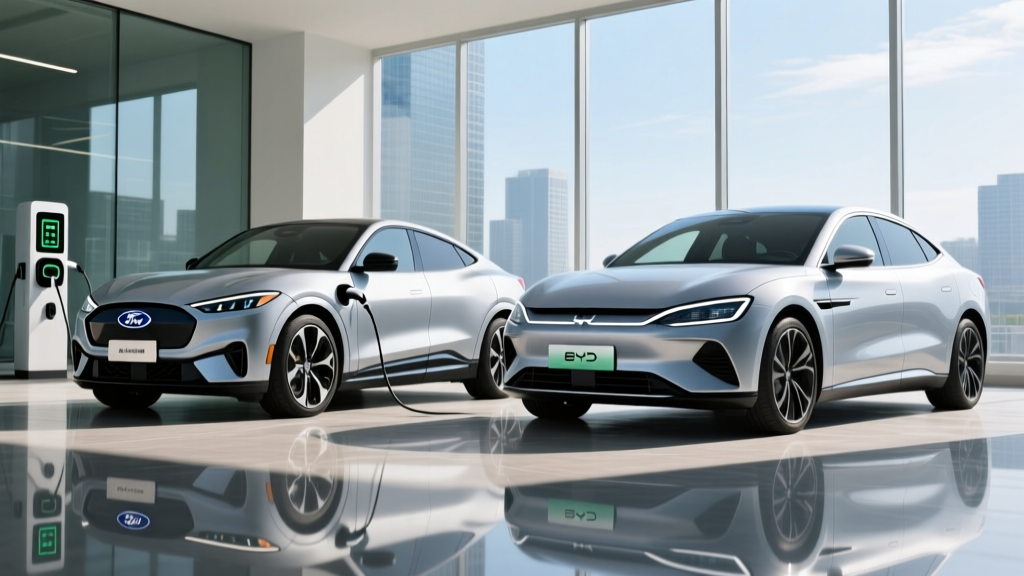
Ford CEO Jim Farley has been vocal about the existential threat — and opportunity — that BYD and other Chinese EV makers represent. But what does that ford ceo farley byd ev competition narrative actually mean for American EV buyers in 2026? Rather than review a single model, this profile examines how Farley's competitive response has reshaped Ford's two flagship EVs — the 2026 Mustang Mach-E and 2026 F-150 Lightning — and whether the result is compelling enough to justify a purchase over rivals from Tesla, Hyundai, and the looming specter of BYD vehicles sold abroad.
Ford's answer to BYD's vertically integrated, low-cost model has been twofold: aggressive price cuts and a pivot toward LFP (lithium iron phosphate) battery chemistry on base trims to slash costs. Below, we break down the real numbers — range, charging, pricing, tax credits — and what ownership actually looks like.
2026 Mustang Mach-E: The EV Built to Compete on Price
The Mach-E entered 2026 with a significant MSRP reduction. The base Select trim now starts at $36,495 (down from $42,995 at 2024 launch), a direct result of Ford's cost-structure overhaul that Farley has openly tied to competing with BYD's pricing power globally. The Premium trim sits at $41,995, and the GT performance variant holds at $55,995.
| Spec | Select (RWD) | Premium (AWD ER) | GT (AWD) |
|---|---|---|---|
| EPA Range | 250 mi | 320 mi | 280 mi |
| Battery (usable) | 72 kWh (LFP) | 91 kWh (NMC) | 91 kWh (NMC) |
| Horsepower | 266 hp | 346 hp | 480 hp |
| 0-60 mph | 6.3 sec | 5.1 sec | 3.5 sec |
| Drivetrain | RWD, single motor | AWD, dual motor | AWD, dual motor |
| MPGe (combined) | 105 MPGe | 98 MPGe | 84 MPGe |
| Base MSRP | $36,495 | $41,995 | $55,995 |
| Battery Warranty | 8 yr / 100,000 mi (70% capacity retention) | ||
Real-World Range: What the EPA Sticker Doesn't Tell You
EPA sticker: 320 miles
Real-world highway (70 mph, 75°F): ~265-280 miles
Real-world highway (32°F, heater on): ~220-240 miles
City/regen-heavy driving: ~300-310 miles
The Mach-E's EPA numbers are respectable, but highway driving at sustained speeds consumes significantly more energy than the combined cycle suggests. In cold weather, expect a 20-30% reduction — this is physics, not a Ford flaw. The LFP-equipped Select trim suffers slightly more cold-weather loss than NMC trims but compensates with a lower cost of entry and better long-term cycle life. LFP chemistry degrades more slowly over thousands of charge cycles, meaning a 2026 Select could retain 90%+ of its original capacity after 150,000 miles.
Charging Speed: DC Fast Charge and Home Level 2
Charging remains one of the most critical ownership variables. Ford adopted the NACS (Tesla) connector starting with 2025 models, giving Mach-E owners native access to Tesla Superchargers — a massive real-world advantage over CCS-only competitors still reliant on Electrify America's inconsistent network.
| Level | Power | Speed / Time |
|---|---|---|
| Level 1 (120V household) | 1.4 kW | ~3-4 mi/hr |
| Level 2 (240V home, 48A) | 11.5 kW | ~30-35 mi/hr; full charge in ~9 hr |
| DC Fast Charge (peak) | 150 kW (Select LFP) / 150 kW (NMC trims) | 10-80% in ~32 min (NMC), ~38 min (LFP) |
The Mach-E's peak DC charge rate of 150 kW is where the BYD comparison gets uncomfortable. A BYD Seal (sold in Europe and Australia) peaks at 150 kW as well but sustains a flatter charge curve thanks to its Blade Battery (LFP) architecture. The Mach-E's charge curve tapers noticeably above 80% SoC — expect the final 20% to take as long as the first 60%. For road-trippers, this means strategic charging stops at 10-80% rather than topping off fully.
At home, the 11.5 kW onboard charger is competitive. A full Level 2 installation typically costs $1,200-$2,500 including a 48A hardwired charger and electrician labor, assuming your panel has capacity. Ford's mobile Power Cord is included but delivers only ~20 mi/hr on a 240V outlet — adequate for overnight top-ups but not a replacement for a dedicated wall unit.
Interior, Tech, and Cargo: Where Ford Outpaces BYD (For Now)
The Mach-E's cabin is where Ford's Western-market instincts shine compared to BYD's more utilitarian interiors. The 15.5-inch vertical touchscreen running SYNC 4A is responsive, supports wireless Apple CarPlay and Android Auto, and handles over-the-air updates reliably. Ford's BlueCruise (hands-on-wheel SAE Level 2 driver assist) is included on Premium and GT trims and performs well on mapped divided highways — though it requires driver attention and is not autonomous driving.
Cargo space measures 29.7 cu ft behind the rear seats and 59.7 cu ft with seats folded. The front trunk (frunk) adds 4.7 cu ft — useful for charging cables or groceries. Rear legroom is 38.9 inches, competitive with the Tesla Model Y (40.5 in) but slightly tighter than the Hyundai Ioniq 5 (39.4 in).
Tax Credit Eligibility and True Cost
The 2026 Mach-E qualifies for the §30D federal EV tax credit, but eligibility depends on your income, the vehicle's MSRP, and battery-component sourcing — rules that shift regularly. As of 2026, the Mach-E Select (with its LFP battery using Chinese-sourced minerals) may face partial credit reduction under critical-mineral sourcing requirements. The NMC-equipped Premium and GT trims, with more North American battery content, are more likely to qualify for the full $7,500.
- MSRP cap: SUVs/vans — $80,000 (all Mach-E trims qualify)
- Buyer income cap: $150,000 single / $300,000 joint AGI
- Point-of-sale transfer: Available — you can apply the credit as a down-payment reduction at the dealer
- Battery sourcing: Verify current-year IRS qualified vehicle list before purchase — rules change quarterly
| Item | Amount |
|---|---|
| Base MSRP | $41,995 |
| Destination charge | $1,895 |
| Federal tax credit (§30D, if eligible) | -$7,500 |
| Estimated state incentives (varies) | -$0 to -$4,000 |
| Effective price (federal credit only) | ~$36,390 |
Always confirm eligibility with a tax professional and the IRS before relying on the credit. Ford's website and fueleconomy.gov maintain updated qualification status.
How the Mach-E Stacks Up Against BYD-Inspired Competitors
Farley's competitive strategy is visible when you compare the Mach-E to its direct rivals. The Tesla Model Y (from $38,490) offers more range (320 mi EPA for Long Range AWD), faster Supercharging (250 kW peak, 10-80% in ~20 min), and a more mature software stack. The Hyundai Ioniq 5 (from $42,990) charges at 350 kW on 800V architecture (10-80% in ~18 min) — nearly twice the Mach-E's speed.
Where the Mach-E wins is driving dynamics and dealer support. Ford's ride quality and steering feel outclass the Model Y's firm suspension, and Ford's 900+ US dealerships provide service access that Tesla's limited service centers cannot match in rural areas. Against BYD vehicles not sold in the US (Seal, Atto 3), the Mach-E benefits from NHTSA safety oversight and IIHS crash testing — the BYD Seal has not been tested by IIHS.
Pros and Cons
- Aggressive $36,495 starting price — undercuts Model Y and Ioniq 5
- Native NACS connector — full Tesla Supercharger network access
- Strong driving dynamics and ride quality
- LFP option on Select trim — lower degradation, lower cost
- BlueCruise included on Premium/GT
- 150 kW peak DC charge rate trails Ioniq 5 (350 kW) and Model Y (250 kW)
- LFP Select range limited to 250 mi EPA
- SYNC 4A can be laggy vs. Tesla's UI
- Cold-weather range loss significant without heat pump on Select
- Tax credit eligibility uncertain on LFP trims due to sourcing rules
Who Should Buy the 2026 Mach-E?
Look elsewhere if: You need maximum DC fast-charging speed for frequent long-distance driving (consider the Ioniq 5), or you need 350+ miles of range for remote-area travel without reliable charging (consider the Model Y Long Range or Rivian R1S).
Frequently Asked Questions
What is the real-world range of the 2026 Mach-E?
The EPA rates the Premium AWD Extended Range at 320 miles. In real-world highway driving at 70 mph, expect 265-280 miles. In freezing temperatures with cabin heat, that drops to 220-240 miles. The base Select (LFP, RWD) delivers 250 mi EPA — plan for ~200 mi in mixed highway use.
How fast does the Mach-E charge?
On a DC fast charger, the Mach-E peaks at 150 kW, reaching 10-80% in approximately 32 minutes (NMC trims) or 38 minutes (LFP Select). At home on Level 2 (240V, 48A), it charges at 11.5 kW, adding roughly 30-35 miles per hour — a full overnight charge.
Does the 2026 Mach-E qualify for the $7,500 federal tax credit?
It depends on the trim and your tax situation. NMC-equipped Premium and GT trims are more likely to qualify fully. The LFP Select may face partial reduction due to critical-mineral sourcing requirements. Buyer income must be under $150,000 (single) or $300,000 (joint). Always verify on the IRS qualified vehicles page before purchasing.
Is the Mach-E worth buying over a Tesla Model Y?
The Mach-E offers better ride quality, a traditional dealer service network, and a lower starting price. The Model Y wins on range efficiency, charging speed, and software polish. If Supercharger access was the Model Y's exclusive advantage, that gap closed when Ford adopted NACS — Mach-E owners now use Superchargers natively.
How does Ford CEO Farley's BYD competition strategy affect buyers?
Farley's public acknowledgment of BYD's cost advantage has driven real price cuts — the Mach-E Select at $36,495 is a direct result. Ford's adoption of LFP batteries mirrors BYD's Blade Battery strategy. For US buyers, this means more affordable EVs with proven chemistry, though charging speeds still lag behind Korean 800V competitors.
What is the battery warranty?
Ford covers the Mach-E battery for 8 years or 100,000 miles, whichever comes first, with a capacity retention threshold of 70%. This is industry-standard and matches Hyundai, Tesla, and Volkswagen.