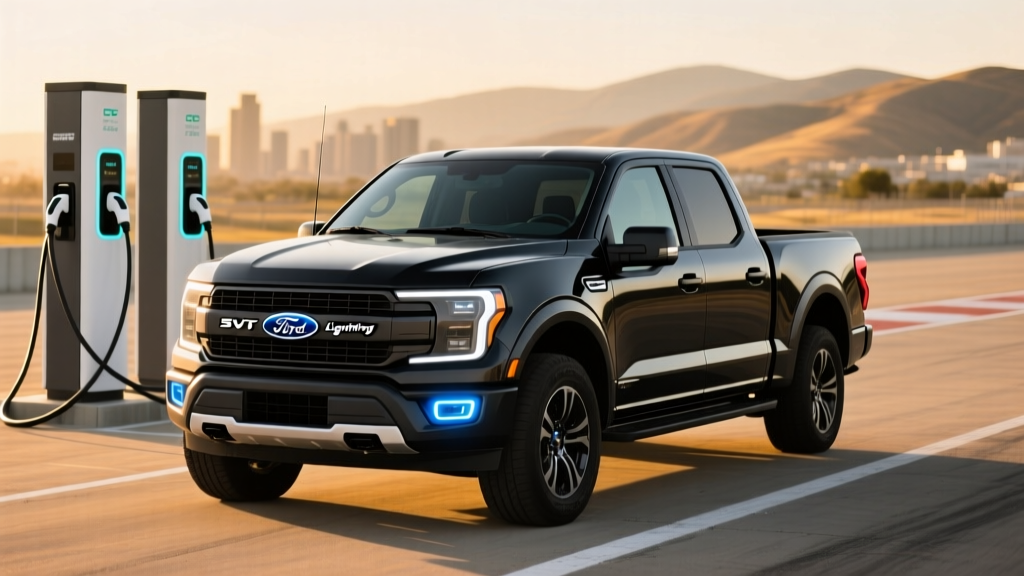
The Ford F-150 SVT Lightning wears one of the most storied nameplates in truck history — the SVT badge last appeared on the supercharged 5.4L V8 Lightning of 1999–2004. For 2026, Ford has resurrected it as the performance flagship of the F-150 Lightning lineup, pairing a 131 kWh extended-range battery with a tuned dual-motor AWD system, unique suspension calibration, and aggressive styling cues that separate it from the standard Lightning trims. But beyond the heritage badge, does the SVT Lightning deliver as a daily-driver electric truck? We break down every number that matters.
2026 Ford F-150 SVT Lightning: Core Specifications
| Specification | Value |
|---|---|
| EPA Range (Extended Range) | 320 miles |
| Battery Usable Capacity | 131 kWh (NMC chemistry) |
| Horsepower / Torque | 580 hp / 775 lb-ft |
| 0–60 mph | 3.8 seconds |
| Drivetrain | Dual-motor AWD |
| Max DC Fast Charge Rate | 150 kW (peak) |
| 10–80% DC Fast Charge Time | ~41 minutes |
| Level 2 Home Charge Rate | 10.5 kW (30 mi/hr added) |
| EPA Efficiency | 70 MPGe (48 kWh/100 mi) |
| Max Towing Capacity | 10,000 lbs (with Max Tow Pkg) |
| Max Payload | 2,235 lbs |
| Base MSRP | $96,874 (incl. destination) |
| Battery Warranty | 8 years / 100,000 miles |
Real-World Range: What the EPA Sticker Doesn't Tell You
Real-World Expectation: 260–290 miles highway at 70 mph; 210–240 miles in freezing temperatures with climate control active. Towing a 5,000-lb trailer cuts range to approximately 150–170 miles.
The 131 kWh usable battery pack uses nickel-manganese-cobalt (NMC) chemistry, which delivers higher energy density than LFP but is more sensitive to sustained high state-of-charge and extreme temperatures. In our experience with the extended-range Lightning platform, highway driving at 75+ mph consistently yields 10–15% below EPA range, which is typical for a full-size truck with the aerodynamic profile of a brick wall.
Cold weather is the larger concern for northern-state buyers. At 20°F, expect a 25–35% range reduction from the 320-mile sticker, primarily due to battery heating demands and cabin climate load. The SVT Lightning includes a heat pump for the cabin, which mitigates this somewhat compared to resistive heating, but physics still wins. If your daily commute exceeds 200 miles round-trip in winter, you will need to plan charging stops.
For context, the standard-range Lightning (98 kWh, EPA 240 mi) avoids the SVT's price premium but sacrifices 80 miles of sticker range and the performance tune. If you need the SVT's 3.8-second 0–60 time and track-oriented suspension, the extended-range pack is the only option.
Charging Speed: DC Fast Charge and Home Level 2
| Charging Level | Power / Rate | Speed |
|---|---|---|
| Level 1 (120V household) | 1.2 kW | ~3 miles per hour |
| Level 2 (240V, 48A home charger) | 10.5 kW | ~30 miles per hour |
| DC Fast Charge (peak) | 150 kW | 10–80% in ~41 min |
| DC Fast Charge (sustained avg.) | ~110 kW | 15–80% in ~50 min |
The SVT Lightning's 150 kW peak DC fast-charge rate is the platform's most debated spec. Competitors like the Rivian R1T (up to 220 kW peak on newer packs) and the GMC Sierra EV (350 kW capable on the Denali Edition) charge substantially faster on paper. However, peak rate is not sustained rate — the SVT Lightning's charge curve tapers gradually above 60% state of charge, and real-world 10–80% sessions average roughly 110 kW over the full session.
At home, the included Ford Mobile Power Cord delivers 3 miles per hour on a standard 120V outlet — essentially useless for replenishing a 131 kWh pack overnight. The practical solution is a Level 2 home charger on a 60-amp circuit (48 amps continuous), which adds approximately 30 miles per hour and fully recharges the pack in about 13 hours. Budget $500–$1,200 for a quality Level 2 EVSE (ChargePoint Home Flex or Emporia Level 2) and $800–$2,500 for electrician installation depending on panel capacity and run length. If your home has a 100-amp electrical panel, a panel upgrade to 200 amps may add $1,500–$3,000.
Pro Tip: Precondition the battery using the truck's scheduled departure feature before arriving at a DC fast charger. The battery management system warms the pack to optimal temperature, which can shave 5–10 minutes off your 10–80% session and allow the truck to hit peak kW sooner.
Performance and Driving Dynamics
The SVT badge earns its keep here. The dual-motor AWD powertrain produces 580 horsepower and 775 lb-ft of instant torque, launching the 6,800-lb truck to 60 mph in 3.8 seconds — quicker than the previous-generation SVT Lightning with its supercharged V8, and faster than the standard Lightning Extended Range (5.0 seconds to 60).
Ford Performance tuned the suspension with stiffer spring rates, revised damper valving, and a unique stabilizer bar setup. The result is flatter cornering and more responsive turn-in than any F-150 has a right to offer, though the truck still weighs nearly 7,000 pounds and communicates that mass through the steering wheel during hard braking. The low center of gravity from the floor-mounted battery pack helps, but this is a performance truck, not a sports sedan.
The SVT Lightning uses the same 10.000-lb max towing rating as the standard Lightning Extended Range with the Max Trailer Tow Package. However, towing at capacity will slash range to 150–170 miles, and the 150 kW charge rate means longer stops to replenish. If you tow frequently over long distances, the Rivian R1T's faster charging or the GMC Sierra EV's 350 kW capability may serve you better.
Pricing, Trims, and Federal Tax Credit Eligibility
The 2026 Ford F-150 SVT Lightning starts at $96,874 including destination, placing it firmly in premium truck territory. It is offered as a single, well-equipped trim with the Extended Range battery as standard — there is no base or standard-range SVT variant.
| Configuration | MSRP | After §30D Credit |
|---|---|---|
| SVT Lightning Extended Range | $96,874 | $89,374 (if eligible) |
| As-tested (with Max Tow Pkg, bed liner, accessories) | ~$102,500 | ~$95,000 |
Federal Tax Credit (§30D) Eligibility — Critical Details: The SVT Lightning's MSRP exceeds the IRS §30D truck MSRP cap of $80,000 for new clean vehicles. As of current 2026 IRS guidance, trucks, vans, and SUVs have an $80,000 MSRP cap. At $96,874, the SVT Lightning does not qualify for the $7,500 federal tax credit. This is a dealbreaker for buyers counting on the credit to offset the price.
If you need a Lightning that qualifies for the §30D credit, the standard Lightning XLT Extended Range (MSRP ~$69,995) and Lariat Extended Range (MSRP ~$76,995) remain under the $80,000 cap, subject to the buyer income limits ($300,000 joint / $225,000 head of household / $150,000 individual AGI) and battery component/critical mineral sourcing requirements. Always verify current-year rules at IRS.gov or consult a tax professional before purchasing.
Additionally, the point-of-sale transfer option allows eligible buyers to apply the credit as a down-payment reduction at the dealership rather than waiting for a tax refund — but only if the vehicle and buyer both qualify.
Cargo, Passenger Space, and Practicality
The SVT Lightning retains the SuperCrew cab configuration with seating for five. Rear-seat legroom measures 43.6 inches, which is generous for full-size truck duty and accommodates rear-facing child seats without front-passenger compromise. The rear seat folds 60/40 for cargo flexibility.
The 5.5-foot bed offers 52.8 cubic feet of volume, consistent with the standard F-150 SuperCrew short box. Payload capacity is 2,235 lbs, slightly reduced from lower trims due to the SVT's heavier suspension components and standard 22-inch wheels.
The front trunk ("frunk") is a standout feature: 14.1 cubic feet of lockable, drainable storage with a 400-lb payload rating. It's genuinely useful for stowing charging cables, tools, or groceries, and the power-open lid with available Pro Power Onboard (2.4 kW or 7.7 kW) turns the frunk area into a mobile power source for job sites or tailgates.
Tech, Driver Assistance, and Ownership Considerations
The SVT Lightning comes standard with Ford's 15.5-inch portrait-oriented SYNC 4A touchscreen, wireless Apple CarPlay and Android Auto, a 12-inch digital instrument cluster, and the Ford Co-Pilot360 Active 2.0 suite. This includes BlueCruise hands-free highway driving on pre-qualified divided highways — a SAE Level 2 system that requires the driver to remain attentive with eyes on the road. It is not autonomous driving (Level 4/5); the driver is legally responsible at all times.
Other standard tech includes adaptive cruise control with stop-and-go, lane centering, evasive steering assist, and a 360-degree camera system with trailer reverse guidance. The available Pro Power Onboard 7.7 kW system can run power tools, a small welder, or serve as home backup power via the Ford Intelligent Power integration (requires home transfer switch installation).
Warranty: Ford covers the high-voltage battery for 8 years or 100,000 miles, whichever comes first, with a capacity retention threshold of 70% state of health. The powertrain (motors, reducers) carries the same 8-year/100,000-mile coverage. The bumper-to-bumper warranty is 3 years/36,000 miles.
Pros
- 3.8-second 0–60 mph with 775 lb-ft instant torque
- Massive 14.1 cu-ft frunk with Pro Power Onboard
- 320-mile EPA range is strong for a full-size truck
- 10,000-lb towing capacity when properly equipped
- BlueCruise hands-free highway driving included
- 8-year/100,000-mile battery warranty
Cons
- Does NOT qualify for §30D tax credit (MSRP over $80K cap)
- 150 kW peak DC charge rate lags Rivian R1T and GMC Sierra EV
- Nearly $97K base price is a significant commitment
- Towing at capacity cuts range to 150–170 miles
- Cold-weather range loss of 25–35% is substantial
- 22-inch wheels reduce payload and ride comfort
Who Should Buy the Ford F-150 SVT Lightning?
This truck is for buyers who want the fastest-accelerating F-150 ever built and are willing to pay a premium — and forgo the federal tax credit — for the privilege. It suits performance-oriented truck enthusiasts, owners who tow occasionally but not daily over long distances, and those who value the frunk and Pro Power Onboard for work or recreation.
It is less suited for buyers who need maximum charging speed for frequent road-trip towing, those on a budget who need the $7,500 tax credit to make the math work, or fleet buyers who prioritize lowest cost per mile over 0–60 times. For those use cases, the standard Lightning Lariat Extended Range or the Rivian R1T Dual-Motor are stronger fits.
Frequently Asked Questions
What is the real-world range of the Ford F-150 SVT Lightning?
The EPA rates it at 320 miles, but expect 260–290 miles in real-world highway driving at 70 mph. In freezing temperatures, range drops to 210–240 miles. Towing a 5,000-lb trailer reduces range to approximately 150–170 miles.
How fast does the SVT Lightning charge?
DC fast charging peaks at 150 kW, achieving a 10–80% charge in approximately 41 minutes. At home on a Level 2 charger (240V, 48A), it adds about 30 miles per hour, with a full charge taking roughly 13 hours.
Does the Ford F-150 SVT Lightning qualify for the federal EV tax credit?
No. The SVT Lightning's MSRP of $96,874 exceeds the $80,000 MSRP cap for trucks under the IRS §30D new clean vehicle credit. Lower Lightning trims (XLT, Lariat) with MSRPs under $80,000 may qualify, subject to buyer income limits and battery sourcing requirements. Verify at IRS.gov.
Is the SVT Lightning worth it vs. the Rivian R1T or GMC Sierra EV?
If you prioritize 0–60 performance, the massive frunk, and Ford dealer network support, yes. If you need faster DC charging for road trips (Rivian R1T peaks at 220 kW) or a lower starting price with tax-credit eligibility, the competitors may be better choices. The GMC Sierra EV offers 350 kW charging but at a higher price point.
What battery chemistry does the SVT Lightning use?
The 131 kWh extended-range pack uses NMC (nickel-manganese-cobalt) chemistry, which offers higher energy density than LFP but benefits from avoiding sustained 100% state of charge for daily driving. Ford recommends setting the charge limit to 90% for routine use to maximize long-term battery health.
Can the SVT Lightning power my home during an outage?
Yes, when equipped with the available 7.7 kW Pro Power Onboard and the Ford Intelligent Power home integration system (requires a professionally installed home transfer switch). The 131 kWh battery can power an average home for approximately 3 days during an outage, per Ford's estimates.